Homemade Bread That Stays Soft for Days (Not Stale): Tangzhong vs. Yudane, Hydration Targets, and Storage That Prevents Starch Retrogradation
RecipeSimpli
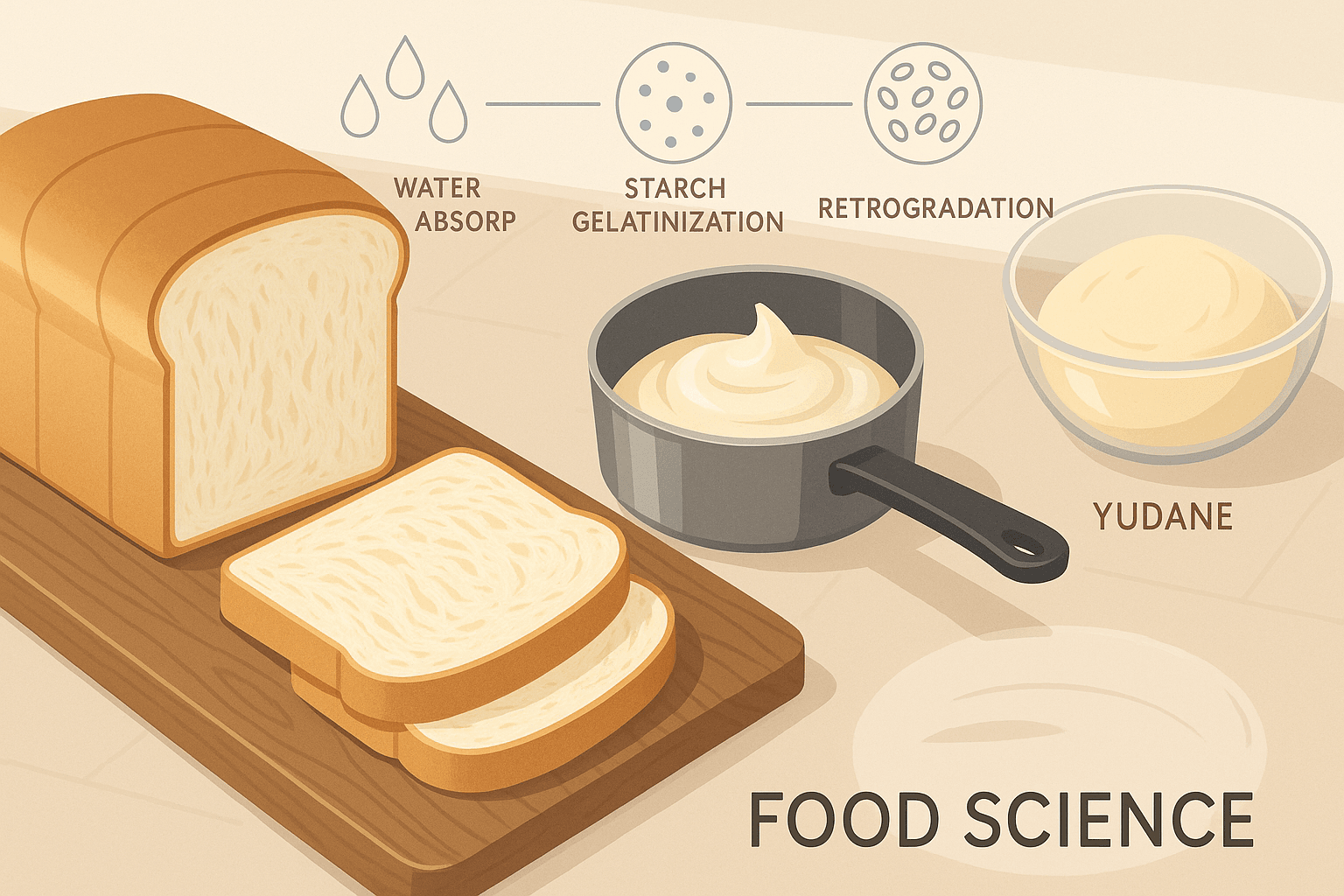
Why bread goes stale (and why it’s not just “drying out”)
If you’ve ever baked a loaf that was pillow-soft on day one and oddly firm, crumbly, or “cottony-dry” by day two, you’ve met bread staling. Here’s the key idea that changes how you bake and store bread:
Most staling isn’t primarily moisture loss—it’s a texture change driven by starch retrogradation.
Inside a baked loaf, starch granules from flour gelatinize (swell and absorb water) as the crumb heats. During cooling and storage, those starch molecules—especially amylopectin—gradually realign into more ordered structures. That re-ordering squeezes water out of the starch network and makes the crumb feel firmer and drier even if the loaf hasn’t lost that much total water.
Meanwhile, moisture does move around:
- From crumb to crust: Crust starts crisp, then absorbs moisture and softens.
- From bread to air: If bread is exposed, it loses water and becomes truly dry.
So the staling you notice is a combination of:
- Starch retrogradation (biggest driver of firming)
- Moisture migration within the loaf (crust softening)
- Evaporation to the environment (actual drying if unwrapped)
The goal, if you want bread to stay soft for days, is to slow retrogradation and manage moisture, not just “add more water.” That’s where tangzhong and yudane shine.
The science lever you control: water binding and gelatinized starch
A fresh bread crumb is a delicate gel: starch, proteins (gluten), fats, sugars, and water. The more effectively your dough can hold water in a way that remains soft, the longer your crumb stays tender.
You can improve this in three major ways:
- Pre-gelatinize some starch (tangzhong or yudane) so it binds more water and resists firming.
- Use hydration targets that suit the loaf style to avoid underhydrated, fast-firming crumbs.
- Add ingredients that slow staling (fat, sugar, dairy, eggs, certain enzymes) and store properly.
Tangzhong and yudane are two of the most practical, kitchen-friendly methods because they use nothing exotic—just flour and water (or milk)—to create a softening “water reservoir” within the dough.
Tangzhong vs. Yudane: what they are, how they differ, and when to choose each
Both tangzhong and yudane come from East Asian baking traditions, especially popularized through Japanese shokupan (milk bread) and related soft breads across Taiwan, China, and beyond.
They’re both forms of starch gelatinization pre-treatment:
- You take a portion of the flour and liquid from your formula.
- You heat or scald it so starch granules swell and trap water.
- You add that paste/gel back into the dough.
Tangzhong (water roux)
Definition: A cooked paste made by heating flour + liquid to about 65°C / 149°F, where starch gelatinizes.
Typical ratio:
- 1 part flour : 5 parts liquid by weight (commonly written as 1:5)
How it’s made:
- Whisk flour and water (or milk) in a small pan.
- Heat, stirring constantly, until it thickens to a pudding-like paste.
- Cool to room temp (or at least lukewarm) before mixing into dough.
Strengths:
- Excellent for ultra-soft sandwich loaves and buns.
- Produces a shred-able, feathery crumb.
- Very reliable and forgiving.
Tradeoffs:
- Requires stovetop time and attention.
- If undercooked, it won’t gel fully; if overcooked, it can become too stiff.
Yudane (scalded dough)
Definition: A scalded mixture made by pouring boiling water over flour (sometimes including a bit of sugar or salt depending on style), then resting.
Typical ratio:
- Often 1 part flour : 1 part boiling water by weight (1:1), though some formulas vary.
How it’s made:
- Place flour in a bowl.
- Pour boiling water over it.
- Stir until a shaggy, thick mass forms.
- Cover and rest (often 1–12 hours), then incorporate into dough.
Strengths:
- Simple: no thermometer needed.
- Develops noticeable sweetness and aroma because scalding can make starch more accessible to enzymes.
- Can improve chew and elasticity while staying soft.
Tradeoffs:
- Because it’s thicker and can be rested longer, it may slightly change fermentation dynamics.
- Some bakers find yudane yields a crumb that is a touch more “bouncy” than tangzhong.
Which should you choose?
-
Choose tangzhong when you want:
- maximum plushness, “cloud-like” crumb
- very consistent results in sandwich bread, rolls, burger buns
-
Choose yudane when you want:
- simpler prep (no cooking step)
- a slightly chewier, elastic softness
- the convenience of making it ahead (overnight rest)
In practice, both work extremely well; the “best” is the one you’ll actually repeat.
How much flour should you gelatinize?
A common successful range is:
- Tangzhong flour: about 5–10% of total flour weight
- Yudane flour: about 10–20% of total flour weight (often higher because the mix is thicker)
You can push beyond that, but too much pre-gelatinized starch can make the dough gummy, overly sticky, or oddly tight.
A practical example (easy math)
Let’s say your recipe uses 500 g total flour.
Tangzhong at 8% flour:
- Flour in tangzhong: 40 g
- Liquid in tangzhong (1:5): 200 g
So you’d remove 40 g flour and 200 g liquid from the main dough and cook them into a paste.
Yudane at 15% flour:
- Flour in yudane: 75 g
- Boiling water (1:1): 75 g
Remove 75 g flour and 75 g water from the dough and scald it.
Hydration targets: why “more water” isn’t always the answer
Hydration (water as a percentage of flour weight) affects softness, openness, and staling rate. But it’s not linear: a higher hydration dough can still bake up firm if the loaf is lean, overbaked, or stored poorly.
Also, flour type matters:
- Bread flour absorbs more than all-purpose.
- Whole wheat absorbs more (bran acts like a sponge and also disrupts gluten).
- Different brands vary.
So consider the ranges below as starting points, then adjust by feel.
Typical hydration ranges (home-baking friendly)
Soft enriched sandwich bread / milk bread (with tangzhong/yudane):
- Roughly 62–75% total hydration
- Lower end if using lots of milk/eggs/fat (they behave differently than water)
- Higher end if you want extra shreddy softness
Lean white pan loaf (no enrichments):
- Roughly 60–70%
- If you want it sliceable and soft, stay toward the upper half and avoid overbaking.
Rustic boule / batard (open crumb):
- Roughly 70–85%
- Great fresh, but lean breads stale quickly because they lack fat and sugar. Freezing is your best long-term softness strategy here.
Whole wheat pan bread:
- Roughly 70–90%
- Whole wheat needs more water and benefits hugely from tangzhong/yudane or a soaker.
Hydration + gelatinization = better water retention
Tangzhong/yudane allows you to carry higher effective hydration without a wet, hard-to-handle dough because some water is locked into the gel structure.
This tends to yield:
- softer crumb for longer
- improved sliceability
- reduced crumbling (especially in whole grain breads)
Ingredients that slow staling (and how to use them intentionally)
If tangzhong and yudane are your primary “staling insurance,” ingredients are your secondary toolkit.
Fat (butter, oil, cream)
Fats tenderize by coating flour particles and interfering with gluten and starch networks. They also help the crumb feel moist.
- Butter adds flavor and tenderness.
- Neutral oil keeps bread soft and can be more forgiving (oil stays soft when cold; butter can firm up in the fridge).
Practical tip: For soft sandwich bread, many formulas land around 5–12% fat (relative to flour weight). Too much can weaken structure unless kneading and shaping are good.
Sugar (or honey)
Sugar is hygroscopic—it attracts water—so it can help breads feel softer longer. It also slows fermentation at higher levels, promotes browning, and can make crumb more tender.
Practical tip: For everyday soft loaves, 5–12% sugar is common. For very sweet breads, it can go far higher (with adjustments to yeast and mixing).
Dairy (milk, powdered milk)
Milk brings lactose (browning), proteins, and fat (if whole milk). Milk powder can improve softness and flavor without adding extra liquid.
Practical tip: If your loaf is consistently dry, swapping part of the water for milk can help, but don’t assume milk automatically fixes staling—retrogradation still happens.
Eggs
Eggs contribute emulsifiers (lecithin), fat, and proteins that affect crumb structure.
- Great for buns, brioche-style loaves, and enriched sandwich breads.
- Can make crumb more resilient and tender.
Salt
Salt won’t “soften” bread, but it strengthens gluten and improves flavor, which affects how you perceive freshness.
- Typical: 1.8–2.2% of flour weight.
Preferments and sourdough
Long ferments can improve flavor and sometimes perceived keeping quality. Sourdough’s acidity can slow mold growth, but it does not stop retrogradation. Many sourdough loaves still firm up quickly (especially lean, crusty styles).
If you want sourdough and lasting softness, consider:
- tangzhong/yudane in a sourdough sandwich loaf
- enriched doughs
- freezing slices
The bake itself: how overbaking and cooling can sabotage softness
You can do everything right in the dough and still end up with bread that stales fast if the bake and cool are off.
Don’t bake out too much moisture
If you bake longer than needed—especially in a dry oven—your loaf loses more water. That makes day-one bread less soft and day-two bread much worse.
Best practice: Use internal temperature as a guide.
- Soft enriched sandwich breads: often done around 88–93°C / 190–200°F
- Lean breads: often 96–99°C / 205–210°F (varies by style)
These are ranges, not laws. If your loaf is very enriched, it may be “done” at a slightly lower internal temp. If it’s very wet or dense, it may need more.
Cool fully before slicing (unless you plan to eat immediately)
Slicing hot bread releases steam rapidly and can create a gummy line near the cut, plus it accelerates moisture loss.
Rule of thumb:
- Small rolls: 20–40 minutes
- Pan loaves: 1–2 hours
- Large boules: 2+ hours
If you want warm bread at dinner: bake earlier, cool, then rewarm slices later (see reheat tricks below).
Storage strategy: preventing staling vs. preventing drying
Storage is where many home bakers unintentionally speed up staling.
The refrigerator is (usually) the enemy
Bread in the fridge feels stale quickly because cool temperatures (around 0–5°C / 32–41°F) accelerate starch retrogradation. This is one of the most counterintuitive truths in bread.
- Do not refrigerate bread unless you have a specific reason (like a very humid environment where mold is a bigger problem) and you accept texture tradeoffs.
Room temperature storage: best for 1–3 days
For soft pan loaves and buns:
- Store airtight (plastic bag, reusable bread bag, or sealed container).
- Keep out of direct sun and away from heat sources.
This reduces water loss to the air. It does not stop retrogradation entirely, but tangzhong/yudane plus airtight storage makes a big difference.
For crusty artisan loaves:
- If you want crust crisp for the first day: store cut-side down on a board or in paper.
- If you want softness: store airtight, knowing the crust will soften.
Slicing: slice only what you need (or pre-slice for freezing)
Every cut surface is a moisture escape hatch.
- If storing at room temp for a day or two, keep the loaf unsliced and slice as needed.
- If freezing, it’s often best to pre-slice so you can grab what you need.
Freezing: the best long-term “fresh bread” hack
If your goal is “soft for days,” freezing is the most powerful tool—often more effective than any ingredient tweak.
How to freeze bread well:
- Cool completely.
- If you want convenience: slice the loaf.
- Wrap airtight: freezer bag with as much air pressed out as possible.
- Freeze as soon as possible after cooling for best quality.
Why it works:
- Freezing largely pauses retrogradation and moisture migration.
How long:
- Best quality within 1–2 months, but it’s often fine longer if well wrapped.
Reheating tricks that reverse staling (temporarily)
Here’s some good news: staling is partly reversible with heat. Warming bread melts and relaxes retrograded starch structures, restoring softness—at least for a while.
For slices (fast)
- Toaster: Best for structure and flavor; great for day-2 bread.
- Skillet: Medium-low heat with a lid for a minute can warm without over-crisping.
- Microwave (carefully): 10–20 seconds for a slice can make it soft, but too long makes it rubbery as it cools.
For whole or half loaves
- Sprinkle the crust lightly with water (especially for lean loaves).
- Bake at 175°C / 350°F for about 8–15 minutes depending on size.
For enriched sandwich bread, skip the water and warm gently wrapped in foil to avoid drying.
From frozen
- Toast from frozen: easiest for slices.
- Or thaw at room temp still wrapped, then warm briefly.
Practical method: building a “stays-soft” sandwich loaf formula
You don’t need a single perfect recipe—you need a framework you can adapt.
A strong baseline framework (baker’s percentages)
For a soft pan loaf designed to stay tender:
- Flour: 100%
- Total liquid (water + milk, including what’s in tangzhong/yudane): 65–75%
- Salt: 2%
- Sugar: 6–10%
- Fat (butter/oil): 6–10%
- Yeast (instant): 0.8–1.5% (lower with long proofing)
- Optional milk powder: 2–4%
Then add:
- Tangzhong flour: 6–10% (taken from the 100% flour)
- Tangzhong liquid: 5× tangzhong flour (taken from total liquid)
Example (for 500 g total flour)
- Flour total: 500 g
- Tangzhong flour (8%): 40 g
- Tangzhong liquid: 200 g
Remaining flour in dough: 460 g
If aiming for 70% total hydration: total liquid = 350 g.
Since 200 g is used in tangzhong, remaining liquid to add = 150 g (water/milk).
Then choose enrichments (example):
- Sugar 8%: 40 g
- Salt 2%: 10 g
- Butter 8%: 40 g
- Instant yeast 1%: 5 g
This structure reliably yields a loaf that stays soft for several days when stored airtight at room temp.
Tangzhong: step-by-step (with success checkpoints)
- Whisk smooth: Flour + cold liquid in a saucepan until no lumps.
- Cook gently: Medium-low heat, stirring constantly.
- Stop at the right thickness: When lines remain briefly as you stir, or it reaches ~65°C/149°F.
- Cool: Spread on a plate or leave in a bowl covered to prevent skin.
Checkpoint: It should be glossy and thick like loose pudding, not a rubbery dough ball.
Common mistakes and fixes:
- Lumpy paste: whisk cold before heating; use a spatula to press out lumps.
- Too stiff: you overcooked; next time lower heat and stop earlier.
- Too thin: you undercooked; keep heating until it clearly thickens.
Yudane: step-by-step (with success checkpoints)
- Boil water.
- Pour over flour in a heatproof bowl.
- Stir vigorously until no dry flour remains.
- Cover and rest: at least 30 minutes, often 4–12 hours.
Checkpoint: It should look like a stiff mashed-potato mass or very thick dough.
Common mistakes and fixes:
- Dry pockets of flour: stir more thoroughly; pour water evenly.
- Hard to incorporate: cut into pieces and mix during kneading; allow it to warm slightly if it’s been refrigerated.
Kneading and fermentation: softness depends on structure
A soft loaf still needs enough structure to trap gas and slice cleanly.
Kneading guidelines
- Aim for a smooth, elastic dough that can stretch thin (windowpane) for enriched sandwich bread.
- Tangzhong/yudane doughs may feel slightly tacky but should become cohesive.
Tip: If you’re using a stand mixer, stop and scrape the bowl; dough can ride the hook and knead unevenly.
Fermentation and proofing
- Underproofing makes bread dense and it stales faster.
- Overproofing can collapse structure and create a gummy, weak crumb.
Simple cue: For pan loaves, proof until the dough crests about 2–3 cm (1 inch) above the rim (depends on pan size and recipe), and a gentle poke slowly springs back but leaves a slight dent.
Cultural context: why these methods became beloved
Tangzhong and yudane weren’t invented as internet “hacks.” They reflect a long-standing preference in many East Asian baking traditions for:
- fine, even crumb
- soft bite that stays pleasant for days
- breads suitable for sandwiches and filled buns
Japanese shokupan is often cited as a showcase for these methods: a loaf engineered for tenderness and sliceability. As these techniques spread globally, home bakers discovered they solve a universal problem: homemade bread is delicious, but stales fast—unless you intervene.
Troubleshooting: when bread still goes stale quickly
Problem: “It’s soft day one, dry day two.”
Likely causes:
- loaf is underhydrated for your flour
- overbaked
- stored in a breathable container
Fixes:
- increase hydration 2–5% next bake
- bake to internal temp, not just time
- store airtight once fully cool
Problem: “It’s gummy or stodgy, even though it’s soft.”
Likely causes:
- underbaked center
- too much tangzhong/yudane
- slicing too early
Fixes:
- verify internal temp; extend bake, tent with foil if browning too fast
- reduce gelatinized flour percentage
- cool longer before slicing
Problem: “Crust gets leathery in a bag.”
That’s normal: airtight storage softens crust.
Fixes:
- for crusty loaves, store cut-side down or in paper for day one
- refresh in hot oven for 8–10 minutes before serving
Problem: “It molds before it stales.”
High humidity, warm kitchens, or very enriched breads can mold sooner.
Fixes:
- freeze what you won’t eat in 48 hours
- cool completely before bagging (trapped warmth encourages condensation)
- keep storage container clean and dry
A realistic game plan for always-soft bread
If you want consistently soft homemade bread without wasting half a loaf, combine technique and storage:
- Use tangzhong or yudane for sandwich loaves, buns, and rolls.
- Target a sensible hydration range (often 65–75% for soft pan loaves).
- Include modest fat and sugar for tenderness.
- Bake to doneness, don’t overbake.
- Cool fully.
- Store airtight at room temp for 1–3 days.
- Freeze slices for anything beyond that.
- Reheat smartly (toast, warm oven, brief microwave) to revive softness.
Do those things and you’ll notice a dramatic difference: bread that stays tender, slices cleanly, and tastes “fresh baked” far longer—without relying on commercial dough conditioners.
Quick reference cheat sheet
Best method for soft bread that lasts: Tangzhong or yudane + airtight storage + freezing extras.
Avoid: Refrigeration (speeds staling), slicing hot, overbaking.
Choose tangzhong if: you want ultra-fluffy, shreddy softness.
Choose yudane if: you want a simple scald method, often with great aroma and elasticity.
Reheat day-old bread: toaster for slices; 175°C/350°F oven for 8–15 min for loaves.
References and further reading (for the curious)
For deeper dives into the underlying science and tested baking approaches, look for work and discussion around:
- Harold McGee, On Food and Cooking (starch gelatinization, bread staling mechanisms)
- Peter Reinhart and Jeffrey Hamelman (bread technique, fermentation, and dough structure)
- Food science explanations of starch retrogradation and water migration in baked goods (often covered in cereal chemistry and baking science texts)
You don’t need a lab to use this science—just a saucepan (or kettle), a scale, and a storage plan.