Why Bay Leaves Taste Invisible, Medicinal, or Deeply Savory: Terpene Extraction, Fat Solubility, and the Simmer Rules Behind Better Stocks, Beans, and Rice
RecipeSimpli
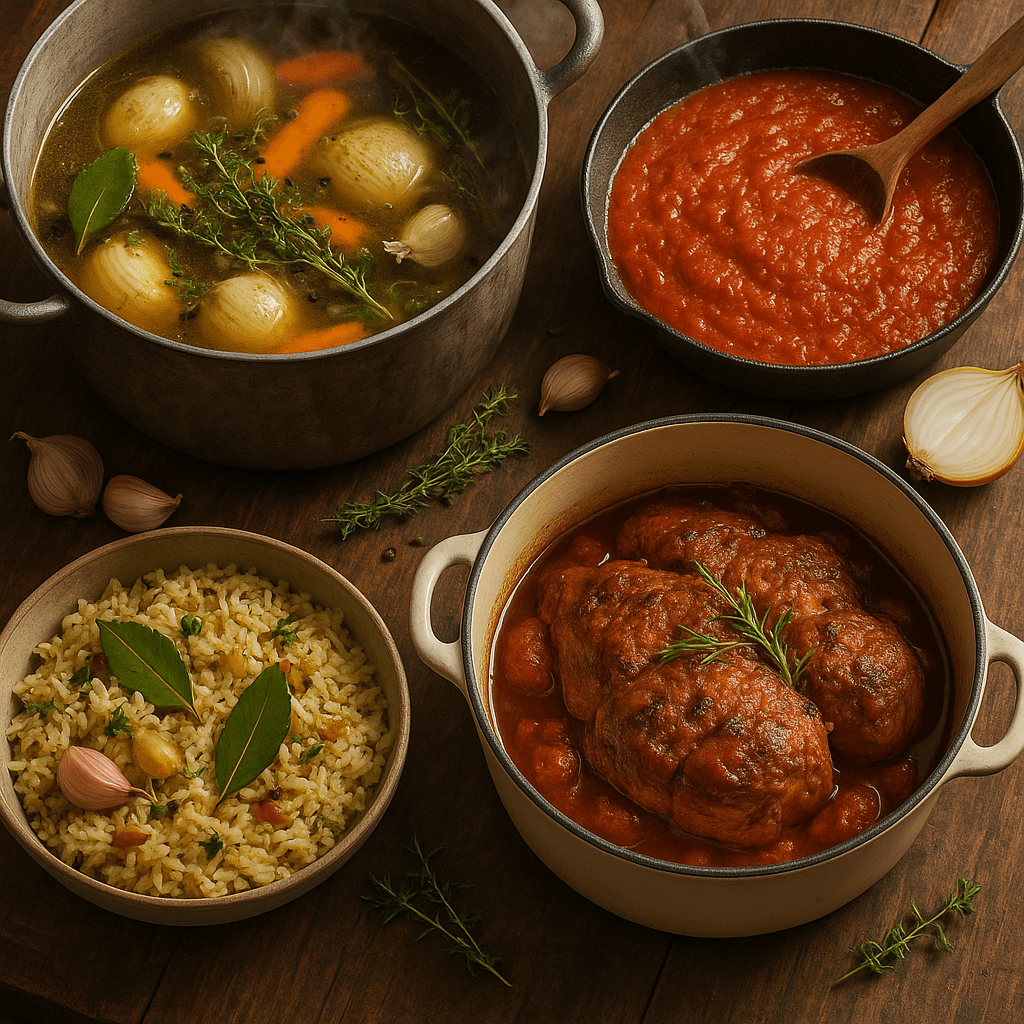
There are few ingredients more likely to provoke kitchen skepticism than the bay leaf. It sits in the jar looking dry, stiff, and faintly decorative, then disappears into soups, braises, beans, and rice with almost no obvious fanfare. Plenty of cooks have wondered whether bay leaves do anything at all. Others have had the opposite experience: a dish that tips from subtle to strangely medicinal, almost eucalyptus-like, with a menthol edge that feels more pharmacy than dinner.
Both experiences are real, and both come down to extraction. Bay leaves are not loud in the blunt way garlic, black pepper, or smoked paprika are loud. They work through volatile aromatic compounds—especially terpenes and related molecules—that dissolve and evaporate differently depending on heat, time, fat, alcohol, water, acidity, and even the shape of the pot. A bay leaf can smell almost pointless in one preparation and become deeply savory, tea-like, woodsy, and quietly structural in another.
That is what makes bay so interesting. It is not a one-note herb, and it is not an ingredient you can judge by nibbling the dry leaf or dropping it into boiling water for three minutes. Bay is a slow extractor. It is a background builder. Used well, it rounds off starches, sweetens the perception of onions and tomatoes, gives stocks more breadth, and adds a subtle spine to braises and pilafs. Used badly, it can feel dusty, medicinal, or simply absent.
This is a guide to why that happens, and how to make bay leaves work for you rather than against you.
Bay leaves are not one thing
First, a useful clarification: when most cooks in Europe and North America say “bay leaf,” they usually mean Mediterranean bay or Turkish bay, from Laurus nobilis. This is the classic culinary bay used in bouquet garni, stocks, tomato sauce, braises, and many rice dishes.
Another leaf sometimes sold in different culinary traditions is Indian bay leaf or tej patta, from Cinnamomum tamala. It is not the same plant and does not taste the same. Tej patta is more cinnamon-like and cassia-like, with warmer spice notes and less of the cool camphor-eucalyptus profile associated with Mediterranean bay. If you substitute one for the other without realizing it, a recipe can feel oddly wrong.
Within Laurus nobilis, there is variation too. Fresh bay leaves tend to taste greener, more floral, and sometimes more obviously pungent. Dried bay leaves usually taste mellower, more tea-like, woodsy, and integrated—assuming they are not ancient and stale. Origin matters, age matters, and storage matters. A brittle jar of bay leaves that has been sitting above the stove for four years is not a fair test of what bay can do.
Why bay can seem invisible
Bay’s key flavor compounds are potent, but many of them are present in small amounts and are perceived more as a shift in the overall aroma than as a standalone “bay” note. This is a big reason cooks disagree about whether it matters.
Unlike parsley, cilantro, or basil, bay is rarely meant to announce itself. It usually contributes in the background. Think of it the way you might think of a bass line in music. You may not hum it afterward, but if you remove it, the whole thing feels flatter.
A second reason bay can seem invisible is that many of its aromatic compounds need time and the right medium to extract. Drop a whole dried bay leaf into a watery soup that simmers only 10 minutes, and you may get very little. Add that same leaf to a pot of beans simmering for 75 to 90 minutes with onions, olive oil, and garlic, and suddenly the broth tastes fuller, rounder, more finished.
A third reason is competition. Bay is easily buried by strong smoke, aggressive chile heat, lots of rosemary, large amounts of clove, or an over-reduced salty sauce. It performs best when there is enough time and enough aromatic space for its subtler compounds to be noticed.
The chemistry: terpenes, oxides, phenols, and why the leaf tastes different in water, fat, and alcohol
Bay leaves contain a complex aromatic mixture. The exact composition varies by harvest and storage, but a few compounds matter especially for cooks:
- 1,8-cineole (eucalyptol): fresh, cool, camphoraceous, eucalyptus-like
- Eugenol: clove-like, warm, spicy, slightly medicinal if overemphasized
- Linalool: floral, citrusy, soft
- Terpinyl acetate and related terpenes: sweet-herbal, resinous, aromatic
- Pinene and other monoterpenes: piney, resinous, green
- Sesquiterpenes and other heavier compounds: woodsy, balsamic, deeper savory impressions
What matters in practice is not just what is in the leaf, but which compounds get extracted, how quickly, and in what ratio.
Water extraction
When you simmer bay in water—stock, beans, soup, rice cooked by absorption—you extract the more water-compatible fraction and whatever aromatic oils slowly migrate out over time into the liquid. Water alone can pull useful flavor from bay, but it is not equally effective at capturing every aromatic note.
This is why bay often feels gentle in broth-based dishes. Water extraction tends to emphasize the subtle tea-like and herbal backbone while muting some of the rounder aromatic fullness that fat can carry.
If the simmer is too short, the water may never extract enough to matter. If it is too violent, volatile aroma compounds can simply steam off.
Fat extraction
Many bay compounds are more soluble in fat than in water. That means dishes with olive oil, butter, rendered meat fat, or coconut milk often carry bay more effectively and more deliciously.
When you sweat onions in 2 to 3 tablespoons of olive oil with a bay leaf before adding tomatoes or stock, some of the leaf’s aromatic oils dissolve into the fat phase. Fat then coats the palate and traps aroma, making bay seem less “sharp” and more integrated.
This is one reason bay works especially well in:
- tomato sauces started with olive oil
- braises with browned meat and rendered fat
- pilafs where rice is toasted in fat before liquid is added
- bean pots finished with olive oil or containing pork fat
Fat doesn’t necessarily make bay stronger in a linear sense. It often makes bay rounder and deeper, while reducing the perception of harsh medicinal top notes.
Alcohol extraction
Alcohol is a powerful solvent for aromatic compounds. Wine, vermouth, beer, or spirits in a braise can extract a broader range of bay aromatics than water alone, especially early in cooking before the alcohol evaporates.
That doesn’t mean your dish should taste boozy. It means a half cup to 1 cup of wine in a braise or tomato sauce can help draw out flavor from bay and other aromatics before the mixture settles into a long simmer.
In practical terms, bay often tastes more complete in:
- beef braise deglazed with 1 cup red wine
- chicken braise with 1/2 cup dry white wine
- tomato sauce started with onion, garlic, olive oil, bay, then 1/2 cup wine before tomatoes
Alcohol also changes aroma release retronasally—the smell that reaches your nose from your mouth while eating—so bay can seem more expressive even when the quantity used is small.
Dried versus fresh bay: not just intensity, but profile
People often assume fresh herbs are always better. Bay is a useful exception to that simplistic rule.
Fresh bay leaves are usually more assertive in the high notes. They can be greener, sharper, and more obviously cineole-driven. Used thoughtfully, that freshness is beautiful in delicate broths, poaching liquids, and lighter braises. But fresh bay can also push toward the cool, medicinal edge more quickly than dried bay, especially if you use multiple large leaves or simmer them for a long time in a relatively small volume of liquid.
Dried bay leaves lose some of the brightest volatile top notes during drying and storage. What remains often reads as smoother, tea-like, woodsy, and less aggressive. In many long-cooked dishes—stocks, beans, beef stew, lentils, ragù—dried bay is actually preferable because it integrates without shouting.
A practical conversion is imperfect because leaf size varies, but a rough rule is:
- 1 fresh bay leaf = about 2 dried bay leaves in aromatic strength for some dishes
That said, this is not reliable enough to be followed blindly. Some fresh leaves are huge and potent; some dried leaves are old and weak. Start conservatively.
How to judge leaf quality
Good dried bay leaves should:
- still smell fragrant when crushed slightly
- be olive green to muted green-brown, not gray dust
- look intact rather than shattered into powder
- have a woody, herbal aroma, not just cupboard smell
If you open the jar and smell almost nothing, the leaves may still add trace bitterness or background herbaceousness, but they will not do what good bay can do.
Why too many bay leaves can taste medicinal
The “eucalyptus” or “medicine cabinet” complaint usually comes from an imbalance in extracted compounds, especially 1,8-cineole and eugenol, relative to the dish’s fat, sweetness, starch, protein, and cooking time.
There are several common causes.
1. Too many leaves for the liquid volume
Bay is subtle, but that does not mean piling in more improves the result. Two leaves in 1 quart (about 1 liter) of delicate broth may be too much, while one leaf in 3 quarts (about 2.8 liters) of stock may be just right.
Bay scales nonlinearly because the compounds accumulate in the cooking medium. More leaves can shift the profile from background complexity to obvious camphoraceousness.
2. Long cooking in a small, covered vessel
A tightly covered small pot traps volatile compounds. That can be good for preserving aroma, but if the leaf-to-liquid ratio is high, the trapped cineole and related notes have nowhere to go. What would have been subtle in a broad, gently uncovered simmer can become dominating in a compact pot.
3. Broken or crushed leaves
Snapping a bay leaf once or twice can increase extraction modestly by exposing more interior surface. Grinding it to fragments, however, dramatically speeds release and makes removal annoying. Fast extraction is not always better. It can overemphasize harsher notes before deeper, rounder flavors have time to balance them.
4. Weak supporting flavors
Bay behaves differently in plain water than in a matrix of onions, fat, gelatin, starch, and acid. In a thin broth with little fat and little sweetness, medicinal notes are more exposed. In a bean pot rich with onion and olive oil, or a braise rich with collagen and wine, those same notes get buffered and woven in.
5. Very fresh leaves used like dried ones
If you substitute fresh bay leaf one-for-one in a recipe developed for dried bay, the result can skew greener and harsher.
The simmer rule: gentle heat extracts better than a hard boil
Bay is one more reason the old stock-making rule matters: simmer gently, don’t boil aggressively.
A hard boil does three unhelpful things:
- It throws volatile aroma compounds into the steam and out of the pot.
- It can make the overall flavor feel muddier rather than more precise.
- It roughens texture in beans, meats, and stocks even as it wastes aroma.
For most bay-infused preparations, aim for one of these heat levels:
- Stock: 180 to 200°F / 82 to 93°C, with only an occasional lazy bubble
- Beans: gentle simmer, not turbulent boiling
- Tomato sauce: low burble, partially covered or uncovered depending on reduction needs
- Braises: oven at 300 to 325°F / 150 to 163°C, with the liquid in the pot barely trembling
- Pilaf absorption cooking: brief boil to start, then covered low heat
Gentle cooking encourages extraction without stripping the dish of its most delicate aromatic compounds.
Time matters—but more time is not always better
Bay needs longer than tender herbs, but it is not infinitely forgiving.
Short cooks: 10 to 20 minutes
This is enough for bay to contribute lightly to quick tomato sauce, rice, or a simple pan sauce if fat is present and the pot is covered for some of the time. In pure water, it may barely register.
Medium cooks: 30 to 60 minutes
This is a sweet spot for many soups, lentils, light braises, and tomato sauces. The leaf has time to release both brighter and deeper notes without becoming woody or medicinal.
Long cooks: 1.5 to 4 hours
This is classic territory for stocks, beans, braises, and ragù. Bay can be wonderful here, but you should consider removing it partway through if the dish is modest in volume or delicately flavored.
Very long cooks: 4+ hours
In very long simmering, bay can flatten or skew medicinal if left in the entire time, especially in reduced liquids. For all-day stocks or slow braises, it is often better to add bay for only part of the cooking window—say the first 60 to 90 minutes for chicken stock, or the first 2 hours of a beef braise—then remove it.
Vessel shape changes flavor release more than many cooks realize
The geometry of the pot affects aroma concentration, evaporation, and extraction.
Wide pot, more evaporation
A wide Dutch oven or sauté pan gives more surface area. Volatile compounds escape more readily, and the liquid reduces faster. This can concentrate dissolved flavors but also vent delicate top notes.
In a wide vessel, bay may taste softer and less medicinal because some cineole simply leaves with the steam. But if the liquid reduces too far, the remaining bay character can become concentrated in a woody way.
Tall narrow pot, less evaporation
A narrower stockpot traps more moisture and more aroma in the headspace. This preserves aromatics better, but it also means bay can build up more intensely. In a narrow pot, err on the side of fewer leaves or earlier removal.
Lid on or off?
- Lid on: more aromatic retention, less reduction, potentially stronger bay impression
- Lid off: more venting of sharp top notes, more reduction, potentially softer but more concentrated base flavor
- Partially covered: often the best compromise for tomato sauce, beans, and braises
Should you tear the leaf?
Usually: tear slightly if you want faster extraction, leave whole if the cook is long.
A whole bay leaf extracts more slowly and evenly. This is ideal for a 1- to 3-hour simmer and makes removal easy.
Tearing one leaf in half can help in shorter cooks like rice pilaf or a 25-minute tomato sauce. It increases surface area enough to speed release without creating hard-to-find fragments.
Avoid crumbling bay leaf into powders for wet cooking unless the recipe is specifically built around ground bay and a short infusion. Powdered bay is hard to strain and can make the texture gritty and the flavor disproportionately harsh.
Practical rules by dish
Now to the useful part: how to use bay in real food.
Stocks
Bay belongs in many stocks, but restraint matters.
Chicken stock
For 3 quarts / 2.8 liters water with chicken bones or parts, onion, carrot, celery:
- use 1 dried bay leaf or 1/2 fresh leaf if large
- add at the start
- simmer 2.5 to 4 hours at 185 to 195°F / 85 to 90°C
- consider removing after 60 to 90 minutes if the stock is relatively small batch or delicately flavored
Why so modest? Chicken stock is easy to overpower. Bay should broaden the aroma, not make the stock taste like herbal tea.
Beef or veal stock
For 4 quarts / 3.8 liters, you can use:
- 1 to 2 dried bay leaves
The stronger, gelatin-rich matrix can support more bay. Still, if the stock cooks beyond 6 hours, remove the leaves after the first 2 hours.
Vegetable stock
Vegetable stock is especially vulnerable to bay dominance because it lacks gelatin and meat richness.
For 2 quarts / 1.9 liters:
- use 1 small dried bay leaf
- simmer only 30 to 45 minutes
If your vegetable stock keeps tasting “old-fashioned” or medicinal, bay is a likely culprit.
Tomato sauce
Bay and tomato are close friends, but timing and fat are what make the friendship work.
For a basic sauce using:
- 2 tablespoons olive oil
- 1 medium onion, finely diced
- 2 cloves garlic
- 1 can (28 ounces / 794 g) whole tomatoes
add:
- 1 dried bay leaf
Technique:
- Warm the olive oil over medium-low heat.
- Add onion and bay leaf; cook 8 to 10 minutes until the onion is soft, not browned.
- Add garlic for 30 seconds.
- Optional but helpful: add 1/4 to 1/2 cup white or red wine and reduce briefly.
- Add tomatoes and simmer gently 25 to 45 minutes.
- Remove the bay after 20 to 30 minutes, then taste.
Why remove it early? Tomato sauce reduces. As water evaporates, the bay compounds become more concentrated. Leaving the leaf in until the very end can push the sauce from savory to woody or medicinal, especially if the batch is small.
If your sauce tastes flat, bay may help. If it tastes minty or eucalyptus-like, either use less bay, remove it sooner, or increase onion and olive oil so the flavor lands in a richer matrix.
Braises
Braises are one of bay’s best homes because they include water, fat, protein, and often wine.
For a 3- to 4-pound / 1.4- to 1.8-kg chuck roast braised in about 3 cups / 710 ml total liquid:
- use 1 dried bay leaf, maybe 2 if the braise is large and boldly seasoned
- brown the meat first
- cook the mirepoix with the bay in fat before deglazing
- add 1 cup wine if desired
- braise covered at 325°F / 163°C or lower for 3 to 4 hours
Taste the liquid around the halfway point. If the bay is already obvious, fish it out. The meat will continue to absorb seasoned liquid even after the leaf is gone.
A common mistake is assuming large meat dishes need multiple bay leaves by default. They need enough bay for the liquid volume and aromatic intensity, not for the weight of the meat alone.
Beans and lentils
Beans are where bay often wins over skeptics.
Legumes have starch, mild sweetness, and plenty of water exposure over a long cook—ideal conditions for bay to contribute a quiet savory frame.
For 1 pound / 454 g dried beans cooked in 2.5 to 3 quarts / 2.4 to 2.8 liters water:
- use 1 dried bay leaf
- add with the beans at the beginning, or after the first boil if you prefer skimming first
- simmer gently until tender, usually 45 minutes to 2 hours depending on bean type and age
If you include:
- 1 onion, halved
- 3 tablespoons olive oil or a chunk of salt pork
- 4 garlic cloves
bay becomes more expressive and less medicinal because the fat and aromatics round it out.
For lentils, which cook faster:
- 1 bay leaf per 1 cup / 200 g lentils is usually enough
- simmer 25 to 35 minutes
- remove the leaf as soon as lentils are tender
Rice, pilaf, and absorption cooking
Bay can be beautiful in rice, but this is where leaf breakage and timing matter most because the cooking window is shorter.
For a pilaf with 1 cup / 185 g long-grain rice:
- use 1/2 to 1 dried bay leaf
- toast the rice in 1 to 2 tablespoons butter or olive oil with the bay for 1 minute
- add 2 cups / 475 ml stock or water
- bring to a boil, cover, reduce to low, cook 15 to 18 minutes
- rest covered 10 minutes, then remove the leaf before fluffing
In plain white rice cooked in water, bay may be too faint to justify itself unless paired with onion, butter, or stock. In pilaf, where fat coats the grains and the pot stays covered, bay is far more convincing.
If using basmati for a more aromatic rice dish, one bay leaf can be enough for 1.5 to 2 cups rice because the rice itself is fragrant and the bay should support, not dominate.
How to avoid eucalyptus-like harshness
If bay has burned you before, these are the fixes that matter most.
Use fewer leaves than your instinct suggests
For many home-sized recipes, 1 dried bay leaf is plenty.
That means:
- 1 pot of soup: 1 leaf
- 1 pot of beans: 1 leaf
- 1 tomato sauce from one large can: 1 leaf
- 1 family-size braise: 1 leaf, maybe 2 if volume is large
Add fat early
Bloom the bay gently with onion in oil or butter when possible. This improves extraction of rounder flavors.
Don’t boil hard
Boiling can strip subtlety and leave the impression of coarse herbal sharpness.
Remove earlier than recipes say
You do not owe the leaf a full ride to the table. Remove it once the dish tastes complete.
Be cautious with fresh leaves
Start with half as much as you think you need.
Replace stale leaves
Old bay does not usually become more medicinal; it just becomes less useful. But cooks often compensate for weak old bay by adding extra leaves, then later switch to fresher bay and accidentally overdo it.
When to remove the bay leaf
There is no universal minute mark, because extraction depends on the dish, pot, and leaf.
Instead, follow these practical windows:
- Quick sauce or rice: remove after 15 to 25 minutes
- Lentils and quick soups: remove at tenderness, usually 25 to 40 minutes
- Beans: remove when the broth tastes seasoned and aromatic, often 45 to 90 minutes in
- Tomato sauce: usually 20 to 30 minutes for small batches, up to 45 minutes for larger ones
- Chicken stock: remove after 60 to 90 minutes if continuing much longer
- Beef braise: remove at midpoint if flavor is already present
Taste the liquid, not just the solid ingredients. Bay lives in the cooking medium.
Why adding two isn’t always better than one
This is the quiet trap of subtle ingredients. When you can’t easily point to what bay is doing, it is tempting to double it. But bay does not necessarily become “twice as savory” when doubled. Often it simply becomes more identifiable as bay—meaning more camphor, more wood, more medicinal edge.
The best bay use is often almost invisible in the finished dish. That invisibility is not failure. It is integration.
Think of bay as structural seasoning, like a small amount of nutmeg in béchamel or a Parmesan rind in soup. Its job is frequently to make the dish taste more itself, not more like bay leaf.
Common mistakes
Tossing bay into a fast soup at the last minute
Bay needs time. If the soup cooks only 10 minutes, either skip the bay or infuse it earlier in the broth.
Using too much in delicate dishes
Vegetable soups, poaching liquids, white sauces, and plain rice need a lighter hand.
Leaving it in forever during reduction
As liquid volume shrinks, bay concentration rises.
Crumbling it into food
This gives uneven extraction and unpleasant fragments.
Pairing it with too many competing resinous herbs
Large amounts of rosemary, sage, and bay together can feel piney and medicinal fast.
A few smart variations
Bay in cream sauces
Use very sparingly: 1 small leaf per 2 cups / 475 ml cream or milk, steeped gently 10 to 15 minutes off heat, then removed. Bay can add elegant savory depth to béchamel or potato gratin, but too much turns the dairy oddly perfumed.
Bay with seafood
Possible, but restrained. A single small bay leaf in a court bouillon or mussel broth can work. More than that can cover delicate marine sweetness.
Bay with mushrooms
Excellent. Mushroom ragù, duxelles-adjacent fillings, and mushroom barley soup all benefit from bay because woodsy terpene notes echo fungal earthiness.
Bay with citrus
Use care. Citrus peel and bay share aromatic territory in ways that can be lovely or vaguely cleaning-product-like. Balance with fat and allium.
The big takeaway: bay is a method ingredient
The most important thing to understand about bay leaves is that they are not just a flavor ingredient; they are a method ingredient. Their effect depends intensely on how you cook them.
If you put a bay leaf into a pot of watery soup for too little time, you may reasonably conclude bay is pointless. If you put three fresh leaves into a narrow pot of tomato sauce and reduce it for 90 minutes, you may reasonably conclude bay tastes medicinal. Both conclusions are really conclusions about extraction conditions.
Used with a little care, bay is one of the great quiet builders in the savory kitchen. It likes gentle simmering, some fat, enough time, and moderation. It shines in foods that give it a place to dissolve and mingle: stocks enriched with gelatin, beans cushioned by starch, sauces rounded by olive oil, braises deepened by wine, rice perfumed in a covered pot.
If you want the shortest possible rule set, make it this:
- Use 1 dried bay leaf for most average home pots.
- Prefer a gentle simmer, not a hard boil.
- Let it cook long enough to extract, usually at least 20 to 30 minutes unless the dish is very small.
- Give it fat or alcohol when possible for fuller flavor.
- Remove it once the dish tastes complete, especially before heavy reduction.
- Be extra cautious with fresh bay and with small-volume cooking.
Do that, and bay stops being a dusty ritual ingredient and starts becoming what it has always been in good cooking: a subtle aromatic tool that can make stocks taste more expansive, beans taste more soulful, tomato sauce taste more finished, and rice taste as though someone cared about every layer of flavor—even the one you can’t quite name.