Why Cassava Turns Stretchy, Sandy, or Perfectly Crisp: Cyanogenic Compounds, Starch Behavior, and the Soak‑Grate‑Toast Rules Behind Farofa, Fufu, and Yuca Fries
RecipeSimpli
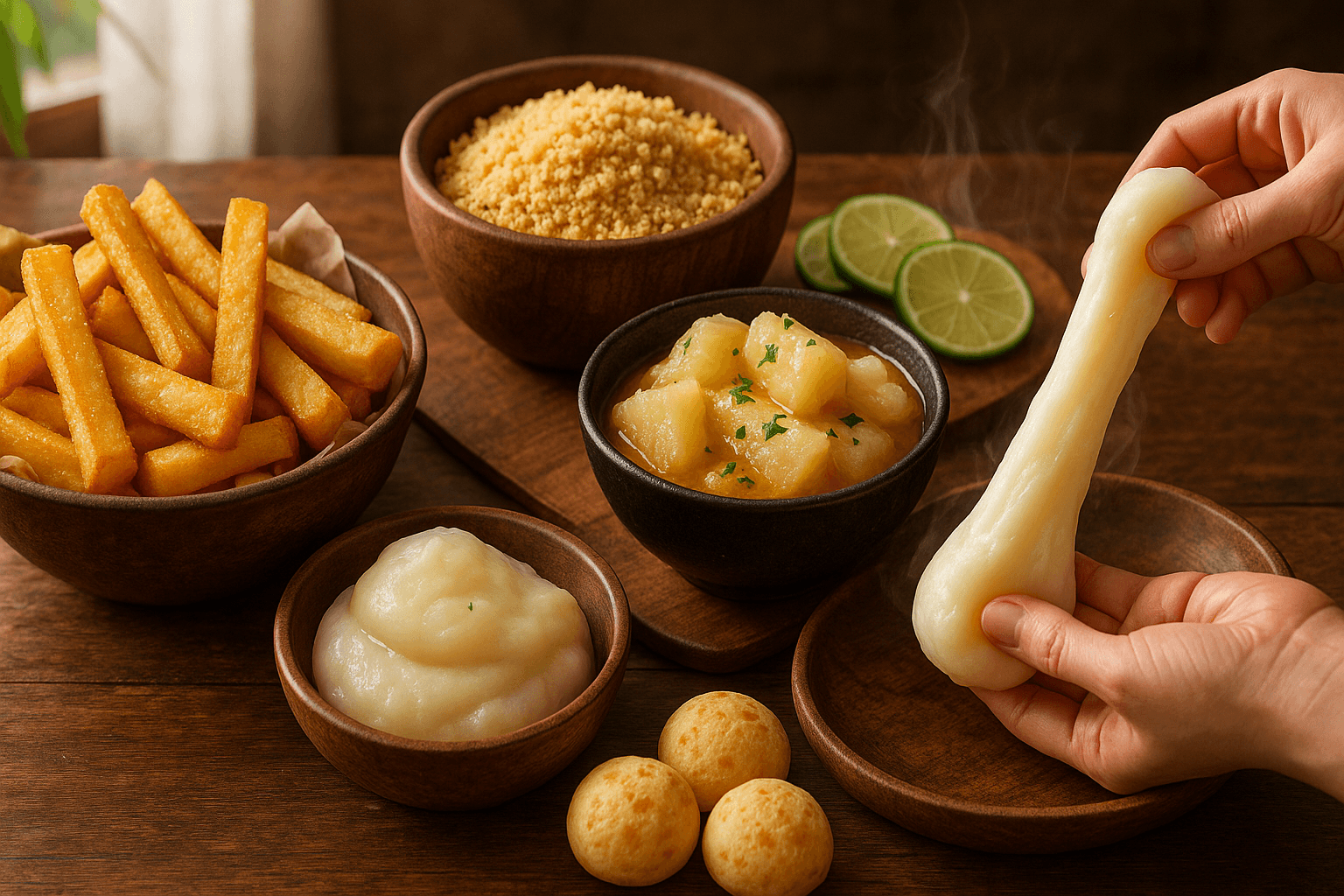
Cassava is one of those ingredients that can seem almost magical when it is handled well and deeply frustrating when it is not. The same root can become a bowl of silky, elastic fufu, a pan of nutty toasted farofa, a shatter-crisp yuca fry with a creamy center, or a gummy, fibrous, oddly sandy disappointment. It can taste mild and comforting, or reveal bitter notes and off aromas that tell you something went wrong long before dinner hit the table.
That split personality is exactly what makes cassava so fascinating. Under the skin, this tropical root is not just "another starch." It carries a particular structure, a particular chemistry, and a long culinary history built around techniques that are not arbitrary at all. The old rules—peel deeply, wash thoroughly, soak when needed, grate when appropriate, press, ferment, boil fully, toast carefully—exist because cassava demands and rewards process.
If you understand three things, cassava starts making sense: first, some varieties contain significantly more cyanogenic compounds than others, so safety and preparation matter; second, cassava starch behaves differently from wheat flour or potato starch, which explains the stretch, density, and crispness people chase in different dishes; and third, many classic cassava preparations are really controlled transformations of moisture, particle size, and starch gelatinization. In other words, farofa, fufu, boiled yuca, cassava fries, and pão de queijo-style doughs are all solving different texture problems with the same raw material.
This guide is about those transformations: why cassava gets stretchy, why it can seem sandy, why it can fry up astonishingly crisp, and how to use the soak-grate-toast logic behind traditional techniques to get consistently better results at home.
Cassava, manioc, yuca: what we are talking about
Cassava is the starchy root of Manihot esculenta, a crop native to South America that spread across the tropics and subtropics through Indigenous agriculture, colonial trade routes, and later local adaptation. Depending on where you are, you might hear it called cassava, manioc, mandioca, yuca, yucca, tapioca root, or manioc root. In the kitchen, these names often overlap, though "yucca" is botanically a different plant entirely; in grocery practice, "yuca" usually refers to cassava.
It is a staple across large parts of South America, the Caribbean, West and Central Africa, and Southeast Asia. In Brazil it becomes farinha, farofa, beiju, tucupi, and polvilho for cheese breads. In West and Central Africa it becomes fufu and related pounded or stirred starches, as well as fermented flours and granules like gari. In the Caribbean and Latin America, chunks of boiled yuca and fried yuca are beloved side dishes, often served with garlic-citrus sauces or stews.
Its importance is practical as well as cultural. Cassava grows where other starch crops struggle, tolerates poor soils, and stores calories underground. But as resilient as it is in the field, it is not a root you treat casually in the kitchen.
Sweet vs. bitter cassava: why the distinction matters
Cassava is often broadly divided into sweet and bitter varieties. Those labels can be misleading if you take them literally. Sweet cassava is not candy-sweet, and bitter cassava is not always obviously unpleasant when raw. The real difference is in the level of cyanogenic glycosides—primarily linamarin and lotaustralin—stored in the plant tissue.
When cassava cells are damaged by peeling, grating, cutting, or chewing, plant enzymes come into contact with these compounds and begin converting them into smaller molecules that can release hydrogen cyanide. That sounds alarming because it is. Poorly processed cassava can be dangerous.
In broad practical terms:
- Sweet cassava contains lower levels of cyanogenic compounds and is the form most commonly sold for home cooking as peeled frozen yuca or fresh market yuca. It still must be peeled and cooked properly.
- Bitter cassava contains higher levels and is traditionally processed through combinations of peeling, grating, soaking, fermenting, pressing, washing, drying, and thorough heating before it is eaten.
Traditional foodways are full of intelligent processing steps because communities figured out over generations how to make cassava safe and delicious. Farinha, gari, fufu flours, and starch products are not just culinary preferences; they are technologies.
The safety rules: peel, remove, soak or process, and cook thoroughly
For most home cooks buying fresh or frozen yuca, the practical safety rules are straightforward.
1. Peel more deeply than you think
Cassava has a rough brown outer bark and a thicker inner peel layer that can be pinkish, cream, or purple-tinted. The edible flesh is the bright white or pale yellow core inside that layer. Use a heavy knife rather than a peeler. Cut the root into 2- to 3-inch (5- to 7.5-cm) sections, slice lengthwise through the skin, and pry the peel away.
Remove:
- the brown outer layer
- the thick inner peel completely
- any discolored spots
Leaving peel behind can contribute bitterness and can leave more of the cyanogenic compounds you are trying to reduce.
2. Split out the woody core when needed
Many cassava roots have a fibrous central core. Once boiled, it often becomes easy to pull out. Some cooks remove it after cooking, some before. Either is fine, but if the root is old and the core looks thick and stringy, it is worth dealing with.
3. Soak when appropriate
For fresh yuca intended for boiling or frying, soaking peeled pieces in cold water for 30 minutes to 2 hours is a useful extra step, especially if the root is very fresh, slightly bitter-smelling, or if you simply want cleaner flavor and surface starch control. For more traditional bitter-cassava processing, soaking can extend much longer and may involve grating, fermenting, or pressing, but that is a different scale of transformation.
For home use, think of soaking as doing three things:
- helping leach out some water-soluble bitter compounds
- washing off excess surface starch and residue
- keeping peeled cassava from discoloring
Refrigerate if soaking more than 1 hour.
4. Cook fully—do not undercook cassava
Boiled cassava should become tender enough that the chunks begin to split open at the edges. Frying cassava should generally start with fully or almost fully cooked pieces. Toasted cassava products should be heated thoroughly and evenly.
A good boiling target for fresh yuca pieces is 20 to 35 minutes in generously salted water, depending on age and size, at a steady simmer around 200 to 205°F / 93 to 96°C. If pieces are still firm and chalky in the center, keep going.
5. Discard roots that signal trouble
Do not use cassava that smells strongly bitter, chemically, moldy, or fermented when you did not intend fermentation. Black streaks, extensive blue-gray discoloration, soft wet patches, or pronounced internal browning are all warning signs.
The science of cassava’s weirdly wonderful texture
Cassava’s texture comes largely from its starch granules, water content, low protein content, and fibrous structure. Compared with potatoes, cassava often feels denser and more elastic when cooked. Compared with wheat-based doughs, it lacks gluten entirely, yet it can still produce stretch under the right conditions. That surprises people the first time they meet a properly made cassava starch dough or fufu.
Starch gelatinization: the foundation of everything
Raw cassava flesh is hard because its starch granules are compact and locked inside plant tissue. As cassava cooks in water, those granules absorb moisture and swell. This process—gelatinization—typically begins in the neighborhood of 140 to 167°F / 60 to 75°C, though exact behavior depends on the starch fraction and whether you are working with root pieces, dried starch, or preprocessed cassava flour.
Once enough starch granules swell and leak amylose and amylopectin into the surrounding water, the texture changes from chalky to creamy, cohesive, and eventually sticky or elastic.
That is why undercooked cassava can feel dry or gritty, while fully cooked cassava can suddenly seem almost fluffy at the edges.
Why cassava can turn stretchy
Stretchiness in cassava preparations comes from a hydrated starch network, especially when cassava is pounded, stirred, kneaded, or otherwise mechanically worked after cooking. Unlike wheat dough, this is not gluten development. It is a gel matrix of swollen starch granules and released starch molecules.
You see this in:
- fufu and related starch swallows, where cooked cassava is pounded or stirred into a smooth, elastic mass
- pão de queijo-style doughs, where cassava starch—especially sour starch—hydrates and expands into a chewy, pull-apart crumb
- mashed boiled yuca, if overworked while very hot and wet
The more you combine heat, adequate moisture, and mechanical shear, the more cassava can move toward elasticity.
Why cassava can seem sandy or gritty
That sandy, grainy feeling can come from several different failures, and they are not all the same.
- Undercooking: the center remains chalky because the starch never fully gelatinized.
- Old or dehydrated roots: moisture loss toughens texture and exaggerates fibers.
- Poorly processed granules or meal: in products like farinha or gari, particle size and incomplete hydration can read as pleasant graininess or unpleasant grit depending on the dish.
- Insufficient pounding or mixing in fufu: tiny lumps remain intact.
- Fibrous tissue and core fragments: especially in mature roots.
- Toasting too fast: the outside browns before internal moisture and structure even out.
Pleasant sandy is the dry, fluffy crumb of good farofa. Bad sandy is chalky boiled yuca or gritty fufu.
Why cassava can become perfectly crisp
Cassava gets very crisp when three things line up:
- the interior is already cooked and moisture-balanced
- the surface is dry enough for efficient evaporation
- the frying or roasting temperature is high enough to drive off water fast and set a rigid crust
This is why the best yuca fries are almost always par-cooked first, then dried, then fried at 350 to 375°F / 175 to 190°C. The interior starch is gelatinized and creamy, while the surface dehydrates and roughens into a crust. If you fry raw cassava from fresh, the outside can burn before the inside cooks through.
The soak-grate-toast rules: the hidden logic behind classic cassava dishes
When people say there are rules to cassava cookery, they often sound traditional or even mysterious. But the recurring techniques are very logical.
Soak
Soaking controls bitterness, safety, temperature, oxidation, and starch wash-off. It is a preparatory water treatment.
Grate
Grating dramatically increases surface area. That matters because it:
- exposes more cell contents for washing or fermenting
- helps enzymes act on cyanogenic compounds so they can be removed or volatilized during later processing
- makes pressing and drying more efficient
- creates uniform particles for toasting or rehydrating
This is why grated cassava is central to products like farinha and many fermented cassava foods.
Toast
Toasting is not just about flavor. It dries, stabilizes, and transforms texture. In cassava meal products, careful toasting reduces moisture to create shelf-stable granules and develops nutty aromas through Maillard browning and other thermal reactions.
If you rush the toast, you get scorched outsides and raw-tasting centers. If you toast evenly over moderate heat, you create grains that stay separate and pleasant.
Those three actions—soak, grate, toast—are really different ways of managing water, toxicity, starch, and texture.
How to boil yuca so it is creamy, not chalky or waterlogged
Boiled yuca should be tender, lightly sweet, and substantial, not soggy. It often gets compared with potatoes, but it behaves differently and likes a different approach.
Best method for boiled yuca
Ingredients
- 2 pounds / 900 g fresh or frozen yuca, peeled if fresh
- 2 quarts / 2 liters water
- 1 1/2 tablespoons kosher salt (about 18 g)
- Optional: 2 garlic cloves, 1 bay leaf
Method
- If using fresh yuca, cut into 3-inch / 7.5-cm lengths and peel deeply.
- Soak in cold water for 30 to 60 minutes if desired, then rinse.
- Place in a pot with water and salt. Add garlic and bay if using.
- Bring to a boil, then reduce to a lively simmer.
- Cook 20 to 35 minutes, until a knife slips in easily and the pieces start splitting.
- Drain well.
- Rest uncovered for 3 to 5 minutes so surface moisture evaporates.
- Remove the woody core if still present.
Common mistakes
- Starting with tiny pieces: they can waterlog before the centers cook evenly.
- Boiling too gently: the root takes forever and can cook unevenly.
- Stopping at knife-tender but not fully opened: cassava often needs a little extra time beyond initial tenderness.
- Serving immediately dripping wet: a brief post-drain rest improves texture.
For serving, toss with olive oil or butter, chopped cilantro, lime or sour orange juice, and lots of garlic. The fat fills cassava’s relatively plain flavor profile, and the acid brightens its density.
How to make yuca fries with a crisp shell and creamy center
Great yuca fries are one of cassava’s highest achievements. They should have a blistered, crisp crust and a center that is fluffy-chewy rather than mealy.
Step-by-step yuca fries
Ingredients
- 2 pounds / 900 g yuca
- Water for boiling
- 1 1/2 tablespoons kosher salt for the boil
- Neutral oil for frying
- Fine salt for finishing
Method
- Peel and cut yuca into thick fry batons, about 3/4 inch / 2 cm thick.
- Boil in salted water for 18 to 25 minutes, until almost fully tender but not falling apart.
- Drain carefully and remove the fibrous core from each piece.
- Spread on a tray and let steam off until the surface looks dry, 10 to 20 minutes.
- For best results, chill uncovered in the refrigerator for 30 minutes to 2 hours. This firms the pieces and dries the exterior.
- Fry at 350°F / 175°C for 4 to 6 minutes until lightly blond if doing a double-fry, or until golden if doing a single fry.
- Rest for 3 to 5 minutes.
- Fry again at 375°F / 190°C for 1 1/2 to 3 minutes until deeply golden and crisp.
- Drain and salt immediately.
Why this works
The first boil gelatinizes the interior starch. The drying phase reduces surface moisture, which would otherwise create steam and soften the crust. The high final fry rapidly dehydrates the surface and creates a brittle shell.
Mistakes that ruin fries
- Skipping the boil: raw interiors, burnt exteriors.
- Frying wet pieces: splattering and soggy crusts.
- Overboiling before frying: pieces break apart in oil.
- Crowding the fryer: oil temperature drops below 325°F / 163°C, causing grease absorption.
If baking or air-frying, toss the parboiled pieces with 1 to 2 tablespoons oil and cook at 425°F / 220°C until browned, turning once or twice. They will be less shatter-crisp than deep-fried but still excellent.
Farofa and toasted cassava meals: how to get nutty, sandy, never greasy
Farofa is a Brazilian dish and category built around toasted cassava flour or meal, often enriched with butter, oil, onions, eggs, herbs, bacon, banana, or nuts. It should feel sandy in the best way: dry, light, toasty, and separate, not pasty.
The exact cassava product matters. Brazilian markets may label ingredients as farinha de mandioca, sometimes coarse, fine, raw, or pre-toasted. Some are naturally drier and more robust than others.
Texture rule for farofa
You are not trying to make a sauce with flour in it. You are coating and toasting granules while keeping them distinct.
Basic farofa ratio
For 2 cups / about 240 g cassava flour or meal:
- 3 tablespoons butter or 2 tablespoons butter + 1 tablespoon oil
- 1 small onion, finely diced
- 1/2 teaspoon kosher salt, plus more to taste
Method
- Warm a wide skillet over medium to medium-low heat.
- Add the fat and onion. Cook slowly for 5 to 7 minutes until translucent and lightly golden.
- Add the cassava flour and salt.
- Stir continuously for 5 to 10 minutes, depending on how raw the flour tastes and how dark you want it.
- Taste for nuttiness. It should smell toasted, not dusty.
- Adjust seasoning and finish with herbs if desired.
The science of good farofa
The goal is controlled moisture management. The onion contributes a small amount of steam and aroma, the fat coats particles and carries flavor, and the heat dries and toasts the cassava meal.
If the pan is too hot, the flour browns unevenly before raw notes disappear. If you use too much fat, the farofa feels heavy and clumps. If you add wet ingredients too early or in excess, the granules swell and merge instead of staying sandy.
Common mistakes
- Too much butter: greasy farofa.
- High heat: bitter spots, uneven toast.
- Not stirring enough: scorched patches.
- Using powder-fine starch instead of cassava meal: gummy rather than sandy texture.
If you want add-ins like scrambled egg, bacon, sausage, toasted nuts, or diced banana, cook them separately or before the flour goes in, then fold together at the end to protect the texture.
Pão de queijo-style applications: why cassava starch bakes chewy and hollow
Pão de queijo and related bakes rely not on the whole root but on cassava starch, often sold as tapioca starch or in Brazilian markets as polvilho doce (sweet starch) and polvilho azedo (sour starch). Sweet and sour here refer not to cyanide level but to starch processing.
- Sweet cassava starch/polvilho doce gives tenderness and body.
- Sour cassava starch/polvilho azedo has been fermented and dried, giving more expansion, aroma, and chew.
A common home ratio for a pão de queijo-style dough is:
- 2 cups / 240 g cassava starch
- 1 cup / 240 ml milk
- 1/4 cup / 56 g butter or oil
- 1 teaspoon salt
- 1 large egg
- 1 to 1 1/2 cups / 100 to 150 g grated cheese
The hot milk-and-fat mixture partially pregelatinizes the starch, creating a tacky dough that can trap steam in the oven. That is why the baked rolls puff, crack, and chew instead of crumbling like shortbread.
Common texture problems
- Too much liquid: batter-like dough, flat bakes.
- Cold liquid added to starch: less initial gelatinization, weaker structure.
- No rest: dough may bake unevenly.
- Low oven temperature: poor lift. Aim for 375 to 400°F / 190 to 205°C.
These same principles explain why tapioca pearls and other cassava starch products can feel delightfully bouncy when cooked correctly and gluey when overhydrated.
Fufu and West/Central African cassava textures: smooth, elastic, never lumpy
The word fufu can refer to a broad family of pounded or stirred starchy staples across West and Central Africa and the diaspora, with local differences in ingredients, methods, and texture expectations. Some versions are made from cassava alone; many are blends, commonly cassava with plantain, yam, cocoyam, or other starches. Some rely on fermented cassava products, while modern home methods may use instant flours.
Because practices vary regionally, the most helpful scientific point is this: good fufu is about complete hydration, even gelatinization, and enough mechanical working to create a unified starch mass without dry particles.
Basic method with cassava fufu flour
Always follow package directions first, since products differ. But a reliable starting point is:
- 1 cup / 140 to 160 g cassava fufu flour
- 2 to 2 1/2 cups / 475 to 600 ml water
- Bring most of the water to a simmer, around 190 to 200°F / 88 to 93°C.
- Whisk a small portion of the flour with some cool water if the product tends to lump, making a slurry.
- Add flour gradually while stirring vigorously with a wooden spoon or sturdy spatula.
- Cook over low heat, stirring and pressing for 5 to 10 minutes or until smooth, glossy, and elastic.
- If too stiff, add hot water 1 tablespoon at a time. If too loose, add a little more flour and keep cooking.
For cooked fresh cassava fufu-style preparations
If making from boiled cassava, cook chunks until very soft, drain thoroughly, and pound or process while hot with minimal extra water. Work quickly. Hot starch is pliable; cooling increases stiffness and lumpiness.
Why fufu turns gummy or gritty
Gummy fufu usually comes from too much free water, insufficient cooking after water addition, or overconcentration of fine starch on the outside while the center remains less integrated.
Gritty fufu usually comes from incomplete hydration, poor stirring, coarse particles, or undercooked flour.
The anti-gumminess rules
- Add flour gradually, not all at once.
- Use simmering, not violently boiling, water once thickening begins.
- Cook beyond first thickening; starch needs time.
- Beat and press the mass to eliminate micro-lumps.
- Adjust with hot water, not cold, once cooking is underway.
Why fresh, frozen, flour, starch, and fermented cassava all behave differently
A lot of home frustration comes from assuming all cassava products are interchangeable. They are not.
Fresh cassava root
Best for boiling, frying, stewing, grating, and traditional processing. It has fibers, variable moisture, and a whole-root flavor.
Frozen yuca
Often an excellent choice because it is processed close to harvest. It can be more reliable than old fresh roots. Usually ideal for boiling and frying.
Cassava flour
This can mean whole-root dried flour, not pure starch. It tends to have more flavor and more fibrous body than tapioca starch. Good for farofa-style uses depending on grind and processing.
Tapioca or cassava starch
This is extracted starch, often very fine and pure. It is the right choice for cheese breads, starch-thickened applications, and chewy gels, not for farofa.
Fermented cassava products
These include sour starches and fermented flours or granules. They bring acidity, aroma, different expansion, and altered hydration behavior.
Understanding which product you have is half the battle.
Troubleshooting by texture
If cassava is giving you trouble, diagnose by feel.
Problem: boiled yuca is chalky in the center
Cause: undercooked or old root.
Fix: cut larger but uniform chunks and simmer longer, 5 to 15 more minutes. If the root never softens properly, it may be poor quality.
Problem: boiled yuca is stringy
Cause: maturity, fibrous core, or old root.
Fix: remove the central core and buy younger or frozen product next time.
Problem: fries are pale and limp
Cause: wet surface, low oil temp, overcrowding.
Fix: dry thoroughly, fry in smaller batches, and maintain 350 to 375°F / 175 to 190°C.
Problem: farofa is clumpy
Cause: too much moisture or fat.
Fix: lower heat, add more cassava meal gradually, and keep stirring to dry it out.
Problem: fufu is lumpy
Cause: flour added too quickly or not enough mixing.
Fix: whisk in gradually, beat hard while hot, and pass through a sturdier mixing phase instead of stopping early.
Problem: cassava dough is gluey
Cause: excess hydration or overworked hot starch in the wrong application.
Fix: reduce liquid, let mixtures rest, and distinguish between desired elasticity and uncontrolled stickiness.
Practical buying and prep advice for home cooks
If you are new to cassava, start with frozen yuca pieces from a Latin American, Caribbean, African, or well-stocked international market. They are convenient, usually peeled, and often more consistent than fresh roots that may have sat too long.
If buying fresh:
- choose firm roots with no soft spots
- look for intact skin with minimal cracking
- avoid roots that feel very light for their size, which can indicate dehydration
- cut ends should look white, not gray-brown or streaked blue-black
Store fresh cassava only briefly, ideally 1 to 3 days refrigerated if unpeeled, because quality declines fast. Peeled cassava should be kept submerged in water in the refrigerator and used within 24 hours, or frozen.
Cultural respect and kitchen humility
Cassava is a powerful example of how traditional food knowledge encodes chemistry and engineering. The peeling, soaking, grating, pressing, fermenting, drying, pounding, and toasting methods associated with cassava are not rustic quirks in need of modernization. They are sophisticated, adaptive systems developed in places where cassava was and is central to life.
If anything, the modern home cook benefits by understanding the "why" behind those methods rather than trying to shortcut them blindly. A Brazilian farofa cook, a Congolese or Nigerian fufu cook, a Caribbean fry master, and a baker working with polvilho are all manipulating the same root in different states to produce radically different pleasures.
That is part of cassava’s beauty: it is humble in appearance, but technically rich.
Takeaways: the rules that make cassava work
If you remember nothing else, remember these practical rules.
For safety
- Peel deeply and remove all skin and inner peel.
- Favor reputable fresh or frozen sweet cassava/yuca for simple home cooking.
- Soak when appropriate, especially for fresh peeled root.
- Cook thoroughly; never serve cassava undercooked.
For creamy boiled yuca
- Simmer in well-salted water for 20 to 35 minutes.
- Cook until the pieces begin to split.
- Drain well and let steam off briefly.
- Remove the woody core.
For crisp yuca fries
- Parboil first.
- Dry the surface well.
- Fry at 350 to 375°F / 175 to 190°C.
- Double-fry for the best crust.
For sandy, fragrant farofa
- Use cassava meal or farinha, not pure starch.
- Toast over medium to medium-low heat.
- Keep fat moderate.
- Stir constantly to keep granules separate.
For stretchy, smooth fufu
- Hydrate gradually.
- Cook fully after thickening begins.
- Stir and beat while hot.
- Adjust with hot water, not cold.
For chewy cassava starch bakes
- Use the correct starch product.
- Scald starch with hot liquid when the recipe calls for it.
- Bake hot enough for steam expansion.
Cassava turns stretchy when its starches are hydrated and worked. It turns sandy when particles stay separate by design—or when cooking fails and starch never fully gelatinizes. It turns crisp when the interior is cooked, the exterior is dry, and heat drives out moisture fast. Once you see those patterns, cassava stops being mysterious.
And then the old rules—soak, grate, toast; boil, dry, fry; hydrate, stir, cook through—start to feel less like warnings and more like keys. Use them well, and cassava gives you some of the most satisfying textures in the starch world: creamy, chewy, sandy, stretchy, and crisp, each exactly where it belongs.