Why Cauliflower Turns Sulfurous, Watery, or Surprisingly Meaty: Pectin Softening, Sulfur Volatiles, and the Heat Rules for Roasting, Mashing, and Steaks
RecipeSimpli
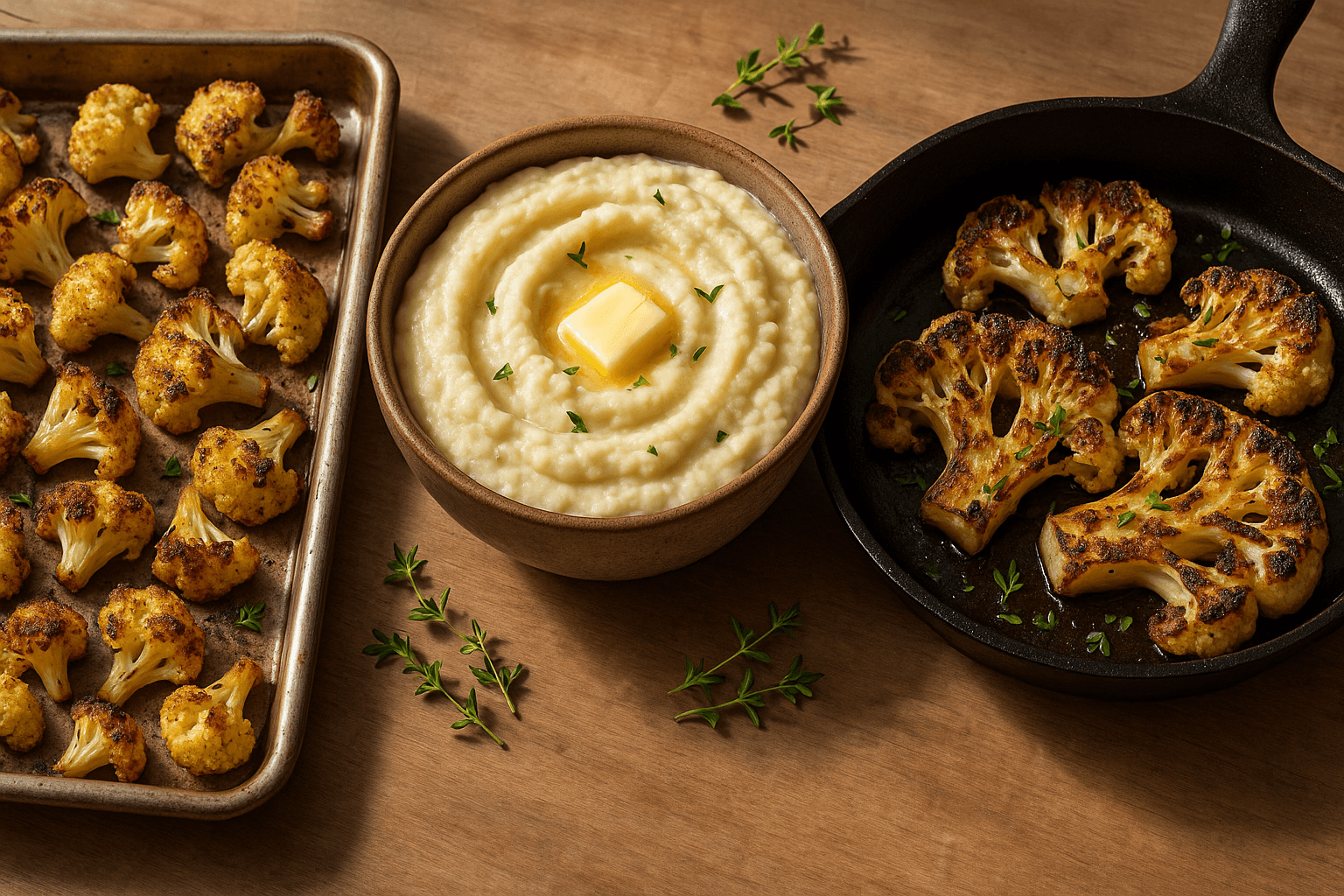
Cauliflower can be one of the most disappointing vegetables in the kitchen or one of the most thrilling. The same head can come out sweet, nutty, and deeply caramelized, or it can slump into a pale puddle that smells like overworked cabbage water. It can mash into something silky and luxurious, or weep onto the plate. It can roast into crisp-edged florets, or, with the right cut and heat, turn into cauliflower “steaks” with a texture so substantial it feels almost meaty. None of this is random. Cauliflower responds dramatically to heat, moisture, salt, and cutting style because its structure is delicate, its water content is high, and its aroma chemistry is unusually volatile.
Once you understand three things, cauliflower gets easier to control: first, how its pectin-rich cell walls soften; second, how sulfur compounds are released and transformed by cooking; and third, how heat and pan conditions decide whether water leaves the vegetable fast enough for browning to happen. Those rules explain why overcrowding a tray makes cauliflower limp, why mashing can become watery even when the flavor is good, why some cooks salt early and others wait, and why florets and steaks need different treatment if you want the best texture.
This is the science-first guide to making cauliflower taste like its best self: sweet, nutty, savory, and concentrated rather than sulfurous, wet, or bland.
Cauliflower’s reputation problem, and why it deserves better
Cauliflower belongs to the brassica family, alongside broccoli, cabbage, Brussels sprouts, kale, and turnips. Like its relatives, it carries sulfur-containing compounds that can produce sharp, cabbage-like aromas when damaged or overcooked. That family resemblance is why bad cauliflower often smells aggressively “vegetable.” But it is also why well-cooked cauliflower has such depth. Brassicas are flavor-dense plants. Their earthy sweetness and savory bitterness can be balanced into something remarkable when moisture is managed and browning is encouraged.
Historically, cauliflower has moved through very different culinary identities. In some cuisines it is stewed into tenderness with spices, tomato, onion, and oil, where moisture is intentionally part of the dish. In others it is fried, pickled, or roasted to concentrate sweetness. Modern Western home cooking often asks cauliflower to impersonate starches and meats: mashed like potatoes, riced like grains, or cut into slabs and served as steaks. That versatility is real, but it comes with a catch. Cauliflower is not potato, rice, or beef. If you cook it as though it were any of those, it punishes you with water release, weak browning, or mushy texture.
The good news is that cauliflower gives clear signals. If you know what the cells are doing, what sulfur compounds are doing, and what your oven or pan is doing, you can steer the result.
The structure: why cauliflower softens, breaks, and sometimes feels “meaty”
Cauliflower is a compact mass of immature flower buds attached to branching stems and a central core. The white curd looks dense, but at the cellular level it is mostly water held within thin-walled plant cells. Those cells are glued together by the middle lamella, rich in pectic substances. Pectin is the broad family of structural polysaccharides that helps plant tissues hold shape. As cauliflower cooks, those pectins change. Heat weakens the bonding between cells, and eventually the tissue loosens, softens, and separates.
That softening is the reason tenderness happens, but it is also the reason overcooking becomes collapse. The trick is to soften enough that the vegetable is pleasant to bite, while not breaking down so far that water pours out and the structure turns limp.
Different parts of the cauliflower soften differently. The stems and core contain more fibrous support tissue and usually take longer to become tender. The curd, made of tightly packed florets, can soften quickly and break apart. That is why a whole floret sometimes seems overdone on the outside and still slightly raw at the stem. The shape matters because heat reaches the edges long before the center.
That same structure explains why cauliflower can feel surprisingly substantial when cut into thick steaks. A steak includes core tissue that acts like scaffolding. When a 1 to 1 1/2 inch thick slab remains attached to part of the stem and core, those internal supports hold the slice together while the outer surfaces brown. The result is not meat-like because the plant somehow becomes protein; it is meat-like because the cut offers chew, resistance, and a large browned surface.
The sulfur story: where the cabbage smell comes from
Cauliflower’s characteristic aroma comes from glucosinolates, sulfur-containing compounds stored in the plant. When the tissue is cut, crushed, or chewed, enzymes and substrates that were separated inside intact cells come into contact. This produces a range of sulfur compounds, some pleasantly pungent and some aggressively cabbagey. Heat complicates the story. Moderate cooking can mellow raw pungency and reveal sweetness, but prolonged cooking, especially in moist heat, can drive the formation and release of volatile sulfur compounds such as hydrogen sulfide and other brassica aromas associated with overcooked vegetables.
That is why a pot of boiling cauliflower left too long often fills the kitchen with a sulfurous smell. In water, the vegetable heats uniformly and softens quickly, but there is little opportunity for evaporation-driven concentration or browning. Instead, volatile sulfur compounds are liberated into the steam, while flavor compounds can leach into the cooking water.
Roasting changes the balance. Dry heat still softens the cells and releases some sulfur compounds, but because the surface dries, sugars and amino acids can undergo browning reactions. Those toasted, nutty aromas compete with and partly mask the brassica notes. In a well-roasted batch, what reaches your nose is a mix of sweet vegetal notes, caramelization, and Maillard complexity, not just sulfur.
One subtle but important point: the sulfur smell is not merely about time. It is about time plus moisture plus temperature profile. Low, slow, crowded roasting behaves more like steaming than roasting, which means the sulfur notes have time to build before meaningful browning appears. High heat with enough space gets you through the danger zone faster.
Water is the hidden ingredient in every cauliflower recipe
Cauliflower is mostly water. That sounds obvious, but it drives nearly every texture problem. When cauliflower cooks, cell walls weaken, internal pressure changes, and moisture begins to migrate outward. If that water evaporates quickly, the surface dries and can brown. If it cannot escape, it collects on the pan, on the vegetable, or later in the mash, diluting flavor and sabotaging texture.
This is why overcrowding is so destructive. Put too much cauliflower on one sheet pan and each floret becomes a humidifier for the others. The pan fills with vapor. Instead of hot, dry air promoting dehydration and browning, the local environment turns damp. Moisture condenses faster than it can evaporate, and the vegetable effectively steams itself. Steamed cauliflower can be delicious in the right context, but if your goal is roasty edges and concentrated sweetness, crowding guarantees disappointment.
Here is a practical rule: a standard half-sheet pan, about 18 by 13 inches, can comfortably roast about 1 1/2 to 2 pounds of florets in a single layer with visible space between pieces. If you have 3 pounds, use two pans, and if possible rotate both pans midway through roasting. If you pile 3 pounds on one pan, you are no longer roasting efficiently.
The same principle applies in a skillet. If you try to sear too many cauliflower steaks at once, the pan temperature drops, released water accumulates, and the slices pale instead of browning.
Browning: how cauliflower becomes sweet and nutty
Cauliflower’s best roasted flavor comes from a combination of water loss and browning chemistry. As moisture leaves the surface, temperatures can climb above the boiling point of water. Once that happens, caramelization of sugars and Maillard reactions between amino acids and reducing sugars can proceed more effectively, though in vegetables the exact balance depends on composition and surface conditions. The result is toasted, nutty, bittersweet complexity.
For browning to happen well, you need:
- Enough heat: typically an oven at 425 to 450°F (220 to 230°C)
- Enough oil to conduct heat and coat the surface thinly
- Enough space for steam to escape
- Enough time for moisture to leave before the interior overcooks
For florets, 425°F is a forgiving sweet spot; 450°F works beautifully if your pieces are not too small and you watch closely. For steaks, a stovetop sear plus hot oven often gives better control than oven-only cooking because you build color fast on the broad cut surfaces.
Oil matters, but more is not always better. Too little oil can leave the surface dry and unevenly colored; too much can make the cauliflower greasy and can pool on the pan, inhibiting direct contact in some spots. A good starting ratio for florets is 1 1/2 to 2 tablespoons oil per pound of trimmed cauliflower. For steaks, use about 1 tablespoon oil in the pan plus a light brushing or rubbing on the steaks themselves.
Salting: when it helps, when it hurts
Salt does several things at once. It seasons. It can draw surface moisture through osmosis. It can also dissolve into released water and form a thin brine on the surface. Whether that helps or hurts depends on the cooking method and timing.
For roasting florets, salting before cooking is usually beneficial if you do not overdo it. A moderate amount of salt helps the pieces taste seasoned throughout and can encourage a bit of early moisture release, which then evaporates in a properly hot oven. The key word is properly. If the pan is crowded or the oven heat weak, that early moisture release contributes to steaming. In other words, salting does not ruin cauliflower; poor evaporation does.
A practical starting point is 3/4 to 1 teaspoon kosher salt per pound of florets, tossed with oil just before roasting. If using fine table salt, use roughly half as much by volume.
For steaks, salting 10 to 20 minutes ahead can help the surface season evenly, but if the slices are very thin or your pan heat is marginal, a wet surface can interfere with browning. In that case, salt lightly in advance, then blot any visible moisture before searing.
For mash, salting the cooking water can improve flavor, but salting too aggressively before draining and drying can make it easier to end up with something that tastes both wet and oddly flat, because the flavor is diluted in retained water. The real issue for mash is not whether you salt, but whether you remove excess moisture after cooking.
Par-cooking for mash: useful, but only if you dry aggressively afterward
Cauliflower mash fails when cooks treat cauliflower like potatoes. Potatoes contain starch that can absorb and bind a certain amount of liquid into a creamy matrix. Cauliflower contains far less starch and far more free water. If you boil or steam it until tender and then puree immediately with butter and dairy, you are often just emulsifying vegetable water with fat. It can taste good for a minute, then slump and weep.
Par-cooking is still the right move for mash because you need to soften the tissues thoroughly before pureeing. The question is how to cook and dry.
Best methods for mash
Method 1: Steam, then dry
- Cut 2 pounds cauliflower into medium florets.
- Steam over simmering water until very tender, 12 to 15 minutes.
- Transfer to a sheet pan or dry skillet over low heat for 2 to 4 minutes, tossing gently, to evaporate surface moisture.
- Let it sit 1 to 2 minutes so steam escapes before processing.
Method 2: Simmer briefly, drain, then dry
- Simmer florets in well-salted water until very tender, 8 to 10 minutes.
- Drain thoroughly in a colander.
- Return to the hot empty pot over low heat for 1 to 3 minutes, shaking and stirring, until visibly drier.
Method 3: Roast for the driest mash
- Toss florets lightly with oil and roast at 425°F for 25 to 35 minutes until very tender and browned in spots.
- Cool slightly, then puree.
Roasted mash has the deepest flavor and the least water, though it will be darker and nuttier than classic pale mash.
Pureeing rules
For 2 pounds cooked cauliflower, start with:
- 2 to 3 tablespoons unsalted butter
- 2 to 4 tablespoons heavy cream, crème fraîche, cream cheese, or mascarpone
- 1/4 teaspoon black pepper
- salt to taste
Add dairy gradually. If it looks smooth already, stop. Cauliflower can go from thick to loose quickly. A food processor gives the smoothest texture; a potato masher yields something looser and more rustic. If you want exceptional body without obvious starchiness, blend in 1 to 2 tablespoons grated Parmesan or 1 tablespoon tahini, both of which help with perception of richness.
A common mistake is covering hot mashed cauliflower and holding it too long. Steam condenses and drips back in. If you must hold it, keep it loosely covered and rewarm briefly in a saucepan over low heat, stirring to drive off excess moisture.
Florets vs. steaks: cutting changes everything
The way you cut cauliflower determines how heat moves, how much moisture escapes, and how much surface area can brown.
Florets
Florets expose lots of irregular edges. That is useful for roasting because craggy tips brown attractively. But if florets vary wildly in size, some burn while others stay firm. Aim for pieces about 1 1/2 to 2 inches across with stems trimmed so each piece sits fairly flat on the pan. If you cut them too small, they dry out before the stems tenderize. Too large, and the stems lag behind.
For especially even roasting, slice very large florets in half lengthwise through the stem so each has a flat side. That flat side can contact the pan and brown better.
Steaks
To make cauliflower steaks, remove the outer leaves but keep the core intact. Trim just enough stem base so the head sits level. Place the head stem-side down and cut from top to bottom into slabs 1 to 1 1/2 inches thick. From an average 2 to 2 1/2 pound head, you may get 2 full steaks and several partial pieces from the sides. That is normal. The side pieces can be roasted alongside as florets.
Thickness matters. Thinner than 3/4 inch and steaks tend to fall apart and overcook before substantial browning develops. Thicker than 1 1/2 inches and the center may remain too firm unless you finish longer in the oven or par-cook lightly.
For maximum integrity, do not force every crumbly side piece into a steak identity. Only the slices attached to the central core truly behave like steaks.
Step-by-step: perfectly roasted cauliflower florets
This method yields browned edges, tender stems, and concentrated flavor without sulfurous sogginess.
Ingredients
- 2 pounds cauliflower florets, cut into 1 1/2 to 2 inch pieces
- 2 tablespoons olive oil or other high-heat oil
- 1 teaspoon Diamond Crystal kosher salt, or about 1/2 teaspoon table salt
- 1/4 teaspoon black pepper
- Optional: 1/2 teaspoon ground cumin, smoked paprika, or curry powder
Method
-
Heat the oven fully. Set the oven to 425°F (220°C). Place a heavy sheet pan inside while it preheats for at least 10 minutes if you want extra browning on contact.
-
Dry the cauliflower well. After washing, spin or towel-dry thoroughly. Surface water is the enemy of browning.
-
Season lightly but evenly. Toss florets with oil, salt, pepper, and any spices. The pieces should look lightly coated, not slick.
-
Spread with space between pieces. Arrange in a single layer on the hot or room-temperature pan. Keep cut sides down where possible. Do not crowd.
-
Roast until the first side browns. Roast 15 minutes without stirring.
-
Turn and finish. Flip the pieces and roast 10 to 15 minutes more, until stems are tender when pierced and edges are well browned.
-
Taste before serving. Add a final pinch of salt, lemon juice, or grated Parmesan if desired.
What can go wrong
- Pale and soft: Pan overcrowded, oven too cool, or cauliflower too wet.
- Burned tips and hard stems: Pieces too small or uneven.
- Bitter spices: Delicate spice powders added too heavily at high heat.
Step-by-step: cauliflower mash that stays thick and silky
Ingredients
- 2 pounds cauliflower florets
- 2 tablespoons unsalted butter
- 2 tablespoons heavy cream or crème fraîche, plus more if needed
- 3/4 teaspoon kosher salt for seasoning, plus water salt if boiling
- 1/4 teaspoon black pepper
- Optional: 1 small garlic clove, roasted or gently simmered with the cauliflower
Method
-
Cook until truly tender. Steam 12 to 15 minutes, or simmer 8 to 10 minutes, until the stems crush easily.
-
Drain and dry. If boiled, drain very thoroughly. Return to the hot pot over low heat for 1 to 3 minutes, stirring, until excess moisture visibly evaporates.
-
Vent steam. Let the cauliflower sit uncovered 1 minute.
-
Puree with restraint. Process with butter, cream, salt, pepper, and optional garlic until smooth. Add more cream only if needed.
-
Adjust texture intentionally. If too loose, return the puree to a saucepan over low heat and stir 2 to 5 minutes to evaporate water. If too thick, add cream 1 tablespoon at a time.
-
Serve promptly. Finish with chives, olive oil, browned butter, or Parmesan.
What can go wrong
- Watery mash: Insufficient drying after cooking, too much added dairy, or holding covered too long.
- Grainy mash: Undercooked stems or insufficient blending.
- Sulfur-heavy mash: Overcooked in water too long, then pureed while still intensely hot and aromatic.
Step-by-step: cauliflower steaks with real browning and a meaty bite
Ingredients
- 1 large head cauliflower, 2 to 2 1/2 pounds
- 2 tablespoons olive oil, divided
- 3/4 teaspoon kosher salt
- 1/4 teaspoon black pepper
- Optional: 1/2 teaspoon ground coriander or smoked paprika
- Optional finishing acid: lemon wedge, yogurt sauce, chimichurri, or tahini
Method
-
Preheat the oven. Heat to 425°F (220°C).
-
Cut the steaks. Slice the head into 1 to 1 1/2 inch slabs through the core. Expect 2 good steaks and some side pieces.
-
Season and rest briefly. Brush with 1 tablespoon oil total, then season with salt, pepper, and optional spices. Let sit 10 minutes. Blot any beads of moisture.
-
Sear in a hot pan. Heat a heavy skillet, preferably cast iron, over medium-high heat. Add the remaining 1 tablespoon oil. Sear steaks 3 to 5 minutes on the first side until deeply golden brown. Flip carefully and sear 2 to 4 minutes more.
-
Finish in the oven. Transfer the skillet or the steaks on a sheet pan to the oven and roast 8 to 12 minutes, depending on thickness, until the core is tender but the steaks still hold shape.
-
Rest briefly and finish. Let sit 2 minutes, then serve with acid or sauce to balance sweetness and bitterness.
Why this works
The skillet creates the rapid surface dehydration and contact heat needed for color. The oven then softens the interior more gently. If you attempt to do the whole job in a crowded pan or a moderate oven, the slices often soften before they brown, losing that meaty contrast.
The science of color: white, golden, or brown
Cauliflower starts pale because it contains few of the pigments that make other vegetables vivid. Its color changes in the pan depend mostly on browning, not chlorophyll shifts like green vegetables. A well-roasted floret goes from matte white to cream, then golden, then dark brown at the edges. That progression reflects both moisture loss and increasing browning intensity.
If your cauliflower stays stark white after a full roast time, it is almost always too wet or too crowded. If it goes grayish and soft, it has likely spent too long in moist heat or sat in trapped steam. Bright white is not always a virtue in cooked cauliflower. Some golden color is evidence that flavor is developing.
Common mistakes that lead to sulfurous, watery, or limp cauliflower
1. Washing and not drying
Even a tablespoon or two of cling water across a tray can delay browning. Dry thoroughly with towels.
2. Cutting random sizes
Small shards burn. Huge stems undercook. Uniformity gives predictability.
3. Too low an oven temperature
At 375°F, cauliflower often softens and steams before it browns meaningfully. Better for many roasting applications: 425 to 450°F.
4. Crowding the pan
This is the big one. Moisture has nowhere to go, so the vegetables steam each other.
5. Adding too much oil
A heavy coating can lead to greasy, soft results rather than concentrated flavor.
6. Boiling too long for mash
The longer cauliflower sits in water, the more flavor leaches out and the more the sulfur profile dominates.
7. Pureeing without drying
This is the classic watery mash error.
8. Expecting steaks from the whole head
Only core-attached slices hold together well. Roast the rest as florets.
9. Under-seasoning after cooking
Because cauliflower contains so much water, it can taste bland even when technically salted. Taste at the end and adjust.
Tips and variations
For sweeter roasted cauliflower
Toss florets with oil and salt only at first. Add spices, garlic, or Parmesan in the last 8 to 10 minutes so they do not scorch before the cauliflower browns.
For extra-crisp edges
Preheat the sheet pan, place cut sides down, and avoid flipping too early. You can also roast at 450°F for slightly less time, about 20 to 25 minutes total, if your oven runs true.
For less sulfur aroma in the kitchen
Use high heat and shorter cook times. Avoid covering cooked cauliflower tightly while hot. Vent steam instead of trapping it.
For a better mash without cream
Use butter plus 1 to 2 tablespoons extra-virgin olive oil and 1 tablespoon grated Parmesan. The fat and cheese improve richness without much added liquid.
For steak-style cauliflower with stronger structure
Lightly par-steam the whole head for 3 to 4 minutes, cool slightly, then cut steaks. This can reduce crumbling, but it also introduces moisture, so dry the surfaces very well and sear aggressively.
For deeply savory flavor
Roast with browned butter added after cooking, or finish with miso butter, anchovy breadcrumbs, toasted nuts, or tahini-lemon sauce. Cauliflower loves fats and condiments that supply umami and bitterness balance.
For spiced applications
Cauliflower pairs especially well with cumin, coriander, turmeric, mustard seed, chili flakes, black pepper, nutmeg, and warm curry blends. In spice-rich preparations, a slight degree of steaming is not always a flaw; moisture can help spices bloom and coat. The key is matching method to goal.
Cultural context: not all good cauliflower is crisp
It is worth remembering that “limp” and “soft” are not automatically failures. Many classic cauliflower dishes intentionally cook the vegetable until fully tender. In South Asian cooking, cauliflower is often sautéed, covered, and cooked with spices until tender and aromatic. In Mediterranean kitchens it may be braised with tomato, onion, olive oil, or chickpeas. In these dishes, moisture is part of the design, and the cauliflower is expected to absorb surrounding flavors rather than stand alone as a browned centerpiece.
What home cooks often call failure is really mismatch: applying a braising-style moisture environment to a roasting goal, or expecting potato-like mash from a vegetable with a very different starch-water balance. Once you define the desired result, the method becomes clearer.
The takeaway rules for every method
If you want cauliflower to taste sweet and nutty rather than sulfurous and limp, remember these rules:
-
Manage water first. Dry the cauliflower well, use enough heat, and give it room. Browning cannot happen on a wet, crowded surface.
-
Respect pectin softening. Cauliflower turns tender when cell-wall structure weakens, but past a certain point it collapses and leaks water. Cook until just tender for roasting; very tender but well-dried for mash.
-
Use high heat strategically. For florets, roast at 425 to 450°F. For steaks, sear first, then finish in the oven.
-
Salt with context. Early salting is usually good for roasting if evaporation is strong. For steaks, salt ahead but blot if needed. For mash, worry less about early salt than about drying after cooking.
-
Cut for the method. Florets maximize edges and browning. Steaks rely on core structure for integrity and chew.
-
Dry after par-cooking for mash. This is the single biggest fix for watery puree.
-
Avoid prolonged moist heat unless that is the goal. It amplifies sulfur aroma and weakens texture.
Cauliflower is not fickle; it is simply honest. It tells you, through smell, texture, and color, whether you gave water a path out and whether you let browning develop before the vegetable surrendered its structure. Learn those heat rules, and cauliflower stops being a compromise ingredient. It becomes what it always had the potential to be: tender when you want tenderness, crisp-edged when you want roastiness, silky when you want mash, and surprisingly meaty when you give the core, the cut, and the heat a chance to do their work.