Why Coconut Milk Breaks, Thickens, or Turns Oily: Fat Globules, Protein Emulsifiers, and the Heat Rules for Curries, Desserts, and Vegan Cream Sauces
RecipeSimpli
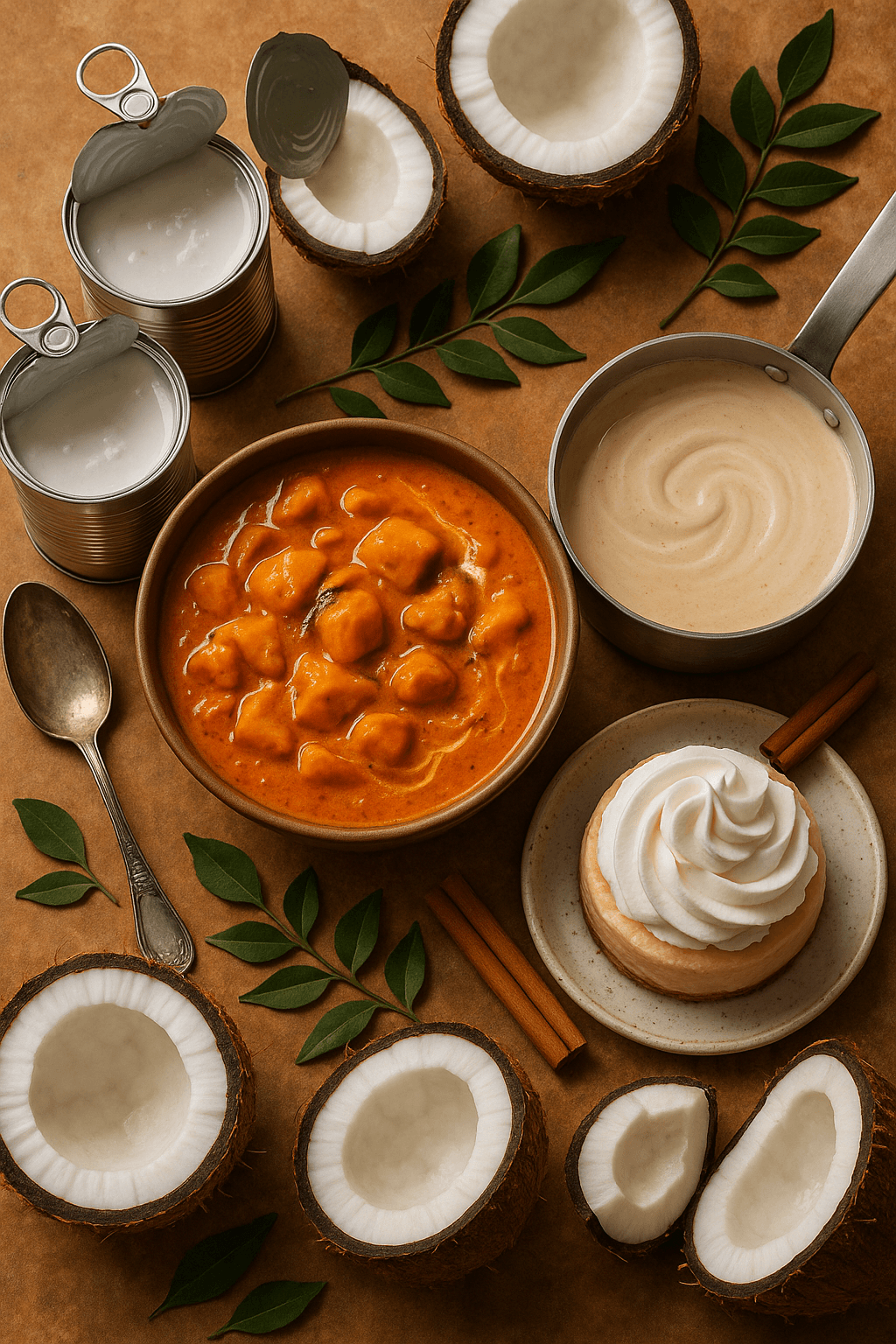
If you have ever opened a can of coconut milk and found a dense white cap sitting on top of a thin, watery layer, you have already met the central fact of coconut milk: it is not a uniform liquid by nature. It is an emulsion, and like all emulsions, it is temporary, conditional, and very sensitive to what you do next.
That sounds technical, but it matters in deeply practical ways. It explains why one curry blooms into a glossy, fragrant sauce while another ends up with orange oil slicks around pale curds. It explains why coconut custard can set smooth as silk or go grainy at the edges. It explains why vegan cream sauces made with coconut milk sometimes coat pasta beautifully and sometimes feel greasy, chalky, or oddly thin. And it explains why recipes that tell you to “never boil coconut milk” are only half right.
The real story is more useful than a rule of thumb. Coconut milk can break, thicken, reduce, split intentionally, resist curdling, or become oily depending on the size and stability of its fat droplets, the amount of protein and plant solids present, the presence or absence of stabilizers, and the combined effects of heat, acid, sugar, salt, starch, and agitation.
Once you understand what is physically suspended in coconut milk, you can control it. You can decide when you want a Thai curry to crack and fry in its own coconut fat. You can keep a coconut caramel sauce smooth. You can build a vegan cream soup without greasy separation. You can choose the right kind of coconut product for whipped topping versus braise versus pudding. And you can troubleshoot texture problems before they show up in the bowl.
Coconut milk is not milk in the dairy sense
Coconut milk is made by grinding coconut flesh with water and pressing out the liquid. That liquid contains several things at once:
- Fat, mostly saturated fat, suspended as droplets
- Water, which forms the continuous phase
- Proteins, in much smaller amounts than dairy milk or soy milk
- Fine coconut solids and fiber particles
- Natural emulsifying compounds, limited compared with egg yolk or dairy cream
That first point is the key. Coconut milk is best thought of as tiny fat globules dispersed in water. The reason it looks creamy is that those droplets are small enough, and numerous enough, to scatter light and feel rich on the tongue.
But coconut is not naturally a particularly strong self-stabilizing emulsion. Compared with dairy cream, it has less protein available to wrap and protect fat droplets. Compared with a commercial mayonnaise, it has far fewer robust emulsifiers. So unless something helps hold it together, gravity and temperature will eventually encourage the fat phase and water phase to separate.
This is why canned coconut milk often arrives visibly layered. It has not “gone bad.” It has simply settled, with the richer coconut cream rising and the thinner aqueous layer sinking.
Coconut milk, coconut cream, and carton coconut beverage are not interchangeable
Many kitchen disappointments start with using the wrong coconut product.
Canned coconut milk
This is the standard cooking ingredient for curries, braises, sauces, puddings, and soups. Typical full-fat canned coconut milk contains roughly 17% to 24% fat, though brands vary widely. Some are very thick and spoonable when cold; others are looser because they contain more water or fewer solids.
Canned coconut cream
Coconut cream is richer, usually around 20% to 30% fat or more, with less water. It is useful when you want body, luxurious mouthfeel, or a high-fat portion to whip when chilled. It also separates even more readily because there is simply more fat present.
Carton coconut beverage
This is the pourable dairy-milk substitute sold refrigerated or shelf-stable in cartons. It is usually heavily diluted, often containing 2% to 5% fat or even less, plus stabilizers, gums, and added vitamins. It behaves more like flavored water with emulsifiers than like canned coconut milk.
It is often fine for coffee, cereal, smoothies, or baking where coconut is not the main structural ingredient. It is usually a poor substitute for canned coconut milk in curries, ganache-style sauces, whipped toppings, and reduced soups because it lacks both the fat and the solids needed for richness.
Coconut cream of coconut, sweetened condensed coconut products, and dessert mixes
These are separate categories altogether. They may contain sugar, stabilizers, thickeners, and very different ratios of fat to water. A dessert recipe built for one of these products will not necessarily work with unsweetened canned coconut milk.
Why canned coconut milk separates in the can
When a can sits on the shelf, the denser water phase and the lighter fat-rich cream phase slowly organize themselves. Cold temperatures make coconut fat firmer, so if a can is refrigerated, the cream layer may become almost solid while the watery layer stays fluid.
Separation depends on:
- Fat content: higher fat tends to separate more clearly
- Particle size: larger fat droplets rise and merge more easily
- Protein and fine solids: these can help slow separation a bit
- Stabilizers: gums and emulsifiers inhibit visible layering
- Storage temperature: colder storage makes the fat phase more distinct
A can with dramatic separation is not necessarily lower quality. In some cases, it is the opposite: fewer stabilizers, more fat, more obvious natural layering. What matters is whether it recombines smoothly after stirring or warming.
If you need a uniform sauce, shake the can before opening if the brand allows it, or empty it into a bowl and whisk thoroughly. If the solid cap is stubborn, warming the can in hot tap water for 5 to 10 minutes often helps soften the fat enough to recombine.
The emulsion: fat globules, proteins, and why coconut is fragile
An emulsion stays together when fat droplets remain small and separate rather than colliding and fusing into larger droplets. The more stable the droplet surfaces, the longer the emulsion holds.
In coconut milk, stability comes from a few sources:
- Naturally occurring coconut proteins
- Phospholipids and minor surface-active compounds
- Tiny suspended coconut solids that increase viscosity
- Commercial stabilizers in some brands, such as guar gum, gellan gum, xanthan gum, carrageenan, or other hydrocolloids
But coconut protein is relatively low. That means there is limited natural protection around those fat droplets. Heat, acid, freezing, and strong boiling can all stress the system. Once droplets merge and separate from the water phase, you see oiling off, curdled-looking graininess, or broken sauce.
Think of coconut milk as a delicate truce between oil and water. Your job in the kitchen is either to preserve that truce or to break it on purpose for flavor and texture.
Why coconut milk thickens
Coconut milk thickens for several different reasons, and they are not all the same.
1. Cooling and fat crystallization
When chilled, coconut fat firms up. This makes coconut cream seem thicker or even scoopable. That is useful for whipped toppings, but it can also create lumps if you add cold coconut cream directly to a hot dish without first softening or whisking it.
2. Evaporation during simmering
As water cooks off, the concentration of fat and suspended solids increases. A curry simmered for 15 to 30 minutes will naturally become richer and thicker.
3. Starch gelatinization
If coconut milk is cooked with cornstarch, tapioca starch, arrowroot, rice flour, or another starch, those starch granules absorb water and swell, increasing viscosity. This is one of the easiest ways to reinforce a fragile coconut sauce.
4. Sugar concentration
In desserts, dissolved sugar changes how water behaves. It can contribute to a thicker, more syrupy feel, though too much sugar can also alter how proteins and other solids interact.
5. Hydrocolloid stabilizers
Gums like guar, xanthan, locust bean gum, and carrageenan thicken water even in small amounts. They also slow droplet movement, making the emulsion less likely to separate.
6. Added proteins or blended ingredients
Blending coconut milk with cashews, soy milk, silken tofu, or nut butter can increase body and emulsifying capacity. This is especially helpful in vegan cream sauces and soups.
Why coconut milk breaks or turns oily
When people say coconut milk “broke,” they usually mean one of three things:
- The fat separated and formed visible oily pools
- The solids clumped or looked grainy
- The liquid phase thinned while curds or cream bits floated separately
These problems can happen together or separately.
Heat is the biggest trigger
Moderate heat is usually fine. Aggressive boiling is where trouble starts. As temperature rises, the protective films around fat droplets can weaken. Droplets move faster, collide more often, and merge into larger ones. Once enough coalescence happens, free fat appears on the surface.
In practical terms:
- A gentle simmer around 185 to 205°F / 85 to 96°C is usually manageable
- A hard rolling boil at 212°F / 100°C, especially for several minutes, increases the risk of splitting
- Thin coconut products break faster than rich ones if there is not enough body to support them
That said, “never boil coconut milk” is too simplistic. Some dishes intentionally cook coconut milk until the emulsion cracks. In Thai curry making, this can be desirable.
Acid can destabilize the system
Coconut milk is not dairy, so it does not curdle exactly like cream under acid. But acid still matters. Lime juice, tamarind, pineapple, vinegar, tomatoes, and certain fruit purees can alter protein behavior and destabilize the emulsion, especially if added early and then boiled.
Best practice: add strong acids near the end of cooking, after the sauce is stable and the heat is lower.
Salt changes hydration and protein behavior
Salt is essential for flavor, but high concentrations can nudge proteins and suspended particles toward aggregation. In normal savory cooking, this is usually not the sole cause of breaking, but in combination with strong heat and acid it can contribute.
Sugar generally protects texture in desserts, up to a point
Sugar binds water and can help produce a smoother, more cohesive dessert texture. But high sugar concentrations combined with prolonged high heat can still cause fat separation or scorching, especially in caramel-like preparations.
Mechanical agitation can help or hurt
Whisking can re-emulsify lightly separated coconut milk. But vigorous stirring during a violent boil can also encourage droplet collisions and worsen visible separation. Blending is powerful, but once an emulsion is severely broken, even a blender may only partially rescue it.
When splitting is a flaw and when splitting is the point
This is one of the most important distinctions for cooks.
In many desserts and cream sauces, splitting is a problem
You want smoothness, visual gloss, and a uniform mouthfeel. A coconut panna cotta, pot de crème, vegan Alfredo, or creamy soup should not have a greasy halo or grainy particles.
In some Southeast Asian curry methods, cracking the coconut cream is intentional
Traditional Thai curry technique often begins by heating the thick cream from the top of the can until some of the emulsion breaks and coconut oil separates out. That oil then fries the curry paste, intensifying aroma and helping fat-soluble flavor compounds bloom.
This is not an accident. It is a controlled split.
The sequence often looks like this:
- Spoon 1/2 to 3/4 cup (120 to 180 mL) thick coconut cream into a pan
- Cook over medium heat for 3 to 8 minutes, stirring occasionally
- Wait for glossy oil to begin separating from the cream
- Fry curry paste in that released fat until fragrant
- Add remaining coconut milk and other liquids to build the sauce
In this context, the initial “breaking” creates flavor. But if the final curry is boiled too hard or reduced too far without enough water, it can still become greasy rather than luscious.
How stabilizers change behavior
Not all coconut milk brands cook the same, and stabilizers are a major reason why.
Common stabilizers
- Guar gum: adds viscosity, reduces separation
- Xanthan gum: excellent at keeping particles suspended, strong even at low levels
- Gellan gum: creates body and stability in beverage systems
- Carrageenan: used in some plant-based dairy-style products for structure
- Modified starches: can thicken and stabilize under heat
A brand with gums may seem “less natural” to some cooks, but it can be a better performer for smooth soups, vegan sauces, frozen desserts, or any application where stability matters more than traditional behavior.
A brand without stabilizers may be ideal when you want to crack the cream intentionally for curry paste frying or when you prefer a more traditional ingredient and do not mind whisking.
The role of starches, gums, and blended ingredients in reinforcing body
If your goal is a silky coconut-based sauce that does not go greasy, pure coconut milk is not always enough. Reinforcement helps.
Starches
For soups, gravies, and dessert sauces, use one of these:
- Cornstarch: mix 1 tablespoon cornstarch with 1 tablespoon cold water per 1 cup (240 mL) sauce for a light thickening
- Arrowroot: similar amount, gives a glossy finish, best added near the end and not boiled hard for long
- Tapioca starch: gives body and elasticity, useful in puddings and pie fillings
- Rice flour: good in some Asian dessert applications, slightly softer thickening
Add starch as a slurry to warm liquid, then cook gently until thickened. This increases viscosity in the water phase, slowing separation.
Gums for home cooks
Most people do not use hydrocolloids daily, but even tiny amounts can transform texture.
- Xanthan gum: about 0.1% to 0.3% by weight for light sauce stabilization
- Guar gum: about 0.2% to 0.5% by weight depending on desired thickness
For 500 g coconut sauce, 0.5 to 1.5 g xanthan can make a noticeable difference. Blend thoroughly to avoid clumps.
Nut and soy blends
These are some of the best tricks for vegan cream sauces.
- Cashews add starches, proteins, and finely dispersed solids that create creamy body
- Soy milk adds protein, which helps emulsification more than coconut alone
- Silken tofu contributes water, protein, and a smooth gel structure
- Almond butter or cashew butter can stabilize sauces in small amounts
For a stable vegan cream sauce, a very effective formula is:
- 1 can full-fat coconut milk, 13.5 oz / 400 mL
- 1/2 cup (75 g) soaked cashews
- 1/2 cup (120 mL) unsweetened soy milk
- Blend until perfectly smooth
This combination is much less likely to break than coconut milk alone.
Heat rules for curries, desserts, soups, and vegan cream sauces
Here are the practical rules that matter most.
For curries
- Use full-fat canned coconut milk
- Decide whether you want a traditional cracked-cream start or a smoother unified sauce
- If cracking cream, begin with the thick top layer and cook it separately first
- Once the curry is assembled, keep it at a gentle simmer, not a furious boil
- Add lime juice, tamarind, or delicate herbs at the end
- If it reduces too far and starts looking greasy, add 2 to 4 tablespoons water or stock, whisk, and lower the heat
For desserts
- Warm gently over low to medium-low heat
- Avoid prolonged boiling unless the recipe is specifically designed for it
- Dissolve sugar before aggressive reduction
- Use starch, agar, gelatin, or another setting/thickening system when structure matters
- Strain before chilling if any graininess appears
- Add acidic fruit components separately or fold them in after the base is cooled somewhat
For soups
- Build flavor in the broth first
- Add coconut milk during the final 10 to 15 minutes when possible
- Simmer gently and do not let the pot churn hard
- Puréeing with vegetables like cauliflower, squash, sweet potato, or carrots increases body and protects against oiliness
- If freezing, know that coconut soups may separate on thawing; reheat gently and blend if needed
For vegan cream sauces
- Reinforce coconut milk with cashew, soy, starch, or nutritional yeast depending on style
- Keep heat moderate, especially after thickening
- Add lemon juice or wine reduction carefully and late
- For pasta sauces, reserve pasta water and use 2 to 4 tablespoons at a time to maintain emulsion while tossing
- Do not reduce to the point where fat visibly weeps from the sauce
Step-by-step: how to use coconut milk successfully in four common applications
1. A smooth coconut curry that does not turn greasy
Ingredients
- 1 tablespoon neutral oil if not cracking the cream first
- 2 to 3 tablespoons curry paste
- 1 can full-fat coconut milk, 13.5 oz / 400 mL
- 1/2 to 1 cup (120 to 240 mL) stock or water
- Protein and vegetables as desired
- 1 to 2 teaspoons fish sauce or soy sauce
- 1 teaspoon palm sugar or brown sugar
- 1 to 2 teaspoons lime juice, added at the end
Method
- Open the can and assess separation. If the top is thick, you may use 1/2 cup of that cream to fry the paste.
- For a traditional cracked start, cook the cream over medium heat for 3 to 6 minutes until some oil separates.
- Add curry paste and fry for 1 to 2 minutes until aromatic.
- Stir in the remaining coconut milk plus 1/2 cup stock.
- Add protein or vegetables and bring just to a simmer.
- Maintain a gentle simmer for 10 to 20 minutes, depending on ingredients.
- Season with fish sauce or soy, then sugar.
- Turn heat to low and stir in lime juice at the end.
- If the sauce looks oily, whisk in 2 tablespoons hot water and remove from high heat.
Common mistake: boiling hard after adding acid.
2. A stable coconut pudding or dessert sauce
Ingredients
- 2 cups (480 mL) full-fat coconut milk
- 1/3 to 1/2 cup (65 to 100 g) sugar
- Pinch of salt
- 2 tablespoons cornstarch or 3 tablespoons tapioca starch
- Flavorings such as vanilla, cardamom, pandan, or cinnamon
Method
- Whisk the starch with 3 tablespoons cold coconut milk or water to make a smooth slurry.
- Place the remaining coconut milk, sugar, salt, and flavorings in a saucepan.
- Heat over medium-low, stirring, until the sugar dissolves and the mixture is steaming but not boiling hard, about 160 to 180°F / 71 to 82°C.
- Whisk in the slurry.
- Continue cooking gently for 2 to 4 minutes until thickened.
- Remove from the heat before it boils violently.
- Strain if needed for absolute smoothness.
- Chill with plastic or parchment touching the surface to prevent a skin.
Common mistake: adding citrus puree directly into the pot at full heat.
3. A glossy vegan cream sauce for pasta
Ingredients
- 1 can full-fat coconut milk, 13.5 oz / 400 mL
- 1/2 cup (75 g) soaked cashews
- 1/2 cup (120 mL) unsweetened soy milk
- 2 tablespoons nutritional yeast
- 1 small garlic clove, cooked or raw depending on preference
- 1 teaspoon lemon juice
- Salt and pepper to taste
- Optional: 1 teaspoon white miso
Method
- Blend coconut milk, cashews, soy milk, nutritional yeast, garlic, and miso until completely smooth.
- Transfer to a saucepan and heat over low to medium-low.
- Stir constantly as it warms; do not let it boil hard.
- If you want extra cling, whisk 1 teaspoon cornstarch with 1 tablespoon water and add it in.
- Simmer gently for 3 to 5 minutes until glossy.
- Season with salt and pepper.
- Off heat, stir in lemon juice.
- Toss with hot pasta, adding reserved pasta water a spoonful at a time until the sauce coats fluidly.
Common mistake: reducing plain coconut milk too far without a stabilizing partner.
4. Dairy-free whipped coconut topping that actually holds
This is where coconut cream’s cold-thickening behavior becomes a strength.
Ingredients
- 2 cans full-fat coconut milk or coconut cream, chilled 24 hours
- 2 to 4 tablespoons powdered sugar
- 1/2 teaspoon vanilla extract
- Optional: 1 to 2 teaspoons tapioca starch or 1/4 teaspoon xanthan gum for extra hold
Method
- Chill the cans upright for at least 24 hours.
- Scoop the solid cream into a cold bowl, leaving the watery liquid behind for smoothies or soups.
- Beat with a mixer for 30 to 90 seconds until fluffy.
- Add sugar and vanilla.
- If the cream softens quickly, add a small amount of tapioca starch or xanthan and beat briefly.
- Hold refrigerated until serving.
Common mistake: using carton coconut beverage, which does not contain enough fat to whip.
The science of acid, sugar, and salt in more detail
Acid
Acid can reduce pH and alter how proteins carry electrical charge. When proteins lose their ability to repel one another effectively, they are more likely to clump. Coconut has less protein than dairy, so the visible result is not always classic curdling. Instead, you may see a rough, slightly sandy or separated texture. Acid also changes pectin and starch behavior in fruit desserts, which can indirectly affect body.
Rule: add citrus, tamarind, or vinegar late unless the recipe specifically compensates with stabilizers.
Sugar
Sugar ties up water, slows some forms of protein aggregation, and contributes viscosity. In frozen desserts, it also lowers freezing point and improves scoopability. In custards and sauces, it can help create a smoother perception.
But sugar is not a magic shield. In coconut caramel, for example, if the heat is too high or the reduction too long, the emulsion can still split into syrup and fat.
Rule: dissolve sugar first and cook sweet coconut mixtures gently.
Salt
Salt can subtly alter the hydration of proteins and dissolved polysaccharides. In savory dishes, normal amounts are rarely the single villain, but salting heavily very early, then boiling hard, can tip a fragile sauce over the edge.
Rule: season thoughtfully and balance salt with liquid volume.
Common texture problems and how to fix them
Problem: oily pools on top of curry or soup
Cause: emulsion broken from overheating, over-reduction, or insufficient stabilizing solids.
Fix:
- Lower the heat immediately
- Whisk in 2 to 4 tablespoons hot water or stock
- Blend briefly if appropriate
- Add a small starch slurry if the sauce is too thin
- Next time, reduce less aggressively
Problem: grainy or chalky coconut dessert
Cause: overheating, poor-quality product, acid shock, or incomplete mixing of solids.
Fix:
- Strain while warm
- Blend with an immersion blender
- Add a touch more sugar or a little fresh coconut milk if too concentrated
- Keep future batches below a hard boil
Problem: thin vegan cream sauce that later turns greasy
Cause: not enough body or protein; coconut milk reduced until fat separates.
Fix:
- Blend in cashews, silken tofu, or soy milk
- Add 1 teaspoon cornstarch per cup and reheat gently
- Finish with pasta water rather than reducing harder
Problem: whipped coconut cream collapses
Cause: insufficient fat, warm environment, or too much remaining liquid.
Fix:
- Use a higher-fat brand
- Chill longer
- Drain watery phase thoroughly
- Add powdered sugar, tapioca starch, or xanthan for structure
How to choose the right coconut product for the job
Choose based on behavior, not just label.
Best for curries and braises
- Full-fat canned coconut milk
- Prefer minimal ingredients if you want traditional cracking
- Prefer lightly stabilized brands if you want guaranteed smoothness
Best for desserts and puddings
- Full-fat canned coconut milk or coconut cream
- Stabilized products are often helpful
- Use starch or gelling agents when precision matters
Best for whipped toppings
- Coconut cream or very high-fat canned coconut milk
- No carton beverage
- Chill thoroughly first
Best for soups
- Full-fat canned coconut milk for richness
- Lite coconut milk only if the soup has another body source, like puréed vegetables
Best for vegan cream sauces
- Full-fat canned coconut milk as one component
- Blend with soy, cashew, or tofu for best structure and less overt coconut flavor
Cultural context: not every cuisine wants the same coconut texture
Coconut is used across South and Southeast Asia, the Caribbean, East Africa, the Pacific, and in modern vegan Western cooking, but the textural ideal changes from dish to dish.
In some Thai curries, visible coconut oil is a sign that the paste has been properly fried and the sauce has developed depth. In some Indian and Sri Lankan dishes, coconut milk is added late and treated gently to preserve sweetness and softness. In Caribbean stews and rice dishes, coconut milk may reduce sturdily with spices and aromatics, where a bit of separation is less important than overall richness. In modern dairy-free pastry work, though, coconut is expected to behave with almost French-sauce precision: smooth, glossy, stable, pipeable, sliceable.
So the right question is not “Should coconut milk separate?” It is “What texture does this dish want?”
Practical takeaways: the rules you can actually cook by
If you remember only a handful of things, make them these:
- Coconut milk is a fragile emulsion of fat in water. Separation is normal; failure is not always spoilage.
- Canned coconut milk, coconut cream, and carton coconut beverage are different tools. Do not swap casually.
- High heat is the main reason coconut milk turns oily. Gentle simmering is usually safer than boiling hard.
- Acid belongs late in most coconut sauces, curries, soups, and desserts.
- Sugar generally supports smooth dessert texture, while starch adds real structural insurance.
- Some curries split on purpose. Controlled cracking can be a classic flavor-building technique.
- For stable vegan cream sauces, coconut works best with help from cashews, soy, tofu, starch, or gums.
- If a sauce looks greasy, add a little water and reduce the heat before trying to save it with more fat.
- For whipped topping, chill first and use only the solid cream.
- Match the product to the outcome you want. Traditional behavior and industrial stability both have their place.
Coconut milk seems unpredictable until you stop thinking of it as a mysterious white liquid and start seeing it as a system. Fat droplets, proteins, solids, temperature, and dissolved ingredients are always negotiating with each other. Once you learn those rules, coconut becomes one of the most versatile ingredients in your kitchen: able to fry a curry paste, enrich a braise, set a pudding, smooth a soup, or stand in for cream with surprising grace.
And perhaps the most reassuring lesson is this: when coconut milk separates, it is not being difficult. It is being honest about what it is. If you meet it on those terms, you can make it do exactly what you want.