Why Cucumbers Stay Snappy, Weep Brine, or Turn Pickle-Soft: Cell Turgor, Enzyme Control, and the Salt‑Acid Rules for Better Salads and Ferments
RecipeSimpli
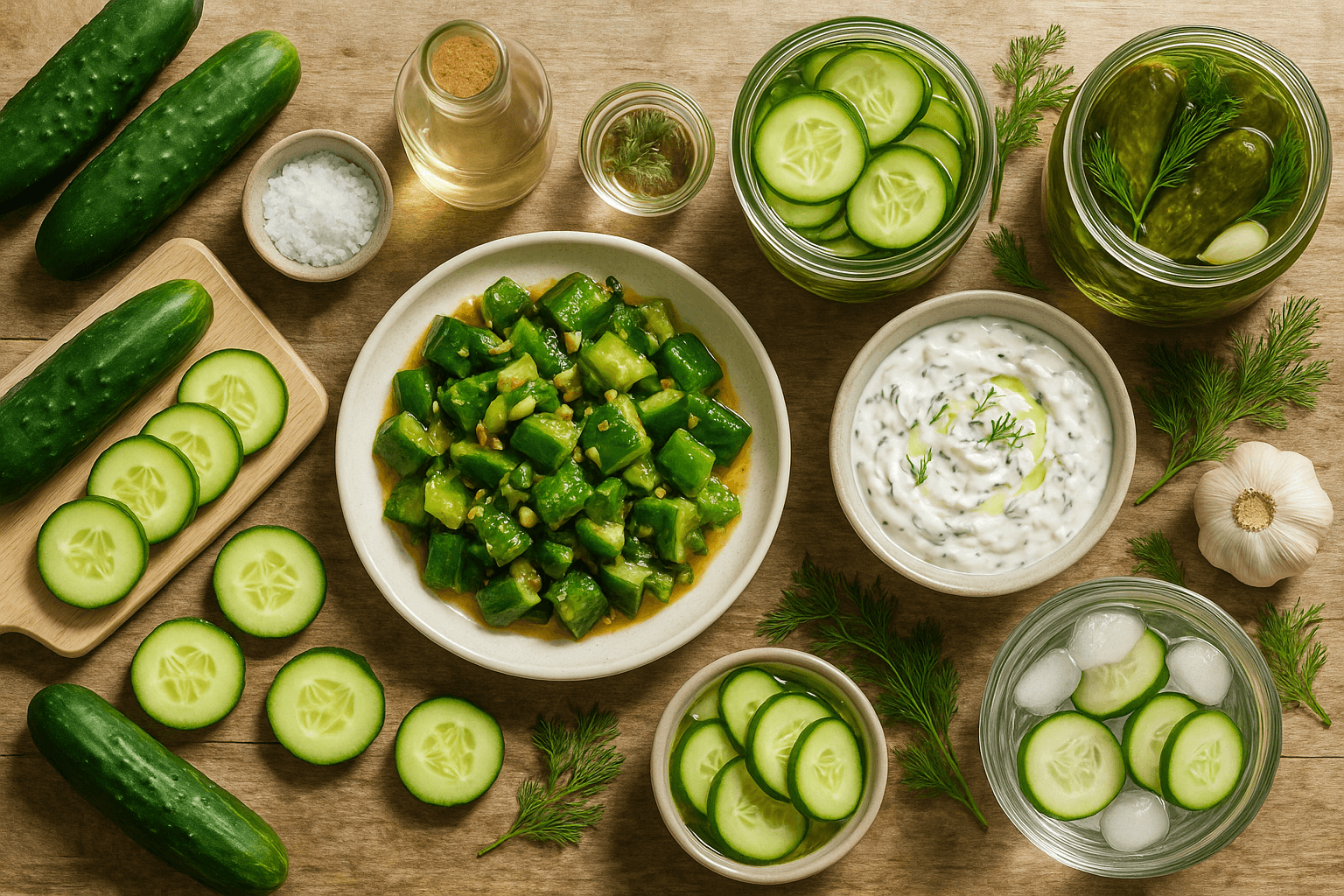
A cucumber can be impossibly crisp one minute, puddling out water the next, and then mysteriously soft after a day in brine. That seems fussy for a vegetable that is, on paper, mostly water. But that is exactly the point: cucumbers are a water-management story. Their texture depends on how that water is held inside cells, how their cell walls are built, what their own enzymes are doing after harvest, and how salt, acid, calcium, and temperature nudge all of those forces in one direction or another.
If you understand a few pieces of kitchen biology—cell turgor, vacuoles, pectin, osmosis, and enzyme activity—you stop treating cucumbers as unpredictable. You can decide when you want explosive crunch, when you want controlled collapse, and when a little pre-salting will improve a dish instead of washing it out. You can make a smashed cucumber salad that stays lively instead of soupy, a tzatziki that tastes concentrated instead of watery, quick pickles that remain snappy for days, and fermented dills that stay crisp instead of going flabby or hollow.
Let’s start with the central fact: most slicing cucumbers are about 95 to 96% water. That sounds like fragility, but fresh crunch comes from water under pressure, not from dryness. Inside cucumber cells, large vacuoles—water-filled compartments—push outward against the cell wall. That internal pressure is called turgor pressure, and it is the mechanical basis of that clean, juicy snap. When turgor is high and the cell wall network is intact, a cucumber feels firm. When water leaves the cells or the wall structure weakens, the texture shifts toward limp, rubbery, or mushy.
Why cucumbers feel crisp in the first place
A cucumber’s flesh is built from countless plant cells, each surrounded by a wall made largely of cellulose, hemicellulose, and pectic substances. The wall is not a rigid shell like glass; it is more like reinforced fabric. Turgor pressure stretches that fabric from within, making the tissue feel taut.
Two things matter here:
- How much pressure remains inside the cells
- How strong the wall and the “glue” between cells remain
The “glue” is largely pectin, a family of polysaccharides concentrated in the middle lamella, the layer that helps neighboring cells stick together. When pectin structure is preserved, cucumber tissue resists slumping. When pectin is degraded or de-cross-linked, the cells separate more easily and the tissue softens.
This is why a cucumber can lose crispness in more than one way. Sometimes it simply loses water and turgor. Other times its cell wall and pectin system get chemically or enzymatically damaged. Often both happen together.
A little history: cucumbers, preservation, and texture obsession
People have been trying to control cucumber texture for a very long time. Cucumbers likely originated in South Asia and spread across the ancient world early. Once they reached regions with strong salting, souring, and fermentation traditions, preserving them naturally became important. But cucumber preservation has always had a built-in challenge: they are delicate, watery, and full of active enzymes. Picklers across Eastern Europe, the Middle East, the Mediterranean, South Asia, and North America developed techniques to manage that problem—cold storage, prompt pickling, soaking in lime or alum in older traditions, using grape or oak leaves, selecting smaller fruit, cutting blossom ends, and eventually using calcium chloride for reliable crispness.
Many of those techniques are based on real structural or microbiological principles. A few are partial truths that became folklore. The trick is sorting the useful science from inherited kitchen habit.
Why cut cucumbers “weep”
When you cut a cucumber, you break cells open directly and expose many more cells to the air. Water can then move out for three main reasons:
- Mechanical damage: slicing, smashing, grating, or seeding ruptures cells
- Osmosis: salt or concentrated dressing pulls water outward
- Gravity and capillarity: liquid migrates along cut surfaces and cell channels
This is why cut shape matters so much.
Thin rounds
Thin slices have a very high surface-area-to-volume ratio. They weep quickly because lots of damaged surface is exposed relative to how much intact interior remains. They also absorb seasoning fast, which is useful in quick salads and refrigerator pickles.
Spears or batons
These expose less surface area than thin rounds, so they lose water more slowly and often stay crisper in salads. They are a good shape when you want fresh bite and less dilution.
Grated cucumber
Grating is basically maximum tissue disruption. It destroys a huge number of cells, releases juice rapidly, and makes salting especially effective for extraction. That is why grated cucumber is ideal for tzatziki, where removing free water is essential.
Smashed cucumbers
Smashing is interesting because it creates irregular fractures rather than neat cut planes. That does two things at once: it increases the release of some liquid, but it also creates rough surfaces and fissures that trap dressing. This gives smashed cucumber salads their characteristic combination of juicy, seasoned, and crunchy. They should not be bone-dry; they should be selectively drained so the dressing clings instead of flooding the bowl.
Halved and seeded boats
When you split a cucumber lengthwise and scoop the center, you remove the most delicate, watery region. That can reduce pooling in composed salads. But seeding is not always a universal improvement, because you are also removing juicy flesh and some flavor. More on that shortly.
The seed myth: do you always need to seed cucumbers?
No. Seeding is useful in some contexts and unnecessary in many.
The seed cavity in mature slicing cucumbers contains softer tissue with more loosely structured gel and more free moisture than the firmer outer flesh. In dishes where excess liquid is a problem—tzatziki, finely chopped salad, cucumber tea sandwiches, or long-marinated salads—removing that center can help.
But if you are using:
- Persian cucumbers
- Kirby cucumbers
- Small garden cucumbers picked young
- English cucumbers with underdeveloped seeds
…then seeding is often needless. Their centers are comparatively tender and less wet than overgrown field cucumbers.
A better rule than “always seed” is this:
- Seed only when the center is obviously soft, watery, or mature
- Leave it in when the cucumber is young, firm, and the dish benefits from juiciness
For smashed salads, I usually do not seed Persian or Kirby cucumbers. For tzatziki, I often seed a large standard cucumber if its core is soft. For quick pickles, small cucumbers are best used whole or halved without seeding.
What pre-salting actually does
Pre-salting, sweating, disgorging—different names, same basic mechanism. Salt on the cut cucumber creates a high-solute environment outside the cells. Water moves out through osmosis, and some dissolved substances move with it. Over time, the cucumber tissue loses part of its free water and some turgor, but it can also become more concentrated in flavor if that released liquid is discarded.
This is why pre-salting is both helpful and risky.
Benefits of pre-salting
- Reduces excess water in the final dish
- Limits dilution of yogurt, dressings, or vinegar brine
- Slightly firms texture in some applications by removing loose surface moisture
- Helps season the cucumber more evenly
Downsides of pre-salting
- Can overdraw water and leave cucumbers limp if done too long
- Can make the final dish too salty if not drained or adjusted
- Can strip away some delicate fresh flavor along with the liquid
- Can reduce the juicy snap that is desirable in a fresh salad
The key question is not “Should I salt cucumbers?” but “Do I want to remove water before seasoning?”
When pre-salting improves texture versus dilutes flavor
Here’s the practical framework.
Pre-salting is usually worth it for:
Tzatziki
Because grated cucumber dumps a tremendous amount of water, pre-salting is almost always useful. If you skip it, that water leaches later and thins the yogurt.
Good rule:
- Grate 1 large cucumber or 2 Persian cucumbers
- Toss with 3/4 teaspoon kosher salt per 12 ounces / 340 g prepared cucumber
- Rest 20 to 30 minutes
- Squeeze firmly in a towel or cheesecloth
This concentrates cucumber flavor instead of diluting it, because the final mixture stays creamy.
Cucumber-onion salads that sit for a while
If the salad will stand more than 15 to 20 minutes, especially with a creamy dressing, a short pre-salt prevents the bowl from turning watery.
Good rule:
- Slice 1 pound / 450 g cucumbers
- Toss with 1 to 1 1/4 teaspoons Diamond Crystal kosher salt or about 1/2 to 3/4 teaspoon Morton kosher salt
- Rest 15 to 20 minutes
- Drain and lightly blot
Smashed cucumber salad
Short salting helps because smashed surfaces release lots of liquid. But the timing should be brief.
Good rule:
- Salt smashed pieces with 3/4 teaspoon kosher salt per pound
- Rest 10 to 15 minutes
- Drain well before adding dressing
Pre-salting is often unnecessary or counterproductive for:
Very fresh cucumber salads served immediately
If you are dressing and serving within minutes, the cucumber’s natural juice is part of the pleasure.
Delicate sandwiches or crudité platters
Salt too early and the slices curl, slump, and lose their clean bite.
Quick pickles where the brine is already correctly balanced
If the pickle is meant to cure in a properly salted, acidic solution, pre-salting may be redundant unless you specifically want to reduce dilution.
The science of softness: endogenous enzymes
Cucumbers contain their own enzymes that keep working after harvest. The most texture-relevant are enzymes that act on cell wall materials, including pectin-modifying enzymes. Once the cucumber is cut, bruised, stored too warm, or held too long, those enzymes can contribute to softening.
Two kitchen consequences matter most:
- Freshness matters enormously. A cucumber pickled the day it is harvested is structurally different from one that has sat warm for days.
- Temperature slows enzyme activity. Cold cucumbers stay crisp longer because low temperatures reduce metabolic and enzymatic breakdown.
This is why great picklers care so much about using small, very fresh cucumbers and refrigerating them promptly before processing or fermenting.
A related old pickling practice—trimming the blossom end—has real science behind it. The blossom end can carry higher levels of pectin-degrading enzymes than the stem end, especially if floral remnants are still attached. Slicing off 1/16 to 1/8 inch / 2 to 3 mm from the blossom end can modestly reduce softening risk in pickles.
Salt, acid, and the structure of cucumber tissue
Salt and acid don’t do the same job.
Salt
Salt draws water outward, changes osmotic balance, seasons tissue, and in fermentation helps select for desirable microbes. At high enough levels, it also inhibits many spoilage organisms.
Acid
Acid changes pH. In quick pickles, vinegar acidifies the environment rapidly, shaping flavor and improving safety. Acid can also influence pectin behavior and enzyme activity. But more acid does not automatically mean more crunch. In fact, a harsh, overly strong vinegar environment can make the surface seem firm while the interior becomes unpleasantly puckered or eventually less fresh-tasting.
The best texture comes from balanced salt, sufficient acid, cold storage, and often calcium, not from simply dumping in extra vinegar.
Vinegar strength in quick pickles: what works
For refrigerator quick pickles, a practical target is using vinegar that is 5% acidity, which is standard for most distilled white vinegar, many cider vinegars, and many wine vinegars sold for pickling. You generally want the final brine to remain adequately acidic.
A dependable quick-pickle brine for cucumber spears or rounds is:
- 1 cup (240 ml) 5% vinegar
- 1 cup (240 ml) water
- 1 to 1 1/2 tablespoons kosher salt
- 1 to 2 tablespoons sugar, optional depending on style
Heat just enough to dissolve the salt and sugar, then cool before pouring over cucumbers if maximum crispness is your goal.
Why cold brine helps
Heat speeds penetration but also softens plant tissues. For snappy refrigerator pickles, a cold or fully cooled brine is usually better than pouring it boiling hot over the cucumbers. Hot brine can be useful for flavor infusion, but it sacrifices some fresh crunch.
Ideal quick-pickle temperature
Store quick pickles at 34 to 40°F / 1 to 4°C. They are best after 12 to 48 hours, depending on thickness. Thin rounds pickle fast but soften faster; spears stay texturally better over several days.
Calcium salts: the most reliable crispness tool
If there is one modern, evidence-based “secret” for crisp pickles, it is calcium. Calcium ions help strengthen pectin networks by forming cross-links in cell wall materials. In plain language, calcium helps the cucumber’s structural glue hold together.
Best option: calcium chloride
Food-grade calcium chloride is widely sold as pickle crisp granules. It is much more reliable and cleaner-tasting than older home methods involving alum or pickling lime.
Typical usage:
- About 1/8 teaspoon per pint jar
- About 1/4 teaspoon per quart jar
Check your product label, because grain size varies.
Calcium chloride works in both quick pickles and fermented pickles. It does not replace good cucumber quality or proper salt levels, but it significantly improves the odds of a crisp result.
What about pickling lime or alum?
These older methods can affect firmness, but they are less convenient and more error-prone. Pickling lime requires thorough rinsing and careful handling because it is strongly alkaline and can interfere with safe acidity if misused. Alum can firm tissues but often contributes harsher texture and is not the first choice for modern home cooks.
If your goal is simple and reliable, use calcium chloride.
Why fermented cucumbers stay crisp—or go soft
Lacto-fermented cucumbers are a different world from quick pickles. Instead of being acidified immediately with vinegar, they are submerged in a salt brine and acidify gradually as lactic acid bacteria consume sugars and produce acid.
This process can create extraordinary texture and flavor, but it has a few failure points.
What keeps fermented cucumbers crisp
- Very fresh, unwaxed pickling cucumbers
- Correct brine concentration
- Cool fermentation temperatures
- Full submersion under brine
- Limited oxygen exposure
- Calcium availability
- Trimming blossom ends
- Not overfermenting
What causes softness
- Old cucumbers with declining cell integrity
- Too little salt
- Fermentation that runs too warm
- Surface mold or oxygen exposure
- Excessive enzymatic activity
- Pectinolytic spoilage microbes
- Fermenting too long after ideal sourness is reached
Practical brine strength for fermented dills
For whole small cucumbers or spears, a dependable range is:
- 3.0 to 5.0% salt by weight of water
For most home ferments, 3.5% is a comfortable middle ground.
To make a 3.5% brine:
- Dissolve 35 g salt in 1 liter water
Or in U.S. kitchen terms:
- Dissolve about 2 tablespoons plus 1 teaspoon Diamond Crystal kosher salt in 1 quart / 946 ml water
Because salt crystal size varies, weight is far more accurate than volume.
Fermentation temperature
The sweet spot for cucumber fermentation is often around 65 to 72°F / 18 to 22°C. Warmer temperatures accelerate fermentation but increase the risk of softness and hollow centers. Cooler temperatures slow the process but generally improve texture.
At 68°F / 20°C, small cucumbers may reach a nicely sour half-sour stage in 3 to 5 days and a fuller sour in 7 to 14 days, depending on size and microbial activity.
Once the flavor is where you want it, move them to refrigeration. Cold storage dramatically slows further acidification and softening.
Why fermented cucumbers go hollow
Hollow pickles are usually the result of growth conditions, maturity, or overly rapid fermentation—not some mysterious curse.
Common causes include:
- Overmature cucumbers with enlarged seed cavities
- Rapid fermentation at high temperatures, causing gas formation faster than tissues can equilibrate
- Irregular growth in the field, often linked to watering stress
- Very large cucumbers, which are simply more prone to internal voids
To reduce hollowness:
- Choose cucumbers 3 to 5 inches / 7.5 to 12.5 cm long for classic dills
- Ferment on the cool side, around 65 to 68°F / 18 to 20°C
- Use cucumbers as fresh as possible
- Avoid oversized fruit
Tannin leaves: myth, truth, and limits
Grape leaves, oak leaves, black tea leaves, horseradish leaves, and similar tannin-rich additions appear in many pickle recipes. The idea is that tannins inhibit pectin-degrading enzymes and help preserve firmness.
There is some truth here. Tannins can interact with proteins and may reduce certain enzymatic effects. But their real-world impact in home pickling is often modest compared with freshness, blossom-end trimming, calcium chloride, salt level, and temperature control.
So: are tannin leaves nonsense? No. Are they the decisive factor in crisp pickles? Also no.
Think of them as optional support, not structural steel.
If you want to use them, one clean grape leaf per quart jar is reasonable. But don’t rely on leaves to rescue old cucumbers or a hot, sloppy fermentation.
Step-by-step: four cucumber applications that benefit from the science
1) Smashed cucumber salad that stays punchy, not watery
Best cucumbers
- 1 pound / 450 g Persian or Kirby cucumbers
Method
- Wash and dry the cucumbers.
- Lightly crush each cucumber with the flat side of a knife or a rolling pin until it splits into craggy pieces.
- Break or cut into 1 1/2-inch / 4-cm chunks.
- Toss with 3/4 teaspoon kosher salt.
- Rest in a colander for 10 to 15 minutes.
- Drain off released liquid; very lightly squeeze or blot if needed.
- Dress with:
- 1 tablespoon rice vinegar or Chinkiang vinegar
- 2 teaspoons light soy sauce
- 1 to 2 teaspoons sesame oil
- 1 teaspoon sugar, optional
- 1 clove garlic, finely grated
- Chili oil to taste
- Serve immediately or within 20 minutes.
Why it works
The short salt rest removes enough free water to keep the dressing from becoming weak. The smashed surfaces hold seasoning better than clean slices, and because the cucumbers are not oversalted or left too long, they retain a lively crunch.
Common mistake
Salting for 30 to 60 minutes as if you were treating eggplant. That often leaves the cucumbers too floppy.
2) Tzatziki with real cucumber flavor, not green yogurt soup
Best cucumbers
- 12 ounces / 340 g cucumber, preferably Persian, English, or a seeded standard cucumber
Method
- If using a mature standard cucumber, halve lengthwise and scrape out the watery seed core.
- Grate on the large holes of a box grater.
- Toss with 3/4 teaspoon kosher salt.
- Rest 20 to 30 minutes.
- Wrap in a towel or cheesecloth and squeeze out as much liquid as possible.
- Mix with:
- 1 cup / 240 g thick Greek yogurt
- 1 tablespoon extra-virgin olive oil
- 1 tablespoon lemon juice
- 1 small garlic clove, very finely grated
- 1 to 2 tablespoons chopped dill or mint
- Chill 15 to 30 minutes before serving.
Why it works
The salting and squeezing remove free water released by grated tissue. The yogurt stays thick, the flavor stays concentrated, and the cucumber pieces remain integrated instead of weeping later.
Common mistake
Skipping the squeeze because the cucumber “already drained.” Resting alone is not enough after grating.
3) Refrigerator quick pickles with better crunch
Best cucumbers
- 1 pound / 450 g Kirby cucumbers, cut into spears or thick rounds
Brine
- 1 cup / 240 ml 5% distilled white vinegar
- 1 cup / 240 ml water
- 1 tablespoon plus 1 teaspoon kosher salt
- 1 tablespoon sugar, optional
- 1/4 teaspoon calcium chloride per quart jar
- Garlic, dill, mustard seed, peppercorns as desired
Method
- Trim 1/16 to 1/8 inch / 2 to 3 mm from the blossom ends.
- Pack cucumbers into a clean quart jar with dill and garlic.
- Add 1/4 teaspoon calcium chloride.
- Combine vinegar, water, salt, and sugar. Warm only until dissolved, then cool completely.
- Pour over cucumbers until submerged.
- Refrigerate at least 12 hours for thin slices or 24 to 48 hours for spears.
Why it works
Cooling the brine preserves fresh texture. Calcium supports pectin structure. Small pickling cucumbers and blossom-end trimming lower the odds of softness.
Common mistake
Pouring boiling brine over cucumbers and expecting deli-style snap. Heat softens them quickly.
4) Lacto-fermented dill pickles that stay crisp
Best cucumbers
- 2 pounds / 900 g very fresh Kirby cucumbers
Brine
- 1 liter water
- 35 g non-iodized salt for a 3.5% brine
Jar additions
- 2 to 4 garlic cloves
- 2 to 3 dill sprigs or 2 dill heads
- 1 teaspoon mustard seed, optional
- 1 grape leaf, optional
- 1/4 teaspoon calcium chloride per quart jar, optional but recommended
Method
- Wash cucumbers gently; do not scrub aggressively.
- Trim a thin slice from the blossom ends.
- Pack into a fermentation jar tightly enough to reduce floating.
- Add garlic, dill, and optional spices.
- Add calcium chloride if using.
- Pour over the brine, making sure cucumbers are fully submerged.
- Use a weight to keep all solids below the brine.
- Ferment at 65 to 72°F / 18 to 22°C, ideally closer to 68°F / 20°C.
- Begin tasting on day 3 or 4.
- Once the pickles reach the sourness you like—often 5 to 10 days for small cucumbers—refrigerate.
Why it works
The salt level favors lactic acid bacteria. Submersion limits oxygen-loving spoilage organisms. Cool temperature protects texture. Calcium and fresh cucumbers strengthen your odds of staying crisp.
Common mistakes
- Using cucumbers that are already bendy or old
- Fermenting near a hot stove at 75 to 80°F / 24 to 27°C
- Letting floating pieces sit above the brine
- Waiting too long to refrigerate after peak flavor
Should you soak cucumbers in ice water?
Sometimes, yes—but know what it can and cannot do.
An ice-water soak for 20 to 60 minutes can temporarily improve firmness in slightly tired fresh cucumbers by restoring some water to tissues and increasing turgor. It is useful for salad cucumbers that have lost a bit of snap in the refrigerator.
But it cannot rebuild degraded pectin or reverse enzymatic softening. It revives wilting; it does not resurrect structural collapse.
Use it for fresh salads, not as a cure for poor pickling stock.
Storage rules before you do anything else
Texture control starts before the knife.
- Store cucumbers cold but not freezing, ideally around 45 to 50°F / 7 to 10°C if you have that option.
- In a very cold household refrigerator, keep them in a warmer drawer if possible.
- Use pickling cucumbers within 1 to 2 days for best results.
- Avoid bruising; damaged areas leak and soften quickly.
- Keep them dry until use.
Interesting wrinkle: cucumbers are sensitive to chilling injury if held too cold for too long, especially below about 50°F / 10°C in commercial storage terms. In home refrigerators, though, short storage is usually fine. The practical takeaway is not to freeze them in the back of the fridge and not to leave them warm on the counter for days.
Common cucumber texture mistakes, decoded
“My salad got watery.”
Likely causes:
- Used very thin slices
- Salted too early and didn’t drain
- Used mature cucumbers with wet seed cores
- Let the salad sit too long before serving
Fix:
- Choose thicker cuts or spears
- Short pre-salt and drain if the dish rests
- Seed only obviously watery cucumbers
- Dress close to serving time
“My tzatziki separated overnight.”
Likely causes:
- Cucumber not squeezed enough
- Yogurt too thin
- Salted only after mixing
Fix:
- Salt grated cucumber first
- Squeeze thoroughly
- Use thick Greek yogurt or strain yogurt separately
“My quick pickles taste good but feel floppy.”
Likely causes:
- Brine poured hot
- Cucumbers too old or too large
- No calcium support
- Stored too long
Fix:
- Use cooled brine
- Use small Kirby cucumbers
- Add calcium chloride
- Eat within several days for peak snap
“My fermented pickles are soft.”
Likely causes:
- Fermented too warm
- Brine too weak
- Oxygen exposure
- Old cucumbers
- Blossom ends not trimmed
Fix:
- Aim for 3.5% brine
- Keep near 68°F / 20°C
- Weight below brine
- Start with fresher cucumbers
- Add calcium chloride
“My fermented pickles are hollow.”
Likely causes:
- Cucumbers too mature or too large
- Fermentation too warm and rapid
Fix:
- Use smaller fruit
- Ferment cooler
- Avoid oversized specimens
Myth-busting, one by one
Myth: You must always seed cucumbers.
False. Seed only mature, watery cucumbers when free liquid is a problem.
Myth: Salting always makes cucumbers crisper.
Partly false. Short salting can improve some dishes by reducing dilution, but too much salting reduces turgor and can make them limp.
Myth: More vinegar means firmer quick pickles.
False. Enough acidity matters, but excessive vinegar does not guarantee crunch. Freshness, cut size, cold brine, and calcium matter more.
Myth: Tannin leaves are the secret to crisp pickles.
Overstated. They may help a bit, but they are secondary to fresh cucumbers, proper salt, cool temperatures, blossom-end trimming, and calcium chloride.
Myth: Soft pickles are always a salt problem.
False. They can also result from enzyme activity, warmth, old cucumbers, oxygen exposure, or pectin breakdown.
Myth: Ice water can fix any cucumber.
False. It restores some turgor in slightly wilted cucumbers, but it cannot repair degraded cell walls.
The big rules to remember
If you remember only a handful of things, make them these:
- Crunch comes from turgor plus intact cell walls. Water under pressure makes cucumbers snappy, but only if pectin structure is still holding cells together.
- Cut shape changes water loss. Thin slices and grated cucumber weep fast; spears hold better; smashed cucumbers need draining but reward you with better dressing adhesion.
- Pre-salting is situational, not universal. Use it when free water will ruin the dish—tzatziki, resting salads, smashed cucumbers. Skip or minimize it for immediate fresh salads.
- Freshness beats hacks. The age and condition of the cucumber are more important than most folk remedies.
- Cold preserves texture. Lower temperatures slow enzyme activity and softening in both fresh prep and pickling.
- For quick pickles, use 5% vinegar, a balanced brine, and cooled liquid. Don’t cook the crunch away.
- For fermented pickles, control salt and temperature. A 3.5% brine and a cool room are your friends.
- Calcium chloride is the most reliable crispness aid. Better than nostalgia, better than guesswork.
- Trim blossom ends for pickles. It is a small step with real science behind it.
- Tannin leaves are optional, not magic. Helpful at most, but not foundational.
Once you see cucumbers as little pressurized structures with fragile walls and active enzymes, their behavior stops feeling random. A watery salad, a silky bowl of tzatziki, a bright quick pickle, and a barrel-style fermented dill are not versions of the same thing. They are different textural goals, each asking you to control water movement, cell-wall stability, and microbial or enzymatic activity in a specific way.
That is the satisfying part. You do not need superstition. You need a plan: choose the right cucumber, cut it with purpose, salt only when it serves the dish, keep things cool, add calcium when pickling, and respect time. Do that, and cucumbers will give you exactly what you want—fresh snap, seasoned tenderness, or deep pickle crunch—on purpose.