Why Green Plantains Fry Crisp, Boil Waxy, or Mash Stretchy: Resistant Starch, Pectin Tightness, and the Soak‑Fry Rules Behind Tostones, Mofongo, and Mangú
RecipeSimpli
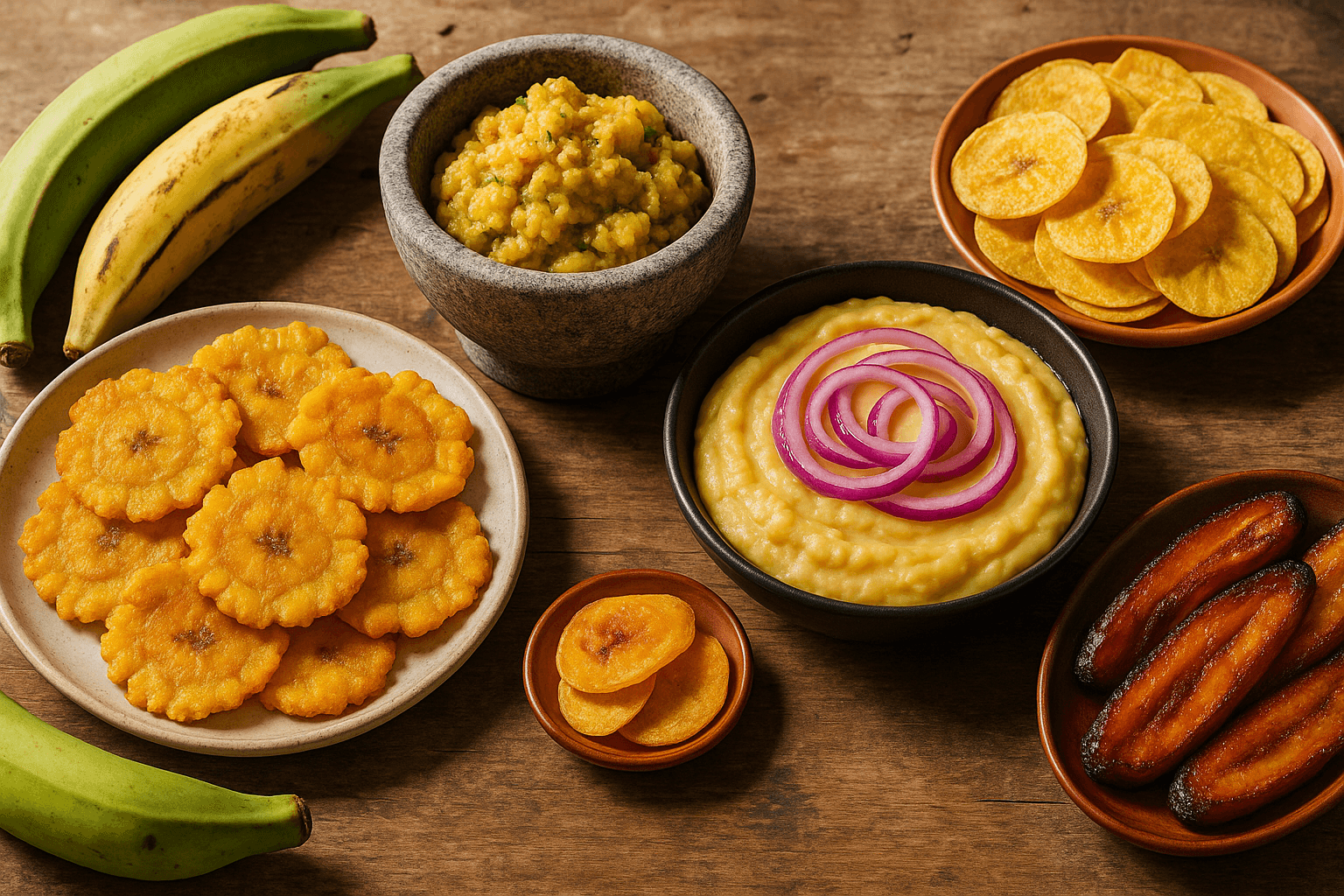
Plantains are one of those ingredients that seem simple until you cook them side by side at different stages of ripeness. A hard green plantain can fry into a shatteringly crisp tostone, simmer into a dense waxy chunk, or pound into a stretchy, garlicky mofongo that clings to the pestle. Let that same fruit ripen toward yellow and black, and suddenly it caramelizes, softens, and collapses into something almost custardy. The change can feel dramatic enough to seem like magic. It is not magic. It is starch chemistry, cell-wall structure, water movement, sugar development, and technique.
If you understand just a few key ideas—how resistant starch behaves, why plantain pectin stays tight longer than dessert banana pectin, what oil temperature really does, and when soaking helps or hurts—you can predict texture instead of hoping for it. That matters because the best plantain dishes are texture-driven. Tostones should be crisp outside and tender within, not leathery. Mofongo should hold together while staying moist, not crumble like dry stuffing. Mangú should be silky and spoonable, not gluey or gummy. Maduros should be creamy and caramelized, not burnt outside and raw in the middle.
Plantains also carry deep cultural meaning across the Caribbean and Latin America. In Puerto Rico, tostones and mofongo are staples with countless local variations. In the Dominican Republic, mangú is foundational, especially at breakfast, often served with sautéed red onions and alongside eggs, salami, or fried cheese in the beloved tres golpes combination. Cuban, Colombian, Venezuelan, Central American, and West African cooking all have rich plantain traditions too, each with its own preferred stage of ripeness and cooking method. Technique is not separate from culture here; these dishes evolved because cooks learned exactly how plantains behave.
This is a science-first guide, but science in the kitchen is only useful if it makes dinner better. So let’s get practical: why green plantains stay firm, why yellow ones sweeten, why boiling and frying create such different textures, how soaking affects surface starch and browning, and what rules to follow at home for better chips, tostones, mofongo, mangú, and maduros.
Plantains are not just “big bananas”
Plantains and dessert bananas belong to the same broader botanical family, but in the kitchen they behave very differently. Dessert bananas are bred to be pleasantly sweet and soft when ripe enough to eat out of hand. Plantains are starchier, denser, and structurally tougher, especially when green. Their peel is thicker. Their flesh is firmer. Their texture changes more dramatically with cooking.
That toughness matters. A green Cavendish banana is unpleasantly chalky, but it softens relatively quickly as it ripens. A green plantain, by contrast, can feel almost woody. It resists biting, slicing, and mashing because it contains more starch packed into sturdier cells and because its cell-wall materials break down more slowly. That is one reason plantains are a cooking fruit rather than a casual snack fruit.
There is also a spectrum within plantains. A fully green plantain is not the same ingredient as a green-yellow one, and neither behaves like a heavily spotted black plantain. Home cooks often get into trouble by treating “plantain” as a single category. In reality, ripeness is the first recipe decision.
A useful kitchen scale looks like this:
- Deep green: very starchy, savory, firm, low sweetness; best for tostones, chips, mofongo, mangú.
- Green with some yellow: still mostly starchy, slightly less rigid; good for tostones, boiling, some mixed applications.
- Yellow with little or no black: starch is converting to sugar; flesh softens; suitable for frying when you want a less sweet but more tender result.
- Yellow with black spots: significantly sweeter and softer; ideal for maduros and caramelized preparations.
- Mostly black: very sweet, very soft, highly prone to rapid browning; excellent for very soft maduros, baking, or mashing into sweet applications.
If you remember nothing else, remember this: green plantains are structure first, sugar last. Black plantains are sugar first, structure last.
Why ripeness changes everything: starch to sugar
The biggest internal change during ripening is the conversion of starch into smaller carbohydrates, including sugars. Green plantains are loaded with starch granules, many of which are not very accessible to digestion when raw. As the fruit ripens, enzymes begin breaking these starches down. The flesh tastes sweeter, but the change is not just about flavor. Texture changes because the solid internal scaffolding is being dismantled.
In a green plantain, starch dominates. Cook it and those starch granules absorb water and gelatinize, but because the plantain also has relatively sturdy cell walls, the cooked result can stay dense and waxy rather than fluffy. As ripening proceeds, some starch is lost to sugars, so there is less granular bulk and more dissolved sweetness. The fruit softens and becomes more prone to collapsing under heat.
This is also where people start talking about resistant starch, often with a halo of health claims. Resistant starch is starch that escapes digestion in the small intestine and can be fermented later in the large intestine. Green plantains do contain a notable amount of it. But two clarifications matter.
First, “contains resistant starch” does not mean “automatically healthy in any amount or in any preparation.” If you deep-fry green plantains and salt them heavily, the final food is still a fried food. It can absolutely be part of a balanced diet, but resistant starch does not cancel calories, sodium, or portion size.
Second, cooking changes starch digestibility. Some resistant starch decreases when starch granules gelatinize during cooking. Cooling can allow some starch retrogradation, creating a different type of resistant starch again. So the nutrition story is dynamic, not fixed. A hot bowl of mangú, a twice-fried tostone, and a cooled boiled plantain salad do not present starch to your body in exactly the same way.
The practical takeaway: green plantains are starchier and generally less sweet; ripe plantains are sweeter and softer. That is the core ripeness rule. The health story is real but often oversimplified.
Why plantains stay firm longer: pectin, hemicellulose, and cell-wall tightness
Now for the structural reason plantains remain firm even after heat. Fruit texture depends not only on starch but also on the architecture surrounding it. Plant cells are enclosed by cell walls made of cellulose, hemicellulose, and pectic substances. You do not need a food chemistry textbook to cook well, but you do need one useful idea: pectin is part of the glue that helps plant cells hold together.
In green plantains, that glue is comparatively tight. Heat softens tissues, but if the pectin network and associated cell-wall structure remain relatively intact, the cells do not separate easily. That is why boiled green plantains can feel waxy, dense, and cohesive rather than fluffy like a potato. It is also why mashed green plantains can become stretchy and elastic instead of loose. You are dealing with cooked starch embedded in a still fairly tenacious structure.
As plantains ripen, enzymes naturally weaken that structure. Pectic substances are modified, cell adhesion loosens, and the flesh softens. That is why ripe plantains collapse more readily when sautéed or fried.
Acid, salt, and mineral content can influence pectin behavior in cooking too. While we usually discuss pectin firmness with beans or fruit preserves, the same broad principle applies here: conditions that maintain cell-wall integrity promote firmer texture, while conditions that speed breakdown promote tenderness. That is one reason adding acidic ingredients too early can sometimes preserve firmness in starchy plant tissues. It is also why a very green plantain can stubbornly remain intact after boiling long enough to be cooked through.
Frying versus boiling: the same plantain, different physics
Why does one green plantain turn crisp when fried but waxy when boiled? Because frying and boiling move heat and water in opposite ways.
Boiling
When you boil plantains, you expose them to water at about 100°C / 212°F. Heat penetrates gradually. Starch gelatinizes as the internal temperature rises, and the plantain absorbs some water. But because the cell-wall structure remains fairly cohesive, especially in greener fruit, the cooked pieces often become firm-tender, dense, and waxy rather than fluffy.
This is desirable in some dishes. For mangú, you want boiled plantains soft enough to mash, but not waterlogged. For some soups or side dishes, that waxy integrity is an asset. The challenge is that overboiling does not necessarily make green plantains fluffy; it can simply make them wet on the outside while still dense in character.
Frying
Frying is a dehydration-and-crust-formation process disguised as cooking in oil. The oil itself does not soak in first; what happens first is rapid surface heating. Water near the plantain’s surface turns to steam and escapes. As moisture leaves, the surface dries enough to crisp and brown.
That is why frying can produce textures boiling never will. A green plantain slice with plenty of starch and little sugar can become glassy-crisp outside while staying tender inside. The low sugar content means it browns more slowly than a ripe plantain, giving you time to drive off moisture and build crunch without scorching.
A ripe plantain behaves differently in oil. Its higher sugar content encourages faster browning and caramelization. Its weaker internal structure softens quickly. Instead of crisping like a chip, it often turns creamy and caramelized. Delicious, but different.
In short:
- Boiling hydrates and gelatinizes starch, preserving a denser interior.
- Frying dehydrates the surface, creating crispness while softening the center.
- Ripeness determines whether frying gives you a savory crisp result or a sweet creamy one.
The soak question: when soaking helps, and when it does not
Ask ten cooks about soaking plantains and you may get ten answers. Some swear by soaking slices in salted water before frying. Others avoid it. Both camps can be right, depending on the dish.
Soaking affects three main things: surface starch, seasoning, and moisture.
For tostones
Traditional tostones are usually fried once, smashed, then fried again. A brief soak after smashing—often in salted water, garlic water, or lightly seasoned water—is common in many kitchens. This serves several purposes:
- It seasons the plantain more evenly.
- It rehydrates the rough smashed surface slightly.
- It can promote steam generation on the second fry, which helps puff and crisp the surface.
But there is a limit. If you soak too long, you waterlog the plantain. Then the second fry takes longer, risks excess oil absorption, and may produce a tougher crust before the interior reheats properly.
Good rule: after the first fry and smash, soak or dip for 10 to 30 seconds in room-temperature salted water if you like that style, then drain well before the second fry. Think quick dip, not marination.
For chips
Thin green plantain chips are a different story. Here, excess surface starch can cause sticking and uneven browning, but excess moisture is your enemy because crispness depends on rapid drying.
A short rinse or soak of 5 to 10 minutes in cool water can help remove some surface starch after slicing. But then the slices must be dried extremely well—really well—before frying. Any lingering surface water can make the oil sputter and delay crisping.
For maduros
Do not soak ripe plantains for maduros. Their sweetness and soft texture are already moving toward collapse. Added water interferes with browning and can make them break apart.
For mofongo and mangú
Soaking is generally not the key variable. Ripeness, cooking time, and how you mash matter much more.
The practical truth is that soaking is a texture tool, not a universal rule. Use it strategically, not automatically.
Oil temperature: the difference between crisp and greasy
If there is one variable home cooks underestimate, it is oil temperature. Green plantains are forgiving in some ways, but poor temperature control will make them heavy or leathery.
For first-fry tostones
Fry green plantain rounds, about 1 inch / 2.5 cm thick, at 300 to 325°F / 150 to 163°C for 4 to 6 minutes, depending on thickness. This first fry is not about browning. It is about cooking the interior until the pieces are just tender enough to smash.
If the oil is too hot, the exterior colors before the center softens. When smashed, the rounds crack badly and fry unevenly. If the oil is too cool, the pieces absorb more oil before enough steam pressure develops.
For second-fry tostones
After smashing to about 1/4 to 1/2 inch / 6 to 12 mm thick, fry at 350 to 375°F / 175 to 190°C for 2 to 4 minutes, flipping once, until golden and crisp.
This hotter second fry drives off surface moisture quickly. That is where the classic tostone crunch comes from.
For plantain chips
Thin slices, around 1/16 inch / 1.5 mm, fry best at 325 to 350°F / 163 to 177°C. Too cool and they turn oily; too hot and they brown before fully drying.
For maduros
Ripe slices or diagonal cuts do best at 325 to 350°F / 163 to 177°C. Going much hotter risks burnt sugars before the interior turns creamy.
A thermometer helps. If you do not have one, watch the bubbles. A proper fry gives active but controlled bubbling. Violent sputtering usually means wet surfaces or overheated oil. Barely any bubbling suggests oil that is too cool.
Why mofongo gets stretchy and mangú gets gummy
These two dishes are cousins in ingredient but not in texture target.
Mofongo
Mofongo is typically made from green plantains fried until tender, then pounded with garlic, salt, and pork cracklings or broth, often in a wooden pilón. The goal is cohesive but nubbly—moist enough to hold shape, textured enough to feel substantial.
Why does it get stretchy? Because green plantains are packed with gelatinized starch held in a still-firm matrix. When pounded, those starches smear and bind. A little elasticity is normal and desirable. Too much means one or more of these happened:
- The plantains were underfried and too dense inside.
- They were overworked into a paste.
- There was not enough fat or broth to lubricate the mash.
- They cooled too much before pounding.
The fix is not to add huge amounts of liquid all at once. That can make mofongo heavy. Instead add warm broth or garlic oil 1 tablespoon at a time while pounding just until the mixture comes together.
Mangú
Mangú is made from boiled green plantains mashed with some of their cooking liquid, butter or oil in some households, and often topped with pickled or sautéed red onions. The desired texture is smoother and looser than mofongo.
Mangú gets gummy when the cooked starch is overworked, especially if mashed aggressively after the plantains cool down. Think of potatoes: overmixing can turn them gluey. Plantains have their own version of that problem.
To keep mangú silky:
- Mash while the plantains are hot.
- Use enough hot cooking liquid to loosen the starch.
- Mash by hand, not with a high-speed blender or food processor.
- Stop when smooth enough; do not whip endlessly.
A ratio that works well is 4 green plantains to 1/2 to 3/4 cup / 120 to 180 ml hot cooking liquid, adjusted as needed, plus 1 to 2 tablespoons butter or oil if desired.
Step-by-step texture guide for major plantain dishes
Tostones: crisp outside, tender center
Best plantain stage
Fully green or mostly green.
Ingredients
- 2 green plantains
- Neutral oil for frying
- 2 cups / 475 ml water
- 1 1/2 teaspoons kosher salt
- Optional: 1 clove garlic, lightly crushed
Method
- Cut off the ends of the plantains. Score the peel lengthwise through the skin but not deeply into the flesh. Pry off the peel.
- Slice into 1-inch / 2.5 cm rounds.
- Heat oil to 315°F / 157°C.
- Fry the rounds for 4 to 5 minutes until pale blond and just tender when pressed. Do not let them brown deeply.
- Remove and drain briefly.
- Smash each round between parchment, a tostonera, or the bottom of a mug to about 3/8 inch / 1 cm thick.
- Stir salt and optional garlic into the water. Dip each smashed piece for 10 to 20 seconds. Drain well and pat lightly.
- Raise oil to 365°F / 185°C.
- Fry the smashed rounds for 2 to 3 minutes, flipping once, until crisp and golden.
- Salt immediately.
Common mistakes
- Browning too much on first fry.
- Smashing before the center has softened.
- Leaving the soaked rounds wet on the surface.
- Crowding the pan and crashing the oil temperature.
Mofongo: savory, garlicky, cohesive
Best plantain stage
Green to green-yellow.
Ingredients
- 3 green plantains
- Neutral oil for frying
- 3 to 4 cloves garlic
- 1 teaspoon kosher salt, plus more to taste
- 1/2 cup / 120 ml warm stock, more as needed
- 1/2 cup crushed chicharrón or pork cracklings, optional
- 2 to 3 tablespoons olive oil or garlic oil
Method
- Peel and cut plantains into 1-inch / 2.5 cm chunks.
- Fry at 325°F / 163°C for 6 to 8 minutes until cooked through and lightly golden.
- In a pilón or sturdy bowl, mash garlic with salt.
- Add cracklings if using and crush lightly.
- Add hot fried plantains in batches, pounding and turning rather than pureeing.
- Add oil and enough warm stock, 1 tablespoon at a time, to moisten and help the mass hold together.
- Shape and serve immediately.
Texture rule
If it seems dry and crumbly, add a little liquid. If it seems pasty and elastic, stop pounding.
Mangú: soft, spoonable, silky
Best plantain stage
Green to green-yellow.
Ingredients
- 4 green plantains
- Water to cover
- 1 1/2 teaspoons kosher salt
- 1/2 to 3/4 cup / 120 to 180 ml hot cooking liquid
- 1 to 2 tablespoons butter or neutral oil, optional
For the onions:
- 1 red onion, thinly sliced
- 2 tablespoons oil
- 2 tablespoons vinegar
- Pinch of salt
Method
- Peel plantains and cut into chunks.
- Cover with water, add salt, and simmer for 20 to 25 minutes until very tender.
- Meanwhile, cook onion in oil over medium heat for 4 to 5 minutes until softened; add vinegar and salt.
- Drain plantains, reserving cooking liquid.
- Mash hot plantains with 1/2 cup / 120 ml hot liquid and optional butter or oil. Add more liquid as needed until silky.
- Top with onions.
Common mistakes
- Undercooking, leading to lumpy dense mash.
- Using cold liquid, which tightens the mash.
- Overmixing, which turns it gluey.
Chips: thin, brittle, salty
Best plantain stage
Fully green.
Method notes
Slice very thinly, preferably with a mandoline, to 1/16 inch / 1.5 mm. Rinse briefly or soak 5 minutes if desired, then dry thoroughly. Fry at 340°F / 171°C in small batches for 2 to 3 minutes until bubbles subside and chips are pale golden. Salt immediately.
Maduros: caramelized edges, creamy interior
Best plantain stage
Yellow with black spots to mostly black.
Method notes
Cut on a bias into 1/2-inch / 1.25 cm slices. Fry at 335°F / 168°C for 2 to 4 minutes per side until deep golden brown and very tender. Drain and serve hot. If the exterior darkens before the center softens, your oil is too hot.
The science of crispness, chew, density, and silkiness
Let’s connect the dots in a more compact way.
Crisp
You get crispness when the surface loses enough water and sets into a brittle structure. Green plantains are especially good for this because they start low in sugar and high in starch, so they can dry and harden before overbrowning. Double-frying improves this by separating interior cooking from final dehydration.
Dense or waxy
Boiled green plantains stay dense because starch gelatinizes within intact cells and a relatively persistent pectin network. They soften, but they do not fluff apart. This is not failure. It is their nature.
Chewy or stretchy
When cooked green plantain starch is compressed or pounded, starch smearing and cell rupture create a cohesive matrix. That is useful in mofongo, but if pushed too far it becomes rubbery.
Silky
Silkiness in mangú comes from balancing fully cooked plantain with enough hot liquid and moderate mashing. You are dispersing starch gently rather than compacting it.
Cultural context: texture as tradition, not accident
Plantain techniques across the Caribbean and Latin America are deeply practical and deeply cultural. Communities built dishes around what the fruit offered at different ripeness stages.
In Puerto Rico, tostones and mofongo reflect a preference for savory green plantain textures: crisp, garlicky, substantial. Mofongo likely reflects layers of Indigenous, African, and Spanish influence, with pounding techniques that resonate strongly with African diasporic foodways. In the Dominican Republic, mangú has become an emblematic comfort food and breakfast anchor, where boiled green plantains are transformed not into crispness but into softness and nourishment. Cuban cooking embraces both tostones and maduros, celebrating the entire ripeness arc. Colombian patacones, often flatter and larger, show another route to crisp green plantain pleasure.
These dishes are not random uses for the same ingredient. They are precise responses to the ingredient’s chemistry. Green plantains invite frying, smashing, boiling, and pounding because they remain structured. Ripe plantains invite caramelization because they sweeten and soften. Tradition noticed what science can now explain.
Debunking common nutrition myths
Myth 1: Green plantains are “healthy starch,” so preparation does not matter
Preparation always matters. Boiled, baked, air-fried, shallow-fried, and deep-fried plantains are not nutritionally identical. Resistant starch is interesting, but it is not a nutritional force field.
Myth 2: Ripe plantains are “bad” because they are sugary
Ripe plantains contain more sugar than green ones, yes, but context matters. They also provide potassium, fiber, and satisfaction. A few maduros alongside beans and protein are not nutritionally equivalent to candy.
Myth 3: Green plantains have no sugar, so they will not brown
Even green plantains can brown eventually through Maillard reactions and the small amount of available sugars present. But they brown more slowly than ripe ones, which is exactly why they crisp well.
Myth 4: Soaking always reduces oil absorption
Not automatically. A controlled brief soak can help certain textures, especially in double-fried tostones, but excess surface moisture can prolong frying and sometimes increase greasiness if technique is poor.
Practical rules to remember
If you want the shortest possible cheat sheet, use this one:
- Choose ripeness before choosing recipe. Green for tostones, chips, mofongo, mangú. Ripe for maduros.
- Boiling makes green plantains soft but waxy, not fluffy. Plan for that texture.
- Double-fry tostones. First fry cooks; second fry crisps.
- Use a quick soak only when it serves texture or seasoning. Dip smashed tostones briefly, not for minutes.
- Dry slices thoroughly for chips. Moisture delays crisping.
- Control oil temperature. Around 300 to 325°F / 150 to 163°C for the first fry, 350 to 375°F / 175 to 190°C for the second.
- Mash hot. For both mofongo and mangú, heat gives you the best control.
- Add liquid gradually. Especially with mofongo, where too much turns substantial into heavy.
- Do not overwork the starch. That is how silky becomes gummy and cohesive becomes rubbery.
- Respect plantains as multiple ingredients, not one. Green, yellow, and black plantains are different tools.
Plantains reward cooks who pay attention. They are not difficult, but they are exacting in the best way: they reveal every choice you make. Slice thick or thin, boil or fry, mash gently or pound hard, cook green or cook ripe—the result changes because the fruit changes. Once you understand resistant starch as structure, pectin as firmness, and frying as controlled dehydration, the kitchen stops feeling mysterious. You stop wondering why one batch turned leathery while another turned crisp. You start making the texture you intended.
And that, really, is why plantains are so satisfying to cook. They are humble, affordable, and deeply rooted in the cuisines of entire regions, yet they offer a master class in food science every time they hit the pot or pan. Learn their ripeness. Learn their starch. Learn the soak-fry rules. Then make your tostones louder, your mofongo moister, your mangú silkier, and your maduros sweeter than ever.