Why Honey Turns Floral, Bitter, or Runny: Sugar Crystallization, Enzyme Activity, and the Heat Rules for Better Baking, Ferments, and Glazes
RecipeSimpli
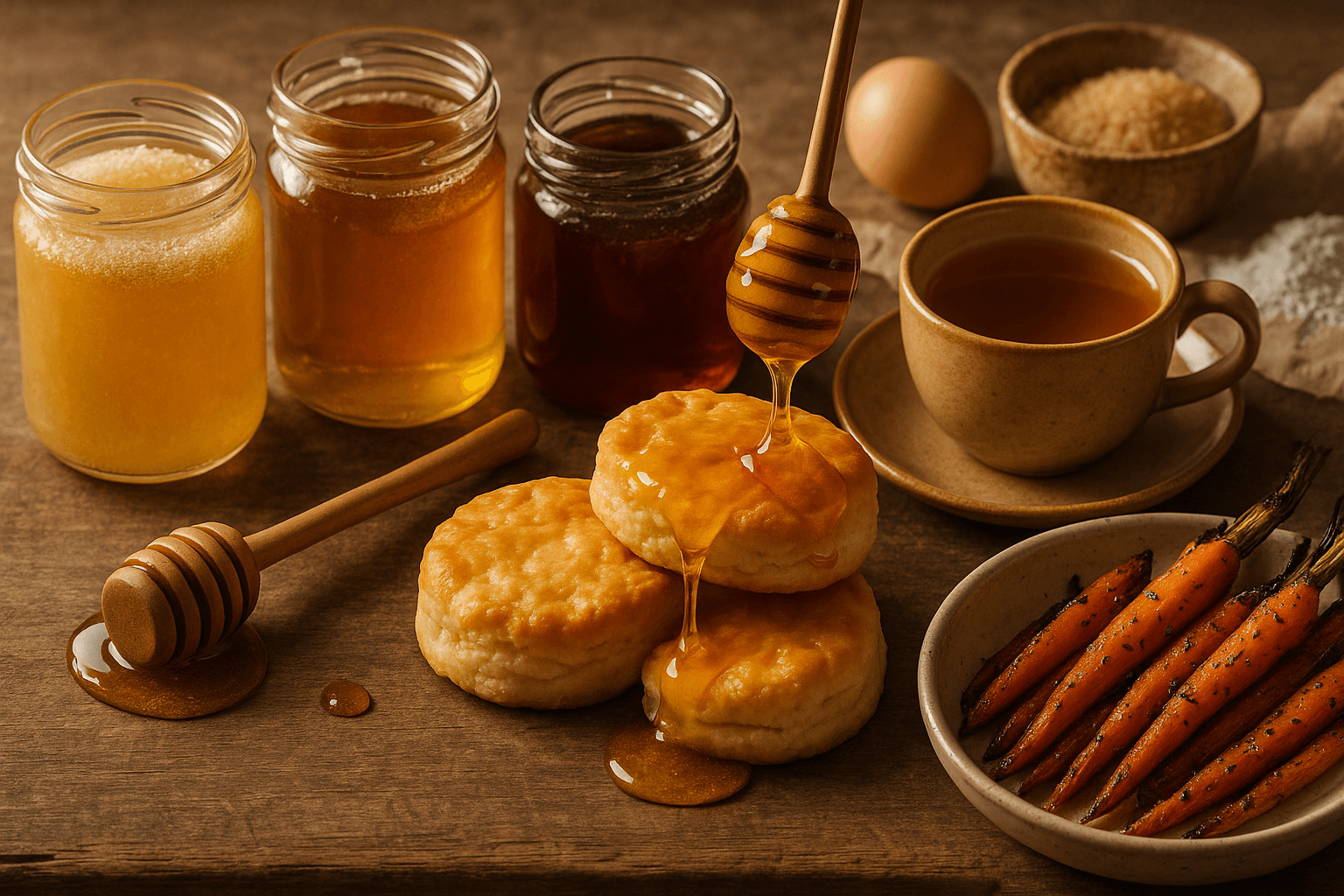
If you keep more than one jar of honey in your kitchen, you already know honey is not one ingredient. One jar pours like warm amber syrup for months. Another turns opaque and spoonable within weeks. One smells like orange blossoms and chamomile; another tastes dark, mineral, and almost bitter, like toasted malt and herbs. Stir one into tea and it disappears into generic sweetness. Brush another onto roast carrots or a chicken glaze and suddenly it blooms, caramelizes, and perfumes the whole dish.
That range is exactly what makes honey worth understanding. In cooking, honey is not just “liquid sugar.” It is a supersaturated sugar solution, an aromatic agricultural product, a mild acid, a source of enzymes, a humectant that holds onto moisture, and a useful fuel for browning and fermentation. Those roles can help you make better cakes, shinier glazes, more fragrant drinks, and more controlled ferments—but only if you know what heat, water, acidity, and time are doing to it.
The practical questions home cooks ask are usually simple: Why did my honey crystallize? Is crystallized honey spoiled? Why does one honey taste floral and another sharp or bitter? Does heating ruin it? Can I swap honey for sugar in baking? Is raw honey really better? And if honey is “antimicrobial,” why does it still ferment or sometimes seem to go funky?
The short answer is that honey’s behavior comes from three intertwined things: its sugar composition, its plant source, and its treatment after harvest. The balance of fructose and glucose largely determines whether it stays runny or crystallizes. The nectar source determines much of its aroma, color, bitterness, and intensity. Heat and storage determine how much of its delicate volatile aroma and enzyme activity survive into your food.
Once you understand those levers, honey gets easier to use deliberately instead of romantically. You stop fighting crystallization. You choose a varietal that suits the dish. You add honey at the right point in a marinade, tea, loaf cake, vinaigrette, or ferment. And you learn when the expensive local raw wildflower honey is worth it—and when a milder, cheaper honey will perform just as well.
Honey’s long kitchen history: prized not just for sweetness
Honey is one of the oldest sweeteners humans used, but historically it mattered for more than sweetness. Before refined sugar became cheap and common, honey sweetened breads, drinks, preserves, sauces, and ceremonial foods across Europe, North Africa, the Middle East, Asia, and the Americas. It appears in mead, in honey cakes, in spice-rich glazes, in medicinal syrups, and in fermented preparations where sugar was not only flavor but substrate.
Cultures that worked with honey regularly noticed its diversity long before food chemistry could explain it. Greek and Roman writers commented on regional honeys. In South Asia, different floral honeys were associated with different flavors and uses. In the Levant and Mediterranean, orange blossom and thyme honeys have long been appreciated for distinct perfume. In Central and Eastern Europe, buckwheat honey became known for its dark, robust character, while acacia honey became prized for staying fluid.
Modern honey science confirms what cooks already sensed. Honey varies because bees collect nectar from different flowers, and nectar chemistry varies enormously. Some nectars yield honey high in fructose and low in glucose, making it slow to crystallize and relatively delicate in flavor. Others produce honey with more glucose, stronger aromas, darker color, and more rapid crystallization. Even weather, soil, harvest timing, and storage influence the final jar.
So when you choose honey, you are choosing both a sweetener and a flavoring. Treating all honey as interchangeable is like saying all wine, tea, or olive oil tastes the same. Sometimes that distinction matters a lot. Sometimes it barely matters at all. The skill is knowing the difference.
Why honey crystallizes: supersaturated sugar, not spoilage
The single most useful thing to know about honey is that crystallization is normal.
Honey is mostly sugar dissolved in a relatively small amount of water. Typical honey is roughly:
- 17 to 18% water
- about 38% fructose
- about 31% glucose
- smaller amounts of sucrose, maltose, and other sugars
- trace acids, minerals, enzymes, pollen, and aroma compounds
The exact percentages vary, but the big idea is this: honey contains more dissolved sugar than would be stable under ordinary conditions. That makes it a supersaturated solution. In such a system, glucose is the sugar most likely to come out of solution and form crystals, while fructose tends to remain dissolved more easily.
That is why the fructose-to-glucose ratio is the key predictor of whether a honey stays liquid or turns thick and grainy. Honeys with relatively more fructose, like many acacia honeys, can remain runny for a long time. Honeys with relatively more glucose, such as clover, alfalfa, dandelion, or some wildflower and rapeseed/canola honeys, crystallize much faster.
Temperature matters too. Honey often crystallizes fastest in the neighborhood of 50 to 59°F (10 to 15°C). Very warm temperatures keep crystals from forming as readily, while refrigeration can make already-formed crystals feel firmer and thicker. A pantry around 68 to 77°F (20 to 25°C) is usually a good compromise for storage, though over very long periods many honeys will still crystallize.
Tiny particles also matter. Pollen grains, bits of wax, air bubbles, or microscopic crystals left in the jar can act as nucleation sites, the little starting points from which larger crystals grow. That’s one reason minimally filtered honey may crystallize faster than highly filtered honey. It is not lower quality. It just has more “seed material” available.
Is crystallized honey bad?
Almost never. Crystallization is a texture change, not a spoilage signal. If the honey smells normal and has not taken on fermented, alcoholic, or obviously sour notes, it is usually perfectly good to eat and cook with.
In fact, many people prefer crystallized honey for spreading on toast, whisking into butter, or dolloping over yogurt because it is less drippy and often tastes fuller. The only issue is usability. If you want it pourable again, you can reverse crystallization gently.
How to decrystallize honey without damaging it
The best method is a warm water bath, not direct flame and not a screaming-hot microwave.
Gentle decrystallizing method
- Place the jar of honey in a bowl or pot of warm water.
- Keep the water between 95 and 110°F (35 to 43°C) if you want to preserve the most aroma and enzyme activity.
- For faster melting, you can go a bit higher, around 120 to 140°F (49 to 60°C), but this will cost you more volatile aroma and some enzyme activity.
- Stir the honey occasionally if the container allows.
- Refresh the warm water as needed until the crystals dissolve.
Depending on the jar size and degree of crystallization, this can take 20 minutes to 1 hour.
What not to do
- Do not boil the jar unless preserving subtle flavor does not matter at all.
- Do not put a plastic squeeze bottle in very hot water unless it is heat-safe.
- Do not microwave aggressively. Short bursts can work in a pinch, but microwaves create hot spots. Those hot spots can scorch flavor and damage aromatic compounds before the whole jar even looks warm.
If your only goal is baking and the honey’s nuanced aroma is not central, mild overheating is not catastrophic. But if you bought a fragrant chestnut, orange blossom, sourwood, or heather honey because it tastes special, high heat is the fastest way to flatten it.
Why one honey tastes floral and another tastes bitter
Honey’s flavor comes from far more than sweetness. The nectar source contributes volatile aromatic compounds, organic acids, phenolics, minerals, and color compounds that shape how your palate reads the honey.
A few broad tendencies help:
- Light honeys are often milder, cleaner, and more floral or citrusy.
- Dark honeys are often stronger, more mineral, malty, resinous, earthy, or bitter.
- Monofloral honeys—orange blossom, acacia, buckwheat, lavender, chestnut, eucalyptus, thyme—can show vivid signature aromas.
- Wildflower honeys tend to be more variable, depending on the local bloom.
Floral notes
When a honey tastes floral, what you are perceiving is a bouquet of volatile compounds derived from the flower nectar and transformed by bee and hive processes. Orange blossom honey can smell perfumed and citrusy; lavender can read herbal and sweet; acacia can seem delicate and vanilla-like.
These aromas are volatile by definition, which means they evaporate easily and are especially vulnerable to heat. That is why stirring a truly fragrant honey into near-boiling liquid often makes the room smell wonderful for 10 seconds and then leaves your cup tasting mainly sweet.
Bitter notes
Bitterness in honey is not necessarily a defect. Some varietals naturally carry tannic, herbal, woody, or phenolic bitterness. Chestnut honey is a classic example: dark, assertive, slightly bitter, and excellent with cheese, yogurt, or grilled meat glazes. Buckwheat honey can taste molasses-like, earthy, and intense. Eucalyptus or heather honeys may seem medicinal or resinous in a way that some people love and others find aggressive.
Bitterness can also become more apparent in overheated honey. As aroma compounds disappear and browning reactions progress, sweetness remains but complexity shifts. Prolonged heating can also create a more cooked, caramelized profile that some tasters interpret as bitterness, especially in delicate honeys.
The enzyme question: what honey contains, and what heat does to it
Honey contains several enzymes, most notably:
- Invertase, which helps break sucrose into glucose and fructose
- Diastase (amylase), which breaks down starches into smaller sugars
- Glucose oxidase, which can produce gluconic acid and hydrogen peroxide under certain conditions
These enzymes enter honey through bee physiology and processing. Their presence is one reason honey is often discussed as a “living” or biologically active food.
In practice, for everyday cooking, enzyme activity matters less than marketing makes it sound—but it is not meaningless.
What heat does
Enzymes are proteins, and proteins denature with heat. The exact rate depends on time, temperature, pH, and water activity, but the practical kitchen rule is simple: the hotter the honey gets and the longer it stays hot, the less enzyme activity remains.
If you heat honey to:
- 95 to 105°F (35 to 40°C): little immediate damage
- around 120 to 140°F (49 to 60°C): gradual loss of delicate aroma and some enzyme activity
- above 140°F (60°C) for extended periods: more significant degradation
- boiling or baking temperatures: enzyme preservation is no longer the right goal
This does not make the honey “bad.” It means that if you care about raw-honey character, add it later and heat it less.
A reality check for cooks
If you bake honey into granola at 325°F (163°C) or roast a honey glaze on salmon at 400°F (204°C), the enzymes are not surviving in meaningful amounts. That is fine. In those cases honey is there for sweetness, browning, moisture, acidity, and flavor—not as an enzymatic supplement.
If you want the specific aroma of a varietal or want to preserve whatever raw characteristics it has, use some of it after cooking: drizzled over warm bread, whisked into a cooled dressing, folded into yogurt, or stirred into tea after it is comfortable to sip rather than actively steaming.
Honey as a humectant, browning agent, and fermentation fuel
These are the three culinary jobs that make honey so useful beyond sweetness.
1) Honey as a humectant
Honey is hygroscopic, which means it attracts and retains water. In baking, that makes it a humectant: an ingredient that helps hold moisture in the finished product.
That is why honey cakes, quick breads, muffins, and certain cookies can stay soft longer than versions sweetened with only granulated sugar. Honey reduces the perception of staling by slowing moisture loss and helping keep crumb tender.
Where this matters most
- Spice cakes n- Gingerbread
- Bran muffins
- Whole-grain quick breads
- Sandwich loaves with a little honey
- Soft bar cookies
- Granola bars
The flip side is that too much honey can make baked goods feel damp, dense, or gummy because you have added both sweetness and liquid.
2) Honey as a browning agent
Honey encourages browning for two reasons:
- It contains reducing sugars like glucose and fructose, which participate readily in browning reactions.
- Fructose browns at a lower temperature than sucrose.
That means honey-sweetened foods often brown faster than sugar-sweetened ones. This is good for crust color, roasted vegetables, glazes, and grill marks—but it is also why honey burns easily.
Where this matters most
- Ham or carrot glazes
- Honey-roasted nuts
- Baklava finishes
- Granola
- Bread crust
- Barbecue sauces
- Broiled or grilled marinades
A glaze that looks pale at 8 minutes can go from amber to bitter in 2 minutes under a broiler.
3) Honey as fermentation fuel
Yeast and other microbes can use honey’s sugars as energy, which is why honey works in mead, certain sodas, fermented garlic honey preparations, and enriched breads.
Honey’s sugars are already largely monosaccharides, so they are relatively easy for yeast to access. But honey is also low in water and naturally inhibitory in the jar because of its high osmotic pressure. In other words, honey does not ferment much on its own because it is too concentrated, not because it is universally microbe-proof.
Add enough water, and you create a hospitable environment for fermentation.
This is why dilution changes everything
Undiluted honey is hostile to many microbes because it ties up water. Once mixed into tea, dough, brine, fruit, or a garlic ferment, the water activity changes. Then yeast or bacteria may thrive if conditions are favorable.
That is why the phrase “honey is antimicrobial” needs context. It is true in a limited, chemistry-specific way. It is not magic kitchen armor.
The heat rules: when to protect honey and when not to worry
If you remember only one section of this article, make it this one.
Rule 1: For delicate flavor, add honey below about 110°F (43°C)
If you want to preserve floral or varietal character in tea, yogurt, dressings, or finishing drizzles, wait until the food is warm, not scorching hot.
For tea or hot toddies, a practical target is 130 to 140°F (54 to 60°C) if you still want some fragrance, and below 110°F (43°C) if aroma preservation is the top priority. That means: let the drink cool for a few minutes before stirring it in.
Rule 2: For decrystallizing, stay around 95 to 110°F (35 to 43°C)
This is slow but gentle and best for preserving character.
Rule 3: For baking and glazes, accept that some nuance will be lost
In a loaf cake, sticky bun, roast glaze, or barbecue sauce, performance matters more than preserving raw enzymes. Choose a honey whose flavor is strong enough to still read after cooking, or save your expensive finishing honey for the end.
Rule 4: Watch the oven and lower temperatures slightly
Because honey browns faster than sugar, reduce oven temperature by about 25°F (15°C) when adapting some recipes, especially quick breads, cookies, or cakes with significant honey content.
Rule 5: Don’t put all the honey in at the start if aroma matters
For a glaze or sauce, use part of the honey during cooking for body and caramelization, then stir in a fresh spoonful off heat for aroma.
That small split addition often tastes much better than using all the honey in the pan from the beginning.
How to swap honey for sugar in baking
Honey is not a 1:1 substitute in behavior, even if sweetness can be approximated.
A practical starting point for replacing 1 cup granulated sugar (200 g) is:
- use 2/3 to 3/4 cup honey (225 to 255 g), depending on desired sweetness
- reduce other liquid in the recipe by 3 to 4 tablespoons (45 to 60 mL)
- reduce oven temperature by 25°F (15°C)
- add 1/4 teaspoon baking soda per cup of honey if the recipe is low in acid and you want to balance honey’s acidity and support browning/tenderness
Why these changes?
- Honey is sweeter than sugar, largely because fructose tastes sweeter than sucrose.
- Honey adds water.
- Honey adds acidity.
- Honey browns faster.
Best candidates for honey substitution
- Muffins
- Snack cakes
- Banana bread
- Oatmeal cookies
- Spice cakes
- Whole wheat loaves
- Granola
- Fruit crisps and bars
Harder candidates
- Delicate high-ratio cakes
- Crisp sugar cookies
- Meringue-based preparations
- Candy work requiring exact crystallization control
Honey changes structure, spread, moisture, and browning. In a chewy oatmeal cookie, that can be lovely. In a crisp sable or a fine-crumb white cake, it can be disruptive.
Step-by-step: using honey well in three common kitchen situations
A. Better baking with honey
Let’s say you want to adapt a simple muffin recipe calling for 1 cup sugar, 2 cups flour, 1 cup milk, 1/2 cup butter, and 2 eggs.
Step 1: Choose the right honey
For blueberry, lemon, vanilla, or tea cakes, use a mild honey such as clover, acacia, or orange blossom. For ginger, rye, coffee, or spice cakes, choose stronger honey such as buckwheat, chestnut, or dark wildflower.
Step 2: Adjust sweetness and liquid
Replace the 1 cup sugar with 3/4 cup honey (255 g). Reduce the milk from 1 cup to 3/4 cup plus 1 tablespoon.
Step 3: Consider acidity and browning
Add 1/4 teaspoon baking soda if the recipe does not already include enough and if the batter is not strongly acidic. Lower the oven from 375°F to 350°F (190°C to 175°C).
Step 4: Watch doneness earlier
Start checking 5 minutes sooner than the original recipe suggests. Honey batters may look done on top before the center fully sets, so use a skewer and touch test.
Step 5: Taste after cooling
Honey flavor becomes clearer once baked goods cool. Warm muffins may read mostly sweet; cooled muffins reveal the varietal more distinctly.
B. Marinades and glazes without burning them
Honey is brilliant in marinades because it balances salt, acid, and bitterness while helping a surface lacquer. But it burns fast.
A reliable marinade ratio for 1 to 1 1/2 pounds (450 to 680 g) of protein or vegetables
Whisk together:
- 2 tablespoons honey (42 g)
- 2 tablespoons soy sauce (30 mL)
- 1 tablespoon acid such as lemon juice, rice vinegar, or cider vinegar (15 mL)
- 1 to 2 tablespoons oil (15 to 30 mL)
- 1 garlic clove, grated
- 1 teaspoon grated ginger
- 1/4 teaspoon black pepper or chile flakes
How to use it
- Marinate chicken or salmon for 20 to 45 minutes.
- Marinate firmer vegetables for 15 to 30 minutes.
- Pat off heavy excess before high-heat cooking.
- Reserve extra marinade separately if you want sauce; do not reuse raw-contact marinade without boiling.
To prevent bitterness
For grilling or broiling, brush on a second layer of honey-rich glaze only in the last 2 to 4 minutes. That gives shine and flavor without extended burning.
C. Hot drinks that keep honey’s nuance
If you stir fragrant honey into freshly boiled water, steam strips away aromatics fast.
Better method for tea
- Brew the tea as usual.
- Let it cool 3 to 5 minutes.
- Taste at around sipping temperature.
- Stir in 1 to 2 teaspoons honey (7 to 14 g).
This is especially worthwhile with orange blossom, acacia, or wildflower honey. In heavily spiced masala chai or strong mint infusions, the distinction may matter less, so use whatever honey you enjoy.
Common mistakes with honey
1. Assuming crystallized honey is ruined
It is usually fine. Warm it gently or use it spreadable.
2. Using expensive floral honey in long-cooked recipes
That rare spring blossom honey will not express itself clearly in a 45-minute oven glaze. Save it for finishing.
3. Applying honey glazes too early
This is the easiest route to bitterness. Late application is safer.
4. Swapping sugar for honey without reducing other liquid
This often yields gummy cakes, dense muffins, or excessive spread.
5. Refrigerating honey unnecessarily
Cold storage can make crystallization and thickening more annoying. Store tightly sealed at room temperature unless there is a special reason not to.
6. Thinking “raw” automatically means superior in every use
Raw may offer more aroma and less processing, but in baking or roasting much of that distinction disappears.
Myths worth debunking
Myth 1: Raw honey is always nutritionally or culinarily superior
Raw honey can be wonderful. It may retain more volatile aroma, more pollen, and more enzyme activity than heavily heated, ultra-filtered honey. If you are eating honey straight, drizzling it over cheese, yogurt, toast, or fruit, that can matter.
But in everyday cooking, context is everything.
- In a cake baked at 350°F (175°C), raw-vs-processed differences shrink a lot.
- In a marinade headed for the grill, delicate aromatics are partly sacrificed anyway.
- In a vinaigrette or finishing drizzle, raw honey can absolutely shine.
So the useful question is not “Is raw better?” but “Will this use let raw honey’s qualities survive?”
Myth 2: Honey has a dramatically lower glycemic impact than sugar in ordinary portions
Honey is still a concentrated sweetener. Its exact glycemic behavior varies by composition, especially fructose content, but in practical cooking terms, it remains a sugar source that should not be treated as metabolically trivial.
Some honeys may produce a somewhat different blood sugar response than table sugar, but the difference is not a license to pour freely. From a recipe standpoint, choose honey for flavor and functionality first, not because it transforms dessert into health food.
Myth 3: Honey’s antimicrobial power makes it automatically safer or preserving in any recipe
Undiluted honey can inhibit many microbes because of its low water activity, acidity, and peroxide-related chemistry. But once diluted into dressings, drinks, sauces, fruit, or ferments, that protection drops sharply.
Do not assume a honey-based marinade is self-sanitizing. Do not assume a honey-sweetened syrup left at room temperature is immune to spoilage. And do not assume a garlic-in-honey mixture is maintenance-free just because honey is involved.
Use standard food-safety judgment.
Honey in ferments: what actually works
Honey can support fermentation beautifully, but expectations should be realistic.
In yeast breads
A small amount of honey—say 1 to 3 tablespoons (21 to 63 g) per loaf—adds tenderness, color, and mild sweetness. It also gives yeast readily available sugar, though flour itself provides fermentable carbohydrates too. At modest levels, honey usually helps dough brown and stay soft. At very high levels, it can slow fermentation by increasing osmotic pressure.
In mead or sweet ferments
Honey is the primary sugar source, but successful fermentation requires dilution, appropriate yeast, nutrients, and time. Honey alone in a sealed jar is not mead-in-waiting.
In garlic honey and similar folk ferments
These preparations can ferment because the garlic releases water into the honey, gradually diluting it. Bubbles may appear. The mixture may thin. That is expected. But it is not a magical exception to food science; it is food science. Water activity changes, microbes wake up, and fermentation becomes possible.
If you make these at home, use clean jars, allow gas to escape appropriately, keep solids submerged as best you can, and monitor aroma and appearance sensibly.
Choosing the right honey for the job
A few home-kitchen pairings make selection easier.
Mild honeys
Examples: acacia, clover, orange blossom, light wildflower
Use for:
- Tea
- Yogurt
- Fruit salads
- Delicate cakes
- Vinaigrettes
- Ricotta toast
- Fresh cheese pairings
Medium honeys
Examples: alfalfa, sage, general wildflower
Use for:
- Everyday baking
- Granola
- Salad dressings
- Roasted vegetables
- Pan sauces
Strong/dark honeys
Examples: buckwheat, chestnut, heather, eucalyptus, dark forest honeys
Use for:
- Gingerbread
- Rye bread
- Sticky glazes
- Barbecue sauce
- Marinades for lamb, pork, duck
- Pairing with aged cheeses
When in doubt, match intensity to intensity. Delicate honey gets lost in aggressively spiced dishes. Strong honey can dominate a simple chamomile tea cake.
A practical home-kitchen honey workflow
If you cook with honey often, this simple system works well:
- Keep one everyday mild honey for baking, tea, and dressings.
- Keep one strong dark honey for glazes, spice cakes, and savory cooking.
- Keep one special finishing honey if you enjoy tasting varietals plainly.
- Store jars tightly sealed in a dark cupboard around room temperature.
- If a jar crystallizes, warm it gently instead of fighting it.
- Add some honey late whenever aroma matters.
This takes honey from vague pantry staple to a precise tool.
The takeaways that matter most
Honey turns runny or crystalline largely because of its fructose-to-glucose ratio. More fructose generally means a longer liquid life; more glucose means faster crystallization. Crystallization is normal, reversible, and not a sign of spoilage.
Honey tastes floral, herbal, mineral, bitter, or delicate because floral source changes its aromatic and phenolic makeup. That is why orange blossom, clover, buckwheat, and chestnut honeys behave like different ingredients, not just different labels.
Heat is the great editor. It strips volatile aroma and reduces enzyme activity. If you care about nuance, add honey to foods that are warm rather than blazing hot, and decrystallize it gently around 95 to 110°F (35 to 43°C).
In cooking, honey earns its place because it is more than sweet. It acts as a humectant that keeps baked goods moist, a browning agent that colors food quickly, and a fermentation fuel once enough water is present.
When swapping honey for sugar, use less honey by volume, reduce other liquid, lower oven temperature slightly, and monitor browning. In marinades and glazes, use honey strategically and add part of it late to avoid bitterness. In hot drinks, wait a few minutes before stirring in your best honey if you want to keep its perfume.
And perhaps most importantly, avoid the two opposite mistakes: treating honey as ordinary sugar, and treating it as mystical. It is neither. It is a deeply varied, chemically fascinating ingredient that rewards good handling.
Once you cook with that in mind, you stop asking why your honey became grainy or why your glaze burned. You start choosing honey with purpose—light or dark, early or late, heated or raw—and your baking, ferments, sauces, and finishing drizzles all get better for it.