Why Pearled, Hulled, and Quick Barley Cook So Differently: Beta‑Glucan Solubility, Bran Structure, and the Toast‑Simmer Rules for Better Soups, Risotto, and Grain Salads
RecipeSimpli
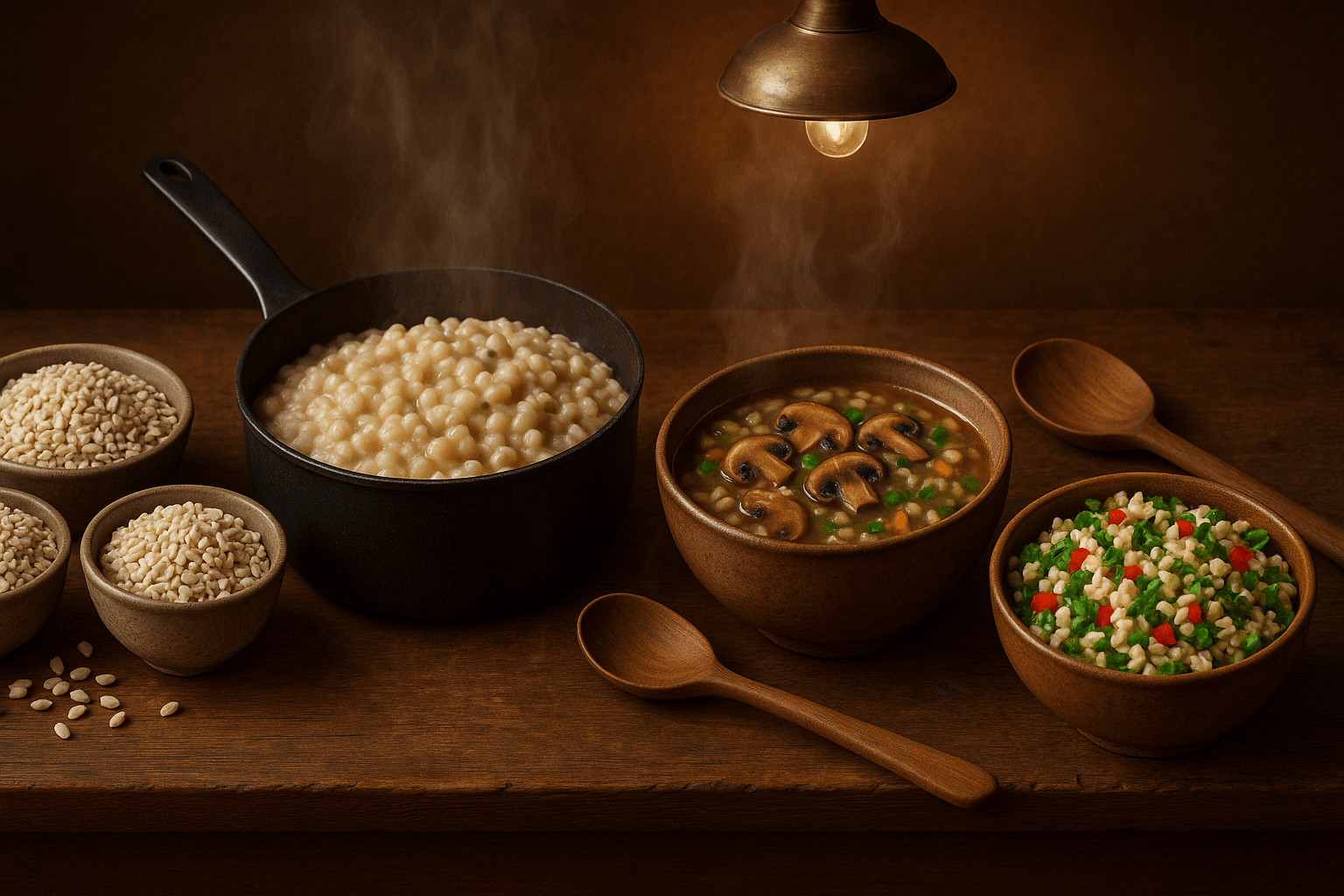
There is a reason one pot of barley stays charmingly chewy, another turns luxuriously creamy, and a third goes from pleasantly tender to wallpaper paste in what feels like five distracted minutes. Barley is often treated as a single pantry grain with a single set of rules, but in the kitchen it behaves more like a family of related ingredients. Hulled barley, pearled barley, and quick barley may all begin as the same cereal grain, yet the amount of bran left on the kernel, the degree of polishing, and the way the grain has been cut or preprocessed dramatically change how water enters, how starch swells, and how soluble fibers leak into your pot.
If you understand those differences, barley stops being mysterious. You can choose hulled barley when you want distinct, nutty grains that hold themselves together in a salad or a rustic pilaf. You can reach for pearled barley when you want a broth to turn glossy and substantial, or when you want a risotto-style pot to become creamy without much added dairy. And you can use quick barley strategically for weeknight soups and porridges—while knowing exactly why it can tip into mush if handled like the other two.
The key ideas are not complicated, but they are specific: barley’s bran structure slows hydration; its beta-glucans, a class of soluble fiber, thicken liquid in a way that is different from pure starch; toasting changes aroma and influences surface hydration; and salt, acid, and finishing fat all alter how we perceive tenderness, creaminess, and “chew.” Once those pieces click, you can build better soups, better risotto-style barley, better grain salads, and better porridges with far fewer gummy disappointments.
Barley in the kitchen: older than trend cycles, broader than one texture
Barley is one of the world’s oldest cultivated grains. It has fed people across West Asia, North Africa, Europe, the Himalayas, East Asia, and parts of the Americas in forms that range from flatbreads and porridges to soups, pilafs, fermented drinks, and roasted grain teas. If your mental image of barley is limited to the occasional deli-style mushroom soup, you are seeing only a narrow slice of its culinary life.
In Eastern Europe, barley has long been prized in soups because it gives body without requiring flour. In the Middle East and neighboring regions, barley appears in rustic stews and pilaf-like preparations where whole grains are meant to stay intact. In Korea, roasted barley tea—boricha—is a daily drink in many homes, valued for its toasty aroma more than for any thickening power. In Japan, mugicha plays a similar role, often served chilled in warm weather. In Tibet and the Himalayan region, roasted barley flour occupies its own important culinary and cultural place. Across these examples, one truth repeats: barley is not only about nutrition or frugality; it is prized because it can be aromatic, soothing, hearty, and texturally versatile.
Modern supermarket labeling, unfortunately, tends to flatten those distinctions. A bag simply says “barley,” or perhaps “pearled barley,” without explaining whether the grain is expected to stay separate, turn creamy, or cook fast. That missing context causes many home-cooking frustrations. People use hulled barley in a recipe designed for pearled barley, then wonder why the grains are still firm after 45 minutes. Or they use quick barley where pearled is intended and end up with a starchy, blown-out soup. The barley is not misbehaving; the cook has simply been given too little information.
What the different kinds of barley actually are
To understand cooking differences, start with anatomy. A barley kernel has an inedible outer hull tightly attached to the grain in many varieties, plus bran layers, an aleurone layer, the starchy endosperm, and a germ. Processing removes some of these layers to varying degrees.
Hulled barley
“Hulled” barley usually means the inedible outer hull has been removed, but most of the bran remains. It is often considered the least processed common form sold for cooking. Because the bran is still largely present, the kernels are darker, nuttier, and slower to hydrate. They retain more of the grain’s original architecture, which is why they tend to hold shape well and stay pleasantly chewy.
Typical simmer time: about 45 to 75 minutes, sometimes longer depending on age and storage.
Best uses: grain salads, pilafs, hearty soups where you want intact grains, breakfast bowls, side dishes.
Pearled barley
Pearled barley has been abraded to remove the hull and some or most of the bran. This polishing exposes more of the endosperm. The grains become lighter in color, faster-cooking, and more willing to release starch and soluble fiber into the liquid.
Typical simmer time: about 25 to 45 minutes.
Best uses: soups where you want body, risotto-style preparations, porridges, casseroles, softer pilafs.
Quick barley
Quick barley is usually pearled barley that has been further processed—sometimes cut into smaller pieces, sometimes partially steamed or pre-cooked, then dried. The exact method varies by brand, which is why package directions matter here more than with the other forms.
Typical simmer time: about 10 to 20 minutes.
Best uses: weeknight soups, fast porridges, emergency grain sides.
Quick barley is convenient, but its convenience comes from structural compromise. It hydrates quickly because processors have already done some of the work of disrupting the kernel. That means it can overcook very quickly and contributes thickening earlier in the cooking process.
Why hulled barley stays chewy while pearled barley turns creamy
This is where structure meets pot physics.
When a grain cooks, water first wets the surface, then diffuses inward. Heat softens cell walls, starch granules absorb water and swell, and eventually some starch and soluble components migrate outward into the surrounding liquid. The speed and extent of those changes depend heavily on what layers are still present.
Bran is a brake
The bran on hulled barley acts as a physical barrier. It slows water penetration, which means the center takes longer to soften. The bran also helps the kernel maintain its shape because the outer layers remain more intact. Even after the grain is fully cooked, hulled barley often feels more “defined” on the palate: you bite through an outer layer before reaching the tender center.
That is why hulled barley shines in dishes where grain identity matters. In a salad, that chew feels lively rather than undercooked. In a pilaf, it reads as robust and grainy. In a soup, it can remain satisfyingly distinct even after reheating.
Pearling speeds hydration and softening
Remove much of the bran, and water reaches the starchy interior more easily. The endosperm hydrates faster. Starch granules swell sooner and more uniformly. The grain softens more thoroughly, and some of its internal material escapes into the pot. The result is not only shorter cooking time but also a creamier overall effect.
This is why pearled barley can mimic one of risotto’s great pleasures. As you stir it in hot liquid, it releases enough starch and beta-glucan-rich soluble material to create a glossy suspension around the grains. It will not behave exactly like Arborio rice—different grain, different starch composition—but it can create a spoon-coating texture that feels remarkably lush.
Quick barley is pre-weakened by design
With quick barley, the pathways for water entry are even more open. Cracks, cuts, or pre-gelatinized regions give hot water rapid access. This is great when dinner needs to happen in 20 minutes. It is less great if you want separate grains after prolonged simmering. Quick barley can transition from tender to bloated fast because much of its structural resistance is already gone.
Beta-glucans: the barley superpower that thickens differently from starch
A lot of barley’s kitchen magic comes from beta-glucans, a form of soluble fiber found in the cell walls of the endosperm and aleurone. Beta-glucans are nutritionally important, but for cooking they matter because they change the texture of water.
What beta-glucans do in the pot
As barley cooks, some beta-glucans dissolve into the surrounding liquid. They increase viscosity, meaning they make the liquid feel thicker and more substantial. But this is not exactly the same thickening you get from flour or from a cornstarch slurry.
Starch thickening tends to feel opaque, pudding-like, or gravy-like when concentrated. Beta-glucan thickening tends to feel slicker and more broth-like, almost as if the liquid has become silkier rather than overtly sauced. In soup, that means barley can make broth feel nourishing and full-bodied without reading as heavy.
This is one reason mushroom barley soup can feel so satisfying even when it is not enriched with cream. The barley is doing a lot of texture work on its own.
Why pearled barley often thickens more noticeably
It is tempting to assume hulled barley, being less processed, always thickens more because it contains more intact fiber overall. Nutritionally, that may be true in broad terms, but in a cooking pot accessibility matters as much as total amount. Pearled barley, with more exposed interior, often releases soluble material more readily during ordinary cooking. That means it can produce a more visibly creamy or glossy result in a practical kitchen timeframe.
Hulled barley still contributes body, but because its structure remains more intact, much of that material stays in the grain longer unless you cook it for a very long time.
Why barley soup gets thicker as it sits
If you have ever refrigerated barley soup and found it much thicker the next day, beta-glucans are a big part of the story. So is starch hydration continuing during cooling and storage. The grains keep absorbing broth, and dissolved solids in the liquid continue to influence viscosity. This is why soup that seemed perfect at the stove can become almost stew-like overnight.
Rule of thumb: if you are making barley soup for leftovers, stop the broth slightly looser than you want to serve it that day. Reserve extra stock or water for reheating.
The toast-simmer rule: aroma first, then controlled hydration
One of the best ways to improve barley flavor is also one of the simplest: toast the dry grain briefly before simmering. This works especially well with pearled or hulled barley destined for pilafs, salads, risotto-style pots, or soups with a defined grain component.
What toasting does
Toasting drives off surface moisture and promotes aromatic reactions at the grain’s exterior. The result is a nuttier, breadier, more complex aroma. You are not deeply browning the barley the way you might toast coffee or dark-roast malt. You are simply waking up the grain.
In practical terms, toast 1 cup barley in 1 to 2 teaspoons oil or in a dry saucepan over medium heat for 3 to 5 minutes, stirring frequently, until it smells nutty and turns a shade or two deeper. Do not walk away; scorched barley tastes bitter and dusty.
Does toasting slow hydration?
Slightly, but not dramatically if done correctly. Gentle toasting dries and warms the surface and can make the first phase of hydration a touch slower. But because the grain then enters hot liquid, the overall effect in a home kitchen is mainly sensory: better aroma, clearer grain flavor, and often a more distinct texture early in cooking.
Where cooks get in trouble is over-toasting. Aggressively browned grain can develop a tougher exterior or uneven hydration patterns, leading to kernels that are dark outside yet still firm in the center.
The practical toast-simmer rule
Use this simple rule:
- Toast when you want barley to taste grain-forward and a little more distinct: salads, pilafs, risotto-style preparations, simple soups.
- Skip or go very light on toasting when you want maximum creamy release fast: porridges, very thick soups, quick-cooking barley dishes.
In other words, toasting leans barley toward aroma and grain definition. Direct simmering leans it toward faster hydration and creaminess.
Salt, acid, and fat: three small levers that change texture perception
Cooks often focus on the grain and liquid while ignoring the seasonings that quietly reshape texture.
Salt helps barley taste fully hydrated
Salt does not magically soften barley the way baking soda can soften beans, but it matters hugely for flavor perception. Unsalted barley can seem tougher than it really is because the grain tastes flat and the chew feels dull. Properly salted cooking liquid makes the interior taste seasoned, which our brains often interpret as more complete tenderness.
For soups and pilafs, a good starting point is 1 teaspoon Diamond Crystal kosher salt per quart/liter of cooking liquid, adjusting for salty stock. If using Morton kosher salt, start lower, around 1/2 teaspoon per quart, because it is denser.
For grain salads, salting the cooking water generously is especially important. Once barley is cooked and cooled, it is harder to season all the way through.
Acid can firm perception and mute creaminess if added too early
Acidic ingredients such as tomatoes, wine, lemon juice, or vinegar brighten barley beautifully, but timing matters. If added early, acid can slow softening a little by affecting pectin-like substances and the general cooking environment around cell walls. More important in practice, early acid preserves a sharper, firmer textural impression.
That can be useful if you want defined grains in a tomatoey soup or a bright barley salad. But if you are chasing creaminess in a risotto-style barley or porridge, add strong acids near the end.
Practical rule:
- Add tomatoes, lemon juice, or vinegar early only if you want a more brothy, grain-distinct result.
- Add them late if you want the barley to soften and release more body first.
Finishing fat amplifies silkiness
A final tablespoon or two of butter, olive oil, sesame oil, or another finishing fat can dramatically change how barley feels. Fat coats the palate, smooths edges, and amplifies the silky impression created by dissolved beta-glucans.
This is why a barley “risotto” finished with 2 tablespoons butter and 1/4 cup grated Parmesan tastes far creamier than the same pot without those additions, even if the actual moisture content is unchanged. Likewise, a chilled barley salad tossed with good olive oil feels less dry and less chewy than one dressed only with lemon.
Nutrition myths: fiber, processing, and glycemic impact without oversimplifying
Barley is often advertised in sweeping health claims. Some are grounded in truth, but they are often presented too simplistically.
Myth 1: Pearled barley is “basically refined” and not worth eating
Pearled barley is more processed than hulled barley, yes. Some bran is removed, and that generally reduces total fiber and micronutrients. But pearled barley still offers meaningful nutrition, including beta-glucans, and remains a valuable whole-grain-adjacent pantry staple in practical cooking. It is not nutritionally identical to hulled barley, but it is not empty starch either.
Myth 2: More fiber always means lower blood sugar response in a simple, universal way
Barley often has a lower glycemic impact than many refined grains, in part because of its soluble fiber. But glycemic response depends on many factors: grain form, degree of processing, cooking time, what the barley is eaten with, portion size, and individual metabolism.
Hulled barley may produce a slower response than quick barley in some contexts because the intact structure slows digestion. But if you cook hulled barley very soft and pair quick barley with fat, protein, and vegetables, the difference may narrow in a real meal. Food matrix matters.
Myth 3: A creamy barley dish must be less healthy than a chewy one
Creaminess in barley often comes from the grain itself—starch plus dissolved beta-glucans—not necessarily from cups of cream. A pearled barley soup that thickens naturally can still be quite nutrient-dense. Texture is not a reliable stand-in for nutritional quality.
The better takeaway is this: choose the barley form for the dish you want, then build the meal thoughtfully around vegetables, legumes, proteins, and fats.
Step-by-step: how to cook each type for the result you actually want
Below are practical methods designed for home kitchens. Actual times vary with brand, harvest age, and your pot, so treat texture—not the clock—as the final authority.
Method 1: Brothy soup with distinct grains
Best choice: hulled barley or a modest amount of pearled barley.
Ingredients
- 1 cup hulled barley or 3/4 cup pearled barley
- 2 teaspoons olive oil or butter
- 1 medium onion, diced
- 2 carrots, diced
- 2 celery stalks, diced
- 8 cups stock or water, plus more as needed
- 1 1/2 teaspoons Diamond Crystal kosher salt to start, less if stock is salty
- Optional mushrooms, shredded chicken, white beans, or greens
- Acid to finish: 1 to 2 teaspoons lemon juice or sherry vinegar
- Finishing fat: 1 tablespoon olive oil or butter
Steps
- Rinse the barley under cold water. Hulled barley especially benefits from a quick rinse to remove dust.
- Optional toast the drained barley in the oil for 3 minutes over medium heat if you want a nuttier, more distinct grain flavor.
- Sweat the aromatics. Add onion, carrot, and celery and cook 5 to 7 minutes until softened but not browned.
- Add liquid and salt. Pour in the stock and bring to a boil.
- Simmer gently. Add hulled barley and simmer 45 to 65 minutes, or pearled barley 25 to 35 minutes, until the grain is tender but not blown open.
- Add quick-cooking ingredients late. Mushrooms can go in midway; greens, cooked beans, or cooked meat can go in during the last 5 to 10 minutes.
- Adjust consistency. If the soup tightens too much, add 1/2 to 1 cup hot water or stock.
- Finish at the end with lemon juice or vinegar and a spoonful of olive oil or butter.
Why this works
A gentle simmer keeps the kernels intact. Late acid preserves brightness without slowing the early softening phase. Finishing fat enhances the broth’s natural silkiness.
Method 2: Risotto-style barley
Best choice: pearled barley.
Ingredients
- 1 cup pearled barley
- 2 tablespoons butter or olive oil
- 1 small shallot or 1/2 onion, finely chopped
- 1/2 cup dry white wine, optional
- 4 to 5 cups hot stock
- 1 teaspoon Diamond Crystal kosher salt to start, depending on stock
- 1 to 2 tablespoons butter to finish
- 1/4 to 1/2 cup grated Parmesan or aged hard cheese, optional
- Black pepper
- Optional mushrooms, roasted squash, peas, or greens
Steps
- Heat the stock in a separate pot and keep it hot.
- Toast the barley lightly in 1 tablespoon butter or oil for 2 to 3 minutes.
- Cook the shallot in the same pot until translucent, about 2 minutes.
- Add wine and cook until nearly evaporated, if using.
- Add hot stock gradually, about 1 cup at first, then 1/2 cup at a time, stirring often and letting each addition absorb partially before the next.
- Cook 28 to 40 minutes until the barley is tender with a slight core and the surrounding liquid looks glossy, not soupy.
- Fold in add-ins near the end if using.
- Finish off heat with butter, cheese, and black pepper. Rest 2 minutes before serving.
Why this works
Pearled barley’s exposed endosperm releases enough starch and beta-glucans to form a naturally creamy emulsion with the stock and finishing fat. Constant stirring is not as essential as with rice risotto, but frequent stirring helps encourage release and even cooking.
Method 3: Chilled barley salad with separate, bouncy grains
Best choice: hulled barley, or pearled barley cooked very carefully.
Ingredients
- 1 cup hulled barley
- 4 cups water
- 1 1/4 teaspoons Diamond Crystal kosher salt
- 1 tablespoon olive oil, plus 2 to 3 tablespoons for dressing
- 2 tablespoons lemon juice or 1 tablespoon vinegar
- Herbs, chopped vegetables, nuts, cheese, or legumes as desired
Steps
- Rinse the barley.
- Simmer in well-salted water until just tender, 45 to 60 minutes for hulled barley.
- Drain well if excess water remains.
- Spread on a tray or large plate to cool quickly. This step matters: trapped steam keeps softening the grain.
- Dress while slightly warm with olive oil first, then acid, then remaining ingredients.
- Chill and taste again before serving; cold food needs more salt.
Why this works
Draining and rapid cooling stop carryover cooking. Oil added before acid helps coat the grains and reduces the dry, squeaky chew barley can develop when chilled.
Method 4: Fast porridge or breakfast barley
Best choice: quick barley or pearled barley.
Ingredients
- 1 cup quick barley or pearled barley
- 3 1/2 to 4 cups water or milk mixture
- Pinch of salt
- Optional cinnamon, cardamom, honey, fruit, nuts
Steps
- Combine liquid, salt, and barley in a saucepan.
- Bring to a simmer, then reduce heat low.
- Cook quick barley 10 to 15 minutes or pearled barley 30 to 40 minutes, stirring more often toward the end.
- Rest 5 minutes before serving.
- Loosen with extra hot liquid if needed.
Why this works
Skipping the toast and using a relatively high liquid ratio encourage rapid hydration and release, giving you a porridge that feels creamy instead of individually grainy.
Common mistakes that make barley gummy, bland, or “blown out”
Mistake 1: Using the wrong barley for the job
Quick barley for salad? Usually too soft. Hulled barley for a 30-minute risotto recipe? Too slow and too firm. Pearled barley in a soup that will simmer all afternoon? Possibly excellent, but add it late or expect a much thicker pot.
Mistake 2: Boiling too hard
A violent boil bangs grains around, encourages surface rupture, and clouds the liquid excessively. Keep barley at a lively simmer, not a rolling fury.
Mistake 3: Salting too timidly
Barley needs seasoning. Underseasoned grains taste tougher and duller.
Mistake 4: Adding acid too early when you want softness
Tomatoes from minute one in a creamy barley pot can keep the dish tasting firmer and less integrated. Build tenderness first, sharpen later.
Mistake 5: Not accounting for carryover hydration
Even off heat, barley keeps drinking. In soups, stop a little early if the pot will sit. In salads, cool the grains fast.
Mistake 6: Reheating leftovers without extra liquid
Barley leftovers nearly always need more water or stock. Start with 2 to 4 tablespoons extra liquid per cup of leftovers and adjust.
Smart variations and cultural inspirations
Mushroom barley soup
Use pearled barley for a fuller, silkier broth. Toast the grain lightly, brown mushrooms deeply, and finish with dill and black pepper. If making ahead, cook the barley separately and combine before serving to control thickness.
Tomato-barley soup
If you want bright, separate grains, simmer barley mostly in stock first, then add tomatoes for the last 15 to 20 minutes. If you want a thicker, integrated tomato-barley stew, add tomatoes earlier and use pearled barley.
Pilaf-style barley
Toast hulled or pearled barley in oil, sauté onion, add hot stock at a ratio of about 1 cup barley to 2 3/4 cups liquid, cover, and cook gently until absorbed. Rest 10 minutes, then fluff. Hulled barley makes a more robust pilaf; pearled makes a softer one.
Barley tea
For boricha or mugicha-style inspiration, toast barley more deeply than you would for soup—until richly fragrant—and steep it in hot water rather than simmering for starch release. The goal here is aroma, not tenderness or thickening.
Cold herb barley salad
Choose hulled barley and lean into parsley, mint, scallions, cucumbers, toasted nuts, and feta. Dress with olive oil generously enough to prevent the grains from seeming dry when chilled.
The easiest decision rules to remember
If you remember nothing else, remember these:
For brothy soups
Choose hulled barley if you want intact, chewy grains in a clear-ish broth. Choose pearled barley if you want the broth to become naturally fuller and silkier. Add barley later in long-cooked soups to avoid over-thickening.
For risotto-style pots
Choose pearled barley. Toast lightly, add hot stock gradually, stir often, and finish with butter or cheese. Add acid at the end.
For chilled salads
Choose hulled barley almost every time. Cook until just tender, drain well, cool fast, oil before acid, and taste for salt after chilling.
For porridges and fast weeknight meals
Choose quick barley or pearled barley. Use more liquid, skip heavy toasting, and watch the clock closely.
For nutty aroma
Toast first.
For maximum creaminess
Simmer first, finish with fat, and hold acid until the end.
Final takeaways
Barley cooks differently not because recipes are inconsistent, but because the grain itself changes profoundly with processing. Hulled barley keeps more bran, so it hydrates slowly, stays chewier, and holds its shape beautifully. Pearled barley has easier water access and releases more starch and soluble beta-glucans into the pot, so it cooks faster and turns broths creamy and glossy. Quick barley is engineered for speed, which makes it convenient but easier to overcook.
The best barley cooking is really a game of matching grain structure to dish structure. Want a hearty salad or sturdy pilaf? Reach for hulled. Want creamy soup or risotto-style comfort? Reach for pearled. Want dinner in a hurry? Reach for quick barley and shorten your simmer.
Then fine-tune with the small but powerful levers: toast for nuttier aroma and more grain definition; simmer gently for even hydration; salt well so tenderness reads clearly; add acid later if you want softness and creaminess; finish with fat for silkiness and balance.
Do that, and barley stops being a vague “healthy grain” and becomes what it really is: one of the most versatile, intelligent ingredients in the pantry, capable of clear broths, velvety pots, springy salads, cozy porridges, and fragrant teas—all depending on how you treat its structure.