Why Vinegar Makes Food Brighter, Tougher, or Strangely Flat: Acetic Acid Chemistry, Volatile Extraction, and the Timing Rules for Pickles, Braises, and Pan Sauces
RecipeSimpli
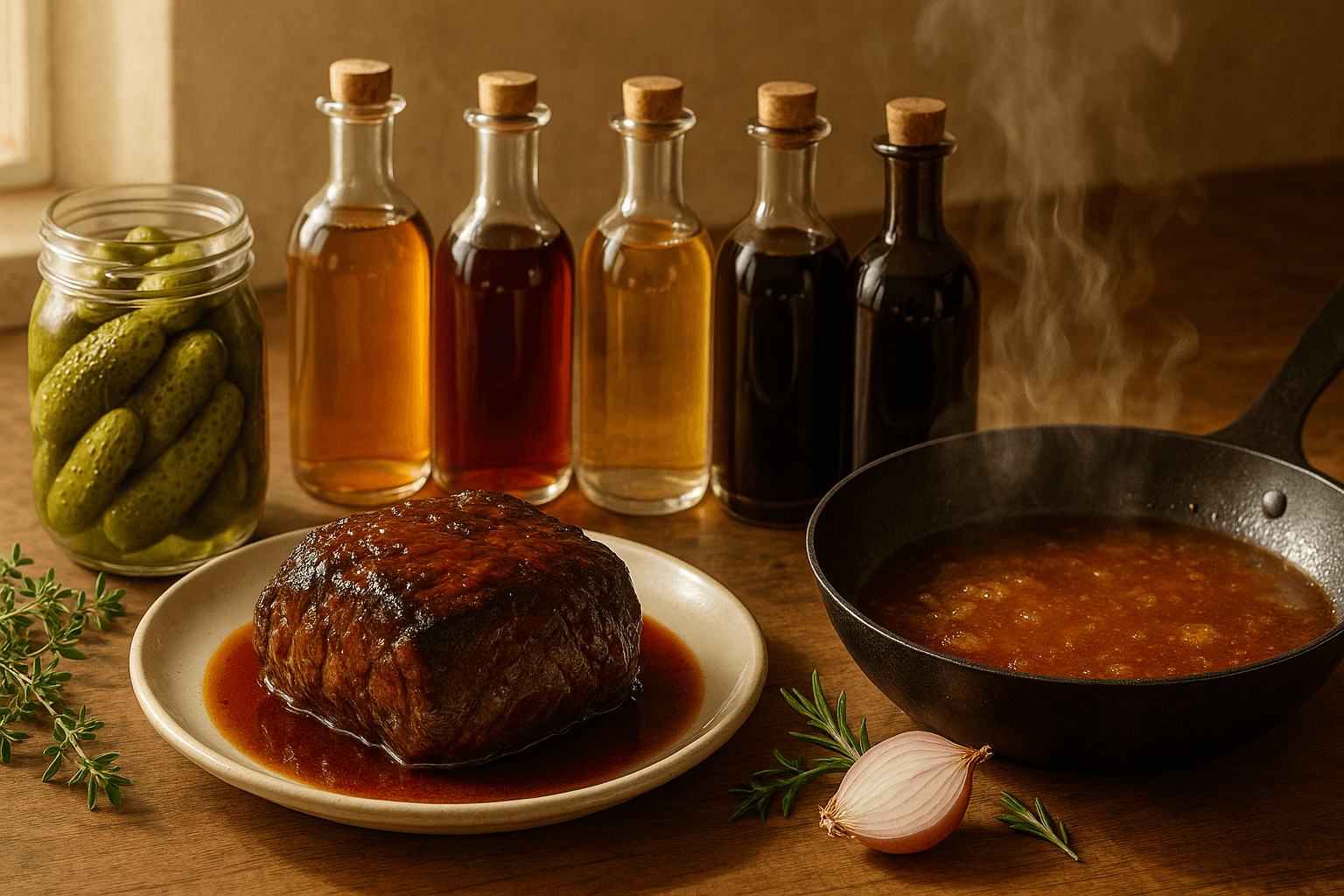
A spoonful of vinegar can make a dish taste alive. It can also make it feel hard, thin, puckery, muddy, or oddly lifeless. That contradiction is what makes vinegar such a powerful cooking ingredient. Used well, it sharpens flavors the way a squeeze of lemon wakes up soup or a pinch of salt wakes up tomatoes. Used carelessly, it can toughen beans, mute sweetness, flatten aroma, or turn a carefully reduced pan sauce into something that tastes like hot salad dressing.
The reason is not simply that vinegar is "sour." Vinegar is chemistry in a bottle: mostly water, a moderate amount of acetic acid, and a varying collection of aromatic compounds left behind by wine, cider, rice, malt, or long aging. That acetic acid can change plant cell walls, influence how proteins hold water, alter how your tongue perceives salt and sugar, and affect which aromas escape from food into the air. And timing matters as much as quantity. Add vinegar at the beginning of cooking and it can shape texture from the inside out. Add it at the end and it behaves more like a high note, changing perceived brightness and aroma without the same structural effects.
If you understand those rules, vinegar stops being a mysterious "splash" and starts acting like a precision tool. You can make pickles that stay crisp rather than collapse. You can build braises with enough acidity to feel balanced but not enough to leave the meat dry and stringy. You can finish pan sauces so they sparkle and cut richness instead of stinging the back of your throat.
A short context: vinegar as preservation, seasoning, and structure
Long before anyone used words like pectin chemistry or volatile compounds, cooks knew vinegar could preserve, brighten, and transform. In many food traditions, vinegar sits right at the border between necessity and style.
In pickling cultures across Eastern Europe, South Asia, East Asia, the Mediterranean, and the Americas, vinegar became a practical preservative and a defining flavor. In Western braising traditions, a little wine vinegar or cider vinegar often appears where a dish risks becoming too fatty or too sweet. In Chinese cooking, black vinegar and rice vinegar are not generic sourness but ingredients with personality. In the British tradition, malt vinegar is both condiment and cooking ingredient, carrying toasted cereal notes that distilled white vinegar simply does not have. In Italy, wine vinegars and balsamic styles can move from aggressive to syrupy and complex depending on age and concentration.
What ties all those uses together is acidity. Most culinary vinegars are around 4 to 7% acetic acid. Distilled white vinegar is often around 5%. Many rice vinegars are milder, sometimes closer to 4 to 4.5%. Some pickling vinegars are specifically formulated at 5% acidity or higher for safe preservation and crisp results. Balsamic vinegars vary enormously: inexpensive commercial balsamic may be wine vinegar plus cooked grape must and caramel coloring, while traditional balsamics are dense, sweet, and precious enough that you would use drops, not quarter-cups.
That range matters because the chemistry you get from a tablespoon of 4% rice vinegar is not identical to what you get from a tablespoon of 6% white wine vinegar. Flavor compounds differ, yes, but so does plain acid strength.
What acetic acid actually does in food
At its simplest, vinegar lowers pH. A lower pH changes how molecules behave.
In cooking, the most important consequences are these:
- It changes plant texture by affecting pectin and hemicellulose in cell walls.
- It changes protein behavior in meat, fish, eggs, and dairy.
- It shifts taste perception so salt, sweetness, bitterness, and richness are experienced differently.
- It influences aroma release by changing volatility and by contributing its own smell.
- It slows or speeds some browning reactions depending on the context.
Those effects overlap, which is why vinegar can seem inconsistent. The same ingredient that firms cucumbers for pickles can make a milk sauce curdle, keep red cabbage vivid, and pull a braise back from richness.
Why vinegar can make vegetables crisper or tougher
Let’s start with the common kitchen surprise: acid often helps vegetables stay firm.
Plant cells are glued together partly by pectin, a family of structural polysaccharides. During cooking, especially in moist heat, pectin can dissolve or break down enough that vegetables soften. Acid slows that softening. In a more acidic environment, pectin is generally more stable, and the cell-wall network holds together longer.
That is why:
- Green beans cooked with tomatoes often stay firmer longer than green beans cooked in plain water.
- Potatoes in an acidic soup can take forever to soften.
- Cucumbers or onions in a vinegar brine stay pleasantly crisp if handled well.
For quick pickles, acid is part of the crispness story, though not the whole story. Salt draws out water, and cold storage slows enzymatic breakdown. But acetic acid helps maintain a firmer texture by reinforcing the pectin network rather than allowing it to dissolve as readily.
A practical pickle brine for refrigerator pickles is often 1 cup (240 ml) vinegar + 1 cup (240 ml) water + 1 to 1 1/2 tablespoons (15 to 22 g) kosher salt + 1 to 2 tablespoons (12 to 25 g) sugar, depending on style. For a sharper, more shelf-stable style, some formulas use more vinegar than water. If your goal is bright, crisp cucumber pickles, use a vinegar at 5% acidity and chill the vegetables promptly after the hot brine is poured, or use a cold brine for very crisp quick pickles.
But there is a flip side. Acid can make some vegetables seem tougher rather than simply crisp. Dried beans are the classic example. If you cook beans in acidic liquid too early, the skins and outer structure can remain stubbornly intact while the interiors struggle to soften. Tomato, vinegar, molasses, and similar acidic ingredients are therefore often added after beans have become mostly tender.
The same timing rule applies to braised vegetables when you want softness. If you want onions to melt into a stew, adding a large dose of vinegar at the beginning can slow that collapse. If you want cabbage wedges to keep shape, early acid helps.
A useful rule for vegetables
- Add acid early if you want vegetables to hold their shape.
- Add acid late if you want vegetables to soften fully first and then taste bright.
Why vinegar sometimes tenderizes meat—and sometimes makes it drier
People often say vinegar "tenderizes" meat. That is true in some limited ways, but it is easy to misunderstand.
Acid affects proteins by denaturing them: changing their structure so they unfold or bond differently. In a marinade, this mostly happens at the surface because vinegar penetrates slowly. A strongly acidic marinade can make the outer layer of meat feel softer at first, but if exposure is prolonged, it can also make that surface mealy, chalky, or dry once cooked.
For a home-cook example, imagine chicken marinated in a mixture with a lot of vinegar for 12 hours. The outer few millimeters may become pale and tightened, almost as if chemically "cooked." Once heat is applied, that layer can squeeze out moisture more readily. The interior, meanwhile, has barely been changed.
So does vinegar tenderize? Not in the deep, steakhouse sense that breaks down connective tissue throughout a roast. Time, heat, salt, and collagen conversion do that. Vinegar mainly changes surface proteins and shifts flavor.
In a braise, acid plays a subtler role. Moderate acidity can help dissolve collagen over long cooking and can balance richness, but too much acid early in the process can cause muscle fibers to tighten and can interfere with the plush, succulent impression you want. That is one reason some braises with wine, tomatoes, or vinegar taste a little stringy if the acid level is high and the sauce never rounds out.
Practical timing for meat
- For quick marinades on thin cuts, use modest vinegar and short times: 1 to 2 tablespoons vinegar per pound (450 g) of meat in a marinade with oil, salt, and aromatics for 30 minutes to 2 hours.
- For fish or shrimp, be even gentler: 1 to 2 teaspoons vinegar per pound for 10 to 20 minutes, or add acid only after cooking. Fish proteins denature quickly.
- For braises, if you want vinegar for structure and balance, start with a small amount, such as 1 to 2 tablespoons for a 3- to 4-pound (1.4 to 1.8 kg) pot roast, then adjust near the end.
- For tough cuts, do not rely on vinegar to do the work of time. Braise at 300 to 325°F (150 to 165°C) until collagen melts and the meat yields easily.
Why vinegar changes salt, sweetness, and overall flavor perception
One of vinegar’s most valuable effects is sensory, not structural. Acid changes how we perceive other tastes.
In moderate amounts, acidity can:
- Make food taste less heavy
- Increase perceived brightness
- Sharpen fruit flavors
- Make sweetness seem more defined
- Increase salivation, which physically spreads flavor around the mouth
But too much acidity can:
- Mask sweetness n- Make salt seem insufficient or oddly disconnected
- Accentuate bitterness
- Create a narrow, sharp taste with no depth
That is why a flat stew sometimes wakes up with 1 teaspoon of vinegar, but a timid tomato sauce does not always improve with 1/4 cup. There is a sweet spot where acid creates contrast, and beyond that point the dish can taste pointy rather than bright.
Acid and salt are especially interesting together. A small amount of acid can make a properly salted dish taste more vivid, as if the seasoning suddenly came into focus. But if a dish is under-salted, adding vinegar can make that deficiency more obvious. This is one reason cooks sometimes add vinegar, taste, then realize the dish needs another pinch of salt too.
Sweetness also changes in the presence of acid. Think of lemonade: sugar and acid define each other. In cooking, a touch of sugar can round harsh acidity, while acid can keep sugar from feeling cloying. In a braise with onions, carrots, and wine, the balance between acid and sweetness determines whether the final flavor reads deep and savory or strangely sour-sweet.
The aroma question: why early and late vinegar additions taste different
This is where vinegar becomes really interesting. Taste is only part of flavor. Aroma is the rest, and timing strongly affects aroma.
Vinegar contains volatile molecules, including acetic acid itself and aromatic compounds from its source material. Volatile means they evaporate easily and travel to your nose. If you add vinegar to a hot pan, some of those volatiles flash off immediately. That can be useful. The harsh raw edge softens, and the remaining sauce tastes integrated. But if all the aromatic lift disappears into the steam, the dish can lose the fresh, high note you wanted.
Early addition
Adding vinegar early in cooking does three things:
- It gives acetic acid time to interact structurally with vegetables, proteins, and sauces.
- It drives off some volatile sharpness, making the result rounder and less obviously vinegary.
- It lets flavors merge, so the acid becomes part of the dish rather than sitting on top.
That is useful in braises, chutneys, sweet-and-sour sauces, barbecue sauces, and pickling liquids.
Late addition
Adding vinegar near the end does something different:
- It preserves more aromatic top notes.
- It raises perceived brightness sharply because the acid is less transformed.
- It affects flavor more than texture because there is little time for structural change.
That is useful in soups, pan sauces, sautéed greens, bean dishes, and rich meats that need lift.
Why dishes can taste strangely flat after adding vinegar
This sounds backward, but it happens all the time. A dish tastes heavy, you add vinegar, and instead of becoming lively it becomes thin or flat.
Usually one of four things happened:
- The dish needed salt, not acid. Acid exposed the lack of seasoning.
- The dish had too little sugar or natural sweetness to balance the acid. This is common in under-caramelized pan sauces.
- The vinegar was heated too long after a late addition. You lost the bright aromatic edge but kept enough acidity to feel sour.
- The vinegar itself was one-dimensional. Distilled white vinegar can be ideal for pickles, but in a delicate pan sauce it may deliver acidity without complexity.
The science of pan sauces: why a splash can pop or sting
A pan sauce is one of the clearest demonstrations of acid timing. You sauté meat, remove it, pour off excess fat, cook shallot or garlic, deglaze with wine or stock, reduce, mount with butter, and finish with acid.
When it works, the acid slices through fond, butterfat, and meat juices so the sauce tastes focused. When it fails, the vinegar feels separate and aggressive.
The key is concentration and sequence.
If you add vinegar too early and reduce it hard, the sauce may lose its fresh edge and become dull. If you add too much too late, especially after the butter, it can taste like vinegar floating on top of fat.
A reliable formula for a pan sauce serving 2 to 4 people:
- 1 teaspoon minced shallot
- 1/2 cup (120 ml) stock or wine
- 1 to 2 teaspoons vinegar
- 1 to 2 tablespoons cold butter
- Salt to taste
Technique:
- After cooking meat, lower the heat to medium.
- Add shallot with a tiny bit of fat and cook 30 to 60 seconds.
- Deglaze with stock or wine and scrape the fond.
- Reduce by about half.
- Add 1 teaspoon vinegar, simmer 10 to 15 seconds.
- Turn off heat and swirl in cold butter.
- Taste. Add salt first if needed, then another 1/2 to 1 teaspoon vinegar only if the sauce still needs lift.
That short simmer after the first acid addition is important. It takes the raw edge off while keeping the sauce bright. The second tiny addition, if needed, acts almost like seasoning.
Pickles: sharpness, crispness, and choosing the right vinegar
Pickles are where vinegar’s textural and flavor roles are most obvious.
For quick cucumber pickles, white vinegar gives a clean, sharp, highly legible sourness. Apple cider vinegar adds fruitiness and a slightly softer impression. Rice vinegar is gentle and elegant but often less acidic, so if you are adapting a preservation recipe, you need to verify the acidity percentage rather than assuming all vinegars are interchangeable.
A crisp quick-pickle method
For 1 pound (450 g) cucumbers, sliced into 1/4-inch (6 mm) rounds:
- 1 cup (240 ml) 5% vinegar
- 1 cup (240 ml) water
- 1 1/2 tablespoons (18 g) kosher salt
- 1 tablespoon (12 g) sugar
- 2 cloves garlic, sliced
- 1 teaspoon mustard seeds
- 1/2 teaspoon black peppercorns
- 4 sprigs dill
Method:
- Pack cucumbers into a clean 1-quart jar.
- Bring the vinegar, water, salt, sugar, garlic, and spices just to a simmer, stirring to dissolve.
- Pour over cucumbers.
- Cool 20 to 30 minutes, then refrigerate.
- Best after 12 to 24 hours, very good for about 1 week.
For maximum crunch, start with very fresh cucumbers, trim a thin slice from the blossom end, and keep heat exposure brief. The blossom end contains enzymes associated with softening. Commercial picklers often use calcium chloride for extra firmness, but good produce and proper acidity already get you far.
Common pickle mistakes
- Using vinegar of unknown acidity for shelf-stable canning
- Diluting vinegar too much and ending up with weak flavor and poor preservation
- Cooking cucumbers too long in hot brine
- Substituting balsamic or low-acid seasoned rice vinegar without adjusting
Braises: when acid deepens flavor and when it gets in the way
A braise wants balance. You have browned meat, gelatin-rich stock, aromatic vegetables, maybe wine, tomato paste, herbs. Richness is the point, but too much richness tastes muddy. Acid restores shape.
The mistake is adding enough vinegar at the start that the dish becomes structurally and sensorially sour before it has time to mellow.
For a 3- to 4-pound chuck roast, a useful approach is:
- Brown the meat well.
- Cook mirepoix until deeply golden.
- Add tomato paste and brown it.
- Deglaze with wine if using; reduce.
- Add stock and herbs.
- Add only 1 tablespoon cider or red wine vinegar at the start, if any.
- Braise covered at 325°F (165°C) for 3 to 4 hours, until fork-tender.
- Skim fat, reduce sauce if needed.
- Finish with 1 to 3 teaspoons vinegar off heat or over very low heat, tasting after each addition.
Why so little at first? Because the braise already develops acidity from wine, tomatoes, and long reduction. The final seasoning addition lets you decide what is missing after all the concentration has happened.
A cider vinegar finish is especially good with pork and apple notes; red wine vinegar works beautifully in darker beef braises; sherry vinegar adds nuttiness and elegance to mushroom-heavy braises.
Choosing the right vinegar: flavor and function
Not all vinegar behaves the same on the palate.
Distilled white vinegar
- Flavor: sharp, clean, simple
- Best uses: pickles, slaws, hot sauces, when you want pure acidity
- Watch out for: harshness in delicate sauces
This is the most direct tool. It delivers acid without much distraction. Excellent for pickling because its flavor is neutral and its acidity is predictable.
Apple cider vinegar
- Flavor: fruity, round, gently tannic
- Best uses: pork, cabbage, chicken, autumn braises, vinaigrettes
- Watch out for: slight cloudiness or mother in some raw versions, which is fine in rustic uses but less ideal in a crystal-clear sauce
Cider vinegar often tastes less sharp than white vinegar even at similar acidity because its aroma carries apple-like softness.
Red wine vinegar
- Flavor: assertive, vinous, savory
- Best uses: beef braises, pan sauces for steak, lentils, robust vinaigrettes
- Watch out for: overpowering delicate fish or pale sauces
White wine vinegar
- Flavor: bright, cleaner and lighter than red wine vinegar
- Best uses: chicken pan sauces, beurre blanc variations, sautéed greens, lighter braises
- Watch out for: reduction too far, which can emphasize thinness
Rice vinegar
- Flavor: mild, soft, often slightly sweet
- Best uses: Asian-style pickles, dressings, dipping sauces, delicate vegetables
- Watch out for: using seasoned rice vinegar unintentionally; it may already contain sugar and salt
If a recipe simply says rice vinegar, check whether it means plain or seasoned. They are not interchangeable one-for-one in all cases.
Malt vinegar
- Flavor: malty, toasty, robust
- Best uses: fried foods, hearty chutneys, some pub-style pickles
- Watch out for: dominating subtle dishes
Balsamic vinegar
- Flavor: sweet-tart, dark, concentrated, variable quality
- Best uses: finishing roasted vegetables, certain pan sauces, reductions used sparingly, strawberries, aged cheese
- Watch out for: treating cheap balsamic like a universal substitute for wine vinegar
Balsamic brings sugar and deep cooked notes along with acid. That means it behaves differently in reduction and balance. A tablespoon can sweeten and darken a sauce as much as it acidifies it.
Sherry vinegar
- Flavor: nutty, layered, dry but aromatic
- Best uses: pan sauces, mushrooms, lentils, roasted vegetables, Spanish-inspired dishes
- Watch out for: wasting a very expensive one in a long, aggressive boil
Timing rules you can actually use
If you remember nothing else, remember this grid:
Add vinegar early when you want:
- Vegetables to hold shape
- Pickles to firm and preserve
- Sauces to taste integrated rather than freshly sharp
- Long-cooked sweet-and-sour balance
Add vinegar late when you want:
- Brightness and aromatic lift
- Rich dishes to feel lighter
- Pan sauces to pop
- Beans, stews, or soups to wake up after cooking
Split the addition when you want both:
This is often the smartest move.
For example, in a braise or tomato sauce:
- Add 1 tablespoon early for integration.
- Add 1 teaspoon at a time near the end for brightness.
That gives you roundness plus freshness.
Common mistakes and how to fix them
Mistake: The sauce tastes harsh
Why: Too much vinegar added late, or the wrong vinegar for the dish.
Fix: Add a knob of butter, a splash of stock, and a pinch of salt. If the dish allows it, a tiny pinch of sugar or a spoonful of caramelized onions can round the acidity.
Mistake: The stew tastes flat after adding vinegar
Why: It needed salt, not acid, or the acid stripped away the sense of richness without enough savory depth behind it.
Fix: Add salt in small increments, then taste again. Consider umami support: reduced stock, soy sauce, anchovy, mushroom powder, or deeper browning next time.
Mistake: Vegetables refuse to soften
Why: Acid added too early.
Fix: Cook longer if practical, or next time soften the vegetables first and acidulate later.
Mistake: Meat marinade turned mushy outside and bland inside
Why: Too much acid for too long.
Fix: Shorten marinating time, reduce vinegar, and rely more on salt and aromatics for penetration.
Mistake: Pickles are soft
Why: Old produce, too much heat exposure, weak brine, or improper acidity.
Fix: Use fresher produce, 5% vinegar, shorter hot contact, and adequate salt.
Step-by-step applications
1. Sharper refrigerator pickles
- Use 5% white or cider vinegar.
- Keep a 1:1 vinegar-to-water ratio for balanced quick pickles; go stronger for extra sharpness.
- Heat brine only until salt and sugar dissolve.
- Pour over fresh, cold vegetables.
- Chill promptly.
- Wait at least 12 hours before judging flavor.
If they taste dull the next day, add 1 to 2 tablespoons more vinegar to the jar. Cold food mutes flavor, so taste once the pickle warms slightly in your mouth before adjusting too aggressively.
2. Balanced braise
- Brown meat deeply; don’t rush this stage.
- Cook vegetables until sweet and golden.
- Add tomato paste and brown it for 2 to 3 minutes.
- Deglaze and reduce wine if using.
- Add stock and only a small initial dose of vinegar.
- Braise low and slow until truly tender.
- Defat and reduce sauce.
- Taste for salt first.
- Add vinegar 1 teaspoon at a time at the end until the sauce tastes focused, not sour.
3. Pan sauce that pops
- Sear meat and remove to rest.
- Pour off excess fat.
- Cook shallot briefly.
- Add wine or stock and reduce by half.
- Add 1 teaspoon white wine or sherry vinegar.
- Simmer 10 seconds.
- Whisk or swirl in 1 to 2 tablespoons cold butter.
- Taste and adjust with salt, then possibly another few drops of vinegar.
If the sauce stings, you either used too much acid or too little reduction and butter. Pan sauces need concentration and fat to carry acidity gracefully.
The science in one sentence per cooking style
- Pickles: acid firms plant structure and defines preservation-style sharpness.
- Braises: acid balances richness but too much early can tighten textures and skew flavor.
- Pan sauces: acid is a finishing instrument, best used in small doses with careful timing.
Final takeaways
Vinegar is not just sour liquid. It is an ingredient that changes texture, taste perception, and aroma all at once. That is why it can make food brighter, tougher, or strangely flat depending on how you use it.
If you want crispness and shape, acid early helps. If you want lift and sparkle, acid late is usually better. If you want both integration and brightness, split the addition.
Choose vinegar by both strength and character. White vinegar gives clarity and force. Cider vinegar gives fruit and warmth. Wine vinegars bring savory complexity. Rice vinegar offers gentleness. Malt brings toast. Balsamic adds sweetness and darkness as much as acidity.
And most importantly, treat vinegar like seasoning, not a magic fix. Add it in measured amounts. Taste after salt. Pay attention to timing. A dish rarely needs "more vinegar" in the abstract; it needs the right vinegar, in the right amount, at the right moment.
That is the difference between a pickle that snaps, a braise that feels polished, and a pan sauce that makes the whole plate taste more itself.