Homemade Granola That Stays Crisp (Not Clumpy or Burnt): Oil‑to‑Sweetener Ratios, Low‑Moisture Mix‑Ins, and the Cool‑Down Cure
RecipeSimpli
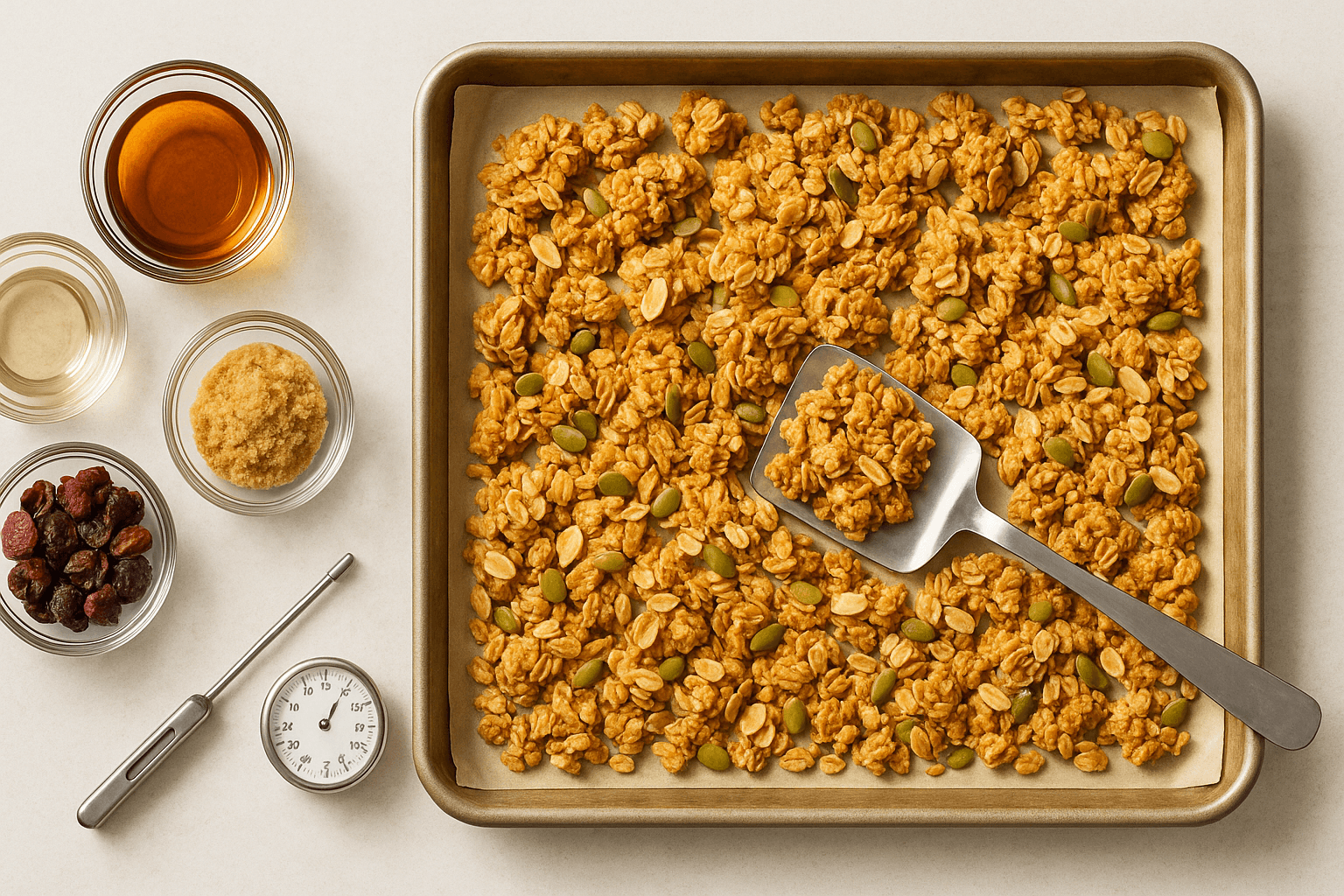
Homemade granola has two common failure modes: it bakes into sticky clumps that go leathery by day two, or it emerges with scorched edges and bitter notes while the center stays pale. Both problems come down to the same forces—moisture, sugar chemistry, fat distribution, and heat management—and the good news is that you can control all of them with a few repeatable ratios and a method that treats granola like the baked food it is, not just “toasted oats.”
This guide is science-first but kitchen-friendly. You’ll learn: the oil-to-sweetener ratio that drives crispness, how to choose low-moisture mix-ins that don’t sog out your batch, and the most underused technique in granola making—the cool-down cure—to lock in crunch for weeks.
1) What “crisp” granola really is (and why it disappears)
Crisp granola is essentially a low-moisture, sugar-and-fat coated cereal matrix.
- Oats and grains provide the structure. As they toast, they lose moisture and develop browning flavors.
- Sugars/syrups form a glassy coating as they heat and then cool. In candy terms, you’re aiming for a thin, brittle “sugar glass,” not a chewy syrup.
- Fats (oil, butter, nut fats) coat particles, help heat transfer, and slow moisture absorption.
The crunch enemy: water activity
Most “soggy granola” isn’t wet in the obvious way. It’s not enough moisture removed during baking, or moisture is reabsorbed from:
- humid air (granola is hygroscopic),
- high-moisture add-ins (fresh fruit, very wet dried fruit, nut butters added too early),
- underbaked syrup that stays tacky instead of turning glassy.
The practical takeaway: crunch comes from drying + setting. You must bake long enough to drive off moisture, then cool in a way that lets the sugar coating set into a brittle state.
2) The core ratios: a granola “formula” you can actually rely on
If you want granola that stays crisp, stop relying on vibes and start with a formula. Here’s a dependable baseline designed for crisp clusters without chewiness.
The crisp granola base formula
For 4 cups (about 360–400 g) rolled oats and/or grains total:
- Fat (oil or melted butter): 1/3 cup (70–80 g)
- Sweetener (honey/maple/syrup/sugar blend): 1/3 cup (105–115 g)
- Egg white (optional but powerful for clusters): 1 egg white (30–35 g)
- Salt: 1/2 tsp (3 g)
- Spices: 1–2 tsp total
- Optional dry sugar for extra crisp: 1–3 tbsp (12–36 g) light brown sugar or granulated sugar
This yields a coating that is thin enough to dry and rich enough to brown without turning into a sticky caramel.
The oil-to-sweetener ratio (the crispness dial)
A useful rule:
- Crisper, less sticky granola: 1:1 by volume (oil : liquid sweetener)
- More clusters, more chew risk: 1:1.25 (oil : sweetener)
- Sticky/chewy, clumpy, fast-staling: 1:1.5+
Why it works:
- Liquid sweeteners (honey, maple) bring water plus sugars. More sweetener means more moisture to drive off and more syrup that can stay rubbery.
- Fat helps coat and separate particles, making it easier for water to evaporate during baking and slowing post-bake moisture pickup.
If you love big clusters but hate chewiness, don’t just add more honey—use egg white (see below) and the cool-down cure.
Choosing sweeteners: what each one does
Different sweeteners behave differently because they contain different sugars and water.
- Honey: strong flavor, browns readily; often yields more chew if overused.
- Maple syrup: thinner, can lead to lighter crunch; still adds water.
- Brown sugar: low moisture, promotes crispness and a “toffee” aroma.
- White sugar: clean sweetness, very crisp set, less flavor complexity.
Best crisp strategy: Use a blend: some liquid sweetener for flavor + some dry sugar for crispness.
Example: 1/4 cup maple + 2 tbsp brown sugar.
The cluster secret: egg white (and why it doesn’t make granola cakey)
Egg white is mostly protein and water. That sounds like the opposite of crisp, but here’s the trick: when whipped lightly and tossed with oats, egg white forms a thin protein network that binds flakes into clusters. During baking, the water evaporates and the proteins set, leaving structure without extra stickiness.
- For clustery but crisp granola, add 1 egg white per 4 cups oats.
- Whisk until foamy (10–15 seconds), then toss with the coated oats.
This technique is popular in many test kitchens because it boosts clustering without needing heavy syrup.
3) Ingredient choices that keep granola crunchy
Oats: old-fashioned beats quick
- Old-fashioned rolled oats: best texture; stable flakes.
- Quick oats: smaller, compact, easier to over-brown and feel dusty.
- Steel-cut oats: can be added in small amounts (up to 1/2 cup) for crunch, but they stay hard if used too heavily.
Add structure with low-moisture grains
For extra crunch and better airflow during baking:
- puffed rice, puffed wheat (add late or they scorch)
- quinoa flakes
- wheat germ (small amount; toasts fast)
- coconut flakes (unsweetened; watch browning)
Nuts and seeds: toast timing matters
Nuts and seeds contain oils that can scorch.
- Almonds, pecans, walnuts: add at the start, but keep an eye on color.
- Seeds (pumpkin, sunflower, sesame): can go in from the start; stir schedule prevents burning.
- Chia/flax: best in small amounts; they can create a gel effect if there’s excess moisture.
Practical rule: if it’s thin or small, it browns faster—either add later or stir more often.
4) Baking method: temperature, pan geometry, and stirring schedule
Temperature: 300°F–325°F is the crisp zone
High heat is the #1 reason granola burns before it dries.
- 300°F (150°C): safest for even drying; takes longer; excellent for big batches.
- 325°F (163°C): faster browning; requires attention.
- 350°F (177°C)+: risky unless your oven is very even and you stir frequently.
Culinary science note: crisp granola needs time for moisture migration from the center of clusters to the surface. Lower heat gives that time without scorching sugars.
Use a rimmed sheet pan, not a deep dish
Granola wants surface area.
- Choose a half sheet pan (about 18 x 13 in).
- Line with parchment (best) or a silicone mat (slightly less browning).
- Spread to an even thickness: about 1/2 inch. Thicker piles dry slowly and become chewy.
The stirring schedule (and when not to stir)
You need two conflicting things:
- enough stirring to prevent burning,
- enough undisturbed time to form clusters.
A reliable compromise:
- Bake 10 minutes undisturbed.
- Stir and re-spread evenly.
- Bake 8–10 minutes.
- Stir again, rotating the pan.
- Bake 6–10 minutes until golden.
Total time: 24–35 minutes depending on oven, pan, and sweetener.
For bigger clusters
After the second stir, press the granola firmly with a spatula into an even layer (like a slab). Then don’t stir again. Let it finish baking, then cool fully before breaking.
This “press + no-stir finish” method gives clusters without requiring extra syrup.
5) The Cool‑Down Cure: the most important step for lasting crunch
Most granola seems “not crunchy enough” when it comes out of the oven. That’s normal.
Granola crisps as it cools because:
- sugars set into a glassy state,
- fats solidify slightly,
- steam escapes and the coating dries.
The cool-down cure method
- When the granola is golden and smells nutty, turn off the oven.
- Crack the oven door open 2–4 inches.
- Leave the pan inside 20–40 minutes.
- Remove and cool completely at room temp without covering.
This gentle “drying finish” reduces residual moisture—one of the main causes of next-day softness.
If you’re in a humid climate, the cool-down cure is not optional; it’s your insurance policy.
6) Mix-ins without sogginess: low-moisture strategy by category
Mix-ins are where most granola goes wrong. The principle is simple:
- Bake only what can be baked dry.
- Add anything sticky, delicate, or moisture-prone after baking and cooling.
Dried fruit (and why it sometimes makes granola limp)
Dried fruit varies wildly in moisture.
Low-moisture, crisp-friendly fruits:
- freeze-dried berries (best crunch)
- dried blueberries (often drier)
- dried cherries (if not too soft)
- banana chips (watch oil-fried versions)
High-moisture, chew-inducing fruits:
- raisins, dates, figs, soft apricots
- “juicy” cranberries packed in syrup
How to use chewy dried fruit without ruining crunch:
- Add only after granola is fully cool.
- If the fruit is very soft, chop and dust lightly with a teaspoon of sugar or cornstarch to reduce stickiness.
- Store fruit-heavy granola in a separate container or mix fruit into individual servings.
Nut butters: great flavor, tricky water balance
Nut butters add fat (good) but can be thick and sometimes contain emulsifiers or added sugars that burn.
Best approach: swirl after baking
- Warm nut butter until pourable.
- Drizzle over fully cooled granola on the pan.
- Let it set, then break into shards.
If you want nut butter baked in:
- Replace part of the oil with nut butter by weight (e.g., swap 30 g oil for 30 g almond butter).
- Keep oven to 300–325°F.
- Watch edges carefully.
Protein powder: how to add it without chalk or softness
Protein powder can clump and can prevent proper browning if added too early.
Option A (best texture): post-bake dusting
- Cool granola completely.
- Toss with protein powder plus a small amount of powdered sugar or milk powder for better dispersion.
Option B: bake a small portion in
- Limit to 1/4 cup per 4 cups oats.
- Mix protein with dry ingredients first.
- Expect slightly less crispness; compensate with a little extra dry sugar and the cool-down cure.
Chocolate: keep it snappy
Chocolate melts, then re-solidifies—but it can glue pieces together and trap moisture.
- Add chocolate chips only after cooling.
- For chocolate-coated clusters, drizzle melted chocolate over cooled granola, then let it set fully before storing.
Coconut: flavor boost, browning risk
Large coconut flakes toast beautifully but can burn.
- Add at the start for deeper toast, but stir as scheduled.
- If your oven runs hot, add coconut for the last 10 minutes.
7) Preventing burning: sugar chemistry and practical safeguards
Burnt granola tastes bitter because sugars and fats break down past optimal browning.
Why it burns fast
- Honey and maple contain sugars that brown readily.
- Thin bits (seeds, coconut shards, oat dust) darken first.
- Dark pans and hot spots accelerate edge browning.
Anti-burn toolkit
- Bake at 300–325°F.
- Use parchment to buffer heat.
- Rotate the pan every stir.
- Keep thickness even; don’t leave piles at the corners.
- If edges brown early, pull the browned edge bits into the center when you stir.
A key sensory cue: you want a toasty aroma. If you smell sharp caramel or bitterness, it’s already close to too dark.
8) A crisp, not-clumpy master recipe (with variations)
This recipe is engineered for crunch and shelf life.
Master Crisp Granola (about 8–9 cups)
Dry
- 4 cups old-fashioned rolled oats
- 1 cup chopped nuts (almonds/pecans/walnuts)
- 1/2 cup seeds (pumpkin/sunflower/sesame)
- 1/2 tsp fine salt
- 1–2 tsp cinnamon (optional)
- 2 tbsp brown sugar (optional but recommended for crisp)
Wet
- 1/3 cup neutral oil (or melted butter/coconut oil)
- 1/3 cup maple syrup or honey
- 1 tsp vanilla
- 1 egg white, whisked until foamy (optional for clusters)
Method
- Heat oven to 325°F (163°C). Line a rimmed sheet pan with parchment.
- Mix dry ingredients in a large bowl.
- Whisk oil, sweetener, vanilla. Toss with dry mix until every flake looks lightly coated.
- If using egg white, pour it in and toss until evenly distributed.
- Spread evenly on the pan (about 1/2 inch thick).
- Bake 10 minutes, then stir and re-spread.
- Bake 8–10 minutes, stir, rotate pan.
- Bake 6–10 minutes more until evenly golden.
- Cool-down cure: turn off oven, crack door, rest pan 20–40 minutes.
- Cool completely uncovered. Break into clusters.
- Add dried fruit/chocolate after cooling.
Doneness note: Granola should be golden, not deep brown. It will crisp more as it cools.
Variation: extra-crispy, less sweet
- Reduce liquid sweetener to 1/4 cup.
- Keep oil at 1/3 cup.
- Add 2–3 tbsp granulated sugar.
Variation: big-cluster bakery style (without chew)
- Use egg white.
- After second stir, press firmly and do not stir again.
- Cool completely before breaking.
Variation: peanut-butter crunch (no sog)
- Bake the master recipe.
- Cool fully.
- Drizzle 1/3 cup warmed peanut butter (optionally mixed with 1–2 tbsp melted coconut oil for a snappier set).
- Let set, then break.
9) Storage tricks: keeping granola crisp for weeks
Crispness is mostly about keeping water out.
Best containers
- Airtight jars with good gaskets
- Snap-lid containers with silicone seals
- Heavy zip-top bags with air pressed out
Add a “desiccant” the food-safe way
If you live in a humid environment:
- Add a small packet of food-safe silica gel (often found in packaged snacks) or
- Use a DIY method: place a tablespoon of uncooked rice in a small piece of cheesecloth and tuck it into the container (not as strong as silica, but can help).
Cool completely before sealing
Warm granola in a sealed container traps steam and guarantees softness. Wait until it’s fully cool—no residual warmth.
How long it lasts
- At room temperature, airtight: 2–4 weeks (often longer if very dry)
- Freezer: 2–3 months (great for big batches)
To refresh slightly softened granola: spread on a sheet pan and bake at 300°F for 8–12 minutes, then cool uncovered.
10) Troubleshooting: diagnose and fix common problems
“My granola is clumpy but not crisp.”
Cause: too much syrup, too thick on the pan, or not enough drying time.
Fix:
- Use 1:1 oil-to-sweetener.
- Spread thinner.
- Add cool-down cure.
- Consider egg white for clusters instead of extra honey.
“It’s crisp at first, then soft the next day.”
Cause: residual moisture + humidity, or container sealed while warm.
Fix:
- Bake a bit longer at lower temp.
- Cool-down cure.
- Cool fully before storing.
- Add fruit only at serving or keep separate.
“It tastes burnt but looks only medium brown.”
Cause: hot spots, dark pan, honey-heavy mix, or scorched seeds/coconut.
Fix:
- Lower to 300°F.
- Stir/rotate more.
- Add fast-browning ingredients later.
- Use parchment.
“It’s sandy/dusty instead of chunky.”
Cause: not enough binder, too much stirring, or too little fat.
Fix:
- Add egg white.
- Press after second stir and stop stirring.
- Ensure full, even coating with oil/sweetener.
11) Cultural context: granola’s flexibility is the point
Granola, as many home cooks know it, grew out of health-food movements and breakfast traditions that prized whole grains, nuts, and portable energy. But crisp baked grain clusters also echo older global practices: toasting grains, candying nuts, and drying mixtures for storage are long-standing culinary strategies.
That’s part of granola’s appeal: it’s a template. Once you understand the moisture and browning rules, you can riff confidently—ginger-sesame granola for yogurt, cacao-nib granola for snacking, or cardamom-pistachio granola that leans dessert-like.
12) Quick reference: the crisp granola checklist
- Ratio: aim for 1:1 oil to liquid sweetener for crispness.
- Add dry sugar for a snappier set.
- Bake low and steady: 300–325°F.
- Spread thin: about 1/2 inch.
- Stir early, not late: stir twice, then press and finish undisturbed for clusters.
- Cool-down cure: oven off, door cracked, 20–40 minutes.
- Mix-ins after cooling: dried fruit, chocolate, protein powder, nut butter drizzles.
- Store airtight only when fully cool.
With these principles, you can make granola that stays crisp, aromatic, and beautifully golden—without the clumpy chew or burnt edges that make homemade batches feel like a gamble.