Homemade Salad Dressing That Doesn’t Separate: The Emulsion Blueprint (Oil‑to‑Acid Ratios, Mustard vs. Mayo, and Shake‑Jar Timing)
RecipeSimpli
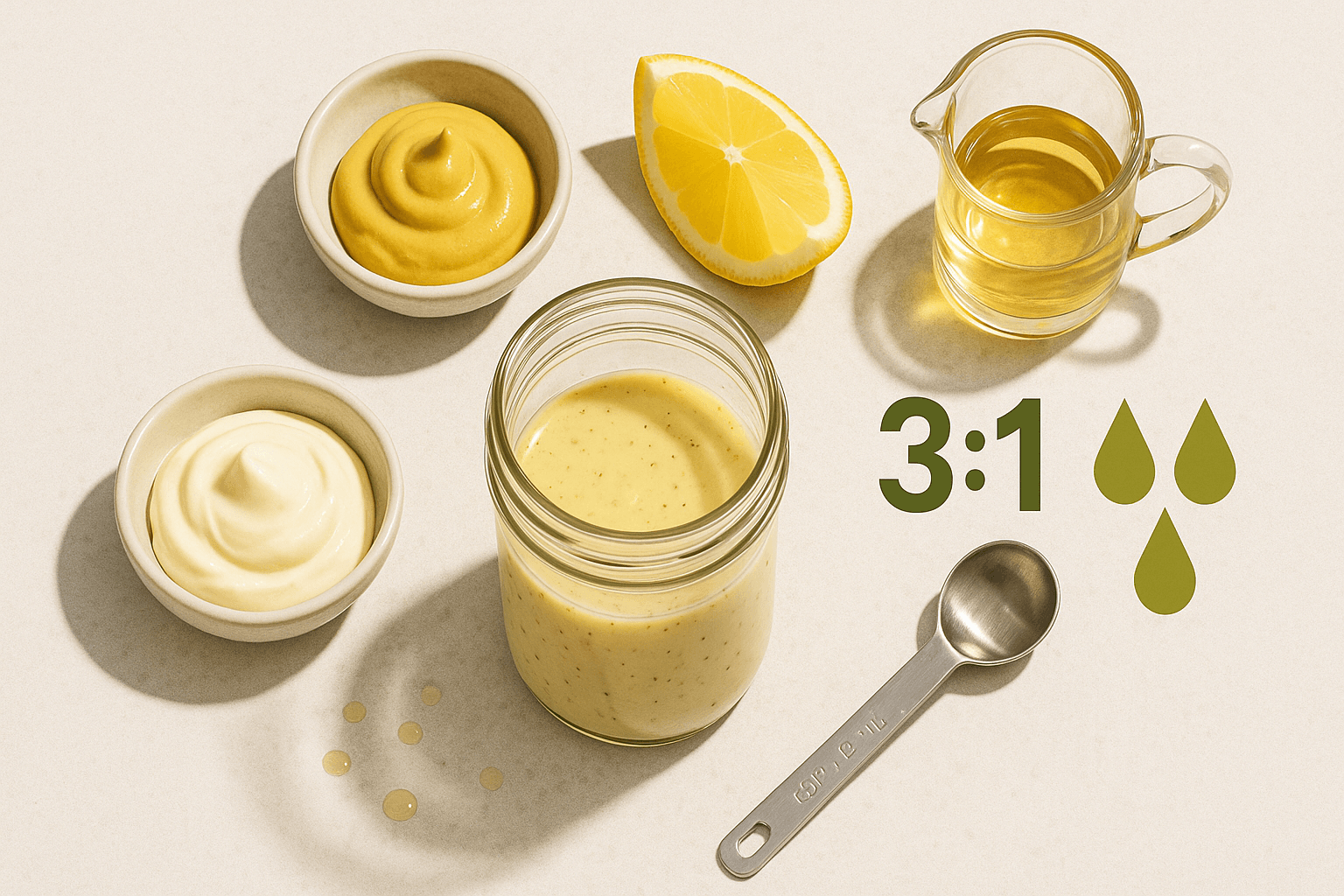
Why homemade dressing separates (and why that’s not a failure)
A classic vinaigrette is, at its core, a temporary truce between two liquids that don’t want to mix: oil (mostly nonpolar fat) and acid (water-based vinegar or citrus juice). When you whisk or shake them, you break the oil into tiny droplets and scatter those droplets through the watery phase. That’s called an emulsion.
The catch: without help, the droplets bump into each other, merge, and rise back into a distinct oil layer—separation. That’s normal physics (surface tension and density differences) doing what they do.
What home cooks usually want is not a “forever” emulsion (like shelf-stable commercial dressing), but a longer-lasting, re-shake-friendly emulsion that stays creamy on the plate, clings to greens, and doesn’t puddle at the bottom of the bowl.
This article is a practical blueprint for getting there: ratios that behave, emulsifiers that actually work, and timing/technique that turns “shakes for 2 seconds and splits instantly” into a dressing that holds.
Emulsion 101 in one minute: the three levers you control
To keep dressing from separating, you can pull three major levers:
-
Droplet size (mechanical force)
- Smaller droplets separate more slowly.
- You get smaller droplets with stronger mixing (vigorous whisking, blender, immersion blender, tight jar shake).
-
Emulsifiers (chemical helpers)
- Emulsifiers have a water-loving end and an oil-loving end, so they sit on the droplet surface and prevent droplets from merging.
- Examples: mustard, egg yolk, mayonnaise (already an emulsion), honey (weak but helpful), miso (good), tahini (good), garlic paste (surprisingly helpful), lecithin.
-
Viscosity/thickening (physical slowdown)
- Thicker watery phase slows droplet movement.
- Examples: xanthan gum, starch, yogurt, mayo, tahini, nut butters, tomato paste, pureed fruit, mucilage from mustard/garlic, even sugar and salt in certain ranges.
A stable homemade dressing usually uses at least two levers: better mixing + a real emulsifier; or a real emulsifier + thicker base.
The oil-to-acid ratio blueprint (and why it matters)
Most people learn “3 parts oil to 1 part acid.” That’s a useful starting point, but it’s not a law. Ratio affects:
- Flavor balance (sharp vs. mellow)
- Perceived thickness (more oil feels richer)
- Emulsion difficulty (more oil requires more emulsifier and/or more aggressive mixing)
A practical ratio ladder
Use this ladder to pick a ratio based on what you’re dressing.
1) Bright and punchy: 2:1 oil:acid
- Great for: sturdy greens (kale), roasted vegetables, grain salads, beans.
- Pros: tangy, wakes up hearty foods.
- Cons: can taste too sharp on delicate lettuces.
2) Classic restaurant vinaigrette: 3:1 oil:acid
- Great for: mixed greens, simple salads, everyday use.
- Pros: balanced; easy to tweak.
3) Soft and mellow: 4:1 to 5:1 oil:acid
- Great for: delicate greens (butter lettuce), salads with lots of bitter components (radicchio), very acidic vinegars.
- Pros: smooth, less bite.
- Cons: harder to keep emulsified unless you use mustard/mayo or blend.
Vinegar strength and type change the math
Not all acids hit the same:
- Distilled white vinegar is clean and sharp—use it sparingly.
- Red/white wine vinegar is medium sharp, classic.
- Balsamic is sweet and viscous—often emulsifies more easily.
- Apple cider vinegar has fruitiness and moderate sharpness.
- Citrus juice (lemon/lime) is aromatic but can “read” sharper than its pH suggests.
If your vinegar is particularly assertive, bump oil up (toward 4:1). If your acid is mellow (some balsamics), you can go down (toward 2:1 or 3:1) without it feeling harsh.
Mustard vs. mayo: which emulsifier should you choose?
Both work, but they behave differently—and they’re best suited to different styles.
Mustard: the vinaigrette workhorse
Why it works: Mustard contains natural emulsifying compounds and fine particles that help stabilize droplets. Dijon is especially reliable.
Best for:
- Classic vinaigrettes
- Herb vinaigrettes
- Shallot vinaigrettes
- Lemon vinaigrettes
How much to use:
- 1 teaspoon Dijon per 3/4 to 1 cup finished dressing is a strong starting point.
- For very stable emulsions (or higher oil ratios), go up to 1 tablespoon per cup.
Flavor effect: tangy, slightly spicy; can amplify sharpness in very acidic dressings.
Mayonnaise: the “cheat code” for stability
Mayonnaise is already a stable emulsion of oil and water held together by egg yolk lecithin. When you use mayo as your emulsifier, you’re essentially “bootstrapping” your dressing with a pre-built structure.
Best for:
- Creamy dressings (ranch-style, Caesar-adjacent)
- Thick deli-style vinaigrettes that cling
- Slaws and potato salads
How much to use:
- 1 to 3 tablespoons mayo per cup yields a lightly creamy, very stable dressing.
- 1/4 cup mayo per cup yields a thick creamy dressing.
Flavor effect: richness, slight sweetness, eggy roundness.
Which is more stable?
For most home applications:
- Mayo is more forgiving and stays emulsified longer.
- Mustard makes a “cleaner” vinaigrette and is plenty stable if you use good technique.
If you want a vinaigrette that behaves like a bottled dressing (without stabilizer additives), mustard + strong mixing is your best bet.
The underrated stabilizers: garlic, miso, tahini, and nut butters
If you’ve ever made a dressing with grated garlic or tahini and noticed it stays blended, you’ve seen viscosity and particulate stabilization in action.
- Garlic (microplaned or pasted): acts like a weak emulsifier; also adds “body.”
- Miso: emulsifies well, adds savoriness and salinity; particularly good in ginger-sesame styles.
- Tahini: powerful stabilizer; can seize with acid at first, then smooth out with gradual liquid addition.
- Nut butters: similar to tahini; great for peanut-lime or almond-lemon dressings.
These are especially useful for egg-free and dairy-free dressings where you want creamy stability.
Salt and sweeteners: how they change texture and stability
Salt: more than seasoning
Salt dissolves in the water phase and can:
- Enhance perceived thickness slightly (by changing how water interacts with dissolved solids)
- Pull moisture from garlic/shallots (creating a more flavorful, slightly thicker base)
- Improve overall flavor integration
Best practice: Add salt early so it dissolves fully in the acid/water phase before oil goes in.
Sugar, honey, maple, syrups
Sweeteners do three useful things:
- Balance acidity
- Increase viscosity in the water phase (slowing separation)
- Help “bridge” flavors, making dressings taste more cohesive
Honey and syrups also have minor emulsifying/structural benefits, but think of them primarily as thickeners + balancers, not miracle stabilizers.
Rule of thumb: For a cup of dressing, start with 1/2 to 2 teaspoons sweetener (more for bitter salads or very sharp vinegar).
The exact whisk/shake order that keeps vinaigrettes together
Technique matters as much as ingredients. The goal is to:
- Build a well-seasoned water phase (acid + salt + aromatics)
- Create a stable “base” with emulsifier
- Add oil slowly enough to create tiny droplets
The Whisk Bowl Method (most reliable for classic vinaigrettes)
For ~1 cup vinaigrette (3:1 ratio):
- 1/4 cup vinegar or lemon juice
- 3/4 cup oil (olive oil, avocado oil, etc.)
- 1 tsp Dijon mustard (or 2 tsp for extra stability)
- 1 small shallot, minced (optional)
- 1 small garlic clove, microplaned (optional)
- 1/2 tsp kosher salt (to start)
- Black pepper
- Optional: 1 tsp honey
Order:
- In a bowl, combine acid + mustard + salt + sweetener + aromatics.
- Whisk until the salt dissolves and the mixture looks uniform.
- While whisking constantly, drizzle in oil slowly—start with a thin stream.
- Once it thickens and looks glossy, you can add oil a little faster.
- Taste and adjust: more salt, more acid, or a touch more sweetener.
Why this works: You’re forming the emulsion gradually. Early on, the mustard and dissolved salt help stabilize the first droplets; once a stable network forms, it’s easier to incorporate the rest.
The Shake-Jar Method (fast, but timing matters)
A jar is convenient and surprisingly powerful, but only if you respect one rule: pre-dissolve salt and fully combine emulsifiers before adding all the oil.
Order:
- Add to jar: acid + mustard (or mayo) + salt + sweetener + aromatics.
- Shake 10 seconds until uniform.
- Add half the oil. Shake 15–20 seconds.
- Add remaining oil. Shake 15–20 seconds.
- Let rest 2 minutes, then shake again 5 seconds.
The “rest then reshake” trick: The brief rest lets bubbles rise and droplets redistribute; the final quick shake tightens the emulsion and improves cling.
Jar choice: Wide-mouth jars make it easier to clean and to add ingredients. Fill only to about 2/3 so there’s headspace to create shear during shaking.
Blender/Immersion Blender Method (smallest droplets, longest hold)
If you want the most stable vinaigrette with minimal effort:
- Blend acid + mustard + salt + sweetener + aromatics.
- With blender running, stream in oil.
The higher shear creates smaller droplets, meaning slower separation. This can keep a vinaigrette creamy for hours (sometimes days), depending on ingredients.
Vinaigrette styles that stay emulsified (with formulas)
Think in formulas, not rigid recipes.
1) Classic Dijon Vinaigrette (3:1)
- Acid: 1/4 cup wine vinegar
- Oil: 3/4 cup olive oil (or 1/2 olive + 1/4 neutral)
- Emulsifier: 1–2 tsp Dijon
- Seasoning: 1/2 tsp salt + pepper
Stability boost: Add 1 tsp honey or a microplaned garlic clove.
2) Shallot-Herb Vinaigrette (2.5–3:1)
- Add 2 tbsp minced shallot + 2–3 tbsp chopped herbs
Tip: Salt the shallots in the acid for 5 minutes before emulsifying. It softens harshness and thickens the base slightly.
3) Citrus Vinaigrette (often best at 2:1)
Citrus is volatile and can taste sharper; many cooks prefer more acid but also more emulsifier.
- 1/3 cup lemon juice
- 2/3 cup oil
- 1 tbsp Dijon
- 1–2 tsp honey
Creamy dressings: stability is easier (if you build the base right)
Creamy dressings typically separate less because they already contain a thickened continuous phase (mayo, yogurt, buttermilk, sour cream, blended tofu, etc.). Still, they can break or thin out if you add liquids in the wrong order.
The creamy dressing order
- Start with the thick base: mayo/yogurt/sour cream/tahini.
- Whisk in seasonings: salt, pepper, garlic, mustard, herbs.
- Add acid next (vinegar/lemon) to brighten.
- Thin gradually with water/buttermilk/oil as needed.
Adding acid to dairy can sometimes cause slight curdling if the dairy is very cold and the acid is added aggressively. Usually it’s cosmetic, but if it bothers you: warm the dairy slightly or add acid more slowly.
Example: Simple “House” Creamy Dressing
- 1/2 cup mayo
- 1/4 cup yogurt or buttermilk
- 1–2 tbsp lemon juice
- 1 tsp Dijon
- 1 small garlic clove, grated
- Salt and pepper
This stays cohesive for days in the fridge because mayo provides a stable emulsion and yogurt adds viscosity.
Dairy-free creamy dressings that stay blended
Dairy-free dressings often separate when they rely only on oil + acid without a strong emulsifier. Use bases that naturally emulsify.
Option A: Tahini-Lemon (classic Middle Eastern-inspired)
Tahini can look “broken” when acid hits it—it thickens and seizes—then becomes silky when you add water.
Formula:
- 1/3 cup tahini
- 1/4 cup lemon juice
- 1 small garlic clove, grated
- 1/2 tsp salt
- Water to thin (start with 1/4 cup, add gradually)
- Optional: 1–2 tbsp olive oil for richness
Order:
- Stir tahini + lemon + salt + garlic (it will thicken).
- Add water a tablespoon at a time, whisking until smooth and pourable.
Option B: Miso-Ginger Vinaigrette (stable without eggs)
Why it works: miso acts as both emulsifier and thickener.
- 2 tbsp white miso
- 2 tbsp rice vinegar
- 1 tbsp soy sauce
- 1 tbsp grated ginger
- 1/2 cup neutral oil
- Optional: 1 tsp sesame oil
Blend or whisk; drizzle oil in gradually for best stability.
Option C: Silken tofu base (neutral, ultra-creamy)
- 1 cup silken tofu
- 2–3 tbsp lemon juice
- 1 tbsp olive oil
- Garlic, salt, herbs
Blend until smooth. This behaves like a thick sauce and won’t split easily.
When emulsions “break” (and how to fix them)
A broken dressing usually means oil droplets have merged and separated out.
Quick fixes
Fix 1: Add a teaspoon of water and whisk hard
- Sometimes a tiny water addition helps re-form the water phase and disperse droplets.
Fix 2: Start a new base, then slowly whisk in the broken dressing
- In a bowl: 1 tsp mustard (or 1 tbsp mayo) + 1 tbsp acid.
- Whisk, then drizzle in the broken dressing as if it were oil.
Fix 3: Use an immersion blender
- Particularly good when you have aromatics and sweeteners already present.
The “cling” factor: making dressing coat greens instead of sliding off
Restaurant salads often taste better because the dressing is:
- Properly emulsified
- Slightly thicker
- Well-seasoned (salt matters)
To improve cling at home:
- Use a small amount of emulsifier (Dijon, mayo, tahini, miso).
- Dress warm or room-temp components (slightly warm roasted veg “grabs” dressing).
- Dry your greens well—water on leaves dilutes the water phase and encourages slipping.
- Add oil last and gradually to create a tighter emulsion.
Cultural context: emulsified sauces are everywhere
Understanding dressing stability gets easier when you recognize you’ve seen these techniques in many cuisines:
- Mayonnaise and aioli (European): egg-yolk lecithin stabilizes oil in water.
- Tahini sauces (Levant): sesame paste emulsifies with lemon and water.
- Miso and sesame dressings (Japan-inspired home cooking): fermented soybean paste adds body and emulsification.
- Peanut sauces (Southeast Asia): nut emulsions with acid/sugar balance.
- Salsa emulsions (some Latin American preparations): blending oil with acidic tomato/chile bases creates temporary emulsions.
Salad dressing is just one member of a big family of emulsified sauces.
A home-cook stability checklist (use this before you blame the recipe)
- Did you dissolve salt in the acid first?
- Did you include a real emulsifier? (Dijon, mayo, miso, tahini, egg yolk)
- Did you add oil gradually (or at least in two stages in a jar)?
- Did you mix hard enough? (10 seconds often isn’t enough; aim for 30–45 seconds of vigorous mixing)
- Is your ratio too oil-heavy for your emulsifier level? (5:1 needs more help than 3:1)
- Is the dressing too cold? (cold oil is thicker but can be less cooperative; some emulsions stabilize better closer to room temp)
Practical “emulsion blueprint” formulas (memorize these)
Blueprint 1: Stable everyday vinaigrette (jar-friendly)
- Acid: 1 part
- Oil: 3 parts
- Emulsifier: 1 tsp Dijon per cup
- Seasoning: 1/2 tsp salt per cup + pepper
- Optional: 1 tsp honey per cup
Jar timing: shake base 10 sec → add half oil shake 20 sec → add rest shake 20 sec → rest 2 min → quick shake.
Blueprint 2: Creamy-but-not-heavy (mayo “bridge”)
- 2 tbsp mayo
- 1/4 cup acid/watery ingredients combined (lemon + vinegar, or vinegar + water)
- 1/2 cup oil (optional; often you don’t need this much)
Whisk mayo + acid first, then drizzle oil if using.
Blueprint 3: Dairy-free creamy (tahini or miso)
- 1/3 cup tahini or 2 tbsp miso
- 1/4 cup acid
- Water to thin
- Oil optional
Storage, food safety, and make-ahead realism
- Vinaigrettes without fresh garlic/shallot: often fine 1–2 weeks refrigerated.
- With fresh garlic/shallot: best within 3–5 days for flavor; keep refrigerated.
- With dairy or egg-based ingredients: treat like perishable sauces; typically 5–7 days refrigerated.
Even stable homemade dressings may slowly separate in the fridge. That’s okay. The goal is that they re-emulsify easily with a quick shake.
Pro tip: If your olive oil solidifies in the fridge, let the jar sit at room temp 10–15 minutes, then shake.
Troubleshooting guide (fast diagnosis)
Problem: “It separates immediately.”
- Likely causes: no emulsifier; oil added too fast; weak shaking.
- Fix: add Dijon or mayo; re-emulsify with whisk or blender.
Problem: “It’s thick, but tastes harsh.”
- Likely causes: too much acid; sharp vinegar; not enough salt/sweet balance.
- Fix: increase oil slightly; add a pinch more salt; add 1/2 tsp honey.
Problem: “It’s greasy and doesn’t coat.”
- Likely causes: emulsion not formed; ratio too oil-heavy; greens too wet.
- Fix: whisk longer; add mustard; dry greens thoroughly.
Problem: “It looks broken after adding lemon.”
- Likely causes: acid added too abruptly to a thick base (tahini/dairy).
- Fix: add water gradually and whisk; or blend.
A final, practical mindset: stability is a design choice
Commercial dressings use stabilizers (xanthan gum, modified starches, lecithin) to remain uniformly mixed for months. At home, you can get remarkably close—without additives—by designing your dressing intentionally:
- Choose a sensible ratio (start at 3:1)
- Use a real emulsifier (Dijon or mayo are the easiest)
- Control order and timing (salt/acid first; oil last, gradually)
- Mix with enough force (whisk longer than you think, or blend)
Once you internalize that blueprint, you can invent dressings freely—swapping acids, oils, sweeteners, and aromatics—while still getting that restaurant-style, glossy emulsion that doesn’t split the moment it hits your salad.
References and further reading
- Harold McGee, On Food and Cooking (emulsions, mayonnaise, sauce stability)
- J. Kenji López-Alt, The Food Lab (practical emulsion technique and sauce methodology)
- Serious Eats (tested vinaigrette and mayonnaise technique articles; emulsion troubleshooting)
- Scientific discussions of emulsions and surfactants in food science texts (lecithin, droplet size, viscosity effects)