Homemade Stir‑Fry That Isn’t Soggy: Wok vs. Skillet Heat, Sauce Thickening Windows, and the “Cook‑Hold‑Combine” Method for Crisp Veg + Tender Protein
RecipeSimpli
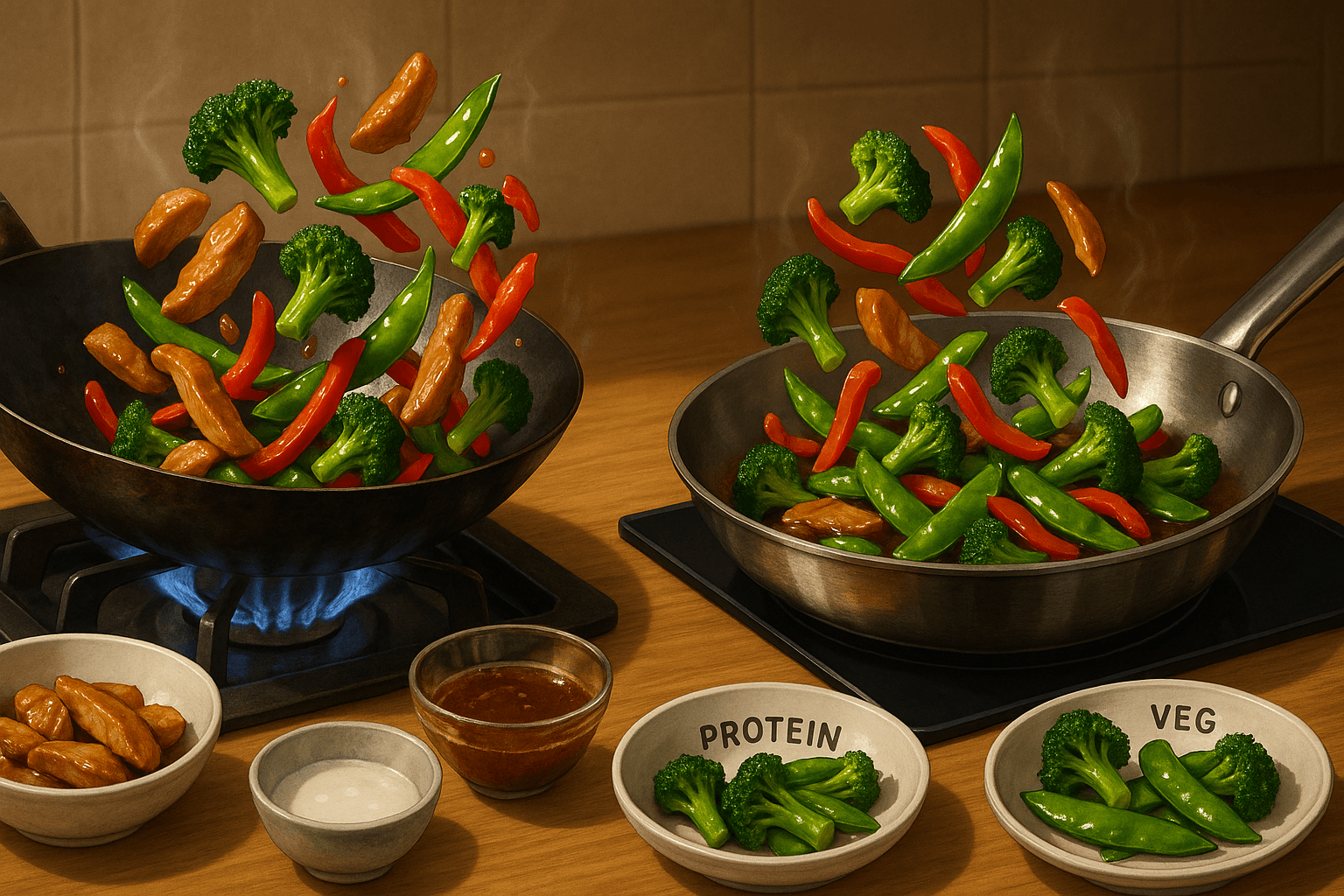
Stir‑fry is supposed to be fast, fragrant, and high‑contrast: crisp vegetables, tender meat (or tofu), glossy sauce that clings instead of pooling. Yet at home it often turns into something closer to a steamy braise—pale vegetables, rubbery protein, and a watery puddle at the bottom of the pan.
The good news: “Soggy stir‑fry” is usually not a recipe problem. It’s a heat management and sequencing problem.
This article gives you a practical, repeatable approach—built on culinary science and common restaurant technique—to make stir‑fries that taste like they came from a roaring burner.
You’ll learn:
- Why woks behave differently than skillets, and how to adapt either pan.
- How moisture works (and works against you) in quick cooking.
- The key concept of sauce thickening windows—when to reduce, when to thicken, when to add aromatics.
- The restaurant-style Cook‑Hold‑Combine method for crisp vegetables + tender protein.
- A flexible, reliable sauce ratio you can use for nearly any combination.
1) The Real Enemy: Water + Low Heat = Steaming
A stir‑fry turns soggy for one main reason: ingredients release water faster than your pan can evaporate it.
Where does that water come from?
- Vegetables: mushrooms, zucchini, cabbage, spinach, onions, and bean sprouts are especially water‑heavy.
- Proteins: if they’re wet from washing, thawing, or a thin marinade, they’ll dump water before browning.
- Sauce: too much liquid too early creates a simmering environment.
When the pan temperature drops and liquid accumulates, you get steam. Steam is great for dumplings; it’s not great for stir‑fry texture.
The goal
You’re trying to keep the cooking environment in the pan closer to:
- Searing + sautéing (hot metal + thin film of oil)
…rather than:
- Simmering (ingredients partially submerged in liquid)
This is why restaurants feel “magical”: they use very high heat and cook in portions. But you can get remarkably close at home with technique.
2) Wok vs. Skillet: Heat Physics in Your Kitchen
Why woks excel (especially on high‑power burners)
A classic round‑bottom or flat‑bottom wok gives you:
- A hot center for searing.
- Cooler sidewalls for pushing food up to pause cooking.
- A large surface area that can evaporate moisture quickly.
On a restaurant wok burner (often far above 20,000 BTU), this creates intense evaporation and fast browning.
Why skillets can be easier at home
Most home stoves—especially electric or induction—don’t deliver the same concentrated heat up the sides of a wok. A wok can actually underperform on weaker burners because only the bottom makes strong contact.
A 12-inch carbon steel skillet or heavy stainless skillet can outperform a wok on many home setups because:
- You get full, consistent contact with the heat source.
- The pan holds heat better (especially thicker pans).
Cast iron can work too, but it’s slower to respond; stir‑fry is about rapid adjustments.
Choosing based on your stove
- Gas (strong burner): wok is excellent.
- Electric coil / weaker gas: large skillet often wins.
- Induction: flat‑bottom wok works, but a skillet may heat more evenly unless you have a powerful induction hob designed for woks.
The practical takeaway
You don’t need a wok to avoid sogginess. You need:
- Enough heat
- Enough surface area
- The right sequencing so liquids don’t build up early
3) Mise en Place Isn’t Fancy—It’s Required
Stir‑fry is fast. That’s the point. But it means you can’t be chopping while the pan is hot.
Before you start cooking, set up:
- Protein sliced evenly (thin, across the grain when appropriate)
- Vegetables cut for similar cook times or grouped into “fast” and “slow” piles
- Aromatics (garlic, ginger, scallions)
- Sauce pre-mixed
- Slurry ready if using cornstarch (more on timing later)
If you do only one thing to improve your stir‑fry texture, do this: pre-mix the sauce. Pouring separate soy sauce, wine, stock, and sugar into the pan leads to uneven thickening and excess liquid.
4) Moisture Management: Dry Food Browns, Wet Food Steams
Dry your ingredients aggressively
This sounds minor until you see the difference.
- Pat proteins dry with paper towels before marinating (or after, if the marinade is watery).
- Spin or towel-dry washed vegetables.
- If using mushrooms, consider a dry sauté first (cook them in a dry pan until their water releases and evaporates, then add oil).
Salt strategically
Salt pulls water out of vegetables via osmosis. If you salt vegetables early, they can release water in the bowl and later in the pan.
- For crisp vegetables: season late or season with salty sauce at the end.
- For watery vegetables (zucchini, eggplant): sometimes a brief salt-and-rest can help, but then you must squeeze and dry before stir‑frying.
Don’t crowd the pan
Crowding is the fastest path to soggy stir‑fry.
When you overload a pan:
- The temperature drops
- Food releases moisture
- That moisture can’t evaporate fast enough
- Everything steams
A good rule: if the pan looks “full” before you even start tossing, it’s too full. Cook in batches and recombine.
5) Tender Protein Without Overcooking: Velveting, Simplified
Many restaurant stir‑fries have meat that’s tender but still seared. A common method is velveting, used across many Chinese cooking traditions.
What velveting does
A thin coating—often involving cornstarch and sometimes egg white—creates a protective layer that:
- Reduces moisture loss
- Buffers heat so the surface doesn’t toughen
- Helps sauce cling later
A home-friendly velveting formula (for ~1 lb / 450 g meat)
- 1 tbsp soy sauce (or 1/2 tbsp soy + 1/2 tbsp water)
- 1 tbsp Shaoxing wine (or dry sherry)
- 1 tsp sesame oil (optional)
- 1–1.5 tbsp cornstarch
- 1–2 tsp neutral oil
- Optional: 1 egg white (for extra silkiness)
Mix, coat sliced meat, rest 10–20 minutes.
Cooking velveted protein
Use one of these approaches:
A) Quick stir‑fry sear (most common at home)
- Heat pan until very hot
- Add oil
- Spread protein in one layer; don’t move for 30–60 seconds
- Toss briefly until ~80–90% cooked
- Remove to a plate (this is part of Cook‑Hold‑Combine)
B) Brief oil poach (more restaurant-like, more oil)
- Gently heat oil and slip in coated meat until it just turns opaque
- Drain, then finish in stir‑fry
Method A is usually enough for home cooks and uses less oil.
6) The Core Technique: Cook‑Hold‑Combine
If you’ve ever wondered why your vegetables go limp while you wait for chicken to cook, or why your beef turns chewy by the time the sauce thickens, this is the fix.
What it means
Instead of cooking everything continuously in one go, you:
- Cook each component quickly at high heat
- Hold it off-heat (on a plate or bowl)
- Combine at the end with a brief sauce-thickening finish
It’s not complicated—it’s just intentional sequencing.
Why it works
- You keep the pan hot (less crowding)
- You control doneness precisely (no overcooked protein)
- Vegetables stay crisp because they spend less total time in the pan
- Sauce thickens when it can actually cling (after the main water release)
7) Sauce Thickening Windows: Timing Is Everything
Most stir‑fry sauces include:
- Salty (soy, fish sauce)
- Sweet (sugar, honey)
- Acid (vinegar, citrus)
- Aromatic (garlic, ginger)
- Liquid body (stock, water)
- Thickener (cornstarch, potato starch)
The problem isn’t the ingredients—it’s when they hit the pan.
The three sauce phases
Phase 1: Aromatic bloom (10–20 seconds)
Aromatics release flavor into hot oil quickly—but they burn easily.
- Add garlic/ginger/scallion whites to hot oil
- Stir constantly
- As soon as fragrant, move on
If you add a full sauce mixture here and it’s watery, you can cool the pan instantly.
Phase 2: Reduction window (optional)
If your sauce is mostly thin liquid (stock + soy + wine), you can reduce it slightly in the empty pan before adding cornstarch.
Reduction concentrates flavor and evaporates excess water.
But don’t reduce a sauce that already has sugar heavily; it can scorch.
Phase 3: Thickening window (15–45 seconds)
Cornstarch thickens around the boil (roughly in the 90–95°C / 194–203°F range). It thickens fast.
Key rules:
- Add slurry at the end, not early.
- Re-stir slurry right before adding (starch settles).
- Add in a thin stream while stirring.
- Once glossy and clinging, stop cooking. Overcooking can thin it back out and dull the flavors.
Why “thicken at the end” prevents sogginess
Vegetables and proteins release moisture during cooking. If you thicken too early, that later moisture can:
- Dilute the sauce back into a thin puddle
- Force you to cook longer to re-thicken (overcooking everything)
So you want thickening to happen after the major moisture release—during the final combine.
8) A Flexible Stir‑Fry Sauce Ratio That Works
Instead of memorizing dozens of sauces, build one you can adapt.
The “Any Stir‑Fry” base (for ~3–4 servings)
Mix in a bowl:
- 3 tbsp soy sauce (or 2 tbsp soy + 1 tbsp tamari for depth)
- 2 tbsp Shaoxing wine (or dry sherry)
- 2 tbsp stock or water
- 1–2 tbsp sweetener (brown sugar, honey, or maple)
- 1 tbsp vinegar (rice vinegar or black vinegar) or citrus juice
- 1–2 tsp toasted sesame oil (optional)
In a separate small bowl (slurry):
- 2 tsp cornstarch + 2 tbsp cold water
This produces a medium-bodied sauce that coats without becoming gluey.
How to adapt it
- More savory: add 1 tsp oyster sauce or 1 tbsp hoisin (reduce sugar slightly)
- More heat: chili crisp, sambal, fresh chilies
- More numbing spice: toasted Sichuan peppercorn oil or ground peppercorn
- More brightness: increase vinegar; add at the end for sharper acidity
- Gluten-free: use tamari + dry sherry
A note on cornstarch amount
Many home recipes use too much starch. The result is a heavy, starchy sheen that cools into a gel.
If you want a lighter coat, start with 1.5 tsp cornstarch instead of 2.
9) A Practical Stir‑Fry Blueprint (Works for Almost Any Combo)
Here’s a repeatable sequence you can memorize.
Step 0: Prep
- Slice protein thin and evenly.
- Cut vegetables and group by cook time:
- Slow: carrots, broccoli, cauliflower, green beans
- Medium: bell peppers, onions, snap peas
- Fast: spinach, bean sprouts, scallion greens
- Mix sauce. Mix slurry separately.
Step 1: Preheat the pan properly
Preheating matters because you need stored heat to handle the temperature drop when food hits.
- Heat pan until a flick of water sizzles and evaporates quickly.
- Add oil and swirl.
Step 2: Cook protein (Cook) → remove (Hold)
- Spread protein in a single layer.
- Let it sear undisturbed briefly.
- Toss until mostly cooked.
- Remove to a plate.
If the pan has stuck bits (fond), that’s flavor. Don’t wash it.
Step 3: Cook vegetables in stages (Cook) → remove (Hold)
- Add a touch more oil if needed.
- Add slow vegetables first.
- Optional: add 1–2 tbsp water and cover for 30–60 seconds to jump-start cooking (a controlled steam), then uncover and let moisture evaporate.
- Add medium vegetables.
- Add fast vegetables last.
- Remove vegetables to a bowl when crisp-tender.
Step 4: Aromatics + sauce base
- Lower heat slightly if needed (garlic burns).
- Add aromatics for 10–20 seconds.
- Add sauce (without slurry) and bring to a simmer.
Step 5: Combine + thicken (Combine)
- Return protein and vegetables.
- Toss to coat and heat through.
- Re-stir slurry and drizzle in while tossing.
- Cook just until glossy and clinging.
Step 6: Finish for aroma and contrast
Off heat, add one or two:
- Toasted sesame oil (a few drops)
- Scallion greens
- Fresh herbs (cilantro, Thai basil)
- Chili oil
- A squeeze of lime
This protects delicate aromas from high heat.
10) Common Soggy Stir‑Fry Mistakes (and Fixes)
Mistake: Marinating in too much liquid
A watery marinade makes the first phase a steam bath.
Fix: Use a coating marinade (velveting) with starch and a little oil. Keep it clingy, not soupy.
Mistake: Adding sauce before vegetables are done releasing water
You thicken, then vegetables weep water, then the sauce breaks thin again.
Fix: Cook veg first; add sauce near the end; thicken during the final combine.
Mistake: One-pan, one-shot cooking
Everything stays in the pan the entire time, so something overcooks.
Fix: Cook‑Hold‑Combine. Use a plate. It’s allowed.
Mistake: Not preheating the pan
A lukewarm pan can’t sear; it steams.
Fix: Preheat until water skitters and flashes.
Mistake: Too much cornstarch
Sauce becomes gummy, then watery later.
Fix: Use less starch and thicken briefly.
11) Cultural Context: Stir‑Fry Is a Method, Not a Single Cuisine
“Stir‑fry” is often associated with Chinese cooking—and for good reason: the technique of chǎo (炒) is foundational in many Chinese regional cuisines. Wok cooking also spread and evolved across East and Southeast Asia.
But the core idea—small pieces, high heat, fast cooking, flavorful sauce—shows up in many forms:
- Cantonese-style glossy sauces
- Sichuan dry-fries with chilies and peppercorn
- Thai basil stir-fries (often finished with fish sauce and holy basil)
- Japanese-inspired yaki preparations
Understanding the method helps you adapt respectfully and successfully: manage heat, manage water, build flavor fast, and finish with balance.
12) Example Stir‑Fries Using the Blueprint
Example A: Chicken + Broccoli (classic, never soggy)
Best pan: skillet or wok
- Velvet chicken slices.
- Cook chicken, remove.
- Cook broccoli with a small splash of water + cover 45 seconds, then uncover to evaporate.
- Add garlic/ginger, add sauce, return chicken.
- Add slurry to gloss.
Tip: Keep broccoli relatively dry after washing; trapped water in florets is a stealth sauce thinner.
Example B: Beef + Bell Pepper + Onion (fast, high heat)
- Slice beef thin across the grain.
- Cook beef in a hot pan without crowding; remove.
- Cook onions/peppers quickly to keep snap.
- Sauce + return beef + thicken.
Tip: If beef releases water, your pan wasn’t hot enough or the beef was wet. Pat dry.
Example C: Tofu + Mushrooms + Snow Peas (vegetarian, moisture-heavy)
- Press tofu (even 15 minutes helps), cube, dust lightly with cornstarch, sear until golden; remove.
- Dry-sauté mushrooms first to drive off water; then add oil.
- Add snow peas late.
- Sauce + tofu back in + thicken quickly.
Tip: Mushrooms are the usual culprit. Pre-cooking them solves most texture issues.
13) Advanced Heat Control: Micro-Adjustments That Matter
Use oil correctly
You don’t need excessive oil, but you do need enough to create a thin conductive layer.
- Too little oil: sticking, tearing, uneven browning.
- Too much oil: greasy mouthfeel, sauce struggles to cling.
Keep food moving—except when you want browning
Tossing constantly can prevent browning. Let the pan do its job.
- Lay protein down; give it contact time.
- Then toss to finish.
Let steam escape
If liquid accumulates unexpectedly:
- Spread food out.
- Increase heat.
- Stop stirring for a moment to let moisture boil off.
If you keep stirring, you cool the surface and slow evaporation.
14) A Quick Troubleshooting Checklist
If your stir‑fry is watery right now, ask:
- Was my pan fully preheated?
- Did I crowd the pan?
- Were my ingredients dry?
- Did I cook veg/protein separately?
- Did I thicken at the end (slurry last)?
Fixing just two of these usually transforms results.
15) The Repeatable “No-Sog” Formula
If you want one mental model to keep forever:
- High heat + small batches keep you in the sear zone.
- Dry ingredients brown; wet ingredients steam.
- Cook‑Hold‑Combine protects texture.
- Thicken at the end during the sauce’s short window.
Once you get the rhythm, stir‑fry becomes what it’s meant to be: quick, flexible, and intensely satisfying—without the watery puddle.