Why Beans Cause Gas, Creaminess, or Blowouts: Seed Coat Chemistry, Soaking Myths, and the Salt‑Acid Timing Rules for Better Pots
RecipeSimpli
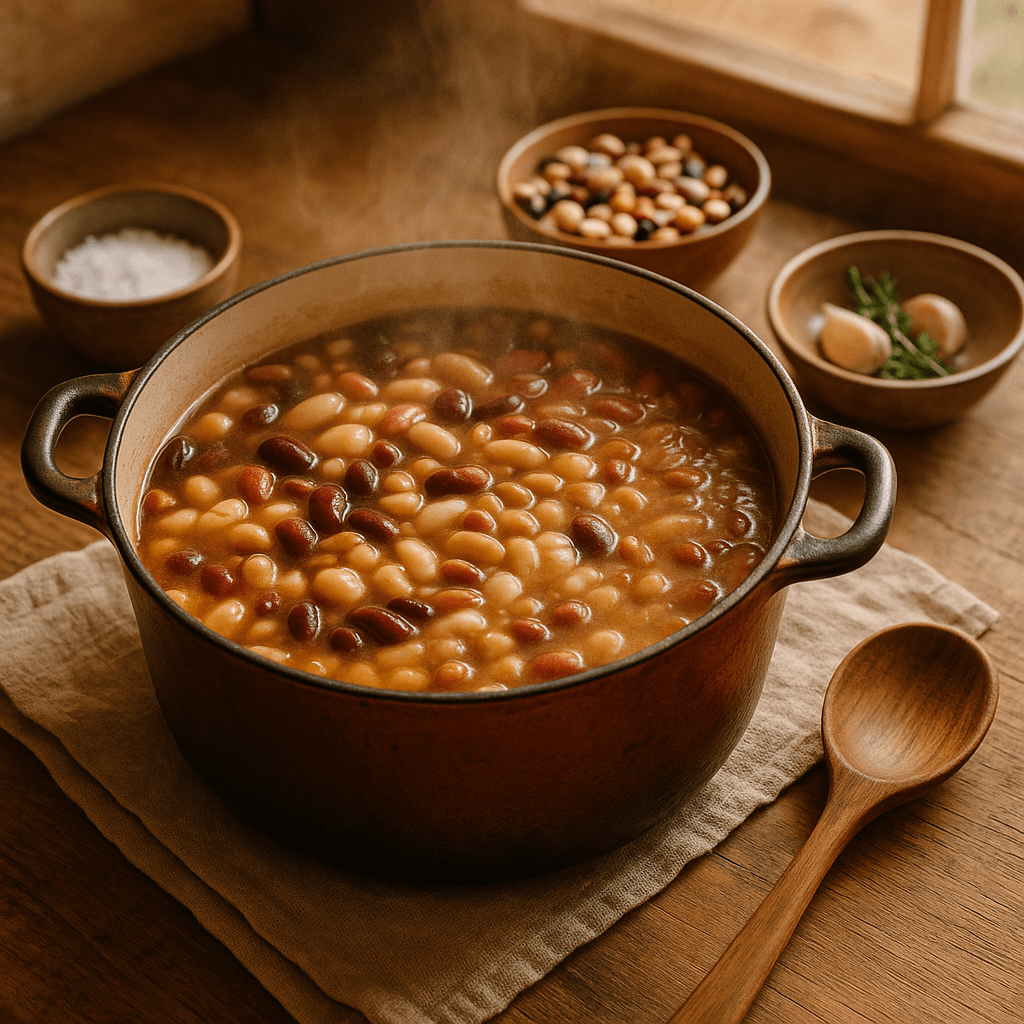
A pot of beans can feel like kitchen magic right up until it doesn’t. One batch comes out plush and creamy, with a broth that tastes rich even before you add olive oil. Another turns into a mess of burst skins, cloudy liquid, and mealy centers. Yet another stubbornly refuses to soften after hours on the stove, as if every bean has made a private vow against tenderness. And hovering over all of it is the oldest bean question of all: why do they make some people gassy, and can anything actually help?
Beans inspire more folklore than almost any humble pantry ingredient. You’ll hear that salt toughens them, that soaking is mandatory, that baking soda is a miracle, that tomatoes should never come near the pot, that old beans are fine forever, that kombu fixes digestion, that skimming foam changes everything. Some of these ideas contain a grain of truth. Some are backwards. Most make more sense once you understand that a dried bean is not just “a bean.” It is a seed with a skin, a matrix of starch and protein, naturally occurring minerals, and a chemistry set hidden inside its cell walls.
If you know what is happening to pectin, starch, calcium, magnesium, and water as beans cook, the usual kitchen mysteries become manageable. You can decide whether you want distinct beans for a salad, spoon-coating creaminess for a stew, or a little strategic breakdown to thicken a braise. You can dramatically lower the risk of split skins and muddy broth. You can season with more confidence. And while no technique can turn beans into a zero-gas food for everyone, you can improve digestibility in practical, evidence-based ways without leaning on kitchen superstition.
Why dried beans behave so differently in the pot
A dried bean is a dormant seed. Its outside is the seed coat, often called the skin. Inside are storage tissues packed with starch granules and proteins that will feed the plant when it germinates. The bean’s structure is held together by cell walls made partly of pectic substances, hemicellulose, and cellulose. For cooks, pectin matters most because it helps determine whether a bean stays intact, softens evenly, or resists tenderness.
When you cook beans, several things happen at once:
- Water moves through the seed coat into the interior.
- Starch granules absorb water and swell.
- Proteins denature.
- Cell wall materials gradually loosen.
- Pectin in the middle lamella, the “glue” between cells, changes in ways that affect tenderness and whether cells separate into a creamy texture.
That balance is why one bean variety cooks up floury and another silky. It is also why bean age, mineral content in water, and acidity can swing texture so dramatically.
Broadly speaking, creaminess comes from cells becoming tender and starchy without the seed coat rupturing too violently. Blowouts happen when the interior hydrates and expands faster than the skin can accommodate, or when agitation and rapid boiling physically tear the seed coat. Tough beans often result when the cell-wall matrix remains reinforced, especially in the presence of calcium and magnesium, or when age-related changes create the so-called hard-to-cook defect.
The chemistry of creaminess: pectin, starch, and cell separation
The dream bean has two textures at once: a skin that stays mostly intact and an interior that turns smooth and custardy. That effect depends on how the inner cells soften and separate.
Inside the bean, starch granules gelatinize as they absorb water and heat. For many beans, this happens across roughly 180 to 205°F / 82 to 96°C, though exact behavior depends on variety and moisture level. As cooking continues, cell walls weaken and the pectins that help bind cells together become more soluble. The result is that the interior can go from chalky to creamy.
But starch is not enough on its own. If cell walls remain too rigid, the bean can be fully hydrated yet still seem firm or grainy. If they weaken too fast while the skin remains tight or unevenly hydrated, the bean may split. Creaminess is really controlled disassembly: enough structural breakdown for tenderness, not so much that the bean collapses into sludge.
Some bean varieties are simply better at this than others. Smaller beans with thinner skins, like black beans, often give up a creamy interior relatively easily. Cannellini and Great Northern beans can become lush and silky but are also more prone to splitting if boiled hard. Chickpeas have denser structure and usually hold shape longer. Lentils and split pulses are another world entirely because their small size and, in some cases, removed skins accelerate hydration and breakdown.
Why beans split: the anatomy of a blowout
A blowout is not just cosmetic. Split skins often release starch into the cooking liquid, making the broth cloudy or “muddy.” Sometimes that is useful if you want a thicker pot liquor. More often, especially for soups, cassoulet-style dishes, or composed bean salads, you want the beans whole and glossy.
Beans usually split for four main reasons:
-
Uneven hydration If the outer layers and interior take up water at very different rates, the inside may swell before the skin has relaxed enough.
-
Excessive heat A rolling boil bangs beans against each other and pushes rapid expansion. Gentle simmering is much kinder to skins.
-
Age and dryness Older beans often hydrate more erratically and may develop skins that detach or interiors that soften unevenly.
-
Acid too early Acidic ingredients can slow skin and cell-wall softening, increasing the chance that pressure builds under a still-firm coat.
To reduce blowouts, treat beans more like poached eggs than pasta. Once the pot reaches a simmer, aim for lazy movement, not turbulent bubbling. On most stoves, that means adjusting the burner to maintain about 185 to 205°F / 85 to 96°C in the liquid. A few bubbles around the edges and occasional movement in the center are enough.
The mineral story: calcium and magnesium can keep beans firm
One of the most important, least discussed variables in bean cooking is the mineral content of both the beans and the water. Calcium and magnesium can cross-link with pectin, strengthening the structure that holds plant cells together. In plain language, these minerals can make beans firmer and slow softening.
This is why hard water can be such a nuisance. If your tap water leaves scale in your kettle or tastes notably mineral-rich, it may be prolonging bean cooking. You can test this by cooking a small batch in filtered or bottled low-mineral water. Many home cooks are shocked by the difference.
Beans themselves also contain calcium and magnesium naturally, and older beans often become harder to soften because of changes over storage that interact with pectins and membranes. This is one reason two bags of the “same” bean can cook very differently.
There is a flip side. Salt in the cooking water often helps, not hurts. That brings us to one of the most persistent myths in bean cooking.
The salt myth: why salting the water often improves beans
For years, cooks were told never to salt beans until the end because salt would toughen them. In practice, moderate salting of the cooking water usually makes beans more evenly seasoned and often more tender-skinned, not tougher.
Why? Sodium ions can help displace some calcium and magnesium associated with pectin structures in the seed coat and outer tissues. That can encourage more even softening. Salted water also seasons beans all the way through instead of leaving you with bland interiors and a salty broth.
A good starting point is:
- 1 tablespoon Diamond Crystal kosher salt per 2 quarts / 2 liters water
- or 1 1/2 to 2 teaspoons Morton kosher salt per 2 quarts / 2 liters water
- or about 10 to 12 grams fine sea salt per 2 liters water
That is enough to matter without making the final dish aggressively salty. If you use broth, cured meats, or salty aromatics later, keep total salt in mind.
If you are nervous, split a batch. Cook half in unsalted water and half in lightly salted water. Most people notice that the salted batch tastes better and often cooks at least as well, sometimes better.
What soaking really does, and what it doesn’t
Soaking is probably the most mythologized step in all of bean cooking. It is useful, but not magical.
What soaking does
A soak, whether overnight or quick, mainly does three things:
-
Hydrates beans before cooking This shortens total cooking time and promotes more even hydration.
-
Can reduce some surface dirt, broken skins, and loose compounds Discarding soak water removes what leaches into it.
-
May reduce some gas-producing oligosaccharides modestly Raffinose-family sugars, including raffinose and stachyose, are water-soluble to a degree. Some leach out during soaking.
What soaking does not do
- It does not guarantee tenderness if beans are old.
- It does not fully eliminate gas.
- It does not make salt unnecessary.
- It does not fix damage from hard boiling or early acid.
Overnight soak vs quick soak
For most medium beans, an overnight soak of 8 to 12 hours in plenty of water works well. Use about 3 quarts / 3 liters water per 1 pound / 450 grams dried beans. Room temperature is fine in a cool kitchen; in a hot kitchen, refrigerate after the first hour or two if you are concerned about fermentation.
A quick soak is useful if you forgot to plan ahead:
- Rinse 1 pound / 450 grams beans.
- Cover with 3 quarts / 3 liters water.
- Bring to a boil for 2 minutes.
- Turn off heat, cover, and let stand 1 hour.
- Drain, rinse if desired, and cook.
Quick soaking hydrates reasonably well, though often not as evenly as a long soak.
Soak water: keep it or dump it?
For digestibility, discarding soak water may help a little because some oligosaccharides dissolve into it. For flavor, the difference is usually small if you are cooking in fresh water with aromatics. If you have very clean, high-quality beans and want to retain every soluble flavor compound, you can cook in the soak water, but for most home cooks I think draining and cooking in fresh water is the easier, cleaner, more predictable option.
Why beans cause gas in the first place
Beans are rich in fiber and contain oligosaccharides, especially raffinose-family sugars that humans do not fully digest in the small intestine because we lack the enzyme alpha-galactosidase. Those sugars reach the large intestine, where gut microbes ferment them, producing gas.
That means gas is not a sign that beans are “bad” or improperly cooked. It is partly a normal consequence of fiber-rich food meeting a microbial ecosystem.
Still, several factors influence how gassy a pot feels:
- Bean variety: Some people tolerate lentils, split peas, adzuki beans, or black-eyed peas better than large kidney beans or chickpeas.
- Portion size: Jumping from almost no legumes to a huge bowl is asking a lot from your gut.
- Preparation: Soaking and draining can modestly reduce oligosaccharides.
- Doneness: Thoroughly cooked beans may be easier to digest than undercooked ones.
- Individual microbiome: This varies enormously from person to person.
Practical ways to reduce gas:
- Start with small portions, around 1/4 to 1/2 cup cooked beans if you are increasing bean intake.
- Prefer smaller or thinner-skinned beans at first.
- Soak and drain dried beans before cooking.
- Cook beans until fully tender; chalky centers are harder on digestion and less pleasant anyway.
- Eat beans regularly rather than rarely; many people adapt over time.
- If appropriate for you, an alpha-galactosidase enzyme supplement can help significantly.
Contrary to a lot of folk wisdom, aromatics like bay leaves, epazote, cumin, fennel, ginger, or kombu may improve flavor and perhaps subjective digestibility for some people, but they do not reliably erase the underlying carbohydrate issue. Use them because they taste good and may help a bit, not because they are chemistry cheats.
The acid rule: when tomatoes, wine, vinegar, and citrus help or hurt
Acid is both a blessing and a timing problem. Acidic ingredients make bean dishes lively and balanced. But if added too early, they can slow softening by stabilizing pectin and slowing the breakdown of cell-wall materials, especially in the skin and outer tissues.
That is why a pot of beans started directly in a strongly acidic tomato sauce may stay stubborn for ages.
A useful home rule is:
- Add strongly acidic ingredients after beans are mostly tender.
“Mostly tender” means the beans are no longer chalky and can be mashed between fingers or against the roof of your mouth with only slight resistance. At that point, adding tomatoes, vinegar, lemon juice, tamarind, wine, or molasses is far less risky.
Exceptions exist. A small onion, a few garlic cloves, or a modest splash of wine in a large pot is usually not catastrophic. But if the dish contains a lot of tomatoes or a substantial acidic braising liquid, wait.
A good timing guideline for 1 pound / 450 grams soaked beans:
- Start beans in water with salt and aromatics.
- Begin checking doneness after 45 minutes for small beans, 60 minutes for medium beans, and 75 minutes for larger beans.
- Add acidic ingredients when beans are about 80 to 90% done.
- Simmer another 10 to 30 minutes, depending on the dish.
Old beans versus fresh-crop beans: one of the biggest hidden variables
Fresh-crop beans are one of the great underappreciated ingredients. They cook faster, more evenly, and often taste sweeter and fuller. Older beans are still usable, but they can develop the infamous hard-to-cook defect, where they seem to hydrate but resist becoming tender.
Over time in storage, especially in warm or humid conditions, bean cell membranes and wall structures change. Pectins can become less amenable to dissolution, and minerals may contribute to stronger cross-linking. The result is a bean that takes much longer and may never achieve ideal creaminess.
Signs your beans are old:
- They take dramatically longer than expected, often 2 to 4 hours or more even after soaking.
- Some beans soften while others remain firm.
- The skins slough off or split before interiors become creamy.
- Flavor seems flat or dusty.
If you buy from stores with low turnover, bean age can be wildly variable. Better bets:
- Shop where dried beans move quickly.
- Look for harvest dates if available.
- Buy from specialty producers if beans are central to your cooking.
- Store beans in a cool, dry, dark place and use them within a year for best results.
Should you use baking soda?
Baking soda is effective, but it is a blunt instrument.
An alkaline environment helps break down hemicellulose and pectic substances faster, so beans cook more quickly and soften more thoroughly. If you are dealing with very old beans or hard water, a tiny amount can rescue a batch.
But too much baking soda causes problems:
- Mushy exteriors
- Split skins n- Soapy or metallic flavor
- Excessive nutrient loss in some vitamins
- A pot that goes from firm to collapsing very fast
If you need it, use restraint:
- Add 1/8 teaspoon baking soda per 1 pound / 450 grams dried beans to the soaking water or cooking water.
That tiny amount is often enough. I would not use it routinely for fresh, good-quality beans unless you specifically want a softer, more broken-down result, such as for hummus or refried beans.
Step-by-step: a science-based method for better pots of beans
Here is a reliable home-kitchen method for 1 pound / 450 grams dried beans, which yields about 5 to 6 cups cooked beans.
1. Sort and rinse
Spread beans on a tray or plate and remove stones, shriveled beans, and debris. Rinse under cool water.
2. Optional but helpful: soak
Place beans in a large bowl and add 3 quarts / 3 liters cold water. Add 1 tablespoon Diamond Crystal kosher salt if you like a brine soak, which can help with skin tenderness and seasoning. Soak 8 to 12 hours.
Drain. Rinse lightly if desired.
If you skip soaking, increase cooking time substantially and expect a slightly higher risk of uneven hydration, especially with large beans.
3. Choose your cooking liquid wisely
Place beans in a pot and cover with 2 to 2 1/2 quarts / 2 to 2.5 liters fresh water. If your water is hard, use filtered low-mineral water.
Add:
- 1 tablespoon Diamond Crystal kosher salt or equivalent
- 1 small onion, halved
- 2 to 4 garlic cloves, smashed
- 1 to 2 bay leaves
- Optional: 1 small strip kombu
Avoid adding tomatoes, vinegar, lemon juice, or large amounts of wine at this stage.
4. Bring up gently
Set over medium heat and bring to a bare simmer. Skim obvious foam if you want a cleaner broth, but do not obsess. Foam is mostly proteins and saponins; removing it has modest effects on final texture.
Once simmering, reduce heat so the pot stays around 190 to 200°F / 88 to 93°C. Cover partially.
5. Cook patiently
Stir rarely and gently. Violent stirring encourages split skins.
Approximate simmer times after soaking:
- Black beans: 45 to 75 minutes
- Pinto beans: 60 to 90 minutes
- Navy beans: 45 to 75 minutes
- Cannellini / Great Northern: 60 to 90 minutes
- Chickpeas: 75 to 120 minutes
- Kidney beans: 75 to 105 minutes
Without soaking, add anywhere from 30 to 90 minutes or more depending on bean type and age.
6. Check doneness correctly
Taste several beans from different parts of the pot. A bean is done when:
- The center is fully creamy, not chalky.
- The skin is tender, not papery.
- It can be pressed easily between fingers.
- The broth tastes bean-rich rather than raw or starchy.
For salads or dishes where the beans will cook again later, stop when they are just tender. For purées, stews, or “pot liquor” style beans, go a little further.
7. Add acid later
When beans are nearly done, add your acidic ingredients:
- 1 to 2 cups crushed tomatoes
- or 1 to 2 tablespoons vinegar
- or 1/4 cup wine
- or citrus juice to taste
Simmer until flavors meld, usually 10 to 30 minutes.
8. Cool with care
If you are not serving immediately, let beans cool in their cooking liquid for the best texture. This reduces surface drying and can help them stay plump.
Refrigerate in liquid up to 5 days, or freeze up to 3 months.
Special safety note: kidney beans
Red kidney beans contain high levels of phytohaemagglutinin, a lectin that can cause severe digestive distress if beans are undercooked. Slow cookers may not always reach a high enough temperature fast enough.
For dried kidney beans:
- Soak if desired.
- Boil vigorously in fresh water for at least 10 minutes at the start of cooking.
- Then reduce to a simmer until fully tender.
Do not cook raw kidney beans from dry entirely in a low slow cooker.
How to get different textures on purpose
Once you know the rules, you can steer texture intentionally.
For intact, glossy beans
Best for salads, marinated beans, and composed soups.
- Use fresher beans.
- Soak overnight.
- Cook in lightly salted, low-mineral water.
- Keep the heat at a gentle simmer.
- Stir minimally.
- Add acid only near the end.
- Cool in the cooking liquid.
For creamy beans with rich broth
Best for bowl beans, stews, braises, and toast toppings.
- Choose naturally creamy varieties like cannellini, Great Northern, black beans, or pintos.
- Soak or brine-soak.
- Salt the cooking water.
- Simmer gently but long enough to let a small portion of beans break down.
- Mash a spoonful against the side of the pot near the end to thicken broth.
- Finish with olive oil or butter for extra body.
For deliberate breakdown
Best for hummus, dal-like textures, bean soups, and refried beans.
- Consider a pinch of baking soda, especially for chickpeas.
- Cook a little beyond standard doneness.
- Stir more freely late in cooking.
- Purée or mash while hot.
Common mistakes that lead to disappointing pots
1. Boiling too hard
This is probably the most common cause of blowouts and ragged beans.
2. Adding acid too early
Tomatoes from the start can dramatically slow softening.
3. Using very old beans without adjusting expectations
Sometimes the problem is not your technique. It is the bag.
4. Undersalting the cooking water
This leaves bland interiors and may forgo some texture benefits.
5. Assuming soak time solves everything
Soaking helps hydration, but it is not a cure-all for old beans, hard water, or rough simmering.
6. Judging doneness by one bean
Different beans in the same pot can lag. Taste several.
7. Using hard water unknowingly
If beans always take forever in your kitchen, your water may be the hidden culprit.
Variety matters more than many recipes admit
If your main goals are creaminess and easy digestion, choice of bean can do as much as technique.
Good bets for creamy, relatively forgiving pots:
- Black beans
- Pinto beans
- Great Northern beans
- Cannellini beans
- Navy beans
Good bets for firm shape retention:
- Chickpeas
- Black-eyed peas
- Small red beans
If you are sensitive to gas, try starting with:
- Lentils
- Split peas
- Adzuki beans
- Black-eyed peas
These are not universal truths, but they are useful starting points.
Seasoning timing beyond salt and acid
Aromatics can go in early because they flavor the cooking liquid without usually interfering much with texture:
- Onion
- Garlic
- Bay
- Herbs like thyme or rosemary
- Dried chiles
- Black peppercorns
- Kombu
Sugary ingredients are best added later, especially if they come with acid, as in barbecue sauce, molasses-rich baked bean sauces, or sweet tomato mixtures. Sugar itself does not toughen beans as dramatically as acid can, but concentrated sauces can slow penetration and change how the surface cooks.
Fat can be added early or late. Early-added olive oil or pork fat contributes flavor, but adding fat near the end preserves brighter aromas. For the cleanest bean flavor and the easiest texture assessment, many cooks add most fat after the beans are tender.
A practical troubleshooting guide
Problem: Beans are still hard after 2 hours
Possible causes:
- Old beans
- Hard water
- Too much acid too early
Fixes:
- Switch to fresh low-mineral water if practical.
- Keep simmering gently.
- Add 1/8 teaspoon baking soda per pound if they are clearly stalled.
- Accept that very old beans may never be ideal.
Problem: Beans are splitting badly
Possible causes:
- Boiling too hard
- Uneven hydration
- Acid too early
- Variety with delicate skins
Fixes:
- Lower heat immediately.
- Soak next time.
- Delay acids.
- Stir less.
Problem: Broth is cloudy and muddy
Possible causes:
- Many burst beans
- Excessive stirring
- Hard boil
Fixes:
- Simmer gently.
- Handle less.
- Use the starch to your advantage in a stew, or strain and rebuild if you need a cleaner presentation.
Problem: Beans are tender but skins seem loose
Possible causes:
- Age
- Wide temperature swings
- Fast hydration and rough simmering
Fixes:
- Cool in liquid.
- Buy fresher beans.
- Maintain steadier heat next time.
The big takeaways
The best bean cooking is less about secret ingredients than about respecting a seed’s structure. Beans become creamy when starch gelatinizes and cell walls soften in balance. They stay intact when hydration is even and simmering is gentle. They resist tenderness when calcium, magnesium, age, or acid reinforce the wrong structures at the wrong time.
Soak if it helps your schedule and texture goals, but do not treat it like a law of nature. Salt your cooking water with confidence. Save acidic ingredients until beans are mostly tender. Be suspicious of old beans and hard water before you blame yourself. Simmer gently, taste often, and choose varieties that match the result you want.
And on the gas question, the truth is refreshingly unromantic: beans contain fermentable carbohydrates, your gut microbes eat them, and some gas is normal. You can reduce it with soaking, variety choice, gradual adaptation, and thorough cooking, but no bay leaf is going to negotiate a total cease-fire.
What you do get in return is one of the most economical, nourishing, and deeply satisfying foods in the kitchen. A well-cooked pot of beans can be brothy and elegant, creamy and rustic, or sturdy enough for salads and braises. Once you understand the chemistry, you stop cooking them by fear or folklore. You cook them on purpose.