Why Cabbage Stays Crunchy, Melts Down, or Smells Funky: Pectin Chemistry, Sulfur Compounds, and the Heat Rules for Slaws, Stir-Fries, and Braises
RecipeSimpli
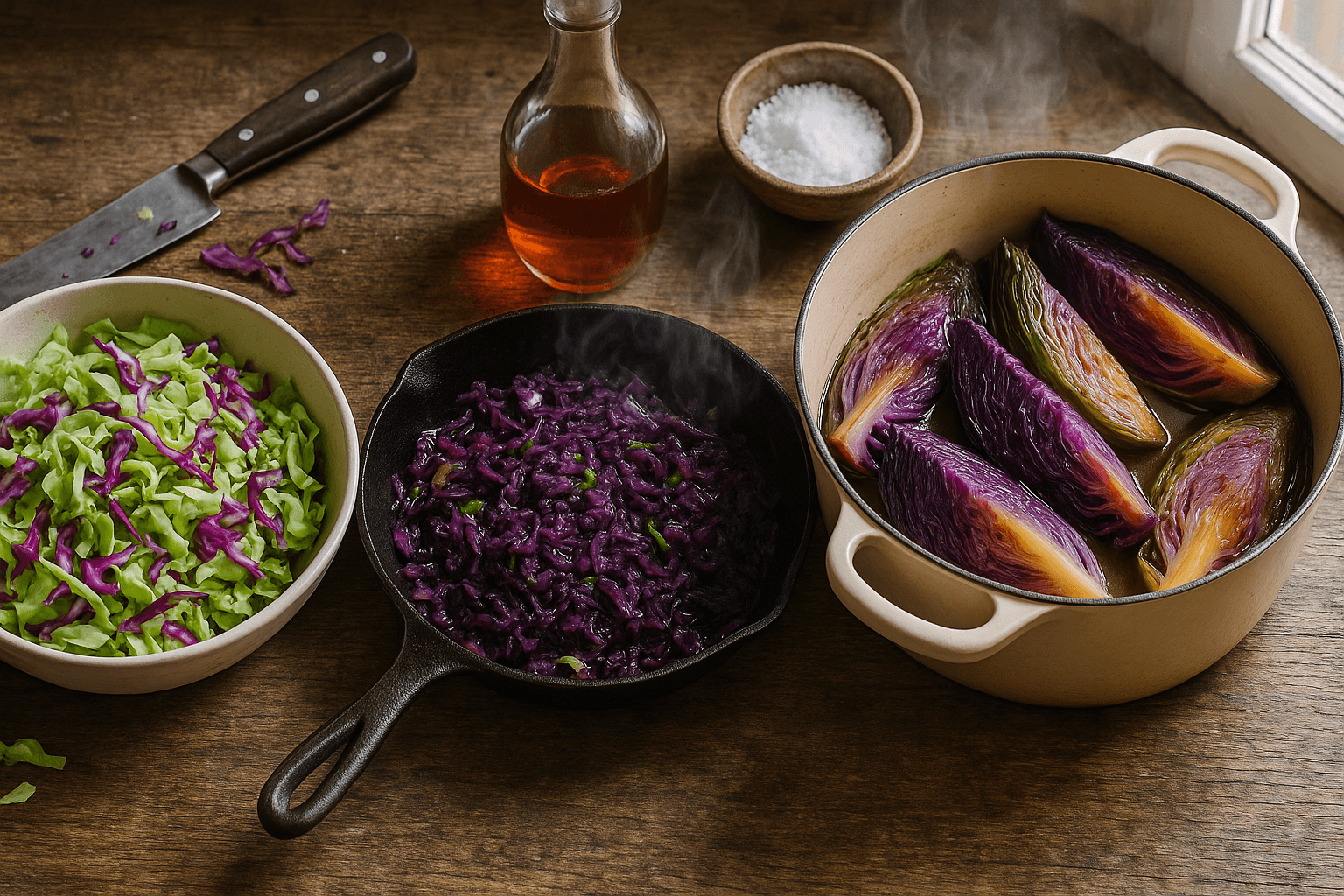
Cabbage is one of the most dramatic vegetables in the kitchen. Treat it one way and it stays loud and crisp, all snap and peppery sweetness. Treat it another and it relaxes into silky ribbons or spoon-tender wedges. Leave it too long over the wrong kind of heat and suddenly the whole kitchen smells like boiled brassicas gone rogue. Few vegetables swing so widely between fresh, sweet, savory, funky, and sulfurous.
That unpredictability is exactly why cabbage rewards understanding. Its texture is governed by pectin and cell walls. Its smell is shaped by sulfur-containing compounds that can read as pleasantly mustardy, deeply savory, or aggressively overcooked depending on how you cut and heat it. Its color—especially in red cabbage—is tied to anthocyanin pigments that shift with acidity and alkalinity. And its water behavior changes dramatically with salt, slicing, and time.
Once you know those rules, cabbage becomes less of a bargain-bin backup vegetable and more of a precision ingredient. You can build a slaw that stays crisp instead of weeping into a puddle. You can stir-fry cabbage so it tastes sweet and toasty instead of limp and wet. You can braise it until lush and tender without crossing into sulfur-heavy mush. And you can understand why green and red cabbage, while close relatives, do not always behave the same in the pan or on the plate.
Why cabbage has such a wide range of textures
Cabbage belongs to the brassica family, alongside broccoli, kale, Brussels sprouts, cauliflower, and mustard greens. Structurally, it is a tightly packed head of leaves composed of water-filled cells, fibrous veins, and a middle lamella—the pectin-rich material that helps glue plant cells together.
When you bite raw cabbage, what you are feeling is not just “freshness.” You are feeling intact cell walls, internal water pressure, and pectin still holding cells in a firm architecture. Cabbage is mostly water—roughly 92 to 93 percent by weight—but that water is trapped inside a structure sturdy enough to deliver crunch.
Whether cabbage stays crunchy or melts down depends largely on three things:
- How much the cells lose water
- How much the pectin network weakens
- How much heat and time damage cell walls and dissolve structure
A quick slaw preserves most of the internal architecture. A hot stir-fry softens the leaves just enough to make them supple while preserving some bite. A long braise eventually breaks down the pectin and softens the fiber enough that the leaves slump into tenderness.
That broad range is why cabbage can play so many roles across cuisines: crunchy in coleslaw, charred in a wok, sour-crisp in sauerkraut, buttery and yielding in braised red cabbage, sweet and jammy in soups and stews, and deeply savory in stuffed or roasted forms.
A quick cultural map of cabbage cookery
Cabbage is global because it is affordable, durable, and nutritionally dense. Northern and Eastern European cuisines use it in soups, braises, stuffed rolls, and fermented preserves. German sauerkraut, Polish bigos, Russian and Ukrainian cabbage soups, and Danish sweet-sour braised red cabbage all rely on manipulating acidity, salt, and time.
Across East Asia, napa cabbage and head cabbage appear in stir-fries, pickles, dumpling fillings, and savory pancakes. Chinese stir-fries often showcase the magic of very high heat, where cabbage turns sweet, lightly smoky, and glossy before sulfur notes have time to dominate. In Japan, shredded raw cabbage accompanies fried foods because its crispness and moisture cut richness. Korean kimchi demonstrates cabbage’s ability to remain texturally lively while undergoing deep microbial transformation.
In the Americas, cabbage became central to slaws, curtidos, chowchow, braises, and skillet dishes because it stores well and adapts to both fresh and cooked preparations. It is one of those ingredients that can be peasant food, comfort food, and restaurant food all at once.
Green cabbage versus red cabbage: why they behave differently
Green and red cabbage are close cousins, but not exact twins.
Green cabbage
Green cabbage tends to taste milder, sweeter, and more neutral when cooked. It often softens a little faster in sautés and braises and is generally the more flexible all-purpose choice. It browns more discreetly, and because its pigment is pale, color changes are less dramatic.
Red cabbage
Red cabbage usually has a slightly firmer texture, a bit more peppery bite, and a stronger visual identity. Its red-purple color comes from anthocyanins, pigments that are highly sensitive to pH. In acidic conditions, red cabbage stays vibrant red-purple. In neutral or alkaline conditions, it drifts toward blue or grayish tones.
That means red cabbage often benefits from a splash of acid in cooking—vinegar, wine, apple cider, lemon juice—not only for flavor but for color preservation. It also often takes a bit longer to tenderize in braises than green cabbage, especially if cooked with acid from the very beginning.
The acid paradox in red cabbage
Here is where cooking science gets interesting: acid helps keep red cabbage brightly colored, but acid can also slow softening. That is because acidic environments help stabilize pectin, making plant tissues hold onto structure longer.
So if you want bright color and some bite, add acid early. If you want maximum tenderness, cook the cabbage most of the way first, then add the acid later.
This is especially useful in braised red cabbage. Start with fat, onions, and cabbage; let it soften for 20 to 30 minutes, then add apples, vinegar, wine, or jam later so you keep color without locking in too much toughness.
The texture science: pectin, calcium, salt, and slicing
Pectin: the vegetable glue
Pectin is a family of structural polysaccharides concentrated in plant cell walls and in the middle lamella between cells. In practical kitchen terms, pectin is part of what holds plant tissues together.
As cabbage cooks, pectin changes. With enough heat and time, the pectin network weakens, the cells separate more easily, and the leaves soften. This is why a quick sauté makes cabbage flexible, while a long braise turns it silky.
But pectin does not behave the same under all conditions.
- Acid slows pectin breakdown, preserving firmness.
- Longer cooking eventually softens structure, but acid can delay it.
- Alkaline conditions can soften vegetables faster, but at a big cost: worse flavor, mushier texture, and drab color. This is why baking soda is generally a terrible idea with cabbage, especially red cabbage.
Salt and water loss
Salt changes cabbage texture long before heat enters the picture. Sprinkle shredded cabbage with salt and two things happen:
- Salt draws water out of the cells by osmosis.
- The leaves soften and become more pliable as turgor pressure drops.
This is useful in slaws, where a controlled amount of water loss can season the cabbage and make it easier to dress. It is also useful in dumpling or fritter fillings, where too much moisture would dilute flavor and create sogginess.
But salt can also overdo it. If you heavily salt cabbage and leave it too long, you get limp strands and a pool of expelled liquid. For a slaw, that can mean watery dressing and dulled crunch.
Slicing thickness matters more than many recipes admit
A 1 mm shred behaves differently from a 1 cm wedge.
- Fine shreds lose water quickly, soften quickly, and absorb dressing quickly.
- Medium ribbons keep more crunch and are better for longer-lasting slaws.
- Large chunks or wedges retain moisture and structure, making them ideal for roasting and braising.
Cut also affects aroma. The more finely you cut cabbage, the more cells you rupture. More cell rupture means more enzyme activity and more release of pungent sulfur-related compounds. That is one reason a very finely shredded cabbage can smell stronger than thick wedges even before cooking.
The smell science: glucosinolates, enzymes, and sulfur compounds
Cabbage’s signature aroma comes from sulfur chemistry.
Brassicas contain compounds called glucosinolates. When cabbage cells are damaged by slicing, pounding, chewing, or blending, enzymes such as myrosinase come into contact with glucosinolates and begin converting them into new compounds, including isothiocyanates and other sulfur-containing molecules.
Some of those compounds smell pleasantly sharp, mustardy, green, or radish-like. In moderate amounts they make cabbage taste lively. But prolonged cooking, especially in plenty of water or at low simmer for too long, can produce more sulfurous volatiles, including notes associated with overcooked brassicas.
Why low heat can smell funkier than high heat
This seems backward until you think about time.
- High heat, short time quickly softens the outer structure, drives off surface moisture, encourages browning, and develops sweetness before too many sulfur compounds build up.
- Low heat, long time, especially in water, gives sulfur compounds more time to form, dissolve, and accumulate in the cooking environment.
That is why stir-fried cabbage can taste sweet and almost nutty, while boiled cabbage can smell assertively sulfurous. It is not only the temperature—it is the combination of temperature, moisture level, and duration.
Venting matters
If you are boiling or braising cabbage, especially green cabbage, keeping the pot partially uncovered for at least part of the cooking can help volatile sulfur compounds escape instead of condensing and reabsorbing. This is an old kitchen trick with a real chemical basis.
Fat helps flavor, not magic
Cooking cabbage in butter, bacon fat, schmaltz, or oil does not eliminate sulfur compounds, but it helps balance them with sweetness, richness, and aromatic browning products. It can also improve flavor distribution and mouthfeel, making cooked cabbage seem rounder and less sharp.
Sweetness versus funk: the heat rules
If you remember only one section from this whole article, make it this one.
For crisp, fresh cabbage
Use no heat or minimal heat. Control water with careful salting. Dress close to serving unless you want a softened slaw.
For sweet, lightly tender cabbage with preserved bite
Use high heat and short cooking: wok, skillet, grill, or hot oven.
For soft, silky, savory cabbage
Use moderate heat with enough moisture and time to break down pectin—but not endless simmering.
For sulfur-heavy, tired cabbage
The danger zone is typically too much time in moist heat, especially with lots of water, weak seasoning, and no browning.
Here are practical targets:
- Raw slaw: 0 minutes cooking; salt 10 to 30 minutes if desired
- Quick sauté/stir-fry: 4 to 8 minutes over high heat
- Roasted wedges: 20 to 30 minutes at 425°F / 220°C
- Braised ribbons: 30 to 50 minutes at a gentle simmer
- Braised wedges: 45 to 75 minutes at 325°F / 165°C oven or low stovetop
- Boiled cabbage: best kept brief, about 5 to 8 minutes for shreds or 10 to 15 minutes for wedges, unless you specifically want very soft cabbage
Raw cabbage: how to build slaws that stay crisp instead of watery
A great slaw is not just chopped cabbage and dressing. It is water management.
The goal
You want enough water loss to season and slightly tenderize the cabbage, but not so much that it collapses or floods the bowl.
A dependable slaw method
For 1 pound / 450 g shredded cabbage:
- 1 pound / 450 g green, red, or mixed cabbage, shredded
- 1 1/4 teaspoons kosher salt (about 6 g Diamond Crystal; use less if using fine salt)
- Optional: 1 teaspoon sugar
- 1 to 2 carrots, grated, optional
- 2 tablespoons cider vinegar or lemon juice
- 2 to 4 tablespoons mayonnaise, yogurt, sour cream, or neutral oil depending on style
- 1 teaspoon Dijon mustard, optional
- Black pepper to taste
Method
- Toss the shredded cabbage with the salt and optional sugar.
- Let sit 15 to 20 minutes for a crisp slaw, or 30 minutes for a more relaxed texture.
- Massage lightly for a softer slaw, or do not massage at all for maximum crunch.
- Drain off any accumulated liquid, or spin briefly in a salad spinner if very wet.
- Add acid and dressing ingredients just before serving.
Why this works
The salt lowers turgor pressure and seasons the cabbage internally. Draining removes excess water that would otherwise thin the dressing. Dressing later preserves crunch because acid and salt continue to soften cabbage over time.
Common slaw mistakes
- Dressing too early: The slaw weeps and loses crispness.
- Too much salt: The cabbage becomes limp and aggressively seasoned.
- Too fine a shred: Good for taco slaws or sandwich toppings, but it softens fast.
- Not balancing acid: Without enough acid, slaw can taste flat; too much acid can make it harsh.
Best cut for slaws
For a classic slaw, aim for ribbons about 2 to 3 mm wide. Thinner than that, and the cabbage softens quickly. Thicker than that, and dressing may not cling as evenly.
Quick sauté and stir-fry: where cabbage gets sweet
This is the technique that changes many people’s relationship to cabbage. Instead of simmering it into submission, you hit it hard with heat.
Why high heat works
High heat evaporates moisture rapidly, which concentrates sugars and allows some browning at the edges. Browning is especially likely once the pan is not overcrowded and surface water has cooked off. You get sweetness, nuttiness, and lightly charred notes with less sulfur accumulation.
A dependable stir-fry formula
For 1 pound / 450 g cabbage:
- 1 pound / 450 g cabbage, cut into 1/2-inch / 1.25 cm ribbons or rough squares
- 1 1/2 tablespoons neutral oil, lard, or bacon fat
- 2 cloves garlic, sliced
- 1 teaspoon grated ginger, optional
- 1/2 teaspoon kosher salt to start
- 1 to 2 teaspoons soy sauce or fish sauce, optional
- 1 teaspoon rice vinegar or lemon juice at the end, optional
Method
- Heat a large skillet or wok over high heat until very hot.
- Add the fat, then the garlic and ginger; stir for 10 to 15 seconds.
- Add the cabbage and salt.
- Stir-fry 3 to 5 minutes for lightly wilted cabbage, or 6 to 8 minutes for more browning and tenderness.
- Add soy sauce or fish sauce in the last minute.
- Finish with a small splash of acid off heat.
Pan rules
- Do not overcrowd the pan. If needed, cook in batches.
- A wide skillet often works better than a small wok on a weak home burner.
- Let the cabbage sit undisturbed for 20 to 30 seconds occasionally to encourage blistering and browning.
What to expect by minute
- Minute 1 to 2: Leaves shine, edges begin to soften.
- Minute 3 to 4: Sweetness increases; aroma turns toasty and vegetal.
- Minute 5 to 6: More browning; texture moves from crisp-tender to tender.
- Minute 7+: Risk of over-softening rises unless you are intentionally going for a more collapsed sauté.
Braising: how cabbage melts down gracefully
Braising is where cabbage moves from sturdy to luxurious. But braising is not “cook forever and hope.” It is a controlled breakdown of structure.
What braising does
Braising surrounds cabbage with moderate heat and some moisture, giving pectin time to weaken and fibers time to soften. Fat coats the leaves, aromatics infuse them, and the cabbage’s natural sugars become more prominent.
The ideal braising environment
You want enough liquid to generate steam and prevent scorching, but not so much that the cabbage boils blandly. Think shallow moisture, not soup.
For 2 pounds / 900 g cabbage:
- 2 tablespoons butter, oil, or bacon fat
- 1 onion, sliced
- 2 pounds / 900 g cabbage, sliced into ribbons or cut into 6 to 8 wedges
- 1 to 1 1/2 teaspoons kosher salt
- 1 cup / 240 ml stock, water, cider, or wine
- 1 tablespoon vinegar, added later if desired
- Black pepper to taste
Method for ribbons
- Heat the fat in a Dutch oven over medium heat.
- Add onion and cook 5 to 7 minutes until soft.
- Add cabbage and salt. Toss until slightly wilted, about 5 minutes.
- Add the liquid, cover partially, and cook over low heat or in a 325°F / 165°C oven for 30 to 45 minutes, stirring once or twice.
- Uncover for the last 5 to 10 minutes if you want excess liquid to reduce.
- Add vinegar near the end for brightness.
Method for wedges
- Brown the cut sides in fat first, about 3 to 4 minutes per side.
- Add the liquid around the edges, not over the tops.
- Cover and cook at 325°F / 165°C for 45 to 75 minutes, depending on size.
- Check with a paring knife: it should slide in with little resistance but the wedge should still hold shape.
Why braised cabbage sometimes stays stubbornly tough
- Too much acid added too early
- Pieces cut too large for the cooking time
- Not enough heat to sustain a gentle braise
- Insufficient salt
- Very old cabbage, which may have drier, tougher leaves
Why braised cabbage sometimes turns mushy and smelly
- Too much liquid, effectively boiling it
- Cooking too long past tenderness
- Lid on tightly the whole time with no venting
- No browning or flavor-building before the liquid goes in
Red cabbage braise: balancing color and tenderness
Red cabbage is its own special case because color matters almost as much as texture.
A practical red cabbage formula
For 2 pounds / 900 g red cabbage:
- 2 tablespoons butter or duck fat
- 1 onion, sliced
- 1 apple, sliced
- 2 pounds / 900 g red cabbage, shredded or sliced
- 1 1/2 teaspoons kosher salt
- 1/2 cup / 120 ml apple cider or red wine
- 1/2 cup / 120 ml stock or water
- 2 tablespoons cider vinegar
- 1 to 2 tablespoons brown sugar, currant jelly, or maple syrup
- 2 cloves, optional
Best sequence
- Soften onion and apple in fat for 5 to 8 minutes.
- Add cabbage and salt; cook until starting to wilt, about 8 minutes.
- Add cider or wine and stock; cover and cook 20 to 30 minutes.
- Add vinegar and sugar for the second half of cooking.
- Continue until tender, another 15 to 25 minutes.
This delayed-acid method lets the cabbage soften more efficiently before the pectin-tightening effect of acid fully sets in, while still preserving that jewel-toned color.
Fermentation: why cabbage can stay crisp while becoming sour
Fermented cabbage looks like magic until you break it down scientifically. Salt draws moisture from the cabbage, creating brine. Lactic acid bacteria convert sugars into lactic acid. The increasingly acidic environment preserves the cabbage, changes flavor, and helps control undesirable microbes.
Why fermented cabbage is not the same as simply salted cabbage
In a plain salted slaw, salt softens cabbage and draws out water. In fermentation, salt does that too, but then acid accumulates gradually through microbial action. That acid changes flavor, safety, and texture over days or weeks.
Why sauerkraut can still have bite
Because fermentation does not necessarily involve high heat, many structural components remain relatively intact. Salt softens the cabbage, but the leaves can stay pleasantly resilient rather than cooked-soft. Temperature, salt concentration, and time all matter.
Basic fermentation ratio
For sauerkraut, a common target is 2.0 to 2.25 percent salt by weight.
For 1 kilogram cabbage, use 20 to 22.5 grams salt.
Massage until enough brine forms to submerge the cabbage, then ferment at roughly 65 to 72°F / 18 to 22°C for 1 to 3 weeks, depending on taste.
Warmer ferments move faster and can soften texture more. Cooler ferments move slower and often preserve crunch better.
Color science: why red cabbage turns blue, dull, or brilliant
Red cabbage is a kitchen pH indicator disguised as a vegetable.
Its anthocyanins respond to acidity:
- Acidic: brighter red-magenta
- Near neutral: purple
- Alkaline: blue to greenish, often dull
This is why red cabbage cooked in hard water or with alkaline ingredients can lose its appetizing vibrancy. It is also why a spoonful of vinegar can rescue the color.
Rules for vivid red cabbage
- Add 1 to 2 tablespoons vinegar per pound / 450 g at some point in cooking.
- Avoid baking soda.
- Minimize prolonged high-pH environments.
- Cook covered only as much as needed, then vent to reduce liquid and brighten flavor.
What about green cabbage color?
Green cabbage contains chlorophyll, which also reacts to heat and acidity, though less dramatically than red cabbage’s anthocyanins. Acid can dull green vegetables toward olive tones over long cooking. But with cabbage, texture and sulfur management are usually the bigger concern than preserving a bright green color, since head cabbage is often pale to begin with.
Common mistakes across all cabbage cooking
1. Overcrowding the pan
This is the fastest route to steamed, watery sautéed cabbage. If the pan is crowded, moisture cannot evaporate quickly enough.
2. Adding acid at the wrong time
Early acid is great for slaws and color retention, but it can slow tenderization in braises.
3. Cooking too long in too much water
This dilutes sweetness, increases sulfur perception, and destroys texture.
4. Under-salting
Cabbage has a lot of water. It needs enough seasoning to taste lively. Start with about 3/4 teaspoon kosher salt per pound / 450 g for cooked preparations, then adjust.
5. Using the wrong cut for the dish
Fine shred for a quick taco slaw? Great. Fine shred for a long braise? It may vanish. Thick wedges for a delicate creamy slaw? Awkward.
6. Ignoring age and storage
Fresh cabbage is heavy for its size, tightly packed, and moist. Old cabbage can be stronger-smelling, drier, and tougher. Remove any dried outer leaves and increase cooking time if needed.
A decision guide: matching technique to outcome
If you want maximum crunch
- Choose fresh cabbage
- Slice medium-fine, not ultra-fine
- Salt lightly and briefly, if at all
- Dress at the last minute
- Keep acid moderate
If you want sweet, savory tenderness with some bite
- Use a hot skillet or wok
- Avoid overcrowding
- Cook 4 to 6 minutes
- Finish with a little soy, butter, or vinegar
If you want silky, spoonable cabbage
- Braise with moderate moisture
- Salt properly
- Cook 35 to 60 minutes depending on cut
- Add acid later if tenderness matters
If you want vibrant red color
- Use red cabbage
- Add acid
- Avoid alkaline ingredients
- Do not overcook into gray-purple oblivion
If you want less funk
- Favor high heat and short cooking or controlled braising
- Avoid prolonged boiling
- Vent the pot when appropriate
- Use aromatics and fat
Three practical mini-recipes
1. Crisp weeknight slaw
Serves 4
- 12 ounces / 340 g green cabbage, shredded
- 8 ounces / 225 g red cabbage, shredded
- 1 teaspoon kosher salt
- 1 tablespoon sugar
- 2 tablespoons cider vinegar
- 3 tablespoons mayonnaise
- 1 teaspoon Dijon
- 1 small carrot, grated
- Black pepper
Toss cabbages with salt and sugar; let sit 20 minutes. Drain well. Toss with carrot, vinegar, mayonnaise, Dijon, and pepper just before serving. This slaw stays crisp because the pre-salting removes excess water before the dressing goes in.
2. Hot skillet cabbage with garlic and chili
Serves 4
- 1 pound / 450 g green cabbage, cut into rough 1-inch pieces
- 1 1/2 tablespoons neutral oil
- 2 garlic cloves, sliced
- 1/2 teaspoon red pepper flakes
- 3/4 teaspoon kosher salt
- 1 teaspoon soy sauce
- 1 teaspoon rice vinegar
Heat a 12-inch skillet until very hot. Add oil, garlic, and chili; cook 10 seconds. Add cabbage and salt. Cook 5 to 6 minutes, tossing and allowing occasional contact with the pan for browning. Add soy sauce in the last minute and vinegar off heat. The result is tender-crisp, sweet, and aromatic, not sulfurous.
3. Gentle braised red cabbage with apple
Serves 6
- 2 tablespoons butter
- 1 onion, sliced
- 1 apple, sliced
- 2 pounds / 900 g red cabbage, sliced
- 1 1/2 teaspoons kosher salt
- 1/2 cup / 120 ml apple cider
- 1/2 cup / 120 ml water
- 2 tablespoons cider vinegar
- 1 tablespoon brown sugar
Cook onion and apple in butter until softened. Add cabbage and salt; cook 8 minutes. Add cider and water; cover and cook at low heat 25 minutes. Stir in vinegar and sugar; cook 20 minutes more, partially covered, until tender and glossy.
The big takeaways
Cabbage is not one texture, one flavor, or one smell. It is a vegetable whose behavior follows clear physical and chemical rules.
- Crunch comes from intact cells, internal water pressure, and pectin holding tissues together.
- Softness comes from water loss, heat damage to cell walls, and pectin breakdown over time.
- Sulfur aromas come from glucosinolate chemistry, especially after cutting and during prolonged moist cooking.
- High heat and short cooking usually preserve sweetness and limit funk.
- Low, wet, extended cooking can create deeper savoriness—but also sulfurous aromas if pushed too far.
- Salt manages water and texture.
- Acid brightens flavor and preserves red cabbage color, but can slow softening.
- Slice size determines how quickly cabbage loses water, softens, and absorbs seasoning.
Once you understand that, every cabbage dish becomes easier to control. Want a slaw with crackling freshness? Salt lightly, drain wisely, and dress late. Want wok-seared sweetness? Use more heat, less crowding, and less time. Want a soft, luxurious braise? Give pectin enough time to yield, but don’t trap the cabbage in a bland, waterlogged simmer.
And if your kitchen ever starts smelling a little too aggressively “cabbage,” that is not bad luck. It is chemistry telling you that the balance of cut, heat, moisture, and time has shifted. The good news is that chemistry is learnable—and cabbage, humble as it is, is one of the best teachers in the vegetable drawer.