Why Corn Tortillas Crack, Puff, or Turn Chewy: Nixtamalization Chemistry, Masa Hydration, and the Comal Heat Rules
RecipeSimpli
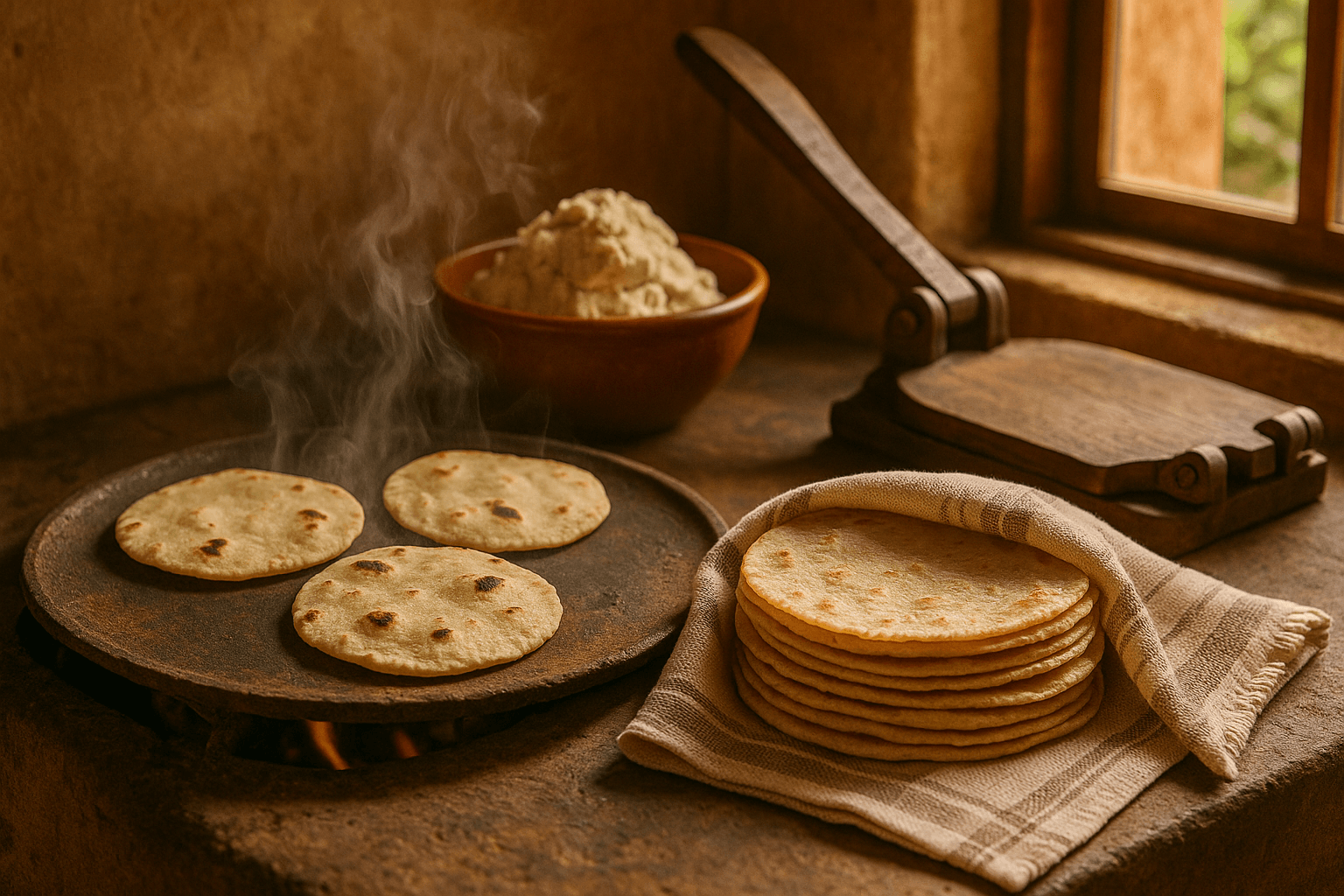
A great corn tortilla looks almost impossible in its simplicity: just maize, water, and heat. But anyone who has made them at home knows how quickly that simplicity turns humbling. One batch cracks around the edges as you press it. Another sticks to the plastic and tears. Some cook up stiff and dry, others come out oddly chewy, and the most maddening batch of all refuses to puff no matter how confidently you flip it. Then, every so often, a tortilla balloons on the comal like it has taken a perfect breath, and suddenly you understand why people spend years chasing this craft.
That puff is not luck. Neither are the cracks, the gumminess, or the chew. Corn tortillas are one of the clearest examples in cooking of chemistry becoming texture in real time. The treatment of the corn, the way the dough absorbs water, the fineness of the grind, the length of the rest, the pressure of the press, and the exact surface temperature of the comal all decide whether your tortilla becomes tender and aromatic or dense and disappointing.
If wheat dough is all about gluten development, corn tortilla dough is about managing a completely different set of structural forces: hydrated starch, fragmented corn particles, dissolved and reformed pectin, calcium from lime, and steam. Understanding those forces makes tortilla making much less mysterious. It also makes you better at troubleshooting because every failure points to a physical cause.
This is a science-first guide, but it is meant for real kitchens. We will cover what nixtamalization actually does to corn, why fresh masa and masa harina behave so differently, how particle size and rest time affect cracking, and how comal heat controls steaming, browning, flexibility, and puffing. Along the way, we will ground the craft in the regional traditions that make tortillas far more than a side bread. In much of Mexico and Central America, tortillas are tableware, staple, utensil, identity, memory, and regional expression all at once. Learning to read masa with your hands and the comal with your eyes is part chemistry, part tradition, and all practice.
Tortillas Begin with Nixtamalization, Not Just Corn
Corn tortillas are not made from ordinary ground dry cornmeal. Their flavor and behavior depend on nixtamalization, the ancient Mesoamerican process of cooking and soaking dried corn in an alkaline solution, traditionally water with cal—food-grade calcium hydroxide, often called slaked lime.
A classic home-style nixtamalization ratio is about 1% cal by weight of the dry corn, sometimes slightly more. For 1 kilogram dried field corn, that means roughly 10 to 15 grams cal dissolved into 3 liters water. The corn is simmered until the skins loosen and the kernels soften somewhat, then rested in that alkaline liquid for hours, often overnight. Afterward, the corn—now called nixtamal—is rinsed and ground into masa.
That alkaline soak changes almost everything important about the tortilla.
What nixtamalization does chemically
1. It loosens the pericarp.
The outer skin of the kernel, called the pericarp, is tough and fibrous. Alkalinity helps break down hemicellulose and weakens the structure holding that skin in place. This is why the skins rub off during washing.
2. It changes pectin and cell adhesion.
The glue-like materials that help plant cells stick together behave differently in alkaline conditions. Some structures weaken, which helps the corn grind into a cohesive dough rather than a gritty meal.
3. It affects starch hydration and gelatinization behavior.
The cooking step partially hydrates and softens the starch granules. The later grinding process smears and disperses those starches and fine corn particles into a dough that can hold together without gluten.
4. It boosts calcium content.
Some calcium from the lime enters the kernels. Nutritionally, this matters. Tortillas made from properly nixtamalized corn contain substantially more calcium than untreated corn products.
5. It changes aroma and flavor.
Nixtamalized corn smells unmistakably different from plain cornmeal. It is deeper, warmer, more savory, more floral, and often slightly mineral in a good way. That tortilla-shop aroma—the one that smells like toasted corn, warm cereal, earth, and sweetness—is nixtamalization at work.
6. It improves niacin availability.
One of nixtamalization’s most important historical nutritional effects is making niacin more bioavailable. This is one reason the process was so significant in Mesoamerican food systems and why populations relying heavily on untreated corn could suffer deficiency diseases when the process was not used.
Why nixtamalized corn behaves like dough and plain cornmeal does not
If you simply grind dry corn into meal and add water, you get wet grit. It may be edible as porridge or useful in certain breads, but it will not form a pliable tortilla dough with the same flexibility and cohesion. Nixtamalization and wet grinding create a matrix of softened corn particles, damaged starch, and moisture that can be pressed into a thin disc and survive turning on a hot comal.
In other words, tortillas are not just “corn flatbreads.” They are the result of a very specific material science.
A Brief Cultural Grounding: Not All Tortillas Are Trying to Be the Same Tortilla
Before we talk technique, it helps to remember that there is no single universal ideal tortilla. Regional traditions across Mexico shape thickness, corn varieties, grind, and intended use.
In Central Mexico, many table tortillas are relatively thin and supple, designed to accompany meals and fold easily around fillings. In Oaxaca, you may find larger tortillas and different textural expectations depending on the dish. In the north, flour tortillas share space with corn, while corn tortillas for certain antojitos may be thicker and more robust. Blue corn, red corn, white corn, and yellow corn all behave a little differently and bring distinct aromas and textures. Tortillas intended for tacos, enchiladas, totopos, tlayudas, or gorditas are not identical products.
Even the puff, while widely prized as a sign of good structure and cooking, is not the sole measure of worth in every context. A tortilla for daily table use should be tender, aromatic, and flexible; one for frying may be pressed and cooked differently; one for holding a juicy guisado may benefit from a slightly sturdier build.
So when we discuss cracking, puffing, and chewiness, we are mostly talking about the home cook’s goal of a tender, pliable, evenly cooked tortilla suited for serving warm and fresh.
Fresh Masa vs. Masa Harina: Why They Need Different Hydration
One of the most common mistakes in home tortilla making is assuming fresh masa and masa harina can be treated the same way. They cannot.
Fresh masa
Fresh masa is nixtamal that has been ground while still moist. It already contains a specific distribution of water inside and around the corn particles. It has freshness, aroma, and often a more vivid corn flavor than reconstituted dough. It also varies from molino to molino and day to day.
Fresh masa generally needs little to no extra water at first. If it seems dry, add water gradually, often 1 tablespoon at a time per 500 grams masa, kneading thoroughly before deciding whether it needs more. Overhydrating fresh masa quickly leads to sticking and difficult handling.
Masa harina
Masa harina starts as nixtamalized corn that has been ground into masa, then dehydrated and milled into flour. To use it, you rehydrate it. But rehydration is not instant reversal. Water has to work its way back into dry particles, and the dough needs time to equilibrate.
A reliable starting ratio for many commercial masa harinas is about:
- 240 grams masa harina (about 2 cups)
- 330 to 360 grams warm water (about 1 3/8 to 1 1/2 cups)
- 4 grams fine salt if desired (about 3/4 teaspoon)
Some brands need more. Some need less. Climate matters. Age of the flour matters. Grind matters.
The key point is this: masa harina often feels too wet for the first minute and too dry ten minutes later if you do not allow for resting. That is because the dry particles hydrate over time.
The hydration rule that saves most batches
For masa harina dough, mix until it just comes together, then rest 15 to 30 minutes covered before final adjustment. After the rest, knead again. Only then decide whether to add more water.
If the dough cracks deeply around the edges when pressed, it is usually too dry. If it sticks aggressively to plastic or squishes outward with a pasty, weak edge, it is usually too wet.
Particle Size, Grind, and Why Some Doughs Crack More Than Others
Tortilla dough is not smooth in the way wheat dough can be smooth. It is a suspension of many particle sizes: coarse fragments of corn tissue, finer starch-rich particles, and moisture in between. That particle distribution determines a lot.
Finer masa
A finer grind usually gives:
- smoother pressing
- less edge cracking
- a more cohesive tortilla
- softer texture
- easier puffing
Coarser masa
A coarser grind often gives:
- more rustic texture
- greater chance of edge fissures
- less even pressing
- more weak points where steam escapes before puffing
This is why freshly ground masa from a good molino can feel dramatically better than some dry supermarket masa products, and also why different masa harina brands perform differently.
If your dough is otherwise properly hydrated but still shows ragged edges, coarse particle size may be part of the reason. You cannot fully fix grind with water alone, though a slightly longer rest and very thorough kneading can help distribute moisture more evenly.
What Properly Hydrated Masa Should Feel Like
This is where recipe language often fails cooks. “Like Play-Doh” is common advice, but not very precise. Better sensory cues:
Proper tortilla masa should be:
- soft but not sticky
- easily rolled into a ball with a smooth surface
- pliable enough that pressing creates mostly smooth edges
- moist enough that a pressed tortilla can peel from plastic cleanly
- dry enough that it does not smear onto your hands
Try this test:
- Roll a 40-gram ball of dough, about the size of a golf ball.
- Press it between plastic or parchment.
- Open the press.
What do you see?
- Deep cracks all around the edge: too dry, or under-rested.
- Minor superficial edge roughness: normal.
- Sticking to the plastic on both sides: too wet.
- Center splitting or tearing while peeling: often too wet, occasionally too thin or too coarsely ground.
- Smooth perimeter with easy release: close to ideal.
Rest Time Is Not Optional
Resting is one of the least glamorous and most important tortilla steps.
When you first mix masa harina and water, moisture is unevenly distributed. Fine particles hydrate faster than coarse ones. Surface water makes the dough feel wetter than it will ultimately be. During a 15- to 30-minute rest, water migrates inward, starches hydrate more fully, and the dough becomes more uniform.
Fresh masa also benefits from a shorter rest, especially if you have adjusted the water. A 10- to 15-minute covered rest helps moisture even out and reduces random weak spots.
Keep the dough covered with a damp towel or plastic wrap. Exposed masa dries fast, especially around the edges, and that surface dryness becomes edge cracking in the press.
Pressing Pressure and Thickness: Why Edge Cracks Happen
A tortilla press is simple, but technique matters. The press does not just flatten dough; it tests the dough’s hydration and cohesion.
Ball size and target thickness
For taco-size tortillas, start with 35 to 45 grams dough per tortilla. For larger tortillas, use 50 to 60 grams.
A common target is about 1.5 to 2 millimeters thick. Too thick and the tortilla can become heavy, bready, or less likely to puff fully. Too thin and it tears, dries out quickly, and may not form the two-layer structure needed for puffing.
Pressing rules
- Use two sheets of plastic cut from a zip-top bag or produce bag, or tortilla press liners.
- Place the dough ball slightly off-center toward the hinge; this often helps even pressure.
- Press once firmly.
- Rotate the tortilla 180 degrees if needed and press lightly again.
- Avoid repeated hard pressing, which can create weak spots and uneven thickness.
Why over-pressing causes trouble
If you keep pressing harder to force a dry dough thin, the edges fracture because the corn particle network lacks enough moisture to stretch and compress smoothly. If you press too thin, the center may lose structural integrity and steam escapes too easily during cooking.
If you do not have a press, you can use a flat dish or skillet bottom, but consistency becomes harder. Thickness variation leads directly to uneven cooking and poor puffing.
The Comal Heat Rules: Steam, Spotting, and Puff Depend on Temperature
If hydration builds the tortilla’s potential, the comal decides whether that potential is realized.
A tortilla puffs when the outer layers set quickly enough to trap steam generated from moisture in the center. That steam separates the tortilla into two layers. If the comal is too cool, the tortilla dries before it can generate enough internal steam pressure. If it is too hot, the exterior sets and scorches too quickly, creating rigid weak points or over-drying the surface before the interior can inflate evenly.
The target comal temperature
A good working range for corn tortillas is roughly 230 to 260°C / 445 to 500°F surface temperature. Many cooks land happily around 240 to 250°C / 465 to 480°F.
If you have an infrared thermometer, use it. It makes tortilla learning much faster.
Without one, look for these signs:
- A drop of water should skitter and evaporate quickly, but not explode instantly into nothing.
- The comal should feel decisively hot, not gently warm.
- Tortillas should show light opaque transition and spotting in the expected time windows below.
The classic three-stage cook
For a tortilla about 1.5 to 2 mm thick:
First side: 20 to 30 seconds
The goal is initial setting, not browning. The tortilla goes from shiny/moist to more matte and opaque, especially at the edges.
Second side: 45 to 60 seconds
This side usually develops more visible spotting. Steam builds internally. Some cooks press very lightly with fingertips or a spatula near the edges to encourage even contact, but only if needed.
Third side: 15 to 30 seconds
Flip back to the first side. This is where the puff often happens. If structure and heat are right, the tortilla inflates partially or completely.
These times vary with thickness, hydration, and comal material, but they are strong starting points.
Why the puff usually happens on the third contact
The first side sets one surface. The second side cooks more deeply and begins generating internal vapor. Returning to the first side reheats and expands that trapped moisture, and if both surfaces are sufficiently sealed, the center separates and balloons.
Spotting vs. scorching
Good tortillas often have scattered brown spots, not uniform dark crust. Spotting means there are hot contact points and enough heat for browning. But if blackened patches appear before the tortilla has had time to steam internally, the comal is too hot.
Signs the comal is too cool
- tortillas take more than 35 seconds to set on the first side
- little or no spotting after a minute on the second side
- tortillas turn dry and stiff before puffing
- pale, flat flavor
- no inflation even with good dough
Signs the comal is too hot
- first side scorches in under 20 seconds
- edges dry and curl rapidly
- dark spots appear before the tortilla firms properly
- finished tortilla tastes bitter or chalky-dry
- puffing is uneven, abrupt, or absent because the shell set too hard too fast
The Science of Cracking, Chewiness, and Puffing
Let’s translate the most common outcomes into causes.
Why tortillas crack
Cracking at the edges during pressing usually means one or more of these:
- dough is too dry
- dough has not rested enough
- grind is too coarse
- surface of dough has dried out from air exposure
- dough ball has not been kneaded smooth before pressing
Cracking after cooking, when you fold the tortilla, usually points to:
- underhydrated dough
- overcooking on the comal
- too-cool holding, allowing moisture loss
- tortillas not being stacked and wrapped after cooking
Why tortillas turn chewy
“Chewy” can mean two different things.
Elastic-chewy is unusual in corn tortillas because there is no gluten network. More commonly, what people call chewy is actually dense, leathery, or rubbery.
That usually comes from:
- tortillas pressed too thick
- insufficient cooking on second side, leaving a heavy interior
- too-low heat, causing prolonged drying rather than quick steam setting
- too much water in some cases, creating a gummy interior before enough moisture escapes
- stale masa harina with poor aroma and weaker structure
A tortilla should be tender and pliable, not bouncy or leathery.
Why tortillas puff
A puff requires:
- enough water in the dough to make steam
- enough cohesion to trap steam
- even thickness so pressure distributes well
- proper first and second side cooking to set surfaces without over-drying them
- sufficient heat on the third stage to expand internal vapor rapidly
No single factor guarantees puffing. It is the system working together.
Step-by-Step: A Reliable Home Method for Corn Tortillas
Here is a practical baseline method using masa harina.
Ingredients for about 12 small tortillas
- 240 grams masa harina
- 340 grams warm water, plus up to 20 grams more if needed
- 4 grams fine salt (optional)
Equipment
- tortilla press
- plastic liners or parchment
- cast iron comal, griddle, or skillet
- clean kitchen towel or tortilla warmer
- infrared thermometer, optional but helpful
1. Mix the dough
In a bowl, combine masa harina and salt. Add 340 grams warm water—not boiling, just pleasantly warm, around 38 to 43°C / 100 to 110°F. Mix with your hand until no dry flour remains.
At this point the dough may feel slightly tacky. That is fine.
2. Rest the dough
Cover and let rest 20 minutes.
After resting, knead for 30 to 60 seconds. If the dough feels crumbly or cracks when squeezed, add water 1 teaspoon at a time. If it feels sticky enough to cling to your palm, dust in a little more masa harina, 1 teaspoon at a time, then rest another 5 minutes.
3. Preheat the comal
Heat your comal over medium-high until the surface reaches about 240 to 250°C / 465 to 480°F. This may take 5 to 10 minutes, depending on your pan.
Do not grease the surface.
4. Portion the dough
Divide into 12 pieces of about 38 to 40 grams each. Roll each into a smooth ball. Keep them covered.
5. Press
Place one ball between plastic sheets in the press. Press firmly once. Check thickness. It should be thin but not paper-thin, roughly 1.5 to 2 mm.
If edges are badly fractured, knead the dough with a little more water before continuing.
6. Peel and transfer
Peel off the top plastic. Flip the tortilla onto your hand and peel off the second layer. Move confidently and lay it flat on the hot comal.
If it sticks to the plastic, the dough is probably too wet.
7. Cook first side
Cook 25 seconds. The surface should lose its raw shine and the edges should look slightly drier and more opaque.
Do not wait for deep browning.
8. Flip and cook second side
Cook 50 seconds. You should see some light brown spots forming.
9. Flip again for the puff
Cook 20 seconds on the third side. If needed, press very gently with fingertips or a folded towel near the edge—not the center—to encourage the steam pocket to expand.
If the tortilla puffs, great. If not, do not panic. A tasty tortilla can still be good without a full balloon.
10. Hold properly
As tortillas come off the comal, stack them and wrap in a clean towel or place in a tortilla warmer. This trapped heat and moisture finish softening them.
Never leave finished tortillas exposed on a plate. They dry quickly and seem worse than they really are.
Troubleshooting: Tortillas That Stick, Split, Dry Out, or Refuse to Puff
Here is the practical diagnostic guide most home cooks need.
Problem: The dough cracks around the edges when pressed
Likely causes:
- too dry
- under-rested
- coarse masa
- exposed dough surface
Fixes:
- knead in water 1 teaspoon at a time per 240 grams masa harina used
- rest covered 10 more minutes
- knead each dough ball smooth before pressing
- keep unused dough covered at all times
Problem: The tortilla sticks to the plastic
Likely causes:
- too much water
- dough too warm and wet
- pressing too soon before rest
Fixes:
- knead in 1 to 2 teaspoons masa harina and rest 5 minutes
- make sure liners are smooth, not wrinkled
- peel the plastic with a quick, confident motion
- avoid overhydrating fresh masa early on
Problem: The tortilla splits or tears during transfer
Likely causes:
- too wet
- pressed too thin
- uneven thickness
- dough not cohesive enough
Fixes:
- add a little masa harina
- press slightly thicker
- make sure the ball starts centered and smooth
- if using coarse fresh masa, knead thoroughly and let it rest
Problem: Tortillas are dry or stiff after cooking
Likely causes:
- dough too dry
- comal too cool, requiring too long a cook
- tortillas overcooked
- finished tortillas left uncovered
Fixes:
- increase dough hydration slightly
- raise comal heat
- shorten first-side cook
- stack and wrap immediately after cooking
Problem: Tortillas are dense or chewy
Likely causes:
- too thick
- too cool a comal
- second side undercooked or overall cook imbalanced
- dough too wet or poorly rested
Fixes:
- press slightly thinner
- increase surface heat into proper range
- follow the 25-second / 50-second / 20-second rhythm and adjust from there
- rest dough fully before pressing
Problem: Tortillas won’t puff
Likely causes:
- uneven thickness
- dough too dry
- comal too cool
- comal too hot
- first side cooked too long
- tortilla flipped too late or too early
- poor cohesion from coarse or stale masa
Fixes:
- aim for even 1.5 to 2 mm thickness
- adjust hydration upward slightly
- verify comal temperature
- keep first side brief, just enough to set
- make sure the second side gets enough time to build internal steam
- try a very gentle edge press on the third side
Problem: Tortillas taste chalky or flat
Likely causes:
- low-quality or stale masa harina
- undercooked tortillas
- excessive lime note from poorly rinsed fresh nixtamal
Fixes:
- buy fresher masa harina and store it airtight
- cook until aromatic with light spotting
- if making fresh masa from nixtamal, rinse adequately but do not scrub away everything indiscriminately
Fresh Masa Specific Notes
If you are lucky enough to get fresh masa from a molino, your process changes slightly.
Start by kneading the masa thoroughly to assess it before adding any water. Fresh masa can vary from quite supple to surprisingly dry, depending on the corn, the grind, and how recently it was made.
A good starting approach for 500 grams fresh masa:
- knead 1 to 2 minutes
- if it cracks when rolled and pressed, add 15 grams water (1 tablespoon)
- knead again and rest 10 minutes
- repeat only as needed
Fresh masa often puffs more readily because the starch and particle structure have not gone through dehydration and rehydration. But it can also spoil faster, ferment subtly if old, or become sour. Use it promptly.
Environmental Factors: Humidity, Altitude, and Delay
Tortillas are sensitive to the room around them.
Dry climate
In arid kitchens, dough loses moisture fast. Cover aggressively. You may need 2 to 5% more water by weight than a recipe written in a humid place.
Humid climate
In humid weather, dough can feel softer and may need a slightly longer rest before you judge it.
Altitude
Water evaporates more readily and boiling behavior changes at high altitude. On the comal, this can make timing feel slightly different. Usually the fix is not dramatic recipe change but careful heat management and better covered holding.
Delay before cooking
If you press several tortillas before cooking, keep them protected. Raw pressed tortillas dry at the edges quickly, and those dry rims often prevent clean puffing.
Common Mistakes That Cause Big Problems
1. Chasing texture with flour additions late in the process
If dough seems wet, many cooks keep adding masa harina until it stops sticking. This often overshoots and creates dry tortillas. Small adjustments, then rest, are better than panic additions.
2. Cooking too long on the first side
This is one of the biggest puff-killers. If the first side dries too much, the tortilla loses flexibility before steam can separate the layers later.
3. Using timid heat
Many home cooks fear burning and keep the pan too cool. Cool pans produce dry, pale tortillas because the dough spends too long losing moisture instead of setting fast and steaming.
4. Leaving tortillas uncovered after cooking
A towel is not optional decoration. It is part of the process.
5. Judging dough before it has rested
Especially with masa harina, this leads to endless correction in the wrong direction.
Variations and Practical Upgrades
Add salt or not?
Many traditional tortillas contain no added salt. Others do. Salt at 1 to 1.5% of masa harina weight is a pleasant range for home cooking. For 240 grams masa harina, that is about 2.5 to 3.5 grams, though 4 grams is still reasonable if you like a more seasoned tortilla.
Mixing warm water with a touch of fat?
For pure tortillas, skip the fat. Fat changes texture and can inhibit the classic behavior of the dough. Save fat for other masa preparations if desired.
Press liners
Thin plastic usually releases better than parchment, though parchment is workable. Dedicated reusable liners can make transfer easier.
Cast iron vs. clay vs. steel
- Cast iron: excellent heat retention, forgiving for home cooks
- Carbon steel: responsive and hot, great once you know your burner
- Clay comal: beautiful traditional character, but requires familiarity and more care
Different surfaces brown differently, but the thermal principle remains the same.
Blue corn and heirloom varieties
These can have extraordinary flavor but may absorb water differently. Begin slightly conservative with hydration, then adjust. Some heirloom masas have softer, more aromatic behavior; others are coarser and need more finesse.
What the Best Home Tortilla Looks, Smells, and Feels Like
It should smell like warm toasted corn with sweetness and depth, not raw meal and not scorched bitterness. The surface should show a few freckles and pale golden-brown patches, not heavy black blistering. It should bend around a filling without splitting. Torn open, it should look cooked through, not gummy in the center. Eaten plain, it should taste complete on its own.
And ideally, yes, it should puff at least some of the time.
But the deeper goal is not performing for the comal. It is producing a tortilla that belongs at the table: supple enough to fold, sturdy enough to hold, fragrant enough to announce itself before anything touches it.
Key Takeaways
- Nixtamalization is the foundation: it changes corn’s structure, flavor, aroma, calcium content, and nutritional quality, making tortilla dough possible.
- Fresh masa and masa harina hydrate differently: fresh masa usually needs very little added water; masa harina needs measured water plus rest time.
- Resting matters: give masa harina 15 to 30 minutes covered so water can distribute evenly.
- Edge cracking usually means dry dough or insufficient rest: add water gradually and keep dough covered.
- Particle size affects behavior: finer masa tends to press more smoothly and puff more easily.
- Press evenly, not brutally: aim for 1.5 to 2 mm thickness with smooth edges.
- Comal temperature is critical: target roughly 230 to 260°C / 445 to 500°F, with many tortillas happiest around 240 to 250°C / 465 to 480°F.
- Cook in three stages: about 25 seconds first side, 50 seconds second side, 20 seconds third side as a starting framework.
- Puffing depends on the whole system: hydration, even thickness, proper heat, and timing all have to align.
- Stack and wrap after cooking: trapped steam keeps tortillas tender.
A corn tortilla is one of the oldest and smartest pieces of kitchen engineering on earth. It takes an inedible hard grain, transforms it through alkaline chemistry, and turns it into a bread that cooks in under two minutes and can function as plate, scoop, wrapper, and meal. Once you understand why a tortilla cracks, puffs, or turns chewy, you stop guessing and start reading the dough. That is when tortilla making becomes less like following a recipe and more like speaking a language—one built from corn, water, heat, and attention.