Why Molasses Makes Cookies Chewy, Bread Bitter, or Barbecue Sauce Deep and Dark: Invert Sugars, Mineral Ash, and the Heat Rules for Better Baking and Braising
RecipeSimpli
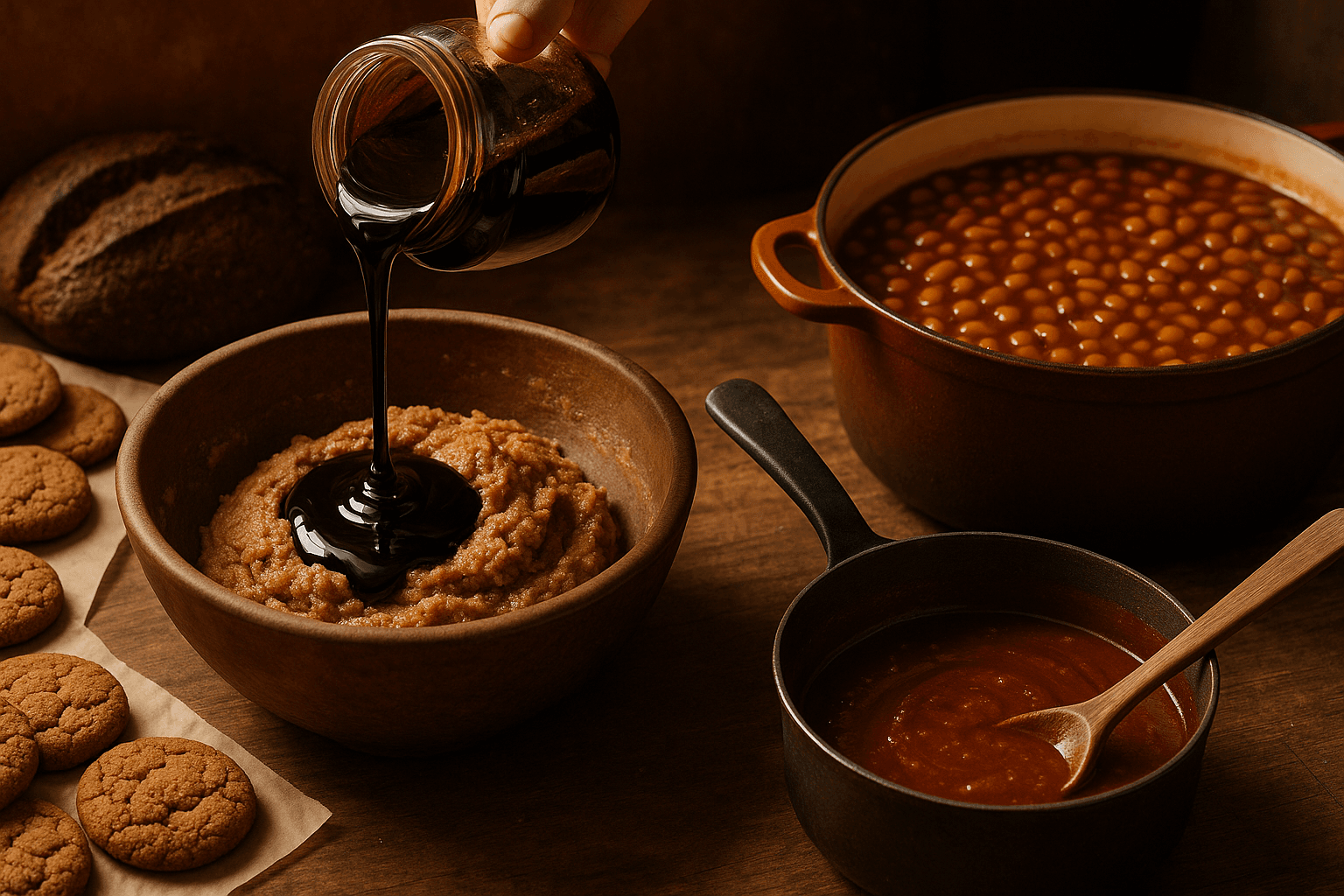
Molasses has a way of making food taste older, deeper, and more serious. A spoonful can turn a sugar cookie into something chewier and warmer. It can give brown bread that dark, almost coffee-like edge. It can make a pot of baked beans taste like it has been tending itself by the fire for hours, and it can give barbecue sauce the kind of depth people often describe as smoky even when no smoke was involved.
But molasses is also one of those ingredients that home cooks often use by feel without fully understanding why it behaves so differently from honey, maple syrup, white sugar, or brown sugar. Add a little and a cookie gets moist and pleasantly bendy. Add too much, or use the wrong kind, and the same dough spreads too far, tastes bitter, or bakes up heavy. In bread, molasses can be a beautiful supporting player, but if you push it or pair it with too much heat, it can make a loaf taste harsh and a crust too dark before the center is ready. In a braise or sauce, molasses can create bass notes and body, but boiled hard for too long, especially in a shallow pan, it can drift from dark and savory into muddy and burnt-edged.
The reason is that molasses is not just “liquid brown sugar.” It is a byproduct of sugar refining with a complex mix of sucrose, invert sugars, acids, water, minerals, flavor compounds, and, in darker grades, a substantial amount of what food scientists often call ash: not literal fireplace ash, but the mineral residue that remains after complete burning in analysis. That mineral load matters. So do pH, viscosity, reducing sugar content, and timing of exposure to heat.
If you understand those pieces, molasses becomes much easier to use intentionally. You can decide when you want chew versus spread, color versus bitterness, sweetness versus depth. You can choose light molasses for balance, dark molasses for stronger personality, and blackstrap only when you actually want its aggressively bitter, mineral, almost medicinal intensity. And you can learn the timing rules that keep it tasting rich in barbecue sauce, baked beans, marinades, and braises instead of overcooked and blunt.
What molasses actually is
Molasses is produced during the refining of sugarcane or sugar beet juice, though in cooking, unless otherwise specified, “molasses” usually means cane molasses. Sugar juice is clarified, concentrated, and crystallized. The sucrose crystals are removed, and the remaining dark syrup is molasses. Depending on how many rounds of boiling and extraction have happened, the syrup changes dramatically.
In broad kitchen terms, you will usually encounter three categories:
- Light molasses: from the first boiling. Sweeter, lighter in color, milder in bitterness, more delicate.
- Dark molasses: from the second boiling. Less sweet, darker, more robust, more bitter, stronger mineral and roasted notes.
- Blackstrap molasses: from the third boiling. Thick, very dark, much less sweet, much more bitter, with high mineral concentration and a strong, sometimes sharply savory taste.
You may also see sulfured and unsulfured molasses. Sulfured molasses is made from young cane treated with sulfur dioxide as a preservative and processing aid. It can have a more pronounced, slightly chemical edge. For baking and savory cooking, unsulfured molasses is usually the better choice because its flavor is cleaner and rounder.
This refining history explains why one tablespoon of molasses is not interchangeable with another. When sucrose is removed in successive rounds, the remaining syrup becomes less purely sweet and more concentrated in everything else: minerals, acids, Maillard precursors, and bitter-tasting compounds.
Why molasses tastes deep: sweetness, bitterness, acidity, and mineral ash
Molasses tastes “dark” because it contains a lot more than sugar.
1. Sucrose and invert sugars
White sugar is mostly sucrose. Molasses still contains sucrose, but it also contains invert sugars, mainly glucose and fructose, formed when sucrose splits in the presence of acid, heat, or enzymes. These reducing sugars matter a lot in cooking.
- Fructose tastes sweeter than sucrose.
- Glucose is less sweet than sucrose but highly reactive in browning.
- Together, invert sugars increase moisture retention and speed browning.
This is one reason molasses can make cookies chewier and darker even when the dough contains less total dry sugar than another formula.
2. Acidity
Molasses is mildly acidic, though exact pH varies by type and producer. That acidity influences leavening, protein behavior, and flavor perception. In baking, acidic ingredients can react with baking soda to produce carbon dioxide. This is why many gingerbread, molasses cookie, and brown bread recipes call specifically for baking soda rather than only baking powder.
Acidity also shifts how we perceive sweetness and bitterness. In molasses, sweetness is not presented cleanly; it arrives bundled with tang and roastiness.
3. Mineral content, or “ash”
When food scientists measure ash, they are measuring the mineral residue left after organic matter is burned away in a laboratory analysis. Molasses, especially darker grades and blackstrap, has a relatively high ash content. That includes minerals like potassium, calcium, magnesium, and iron.
These minerals contribute to flavor in important ways:
- They can amplify savory, earthy, and slightly metallic impressions.
- They can blunt pure sweetness.
- They can make blackstrap taste more bitter and stern than its color alone would suggest.
This is why blackstrap is not just “stronger molasses.” It is structurally different in flavor balance. It has less sweetness to cushion its bitterness, more minerals, and often a sharper finish.
4. Thermal flavor compounds
Repeated concentration and heating during refining build caramelized and cooked flavors. Molasses can bring notes of toffee, smoke, licorice, coffee, dried fruit, soy, and burnt sugar. These are valuable in small to moderate doses, but with too much heat later in your own kitchen, those same notes can compound into harshness.
Why molasses makes cookies chewy
When people say molasses makes cookies chewy, they are usually noticing the effects of hygroscopic sugars, moisture retention, and spread dynamics.
Hygroscopicity: molasses grabs water
Molasses contains glucose and fructose, both more hygroscopic than sucrose. Hygroscopic ingredients attract and hold water from the dough and from the surrounding environment. This has several practical effects:
- Cookies stay softer longer.
- Interiors retain moisture after baking.
- Texture bends toward chewy rather than crisp.
If a plain sugar cookie goes stale into brittleness, a molasses-rich cookie often goes stale more slowly and tends to remain pliable.
It reduces crystallization
Sucrose likes to crystallize under the right conditions. Invert sugars interfere with that. Less recrystallization means less sandy texture and a softer bite. This is part of why molasses contributes to a smooth, cohesive chew instead of a dry snap.
It changes spread
Molasses is liquid, acidic, and rich in sugars that brown quickly. Depending on the formula, it can either increase spread or, if paired with enough flour and chill time, produce a thick, soft cookie with dense chew.
In many drop cookies, extra molasses tends to:
- increase moisture,
- dissolve sugar efficiently,
- soften the dough,
- encourage spreading if the dough is warm or under-floured.
That is why a classic chewy molasses cookie dough is often well chilled, sometimes for 1 to 24 hours, before baking.
It speeds browning
Because molasses contains reducing sugars, cookies brown faster. A molasses cookie may look done at the edges while still soft in the center at 350°F / 175°C after 8 to 11 minutes, depending on size. Pulling them at the right moment matters. Overbake them and you lose the very chew molasses helped create.
A practical cookie formula rule
For a standard home-baking batch built around about 280 to 320 g flour and 170 to 225 g butter, using 60 to 120 g molasses is usually enough to noticeably increase chew and depth without turning the cookie cakey or overly assertive.
- 30 to 60 g: subtle warmth, mild chew
- 60 to 90 g: classic chewy molasses-cookie zone
- 90 to 120 g: stronger flavor, darker color, more spread risk
- Over 120 g: usually requires formula adjustments in flour, chilling, or leavening
For most cookies, light or dark molasses works best. Blackstrap is rarely the best choice unless you intentionally want bitterness and a very adult flavor profile.
Why molasses can make bread bitter, heavy, or too dark
Molasses and bread have a long, important history: Boston brown bread, rye breads, anadama bread, pumpernickel-style loaves, steamed breads, and enriched pan loaves all benefit from it. But bread is where molasses misuse shows up quickly.
Yeast does not respond to molasses the same way it does to plain sugar
Yeast can metabolize simple sugars readily, and invert sugars are accessible. But very sugary doughs create osmotic pressure that can slow yeast, and darker molasses adds minerals and acids that change the fermentation environment.
At modest levels, molasses can support fermentation and improve browning. At high levels, especially with blackstrap, it can:
- slow fermentation,
- weigh down the dough,
- increase bitterness,
- darken crust too fast.
For a lean or moderately enriched loaf using 500 g flour, a good starting point is:
- 15 to 30 g light or dark molasses for subtle flavor
- 30 to 60 g for clearly molasses-forward bread
- More than 75 g begins to significantly alter dough behavior and sweetness balance
For blackstrap, think more like 10 to 30 g per 500 g flour unless the recipe is specifically built around it.
Acidity affects gluten and tenderness
A mildly acidic ingredient can help moderate gluten strength, but too much liquid sweetener can make dough feel sticky, heavy, and less elastic. Molasses does not “destroy” gluten in normal recipe quantities, but it does change the dough system:
- it adds water,
- it competes for water,
- it changes pH,
- it contributes dissolved solids that affect dough handling.
The result can be a dough that feels tackier and a crumb that is softer and denser. In some breads, that is desirable. In a lofty sandwich loaf, too much molasses can work against volume.
Reducing sugars speed crust color
This is one of the biggest practical issues. Molasses-rich breads brown fast because glucose and fructose are highly reactive in Maillard browning and caramelization pathways. A loaf can look done outside while the center still needs time.
To avoid this:
- Bake enriched molasses breads at 350 to 375°F / 175 to 190°C rather than aggressively hot temperatures.
- If the crust darkens too quickly, tent loosely with foil after the first 20 to 30 minutes.
- Check doneness by temperature: enriched pan breads are usually done around 190 to 200°F / 88 to 93°C internal.
Why blackstrap tastes bitter in bread
Blackstrap has less sugar and more mineral intensity. Bread, especially mildly flavored wheat bread, does not always have enough salt, fat, spice, or fermentation complexity to absorb that intensity gracefully. What tastes deep in a tablespoon of barbecue sauce can taste austere and metallic in a slice of bread.
Blackstrap works better when paired with:
- rye or whole grain flours,
- cocoa or coffee in tiny amounts,
- warm spices,
- long fermentation,
- assertive savory toppings.
It works less well in soft dinner rolls or lightly sweet breakfast breads unless used sparingly.
Molasses, spread, chew, and crust color: the baking science in one view
When you add molasses to dough or batter, you are changing at least six things at once:
- Water content: molasses is liquid.
- Sugar profile: not just sucrose, but glucose and fructose.
- Acidity: affects leavening and flavor.
- Mineral content: affects bitterness and taste complexity.
- Browning potential: reducing sugars make color fast.
- Water binding: increased hygroscopicity alters texture over time.
That combination explains why molasses-rich baked goods often have:
- darker color,
- softer interior,
- longer shelf life,
- more chew,
- more rapid edge browning,
- deeper flavor but greater bitterness risk.
Why timing matters in barbecue sauce, baked beans, marinades, and braises
Molasses is wonderful in savory cooking, but unlike stock, onions, or collagen, it does not always improve from endless cooking. In fact, one of the best rules for savory molasses cookery is this:
Use long heat for integration, not for punishment.
What goes wrong when molasses cooks too long
In a moist environment, molasses can simmer gently for a while and round out. But in a shallow pan, on direct heat, or in a sugary sauce reduced aggressively, several problems appear:
- bitterness concentrates,
- sugars darken past pleasant complexity toward scorch notes,
- acidity sharpens,
- flavors flatten into “dark sweetness” without definition.
This is why some homemade barbecue sauces taste better after 15 to 25 minutes of gentle simmering than after an hour of hard reduction.
Barbecue sauce: add depth, not burnt syrup
A balanced tomato-based barbecue sauce often benefits from 1 to 4 tablespoons (20 to 80 g) molasses per 2 cups / 475 ml sauce, depending on style.
A reliable technique:
- Sweat onions or shallots in a little oil over medium-low heat for 5 to 8 minutes if using.
- Add spices briefly for 30 seconds.
- Add tomato base, vinegar, Worcestershire, mustard, and other liquids.
- Add molasses with the main liquid ingredients.
- Simmer very gently, partially covered if thickening fast, for 15 to 20 minutes.
- Taste. If you want brighter top-note sweetness and less cooked darkness, stir in 1 to 2 teaspoons extra molasses off heat or in the last 2 to 3 minutes.
This split-addition approach works beautifully: some molasses cooks in for body, some stays fresher for aroma.
Keep heat low. If the sauce spits thickly, the heat is too high.
Baked beans: molasses loves a wet, buffered environment
Molasses does exceptionally well in baked beans because beans, pork, onions, and abundant liquid create a buffered environment where its bitterness is softened and its sweetness spreads out.
For 1 pound / 450 g dried navy beans, a classic range is 60 to 160 g molasses depending on style. Light molasses gives sweetness and color; dark molasses gives stronger identity.
Timing rule for beans:
- Add molasses early enough to permeate the pot, usually at the start of oven baking or long simmering.
- Keep the cooking environment moist and covered for most of the time.
- Uncover only toward the end, about the final 30 to 45 minutes, if you want concentration and top browning.
Because the environment is wet and relatively moderate, molasses deepens rather than burns. But if the beans dry out, the sugars on the surface can turn acrid quickly. Check liquid levels every 45 to 60 minutes during long baking.
Marinades: molasses burns before meat is done
This is where many cooks get into trouble. Molasses in a marinade is flavorful, but sugar on the exterior of meat burns fast over high heat.
For a marinade, keep molasses moderate:
- 1 to 2 tablespoons per pound / 450 g meat is usually enough.
- Combine with salt, acid, aromatics, and a little oil.
- Marinate 2 to 12 hours for most cuts.
Then follow this rule:
Wipe off excess marinade before searing or grilling.
The flavor penetrated what it could; the extra syrup on the surface mostly threatens scorching.
For grilled foods, reserve some fresh marinade before it touches raw meat and reduce that separately into a glaze. Brush it on during the last 5 to 10 minutes of cooking, especially for chicken, ribs, pork tenderloin, or salmon.
Braises: when to add molasses
Molasses can be excellent in short ribs, brisket, lamb shanks, pork shoulder, or pot roast, especially when the braising liquid includes tomato, beer, cider, coffee, soy, mustard, or dried chiles. But quantity and timing matter.
For a braise serving 4 to 6 people, start with 1 to 3 tablespoons (20 to 60 g) molasses in the braising liquid.
Best practice:
- Add a modest amount at the beginning for background depth.
- Braise covered at 300 to 325°F / 150 to 165°C or at a bare stovetop simmer.
- If you reduce the braising liquid into a sauce at the end, taste before adding more molasses.
- For a glossier, more vivid finish, add another 1 to 2 teaspoons near the end rather than concentrating all the sweetness from the start.
This prevents the final sauce from becoming muddy or bitter during reduction.
Step-by-step: how to choose the right molasses for the job
Use light molasses when you want
- sweetness with mild depth,
- softer flavor in cookies,
- a gentle note in sandwich bread,
- subtle caramel in sauces,
- flexibility.
Best uses:
- chewy cookies,
- gingerbread for people who dislike bitterness,
- sandwich loaves,
- glazes,
- baked beans with a sweeter profile.
Use dark molasses when you want
- stronger roast notes,
- more color,
- more assertive personality,
- that classic old-fashioned molasses flavor.
Best uses:
- gingersnaps,
- Boston brown bread,
- rye breads,
- barbecue sauce,
- baked beans,
- robust braises.
Use blackstrap only when you intentionally want
- bitterness,
- mineral depth,
- less sweetness,
- a savory, almost bitter-chocolate or coffee-like edge.
Best uses in small amounts:
- complex barbecue sauces,
- stout or rye breads in restrained quantity,
- spice-heavy cookies as a partial replacement,
- baked beans when balanced with brown sugar or another sweetener.
A smart blackstrap strategy is to replace only 25 to 50% of the light or dark molasses in a recipe rather than using it exclusively.
Step-by-step: better molasses cookies
Here is a practical method for a chewy molasses-spice cookie.
Formula
- 280 g all-purpose flour
- 2 g fine salt
- 1 teaspoon baking soda
- 2 teaspoons ground ginger
- 1 teaspoon cinnamon
- 1/4 teaspoon cloves
- 170 g unsalted butter, softened
- 150 g dark brown sugar
- 80 g dark molasses
- 1 large egg
- 5 g vanilla extract
- Optional: 50 g granulated sugar for rolling
Method
- Whisk flour, salt, baking soda, and spices.
- Cream butter and brown sugar for 2 to 3 minutes until slightly lightened, not fully fluffy.
- Beat in molasses, egg, and vanilla.
- Mix in dry ingredients just until combined.
- Chill dough at least 2 hours, ideally overnight.
- Portion 30 to 40 g each and roll lightly in sugar.
- Bake at 350°F / 175°C for 9 to 11 minutes.
- Pull when edges are set but centers still look a little soft.
- Cool on the pan 5 minutes, then transfer.
Why this works
- Brown sugar plus molasses doubles down on moisture retention.
- Moderate baking soda neutralizes some acidity and encourages spread.
- Chilling controls that spread.
- The relatively brief bake preserves chew.
Common mistake: adding too much molasses and then baking longer to “set” the cookies. That usually gives flat, dark cookies with bitter edges.
Step-by-step: better molasses bread
For a softly sweet pan loaf with character but no harshness:
Formula
- 500 g bread flour
- 10 g fine salt
- 7 g instant yeast
- 30 to 45 g unsulfured molasses
- 25 g butter or neutral oil
- 320 to 340 g warm water, about 90 to 95°F / 32 to 35°C
Method
- Mix flour, salt, and yeast.
- Dissolve molasses in the warm water; add fat.
- Combine into a dough and knead until smooth, about 8 to 10 minutes by stand mixer or 10 to 12 minutes by hand.
- Ferment until doubled, roughly 60 to 90 minutes at warm room temperature.
- Shape and place in a greased loaf pan.
- Proof until the dough crowns about 1 inch / 2.5 cm over the pan, about 45 to 75 minutes.
- Bake at 375°F / 190°C for 35 to 40 minutes.
- If darkening too quickly, tent with foil after 20 to 25 minutes.
- Cool fully before slicing.
Why this works
The molasses level is high enough to register but low enough not to sabotage structure. The moderate bake protects the crust from over-darkening before the crumb sets.
If you want a stronger flavor, first increase to 60 g molasses. Only after that would I consider introducing a small amount of blackstrap, maybe 10 to 15 g, in place of part of the regular molasses.
Step-by-step: better barbecue sauce with molasses
Formula
- 1 tablespoon neutral oil
- 60 g onion, finely minced
- 1 small garlic clove, minced
- 240 g ketchup or tomato puree
- 120 ml apple cider vinegar
- 60 ml water
- 40 to 60 g dark molasses
- 25 g brown sugar, optional depending on desired sweetness
- 1 tablespoon Worcestershire sauce
- 2 teaspoons yellow mustard
- 1 teaspoon smoked paprika
- 1/2 teaspoon black pepper
- 1/2 teaspoon kosher salt, then adjust
- Pinch cayenne
Method
- Cook onion in oil over medium-low heat until soft, 6 minutes.
- Add garlic for 30 seconds.
- Add everything else except a final optional touch of molasses.
- Bring just to a simmer.
- Cook on low, stirring often, 15 to 20 minutes.
- Taste. If you want more aromatic top-note depth, stir in 1 to 2 teaspoons molasses at the end.
- Blend if smooth texture is desired.
Why this works
The sauce gets enough heat to integrate, but not so much that the molasses turns flat or harsh. The vinegar, tomato, and Worcestershire provide acid and umami to keep sweetness from dominating.
Common mistakes and how to avoid them
Mistake 1: treating all molasses as interchangeable
They are not. Light, dark, and blackstrap differ in sweetness, mineral intensity, bitterness, and browning behavior.
Mistake 2: using blackstrap for a recipe designed for regular molasses
This is the fastest route to bitterness. If substituting blackstrap, start with replacing only a fraction.
Mistake 3: forgetting that molasses adds liquid
In cookies and breads, extra molasses may require slightly more flour, less other liquid, or more chilling time.
Mistake 4: using high heat in sugary sauces
Molasses sauces should usually simmer gently. Rapid reduction risks bitterness and scorching.
Mistake 5: brushing molasses-heavy glaze on too early
Sugar burns. Apply glazes late, especially on grilled or roasted meats.
Mistake 6: judging doneness by color alone
Molasses-rich baked goods brown early. Use touch, structure, and where appropriate, internal temperature.
Tips and variations
Pair molasses with flavors that understand it
Molasses gets along especially well with:
- ginger, cinnamon, clove, allspice
- coffee and cocoa in small amounts
- rye, whole wheat, oat, buckwheat
- mustard, soy, Worcestershire
- apple cider vinegar
- pork, beef, lamb
- dried chiles and smoke
- orange zest in baking
Blend sweeteners for better balance
You do not always need molasses to do everything alone. Combining it with:
- brown sugar,
- honey,
- maple syrup,
- white sugar,
- sorghum,
can create a better sweetness curve and control bitterness.
If your sauce tastes muddy
Try adding, off heat:
- 1 to 2 teaspoons cider vinegar for brightness,
- a pinch more salt,
- a little mustard,
- a small fresh addition of molasses rather than more cooked molasses.
If your bread is too bitter
Next time:
- switch from dark to light molasses,
- reduce the quantity by 15 to 30 g,
- avoid blackstrap,
- add a touch more salt if the loaf tasted flat as well as bitter,
- bake slightly cooler or tent earlier.
If your cookies spread too much
Next time:
- chill longer,
- reduce molasses by 15 to 30 g,
- increase flour by 10 to 20 g,
- bake from cold dough,
- make sure butter was not overly warm.
A little cultural context
Molasses has deep roots in Atlantic and American foodways, Caribbean cooking, and the history of sugar production itself. It sits at the intersection of abundance and extraction: once a practical sweetener and trade commodity, then a defining flavor in colonial New England baked beans and brown bread, in ginger cakes, in Caribbean rum production, and in countless sauces and breads shaped by cane agriculture and the economics of sugar refining.
That history helps explain why molasses flavors often read as “traditional” or “old-fashioned.” It was not a novelty ingredient; it was a pantry foundation. Many regional recipes were built around its exact strengths: moisture, color, keeping quality, and compatibility with spice, grains, and slow-cooked dishes.
Understanding the ingredient scientifically does not strip away that character. It actually explains why those older cooks used it so intelligently. They paired dark molasses with long, moist bean baking. They used it with rye and whole grains that could meet it halfway. They often balanced it with spice, salt pork, mustard, or vinegar. In other words, they built recipes around the ingredient’s chemistry long before they used words like hygroscopicity or reducing sugars.
The takeaways
Molasses is powerful because it does several jobs at once. It sweetens, but not cleanly. It darkens, softens, moistens, acidifies, and browns. That is exactly why it can make cookies wonderfully chewy, bread unexpectedly bitter, or barbecue sauce deeply complex.
If you remember only a few rules, make them these:
- Choose the right grade: light for sweetness and flexibility, dark for deeper flavor, blackstrap only in restrained, intentional amounts.
- Respect its water-binding power: more chew and moisture, but also more spread and softer doughs.
- Remember that it browns fast: reducing sugars accelerate color in cookies and breads.
- Use moderate amounts in yeast doughs: too much can slow fermentation and push bitterness.
- Cook it gently in savory applications: enough heat to integrate, not so much that it turns harsh.
- Add some late when you want freshness: especially in sauces, glazes, and braises.
Used thoughtfully, molasses is not just a sweetener. It is a structural ingredient and a flavor system. It can make a cookie bend instead of snap, a loaf taste hearty instead of merely sweet, and a sauce feel resonant instead of one-dimensional. Once you understand the invert sugars, the mineral ash, and the heat rules, you stop guessing and start using molasses the way great cooks do: deliberately, sparingly when needed, and always in service of balance.