Why Mushrooms Squeak, Brown, or Steam: Chitin Structure, Water Release, and the Pan Strategy That Builds Deep Umami
RecipeSimpli
Why Mushrooms Squeak, Brown, or Steam: Chitin Structure, Water Release, and the Pan Strategy That Builds Deep Umami
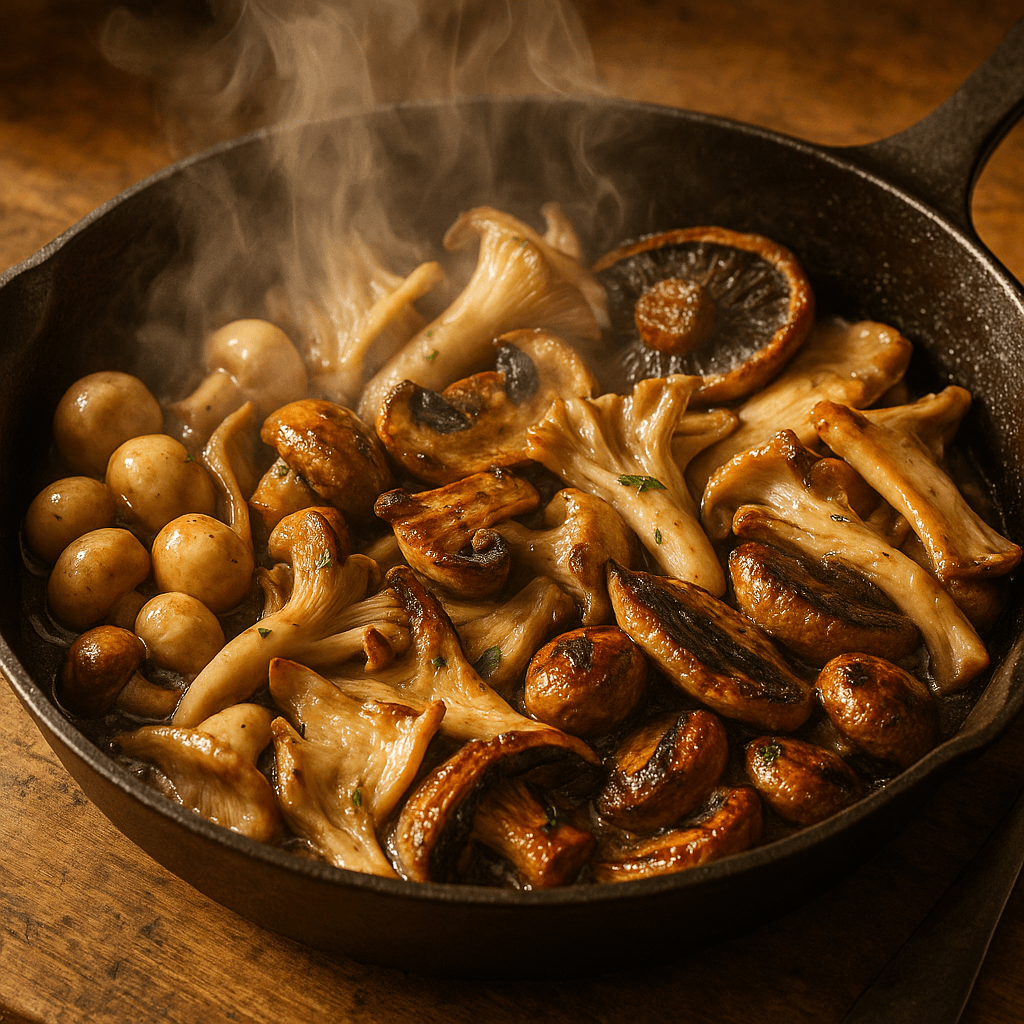
If you cook mushrooms often, you’ve probably had at least one confusing pan moment. You add a generous pile to a hot skillet, expecting golden edges and steakhouse aroma, and instead they flood the pan, hiss loudly, turn grayish-beige, and bounce around with a faint rubbery squeak. A few minutes later, just when it seems all hope is lost, the water vanishes, the mushrooms collapse, and suddenly they begin to bronze, smell nutty, and taste deeply savory.
That whole sequence is normal. In fact, understanding it is the key to cooking mushrooms well.
Mushrooms are one of the most misunderstood ingredients in the kitchen because they do not behave like vegetables, and they do not behave like meat either. They are fungi, built with different structural materials, carrying a lot of water, loaded with flavor compounds, and capable of going from sponge-like to silky to crisp depending on heat, fat, and timing. The familiar rule—don’t crowd the pan—isn’t wrong, but it is incomplete. Mushrooms can be cooked beautifully even in a full pan if you understand what stage you are in: first release, then evaporation, then browning.
This article is a science-first guide to that process. We’ll look at how mushroom cell walls made of chitin and glucans hold and release water, why species shed moisture differently, what the audible “squeak” stage actually means, why browning begins only after surface moisture is driven off, and how to choose between dry-pan and oil-first methods. We’ll also tackle washing versus brushing, salt timing, fat absorption, and the best strategies for button, cremini, shiitake, oyster, and portobello mushrooms in sautéing, roasting, and stewing. Finally, we’ll touch on nutrition—especially ergothioneine, vitamin D in UV-exposed mushrooms, and why mushrooms offer remarkable umami without truly cooking like meat.
If you’ve ever wondered why your mushrooms steamed, why they drank all the butter, or why some batches squeaked in the pan while others browned almost immediately, this is the missing manual.
Mushrooms are fungi, not vegetables—and that matters in the pan
In culinary terms, we often lump mushrooms in with produce. In biological terms, they are much closer to their own kingdom. That matters because structure determines cooking behavior.
Most plant tissues are built around cellulose, hemicellulose, and pectin. Mushrooms, by contrast, have cell walls rich in chitin and beta-glucans, along with proteins, minerals, and a complex internal network that holds a great deal of water. Chitin is a tough structural polysaccharide; beta-glucans are also structural carbohydrates, but they contribute differently to texture and water interactions.
This doesn’t mean mushrooms are hard like shells or insect exoskeletons, though people sometimes mention chitin in that dramatic way. In mushrooms, chitin exists as part of a hydrated, flexible biological structure. Combined with glucans and other wall materials, it creates tissue that is springy, porous, and able to hold substantial moisture. That’s one reason raw mushrooms feel firm yet light, and why they change so dramatically once heated.
Fresh supermarket mushrooms are often 80 to 92% water, depending on species, age, and storage. A pan of mushrooms is, in effect, a pan full of flavored water trapped inside fungal tissue.
A little cultural context
Humans have prized mushrooms for centuries for exactly the qualities that can make them tricky to cook: their aroma, their savoriness, and their ability to take on texture transformations. European traditions celebrate browned wild mushrooms in butter and cream. East Asian cuisines often emphasize hydration, broth extraction, and layered umami, especially with shiitake and other dried species. In modern restaurant cooking, mushrooms often bridge roles: garnish, main ingredient, stock enhancer, or meat extender.
Yet across cuisines, one truth repeats: mushrooms need a deliberate heat strategy. Their most delicious state is rarely their first state in the pan.
Why mushrooms release so much water
When mushrooms hit heat, several things happen almost at once.
-
Internal water heats up and begins to migrate outward.
The mushroom’s cells and intercellular spaces contain a lot of water. As temperature rises, that water becomes more mobile. -
Cell structures weaken and collapse.
Heat softens membranes and changes proteins. The structural integrity of the tissue declines, allowing water to escape more easily. -
The pan environment fills with steam.
Once enough water reaches the surface, it evaporates into steam—unless it accumulates faster than it can leave the pan. -
The mushrooms shrink significantly.
As water leaves, the mushrooms lose volume, become denser, and eventually have a chance to brown.
The rate and amount of water release depend on:
- Species
- Slice size
- Pan heat and material
- How crowded the pan is
- Whether salt is added early
- How fresh the mushrooms are
- Whether they were washed and left wet on the surface
Notice the distinction between surface wetness and internal moisture. Even perfectly dry-looking mushrooms contain plenty of water inside. Washing does not “ruin” mushrooms nearly as much as many people think. A quick rinse may add some surface water and a little absorbed moisture, but compared with what’s already inside, that extra amount is relatively modest.
The washing versus brushing myth
You’ve probably heard that mushrooms should never be washed because they “absorb water like sponges.” This is one of those kitchen myths built on a grain of truth but exaggerated beyond usefulness.
Mushrooms can absorb some water, especially if soaked for a long time or held in water after slicing. But a brief rinse under cold running water or a quick swish followed by prompt drying is usually fine.
What actually happens
- Whole mushrooms have a relatively limited exposed surface area.
- A quick rinse removes grit efficiently.
- If you dry them well—on towels or in a salad spinner—the extra surface water is manageable.
- The biggest cooking issue is not that they become permanently waterlogged; it’s that surface moisture delays browning because the pan must first evaporate that water.
Best practice
- For very clean cultivated mushrooms: wipe or brush if you want, especially if you’re cooking immediately and want to minimize surface moisture.
- For gritty mushrooms: rinse briefly. Dirt in the pan is worse than a few extra seconds of evaporation.
- Never soak sliced mushrooms unless a recipe specifically calls for it. Slices have much more exposed area and can take on more water.
In a home kitchen, cleanliness matters more than ritual. If they’re dirty, wash them. Just dry them well.
Why different mushrooms shed moisture differently
Not all mushrooms cook alike. Their structure, density, cap shape, gill exposure, and moisture distribution all affect how they release water.
Button mushrooms
These are young Agaricus bisporus, mild in flavor and relatively high in water. Because they are compact and often sold very fresh, they can release a lot of liquid before browning.
Best traits: reliable, affordable, evenly shaped
Challenges: easy to steam, flavor can be subtle unless browned well
Cremini mushrooms
Also Agaricus bisporus, just a more mature stage than button mushrooms. They tend to have slightly deeper flavor, a bit more color, and often a somewhat firmer texture.
Best traits: richer flavor than buttons, versatile
Challenges: still water-rich; still need full evaporation before browning
Portobello mushrooms
Fully mature Agaricus bisporus with large caps and exposed dark gills. Their size makes them useful for searing and roasting, but they can also dump substantial moisture, especially if cooked whole.
Best traits: broad surface for searing, meaty bite, strong umami
Challenges: can go soggy in the center, gills can darken sauces, large size complicates even cooking
Shiitake mushrooms
Fresh shiitake are denser, less watery than many Agaricus mushrooms, and more aromatic. Their caps brown beautifully. Stems are usually fibrous and better reserved for stock.
Best traits: concentrated flavor, better browning, strong umami
Challenges: caps vary in thickness; stems are tough
Oyster mushrooms
Delicate, ruffled, and relatively quick-cooking. Because they have more thin edges and less dense, compact mass, oysters can shed and evaporate moisture efficiently—if spread properly.
Best traits: lacey crisp edges, elegant texture, fast cooking
Challenges: fragile, can wilt unevenly if piled too deep
Why the differences happen
Species differ in:
- Cell wall composition and thickness
- Tissue density
- Cap-to-stem ratio
- Surface area relative to mass
- How tightly cells are packed
- Age and maturity at harvest
In practical terms, thicker, denser mushrooms often hold shape better but may still release significant internal moisture. More delicate mushrooms may seem drier simply because their thin structure evaporates moisture rapidly.
The “squeak” stage: what that sound means
That little squeak or chirp mushrooms make in the pan is not your imagination. It usually appears in the transition between raw firmness and browned softness.
What’s going on?
The squeak is a sign of moist but firm fungal tissue rubbing against the hot pan and against itself while the surface is still not lubricated by enough rendered moisture reduction or browning fat behavior. At this stage:
- The mushrooms have heated through enough to become springy and slightly rubbery.
- Internal water is moving out, but there is still enough moisture present to prevent efficient browning.
- The surface proteins and polysaccharides haven’t yet undergone the concentration and dehydration needed for deep Maillard browning.
It’s a bit like the culinary equivalent of tires on a damp road. The mushrooms are neither raw nor browned. They’re in transition.
Is squeaking good or bad?
Neither. It is a stage, not a verdict.
If you keep cooking, allow moisture to evaporate, and maintain appropriate heat, the squeak stage often gives way to the good part: sizzle, concentration, browning, aroma.
If you lower the heat too much, cover the pan, or add too much liquid too early, the mushrooms may remain soft and steamed without ever moving into browning.
Browning starts only after water is driven off
This is the central law of mushroom cookery.
Deep browning requires temperatures well above the boiling point of water. As long as the mushroom surfaces are wet and actively releasing moisture, the pan environment hovers near 100°C / 212°F in those wet zones. That is hot enough to cook and soften, but not hot enough for substantial browning.
The chemistry
The rich savory browning on mushrooms comes from a combination of:
- Water evaporation and concentration of solids
- Maillard reactions between amino compounds and sugars
- Some caramel-like aromatic development, though mushrooms are not sugar-rich in the way onions are
- Oxidation and fat-mediated flavor development
Once surface moisture is mostly gone, the temperature at the mushroom-pan interface can rise more rapidly. Then the mushrooms begin to:
- color from beige to gold to brown
- smell nutty, roasted, and more complex
- develop concentrated umami and meaty aroma notes
Practical temperature cues
For effective sautéing:
- Preheat the pan over medium-high to high heat for 1 to 2 minutes.
- Add mushrooms and expect an initial wet phase.
- Browning often does not begin in earnest until 5 to 10 minutes into cooking, depending on quantity and species.
- Once the pan looks mostly dry and the sound changes from watery hiss to sharper sizzle, browning is finally underway.
This is why cooks who stop too early think mushrooms “didn’t brown,” when in fact they never made it past the steaming phase.
Do mushrooms absorb fat? Yes—but timing matters
Another classic frustration: you add butter or oil, and mushrooms seem to drink it all instantly.
They do absorb fat, especially early in cooking. Their porous structure and still-intact surface architecture can wick oil into spaces between and within tissues. But this behavior changes as they cook.
Early phase
- Mushrooms can absorb a surprising amount of oil.
- The pan may look dry quickly.
- Butter solids may risk scorching if heat is high and water release hasn’t started yet.
Later phase
- As mushrooms release water and collapse, some absorbed fat effectively rebalances across the pan.
- Surfaces become more capable of frying and browning.
- A second small addition of fat near the browning stage can be more effective for flavor than dumping in all the fat at the beginning.
Smart fat strategy
For 1 pound / 450 g mushrooms, a good working range is:
- 1 to 2 tablespoons neutral oil for initial sautéing, plus
- 1 to 2 tablespoons butter added later for flavor, once most water has evaporated
This staged approach gives you control. Oil handles heat well early; butter shines once the mushrooms are ready to brown.
Salt timing: early, late, or both?
Salt affects flavor, moisture movement, and browning pace.
If you salt early
Salt draws some water toward the surface through osmotic effects and accelerates the wet phase. That can delay browning slightly, but it also seasons the mushrooms more evenly.
If you salt late
You may get faster browning because the surfaces stay drier longer. But late salting can mean less even seasoning unless you toss well and cook briefly afterward.
The most useful answer
There is no single correct moment. It depends on your goal.
- For maximum sear and color: lightly salt near the end.
- For even seasoning in a sauté or stew base: salt early or in two stages.
- For roasting: salt before cooking, since dry oven heat and exposed surfaces help evaporation anyway.
A practical compromise for skillet mushrooms:
Add a small pinch of salt at the start and final seasoning near the end.
For 1 pound / 450 g mushrooms, start with about 1/4 teaspoon kosher salt, then adjust with another 1/4 teaspoon or less after browning.
Dry-pan versus oil-first: both work, but for different outcomes
This is where many cooks get dogmatic. In reality, both methods are valid.
1. The dry-pan method
You place mushrooms in a hot skillet with no fat. They release water, the water evaporates, and only then do you add fat.
Why use it?
- Excellent for very moist mushrooms
- Prevents the “they drank all my butter” problem
- Promotes clear stage separation: release, dry-out, brown
- Great for mushrooms you plan to glaze with butter later
Best for
- Button mushrooms
- Cremini
- Large batches
- Cooked mushroom fillings where concentrated flavor matters
How to do it
- Heat a wide skillet over medium-high heat.
- Add sliced mushrooms in an even layer.
- Stir occasionally as they release water.
- Cook until the pan is nearly dry, 5 to 8 minutes.
- Add 1 to 2 tablespoons oil or butter.
- Continue cooking until browned, 3 to 6 minutes more.
Drawback
You can get slightly less early surface frying flavor compared with oil-first cooking.
2. The oil-first method
You heat oil in the skillet, then add the mushrooms.
Why use it?
- Better immediate contact and heat transfer
- Great for smaller batches where you want active sautéing and quick browning once water releases
- Helps coat delicate mushrooms like oysters
Best for
- Shiitake caps
- Oyster mushrooms
- Smaller quantities in a large pan
- When you want mushrooms integrated with garlic, thyme, shallots, or butter finishing
How to do it
- Preheat the skillet over medium-high heat.
- Add 1 tablespoon neutral oil.
- Add mushrooms and toss to coat.
- Cook, stirring minimally at first, then occasionally.
- Let the wet phase pass.
- Add butter near the end for browning and aroma.
Drawback
If the pan is crowded or heat is too low, the mushrooms can absorb oil, then steam anyway.
The real answer
Choose the method based on volume, species, and your goal—not ideology.
The pan strategy that actually works
Instead of repeating “don’t crowd the pan” as a commandment, let’s make it more useful.
What crowding actually does
A crowded pan:
- slows evaporation
- traps steam above the mushrooms
- reduces direct pan contact
- prolongs the wet phase
But crowding is not fatal. It simply changes the timeline.
The better rule
If you crowd the pan, plan for a longer water-release stage before browning.
That means:
- use a wide skillet if possible
- keep heat assertive but not scorching
- resist adding extra fat too early
- wait for moisture to cook off before expecting color
Ideal setup for sautéed mushrooms
For 1 pound / 450 g mushrooms:
- Use a 12-inch / 30-cm skillet if possible.
- Slice mushrooms 1/4 to 1/2 inch thick for general sautéing.
- Preheat pan 1 to 2 minutes.
- Keep heat at medium-high.
- Cook total 8 to 14 minutes, depending on species and quantity.
What to watch for
- Raw stage: firm, pale, matte
- Wet stage: pan fills with liquid, soft hissing
- Squeak stage: rubbery bounce, faint chirp, transitional texture
- Dry stage: liquid mostly gone, mushrooms shrunken
- Brown stage: sharper sizzling, golden edges, nutty smell
- Finish stage: butter, herbs, garlic, acid, or soy can now be added without sabotaging browning
Step-by-step: the master sauté method
This is the most reliable home method for deeply browned mushrooms with concentrated umami.
Ingredients
- 1 pound / 450 g mushrooms, trimmed and sliced or torn
- 1 tablespoon neutral oil
- 1 tablespoon unsalted butter
- 1/4 teaspoon kosher salt, plus more to taste
- 1/8 teaspoon black pepper
- Optional: 1 small shallot, finely minced
- Optional: 1 clove garlic, minced
- Optional: 1 teaspoon fresh thyme leaves
- Optional finish: 1 teaspoon soy sauce, 1 teaspoon sherry, or 1 teaspoon lemon juice
Method
-
Clean the mushrooms.
Brush or briefly rinse as needed. Dry thoroughly. Remove tough stem ends. For shiitake, remove stems entirely and save for stock. -
Cut appropriately.
- Button/cremini: slice 1/4 inch / 6 mm thick
- Portobello: cut into 1/2 inch / 1.25 cm strips
- Shiitake: halve or slice caps
- Oyster: tear into medium pieces
-
Preheat the pan.
Use a large skillet over medium-high heat for 1 to 2 minutes. -
Add oil and mushrooms.
Add the oil, then the mushrooms. Toss once to coat. Spread them as evenly as possible. -
Season lightly.
Add 1/4 teaspoon kosher salt. -
Leave them alone briefly.
Let them sit 1 to 2 minutes before stirring, so some surfaces can heat effectively. -
Cook through the wet phase.
Stir every 1 to 2 minutes. Expect liquid to collect. Continue cooking until that liquid mostly evaporates, 5 to 8 minutes. -
Watch for the transition.
When the pan looks almost dry and the mushrooms begin to sizzle more sharply, add the butter. -
Brown aggressively but attentively.
Cook another 3 to 5 minutes, stirring occasionally, until mushrooms are deeply browned at the edges. -
Add aromatics at the end.
Lower heat to medium. Add shallot and cook 30 to 60 seconds. Add garlic and thyme; cook 15 to 30 seconds more. This prevents burning. -
Finish.
Add pepper and, if desired, a tiny splash of soy, sherry, or lemon juice. Taste and adjust salt. -
Serve immediately.
Spoon over toast, steak, polenta, pasta, rice, eggs, or fold into grains.
Common mistakes
- Adding garlic too early: it burns while mushrooms are still steaming.
- Too low heat: water never evaporates efficiently.
- Constant stirring: limits contact and delays browning.
- Too much fat too early: mushrooms absorb it before they’re ready to brown.
- Stopping after 4 minutes: they’ve only just begun.
Species-by-species strategy
Button mushrooms
Best uses
Searing, sautéing, roasting, duxelles, soups
Pan strategy
Use dry-pan first or minimal oil first. Buttons release a lot of liquid.
Searing notes
- Slice or quarter evenly.
- Cook until liquid fully evaporates before expecting color.
- Finish with butter and herbs.
Roasting
Roast at 425°F / 220°C for 20 to 30 minutes, tossing once. Use enough space for moisture to evaporate.
Stewing
Buttons hold shape reasonably well in braises but can lose nuance if overcooked. Brown first if possible.
Cremini mushrooms
Best uses
General-purpose sautéing, roasting, pasta sauces, pan sauces
Pan strategy
Same as button, but reward is deeper flavor.
Searing notes
Excellent for mixed-mushroom sautés. Brown patiently.
Roasting
Roast at 425°F / 220°C for 22 to 30 minutes with oil, salt, pepper.
Stewing
Good in ragù, barley soup, creamy sauces. Their flavor survives dilution better than buttons.
Shiitake mushrooms
Best uses
High-heat sautéing, stir-frying, broths, rice dishes
Pan strategy
Oil-first works well. Shiitake caps brown more quickly and have stronger natural umami.
Searing notes
- Remove stems.
- Score thick caps lightly if desired for even cooking.
- Use moderate amounts of fat.
Roasting
Roast at 400°F / 205°C for 18 to 25 minutes. They can go from chewy to crisp at the edges beautifully.
Stewing
Fresh shiitake are excellent in brothy dishes, but long cooking softens their firmer texture. Dried shiitake are even more powerful in stews and stocks.
Oyster mushrooms
Best uses
Quick sautéing, roasting, crisp-edged presentations, tacos, toast toppings
Pan strategy
Oil-first in a spacious pan. Tear instead of slicing to preserve appealing texture.
Searing notes
- Don’t pile them too thickly.
- Use enough oil to coat the frilled surfaces lightly.
- Minimal stirring helps frilly edges crisp.
Roasting
Roast at 425°F / 220°C for 15 to 22 minutes. Watch closely; thin edges brown fast.
Stewing
Less ideal for long stews if you want distinct structure. Better added near the end.
Portobello mushrooms
Best uses
Grilling, searing, roasting, sandwich fillings, sliced sautés
Pan strategy
For whole caps, use moderate heat first to drive off moisture, then finish hotter for color. For strips, treat like large cremini.
Searing notes
- Remove stems.
- You may scrape out gills if you want a cleaner-looking sauce, though it is not required.
- Salt moderately; large caps can seem underseasoned if not properly finished.
Roasting
Roast whole or halved at 425°F / 220°C for 20 to 30 minutes, depending on size. Consider roasting gill-side up first, then turning to evaporate pooled liquid.
Stewing
Portobellos can become silky but also darken the liquid significantly.
Roasting mushrooms: when the oven beats the skillet
Roasting is ideal when you want mushroom flavor with less pan babysitting.
How roasting works
The oven provides surround heat, and with enough space on the tray, released moisture can evaporate while surfaces dehydrate and brown.
Best roasting formula
For 1 pound / 450 g mushrooms:
- Toss with 1 1/2 tablespoons olive oil
- Season with 1/2 teaspoon kosher salt
- Spread on a parchment-lined or bare sheet pan in one layer
- Roast at 425°F / 220°C
- Toss once halfway
When roasting shines
- big batches
- mixed mushrooms
- meal prep
- adding to grain bowls, salads, omelets, and soups later
Common mistake
Overcrowding the sheet pan. If mushrooms are piled or touching too densely, they roast sluggishly and steam one another.
Mushrooms in stews and soups: browning still matters
Mushrooms are excellent in stews, but if you drop them raw into a wet environment, they give flavor mostly by infusion, not by roasted concentration.
For deeper flavor in soups and braises
Brown the mushrooms first, then add liquid.
This does two things:
- develops roasted and Maillard notes
- reduces their water burden before they dilute the dish
When not to brown first
If you want a cleaner, more delicate mushroom broth or a lighter soup, adding mushrooms directly can be appropriate. This is common in some brothy preparations where extraction and perfume matter more than roastiness.
The science of umami: why mushrooms taste savory without acting like meat
Mushrooms are famous for umami because they contain glutamic acid and, in some species and especially dried forms, notable levels of 5'-nucleotides such as guanylate. These compounds amplify savory taste, especially in combination with glutamates from other foods like soy sauce, Parmesan, tomatoes, miso, cured meats, or seaweed.
That synergy is why mushrooms can make a dish taste fuller, rounder, and more “meaty.”
But mushrooms are not meat in culinary behavior.
Key differences from meat
- No muscle fibers: mushrooms don’t tighten or relax like meat proteins.
- Much higher water percentage in a different structure: they flood the pan differently.
- Different browning chemistry: they can brown beautifully, but they lack the same protein-fat matrix as meat.
- Little fat of their own: their flavor often benefits from added fat.
So while mushrooms can provide deep savoriness and satisfying chew, they should not always be treated as a meat analog in technique. The best mushroom cookery respects mushroom physics.
Nutrition nuance: ergothioneine, vitamin D, and what mushrooms really offer
Mushrooms are nutritionally interesting in ways that go beyond being low-calorie and flavorful.
Ergothioneine
Mushrooms are one of the richest dietary sources of ergothioneine, a sulfur-containing compound often discussed for its antioxidant role. Research continues on its physiological significance, but it is widely considered a noteworthy bioactive component in mushrooms.
Different mushroom species contain different amounts, and growing conditions matter. While you should be cautious about overstating specific health claims, it is fair to say mushrooms offer unique phytochemical value beyond ordinary culinary produce.
Vitamin D in UV-exposed mushrooms
Mushrooms contain ergosterol, which can convert to vitamin D2 when exposed to ultraviolet light. Some commercially sold mushrooms are specifically labeled as UV-exposed or vitamin D enhanced.
What this means in practice
- Standard mushrooms may contain little vitamin D unless they’ve had UV exposure.
- UV-treated mushrooms can provide meaningful amounts.
- Sun exposure at home may increase vitamin D2 somewhat, though results are variable and labeling is more reliable.
Fiber and minerals
Mushrooms provide modest fiber, including beta-glucans, and minerals such as selenium, copper, and potassium, depending on species and cultivation.
They are not protein-dense like meat
Mushrooms contain some protein, but not nearly enough to be nutritionally equivalent to meat on a gram-for-gram basis. Their culinary power lies more in flavor, volume, and texture than in replacing meat’s macronutrient profile.
Tips and variations
Use soy sauce strategically
A 1 teaspoon splash near the end boosts glutamate synergy and darkens the flavor without making the dish taste overtly Asian unless you add more.
Try a two-fat approach
Start with neutral oil, finish with butter. You get better heat tolerance and better flavor.
For extra browning, leave larger surfaces intact
Halved small mushrooms or large thick slices often brown better than very thin slices, which can lose too much moisture too quickly and simply shrivel.
Deglaze only after browning
A teaspoon or two of sherry, white wine, or stock after color develops can lift fond and coat the mushrooms. Add liquid too early and you prolong steaming.
For intense mushroom toast
Cook 12 ounces / 340 g cremini + 4 ounces / 115 g shiitake with thyme and shallot; finish with butter and sherry over thick toast rubbed with garlic.
For a stew-ready batch
Brown mushrooms hard, cool them, then fold into braises in the last 20 to 30 minutes so they keep some structure.
For crispy oyster mushrooms
Tear into clusters, toss lightly with oil and salt, roast at 425°F / 220°C until edges frizzle, about 16 to 20 minutes.
Troubleshooting: if your mushrooms aren’t doing what you want
They’re pale and watery after 8 minutes
- Pan too crowded
- Heat too low
- Surface moisture too high
- Be patient; keep cooking
They browned unevenly
- Pieces were cut too differently
- Pan had hot spots
- You stirred too often
They’re greasy
- Too much fat was added early
- Mushrooms absorbed oil before releasing water
- Try dry-pan first next time or add part of the fat later
They’re rubbery
- You stopped at the squeak stage
- They need more time to move into browning
Garlic burned before the mushrooms browned
- Add garlic in the final minute, not at the beginning
Roasted mushrooms turned soggy
- Sheet pan overcrowded
- Oven temperature too low
- Mushrooms were piled rather than spread
Takeaways: the mushroom rules worth remembering
If you only keep a few principles from all this, make them these:
-
Mushrooms are full of water, and that water must leave before real browning begins.
Steaming is not failure. It’s phase one. -
Chitin and glucan-rich cell walls give mushrooms their springy, moisture-holding structure.
That’s why they feel firm raw, squeaky in transition, and silky once fully cooked. -
The squeak stage is a sign you’re in the middle, not the end.
Keep going. -
Washing is fine if you do it briefly and dry well.
Dirt is worse than dogma. -
Fat timing matters.
Mushrooms absorb oil early; finishing fat later often gives better flavor and browning. -
Salt timing depends on the goal.
Early salt seasons evenly but can prolong the wet phase. Late salt favors sear. -
Different species need different treatment.
Buttons and cremini shed heavily; shiitake brown readily; oysters reward delicacy; portobellos need moisture management. -
Mushrooms deliver serious umami, but they are not meat.
Their savory power comes from glutamates and nucleotides, not from muscle structure or fat. -
For home cooks, the winning pan strategy is simple:
high enough heat, enough space if possible, patience through the water-release stage, and fat plus aromatics added at the right moment.
That’s the real secret. Not “never wash them,” not “always use butter,” not even “never crowd the pan.” Just understand the stages, and mushrooms become one of the easiest ingredients to cook with confidence.
Once you know what the steam means, what the squeak means, and what the dry, sizzling turn means, you stop fighting mushrooms and start guiding them. And that’s when they give you their best: browned edges, concentrated savor, and the kind of deep umami that makes a simple pan of fungi taste far bigger than itself.