Chicken Spinach and Mushroom Recipes Without Soggy Veg: Moisture Management, Pan Crowding Rules, and a Creamy Sauce That Won’t Split (Plus Meal‑Prep Variations)
RecipeSimpli
Why This Dish Goes Wrong (and How to Make It Foolproof)
Chicken + mushrooms + spinach is a weeknight classic across many cuisines and home-kitchen traditions: chicken and fungi are deeply savory together, and a quick wilt of greens brings freshness and color. Yet the same dish routinely disappoints for three predictable reasons:
- Mushrooms steam instead of brown, turning pale and rubbery.
- Spinach becomes dull and watery, leaking into the pan and thinning the sauce.
- Creamy sauces split (curdle or look grainy) when the pan is too hot, too acidic, or the dairy isn’t stabilized.
All three failures have the same root cause: moisture management and heat control. Mushrooms are mostly water; spinach is mostly water; chicken releases juices; and dairy is an emulsion that can break when stressed.
This article gives you a structured, repeatable method to get:
- mushrooms with real browning (the flavor you’re actually craving),
- spinach that stays bright and tender (not swampy), and
- a sauce that stays smooth—whether you use cream, yogurt, crème fraîche, or a dairy-free option.
Along the way you’ll get timing cues, pan-crowding rules, deglazing tips, and meal-prep variations for pasta, rice, and low-carb plates.
The Culinary Science You’ll Use (Without Needing a Lab)
Browning: Maillard vs. “Just Cooked”
When cooks say they want mushrooms “caramelized,” they usually mean deep browning from Maillard reactions—a set of flavor-building reactions between amino acids and sugars that happen best at higher surface temperatures and relatively low surface moisture.
Mushrooms fight you because they’re water-rich. If the pan is crowded or not hot enough, the mushrooms release water faster than it can evaporate, and you get steaming instead of browning.
Key takeaway: browning mushrooms is less about time and more about evaporation capacity—heat, surface area, and not too many mushrooms at once.
Spinach: Chlorophyll and Color
Spinach turns dull when:
- it’s cooked too long,
- it sits in an acidic environment, or
- it’s held hot for extended time.
You can’t completely “lock in” bright green forever, but you can keep it vibrant by adding it late, cooking just until wilted, and keeping acids (lemon, wine) balanced and not excessive.
Creamy Sauce Stability: Emulsions, Proteins, and Heat
A cream sauce splits when:
- heat is too high, causing milk proteins to tighten and squeeze out water,
- there’s too much acid without buffering fat,
- it’s boiled hard, or
- it’s not emulsified with enough fat/starch.
Professional kitchens often stabilize sauces with controlled heat, reduced stock, or small amounts of starch. You can do the same at home with very simple techniques.
Ingredient Choices That Make Technique Easier
Chicken: Breast vs. Thighs
- Thighs (boneless, skinless) are more forgiving: higher fat, less prone to drying, and their juices help build sauce.
- Breasts work beautifully if you use even thickness (pound lightly) and avoid overcooking.
If you’re learning, choose thighs. If you want a leaner dish, breasts are fine—just watch temperature.
Mushrooms: Which Type Browns Best?
- Cremini (baby bella): the weeknight workhorse; good browning and flavor.
- White button: mild; still browns well.
- Shiitake: intense umami; remove tough stems.
- Oyster: delicate; browns quickly.
A mix is excellent, but keep sizes similar so they cook evenly.
Spinach: Fresh vs. Frozen
- Fresh baby spinach: easiest for bright color and quick wilting.
- Frozen spinach: workable for meal prep, but you must thaw and squeeze very dry or it will flood the sauce.
Dairy: What’s Most Stable?
From most forgiving to most finicky (in hot pans):
- Crème fraîche (very stable due to higher fat and cultured proteins)
- Heavy cream
- Cream cheese (stable but thick; use small amounts)
- Half-and-half
- Milk
- Greek yogurt / sour cream (can work, but needs careful tempering and low heat)
Dairy-Free Creaminess
Reliable options:
- Cashew cream (blended cashews + water; very stable)
- Full-fat coconut milk (stable; flavor is noticeable)
- Oat cream (stable; neutral-ish)
- Silken tofu blended (stable if not boiled hard)
The Core Rules: Moisture Management & Pan Crowding
Rule 1: Dry Ingredients Brown; Wet Ingredients Steam
- Pat chicken dry before seasoning.
- Avoid rinsing mushrooms; wipe or brush. If you must wash, dry aggressively.
- Spinach should be dried (salad spinner helps).
Rule 2: Don’t Crowd the Pan (The “Single Layer” Rule)
Crowding reduces evaporation because moisture can’t escape fast enough.
Practical threshold: if mushrooms overlap heavily, you’re steaming.
Fixes:
- Use a wider pan (12-inch skillet).
- Cook mushrooms in batches.
- Cook chicken first, remove, then mushrooms.
Rule 3: Salt Timing Matters
- Salt on mushrooms too early can draw water quickly (not always bad, but it can delay browning).
- A good approach: start mushrooms dry in a hot pan; once they begin to brown, salt.
Rule 4: Deglaze at the Right Moment
Deglazing is dissolving browned fond (the flavorful bits stuck to the pan) using a liquid.
- Deglaze after mushrooms and/or chicken have left fond.
- Let the deglazing liquid simmer briefly to cook off harsh alcohol and concentrate flavor.
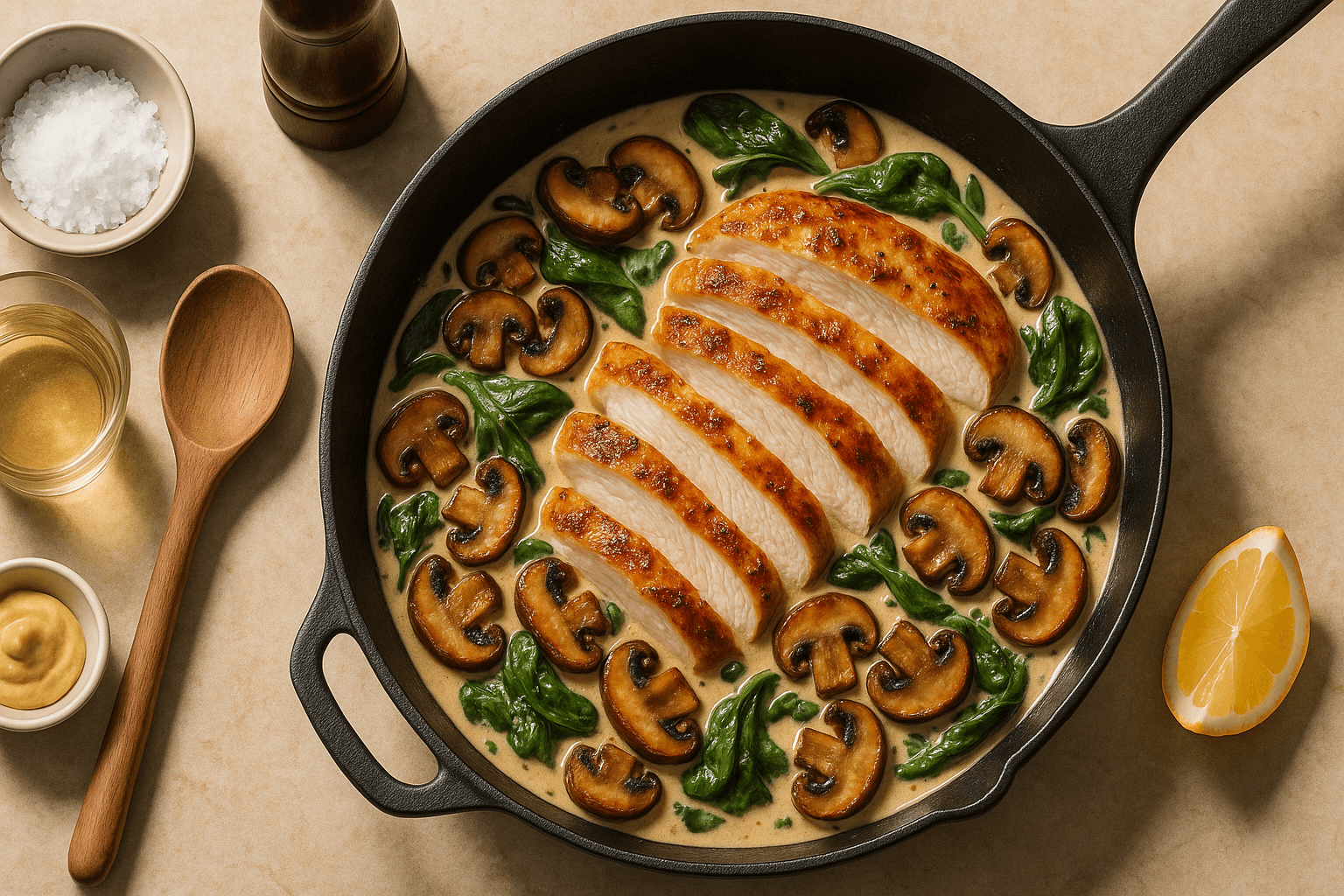
The Master Method (Creamy Chicken, Mushrooms, Spinach)
This is a blueprint you can adapt to pasta, rice, mashed potatoes, cauliflower rice, or zucchini noodles.
Yield & Timing
- Serves: 4
- Active time: 25–35 minutes
- Total time: ~35–45 minutes
Ingredients (Base Version)
Protein & veg
- 1.25–1.5 lb (570–680 g) chicken thighs or breasts
- 12–16 oz (340–450 g) mushrooms, sliced or torn
- 5–6 oz (140–170 g) fresh baby spinach
- 1 small shallot (or 1/2 onion), finely chopped
- 2–4 cloves garlic, minced
Sauce & aromatics
- 1 tbsp olive oil (plus more if needed)
- 1–2 tbsp butter (optional but helpful for flavor and emulsifying)
- 1/2 cup (120 ml) chicken stock
- 1/3–1/2 cup (80–120 ml) heavy cream (or crème fraîche; see swaps)
- 1 tsp Dijon mustard (optional, helps emulsify and adds depth)
- 1–2 tsp lemon juice (optional, for balance)
- 1/4 cup grated Parmesan (optional, thickens and seasons)
- Salt and black pepper
Optional flavor boosters
- 1/2 tsp smoked paprika or sweet paprika
- 1/2 tsp dried thyme (or a few sprigs fresh)
- 1–2 tsp soy sauce or Worcestershire (umami)
- Red pepper flakes
Equipment
- 12-inch stainless steel or cast iron skillet (nonstick works but browning is weaker)
- Tongs
- Instant-read thermometer (highly recommended)
Step-by-Step With Timing Cues (and What You’re Looking For)
Step 1: Prep for Speed (5 minutes)
- Pat chicken dry; season with salt and pepper (and paprika/thyme if using).
- Slice mushrooms to an even thickness.
- Mince shallot and garlic.
- Wash and dry spinach well.
Why this matters: once you start sautéing, the window between “browned” and “burnt/overcooked” is small. Mise en place makes the whole dish calmer.
Step 2: Sear Chicken and Remove (8–12 minutes)
- Heat skillet over medium-high until hot.
- Add oil (and a little butter if desired).
- Add chicken in a single layer.
- Sear without moving until deep golden, 3–5 minutes per side depending on thickness.
Temperature cue:
- Thighs: 175–185°F (79–85°C) are juicy and tender.
- Breasts: pull at 155–160°F (68–71°C) and rest; carryover brings it up.
Remove chicken to a plate.
If the fond looks very dark/black: lower heat and add a splash of stock to prevent bitterness.
Step 3: Brown Mushrooms Properly (10–15 minutes)
This is the heart of the dish.
- If pan is dry, add a bit more oil/butter.
- Add mushrooms in a single layer. If you have too many, do two batches.
- Do not salt immediately. Let them sit 2–3 minutes.
- Stir occasionally, letting them contact the pan long enough to brown.
Visual cues:
- Early: mushrooms look dry, then begin to sweat.
- Middle: water pools, then evaporates.
- Success moment: the squeaking stops, the pan sound changes from “wet” to “fry,” and edges turn deep brown.
Now add a pinch of salt and continue until richly browned.
Optional trick (the “dry sauté”): start mushrooms in a dry pan (no oil) to drive off water, then add fat once they begin to brown. This can speed browning and prevent oil absorption early on.
Step 4: Aromatics (1–2 minutes)
Add shallot to the mushrooms; cook until translucent. Add garlic last (30 seconds) so it doesn’t burn.
If using thyme sprigs, add now.
Step 5: Deglaze (1–3 minutes)
Add stock (or a splash of white wine, then stock). Scrape the fond.
Let it simmer briefly.
Goal: dissolve flavor into the liquid and reduce slightly so it’s not watery.
Step 6: Build a Creamy Sauce That Won’t Split (3–6 minutes)
Reduce heat to medium-low.
Add one or more stabilizers:
- Dijon mustard (great emulsifier)
- A small handful of Parmesan (adds body)
- A teaspoon of starch slurry (see below)
Then add cream (or crème fraîche). Keep it at a gentle simmer—no hard boiling.
Optional: The 30-Second Insurance Policy (Starch Slurry)
If you want maximum stability (especially with half-and-half or dairy-free milks), whisk:
- 1 tsp cornstarch + 1 tbsp cold water Then whisk into the sauce and simmer gently 30–60 seconds.
This small starch amount helps prevent separation and makes the sauce cling.
Step 7: Add Spinach at the End (30–90 seconds)
Add spinach in handfuls, tossing until just wilted.
Bright spinach rule: when it collapses and turns glossy green, stop cooking it.
Step 8: Return Chicken + Finish (2–4 minutes)
Return chicken (and juices) to the pan. Simmer gently to heat through and unify flavors.
Finish with:
- black pepper
- lemon juice (a small squeeze)
- Parmesan (if using)
Taste and adjust salt.
Common Problems and Fixes (Troubleshooting Table)
1) Mushrooms are pale and watery
Cause: pan crowded, heat too low, salted too early.
Fix:
- Cook in batches.
- Use higher heat early.
- Let water evaporate before adding more fat or salt.
2) Spinach makes the sauce watery
Cause: spinach added too early or not dried.
Fix:
- Add at the end.
- Dry spinach well.
- If using frozen spinach, thaw and squeeze until very dry.
3) Sauce split / looks grainy
Cause: boiled after dairy added; too much acid; low-fat dairy; overheating.
Fix (in the moment):
- Lower heat immediately.
- Whisk in 1–2 tbsp cold cream (or cold water) to help re-emulsify.
- Add a tiny starch slurry and whisk gently.
Prevent:
- Add dairy at medium-low.
- Don’t boil.
- Prefer crème fraîche or heavy cream.
4) Chicken is dry
Cause: overcooked breast; too high heat too long.
Fix:
- Use a thermometer.
- Pull breast at 155–160°F and rest.
- Choose thighs for meal prep.
Sauce Variations (Creamy, Light, Dairy-Free)
A) Classic Heavy Cream + Parmesan
- Most stable, classic “restaurant” texture.
- Add Parmesan off heat to reduce risk of graininess.
B) Crème Fraîche + Lemon
- Tangier and extremely stable.
- Great with thyme and a final squeeze of lemon.
C) Greek Yogurt (High Protein) Without Curdling
Yogurt is more likely to split, but you can make it work:
- Turn heat to low.
- Temper: whisk a ladle of warm sauce into yogurt, then whisk back into pan.
- Do not boil.
Best for a lighter, tangy finish.
D) Dairy-Free Cashew Cream
Blend:
- 1/2 cup raw cashews (soaked 20 min in hot water)
- 3/4 cup water
- pinch of salt
Stir into sauce base; simmer gently. Very stable, great mouthfeel.
E) Coconut Milk + Lime (Different Direction, Still Great)
Use full-fat coconut milk; season with garlic, ginger (optional), and finish with lime. Note: this moves away from “classic creamy” into a more globally-inspired profile.
Flavor Profiles (So It Never Feels Repetitive)
Use the same technique and change the character:
1) French Bistro
- Thyme, Dijon, white wine deglaze, crème fraîche.
- Finish with parsley.
2) Italian-American Creamy Garlic
- More garlic, Parmesan, maybe sun-dried tomato strips.
- Serve over pasta.
3) Eastern European-Inspired
- Paprika + sour cream (tempered) + dill.
- Serve with egg noodles or potatoes.
4) “Steakhouse” Umami
- Worcestershire in the sauce.
- Finish with cracked pepper.
5) Light and Lemony
- Skip heavy cream; use stock reduction + a knob of butter + lemon.
- Add capers if you like.
Deglazing Tips That Actually Change the Result
Deglazing is where home-cooked becomes “why does this taste like a restaurant?”
Choose a deglazing liquid that matches your end goal
- White wine: bright, classic with mushrooms.
- Chicken stock: neutral, safe.
- Vermouth: excellent pantry option; keeps well.
- A tiny splash of soy sauce (not a deglaze by itself, but a booster): adds savory depth.
Reduce after deglazing
After scraping fond, simmer 1–2 minutes so the liquid isn’t thin. Reduction concentrates gelatin (from stock) and dissolved proteins—this helps sauce body.
Watch salt if using Parmesan or soy
Both add salinity fast; season at the end.
Meal-Prep and Make-Ahead: Keeping Texture on Day 2–4
Creamy chicken and mushrooms can meal-prep beautifully—if you separate components and reheat gently.
The biggest meal-prep enemies
- Overcooked chicken from repeated heating.
- Spinach turning army-green from prolonged hot holding.
- Sauce breaking when microwaved too aggressively.
A meal-prep strategy that works
Option 1: Cook Everything, But Underdo the Spinach
- Cook dish fully but add spinach only until barely wilted.
- Cool quickly (spread in shallow container).
Reheat gently; spinach will finish softening.
Option 2: Hold Spinach Separate (Best Color)
- Meal prep chicken + mushrooms + sauce.
- Store spinach separately.
- When reheating, stir fresh spinach into the hot dish for 30–60 seconds.
Reheating rules for creamy sauces
- Stovetop is best: low heat, add a splash of stock/water to loosen.
- Microwave: use 50–70% power, stir halfway, avoid boiling.
Serving Variations: Pasta, Rice, and Low-Carb
1) Pasta (Creamy Mushroom Chicken Pasta)
Best shapes: fettuccine, penne, rigatoni.
Tips:
- Reserve 1/2 cup pasta water.
- Toss pasta into the skillet at the end; add pasta water gradually to emulsify and help sauce cling.
- Keep sauce slightly thicker before adding pasta.
2) Rice (Weeknight Bowl)
- Serve over jasmine rice, brown rice, or wild rice blend.
- Make sauce slightly looser with extra stock.
- Add a crunchy topping (toasted almonds, fried onions) to contrast creaminess.
3) Mashed Potatoes or Polenta
- Lean into the comfort-food angle.
- Keep sauce thicker; mushrooms should be deeply browned for maximum payoff.
4) Low-Carb Options
- Cauliflower rice: keep sauce thicker so it doesn’t waterlog.
- Zucchini noodles: salt and drain zoodles before serving, or sauté briefly and plate separately.
- Spaghetti squash: roast and squeeze lightly to remove excess moisture.
Low-carb pro tip: avoid adding watery vegetables (like raw zucchini) directly into the creamy sauce unless you pre-cook and drain them.
Scaling Up (Without Steaming Everything)
Cooking for 6–8?
- Use two skillets or cook in stages.
- Brown mushrooms in batches and spread them on a sheet pan to hold.
- Sear chicken in batches; keep warm in a 200°F (95°C) oven.
The enemy of scaling is the same enemy as always: crowding.
A Note on Food Safety and Storage
- Cool cooked food quickly (shallow containers help).
- Refrigerate within 2 hours (1 hour if your kitchen is very warm).
- Eat within 3–4 days.
- Reheat to steaming hot; for chicken, many guidelines recommend 165°F (74°C).
Putting It All Together: A Practical Checklist
Before you start:
- Big enough skillet (12-inch)
- Chicken patted dry and evenly sized
- Mushrooms sliced and ready
- Spinach washed and thoroughly dried
During cooking:
- Sear chicken and remove
- Brown mushrooms in a single layer (batch if needed)
- Deglaze and reduce
- Add dairy at medium-low; never hard-boil
- Add spinach last
For meal prep:
- Cool quickly
- Reheat gently; add splash of liquid
- Consider adding spinach fresh at reheat
Cultural Context: Why This Combination Is So Universal
Chicken, mushrooms, and greens appear together across countless home styles because they map neatly onto a classic plate-building logic:
- Chicken provides protein and mild flavor that welcomes sauces.
- Mushrooms contribute glutamates and nucleotides—compounds associated with savory depth (often described as umami), which is why they pair so naturally with chicken.
- Greens offer bitterness and freshness to cut richness.
The “creamy skillet” method is a modern home-kitchen cousin of older traditions: pan sauces built from browned bits (fond), deglazed with wine or stock, enriched with dairy or fat. It’s not tied to one region so much as it is tied to the enduring logic of making something greater than the sum of its parts.
Credible Culinary Science Touchstones (for Further Reading)
If you like the “why,” these are widely respected resources often referenced by chefs and food writers:
- Harold McGee, On Food and Cooking (foundational food science; great on proteins, emulsions, and plant pigments).
- J. Kenji López-Alt, The Food Lab (practical experiments on browning, moisture, and technique).
- Shirley Corriher, CookWise (clear explanations of sauce stability and common kitchen problems).
You don’t need to read them to cook this dish—but their explanations align with the same principles you’re applying here: control water, control heat, and build flavor in layers.
Final Takeaway: The “No Soggy Veg” Formula
If you remember only one thing, make it this sequence:
- Sear chicken → remove.
- Brown mushrooms properly (single layer, patient heat).
- Aromatics → brief.
- Deglaze → reduce.
- Add dairy on low heat (stabilize if needed).
- Spinach last (quick wilt).
Once that’s muscle memory, you can swap flavors endlessly—mustard and thyme one week, paprika and dill the next, cashew cream for dairy-free, pasta for comfort, cauliflower rice for lightness—without ever returning to soggy mushrooms or broken sauce.