Homemade Pesto That Stays Bright Green (Not Bitter): Blanch‑Shock Timing, Oil Choices, and a Freezer‑Proof Ratio for Basil, Kale, and Arugula
RecipeSimpli
Why pesto turns brown (and why it gets bitter)
A great pesto tastes alive: grassy, nutty, garlicky, with enough fat to feel silky and enough salt to make the herbs sing. But home pesto has two common problems:
- It browns—sometimes within minutes.
- It turns bitter—sometimes immediately, sometimes after a day in the fridge.
Both issues have clear causes, and you can fix them with a few science-backed choices.
Browning: oxidation and enzymes
Green herbs contain chlorophyll, but the browning you see in pesto is usually less about chlorophyll “dying” and more about enzymatic browning. When basil leaves are cut, bruised, or blended, cells rupture and enzymes like polyphenol oxidase (PPO) mix with oxygen. PPO catalyzes reactions that form brown pigments.
Oil on top helps a little by limiting oxygen, but oxygen is already mixed into the pesto from blending—and enzymes may still be active.
Bitterness: phenolics, tough greens, and overprocessing
Bitterness comes from a few sources:
- Basil stems, older leaves, and certain varieties can be peppery or bitter.
- Kale and arugula contain naturally bitter compounds (glucosinolates and related sulfur compounds in brassicas). Their bitterness can become more pronounced when aggressively blended.
- Over-blending can heat the mixture and over-extract bitter phenolics.
- Astringency (that drying sensation) often reads as bitterness; it can come from excessive raw garlic, very robust olive oil, or too much hard cheese.
The goal is not to eliminate all bitterness—some pleasant bite is part of pesto’s charm—but to keep it balanced, fresh, and sweet-green rather than harsh.
A quick cultural note: pesto isn’t one fixed recipe
Classic pesto alla genovese (from Liguria, Italy) is traditionally made with Genovese basil, pine nuts, garlic, Parmigiano-Reggiano, Pecorino Sardo (or Pecorino Romano in many modern kitchens), and extra-virgin olive oil, often ground in a mortar.
But “pesto” broadly means a pounded sauce (from pestare, to pound). That’s why kale pestos, arugula pestos, walnut pestos, pistachio pestos, and even sun-dried tomato pestos fit comfortably into the pesto family—especially for home cooks adapting to season, budget, allergies, or taste.
This article focuses on keeping pesto:
- Bright green
- Smooth and emulsified
- Low in harsh bitterness
- Freezer-friendly (no brown cubes)
The blanch‑shock method: the most reliable way to keep pesto green
If you want the biggest improvement with the least ongoing effort, do this: blanch the greens briefly, then shock in ice water.
Why blanching works
Blanching quickly:
- Deactivates browning enzymes like PPO (or at least greatly reduces their activity).
- Sets the green color by driving air out of leaf tissues and changing how chlorophyll appears (it often looks brighter).
Shocking in ice water:
- Stops the cooking instantly.
- Helps preserve aroma and texture.
Yes, basil is delicate. And yes, traditionalists may skip blanching for maximum raw basil perfume. But if your priority is bright green pesto that holds its color (especially for freezing), blanching is the most dependable method.
Timing chart: basil vs kale vs arugula
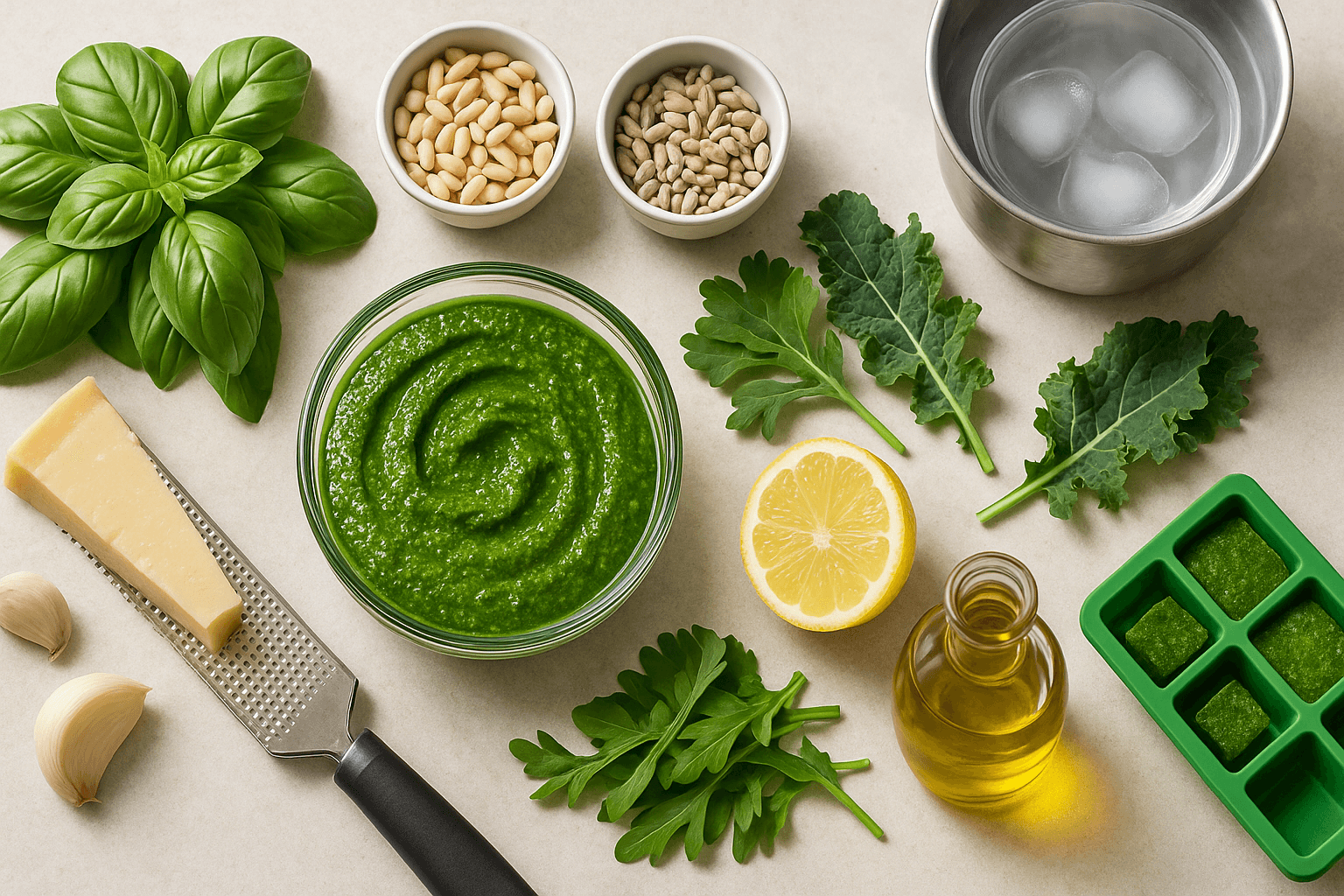
Use boiling salted water (it should taste like the sea) and prepare a big bowl of ice water.
Basil: 5–10 seconds
- Goal: just wilt, not cook.
Arugula: 10–15 seconds
- Slightly sturdier than basil; still quick.
Kale (torn leaves, ribs removed): 45–60 seconds
- Enough to soften and reduce harshness.
Mixed greens: blanch in batches by toughness
- Kale first, then arugula, then basil.
The crucial step people skip: drying thoroughly
After shocking, squeeze and dry the greens very well:
- Use your hands to squeeze firmly.
- Then wrap in a clean towel and wring.
Excess water dilutes pesto and makes it harder to emulsify. A little moisture is fine (and can help blending), but puddles are not.
Oil choices: flavor, bitterness, and oxidation stability
Oil is not just lubrication; it’s the solvent for aroma molecules and the backbone of pesto’s texture.
Extra-virgin olive oil (EVOO): choose the right style
- Peppery, very bitter EVOOs can make pesto taste harsh—especially with arugula or kale.
- A mild, fruity EVOO often makes a better everyday pesto.
If you love robust EVOO, you can still use it—just consider blending it with a milder oil.
Blended oils: a practical home-cook trick
A common restaurant approach for green sauces is to use a mix of:
- 70–80% mild olive oil (or light olive oil)
- 20–30% neutral oil (grapeseed, sunflower, canola)
Why it helps:
- Neutral oil reduces perceived bitterness.
- Some neutral oils are less intensely flavored, letting herbs shine.
Oxidation and rancidity: what matters in storage
Pesto’s enemies in the fridge/freezer are:
- Oxygen (browning)
- Time and heat (staling)
- Light (oxidation)
Freezing dramatically slows oxidation. In the fridge, keep pesto:
- In an airtight container
- Pressed flat to eliminate air pockets
- With a thin layer of oil on top
A freezer‑proof ratio (works for basil, kale, arugula, or blends)
Ratios make pesto repeatable—especially when you’re swapping greens.
The core ratio (by weight, best for consistency)
For 100 g greens (basil, arugula, kale, or a blend):
- 60–80 g oil
- 25–35 g nuts or seeds (or nut-free option below)
- 30–45 g grated hard cheese
- 6–10 g garlic (about 1–2 small cloves)
- 2–4 g salt (start low if cheese is salty)
- 5–15 g lemon juice (optional but helpful)
This yields a pesto that:
- Is thick enough to cling to pasta
- Freezes well without separating badly
- Stays green longer
Why this ratio works
- Enough oil to coat herb particles and reduce oxygen exposure.
- Enough cheese for body and savoriness without making it paste-like.
- A moderate amount of nuts/seeds for creaminess and emulsification.
- Optional acid (lemon) brightens flavor and can slightly slow browning.
If you measure by volume (good enough)
For packed 3 cups greens (varies by herb, but a useful home measure):
- 1/2 to 2/3 cup oil
- 1/4 to 1/3 cup nuts/seeds
- 1/2 to 3/4 cup finely grated Parmesan/Pecorino
- 1–2 cloves garlic
- Salt to taste
- Optional: 1–2 teaspoons lemon juice
Volume is less consistent than weight, but the ranges are forgiving.
Bitterness control: ingredient choices and technique
1) Choose younger greens (and prep them right)
- Basil: favor tender leaves; go easy on thick stems.
- Kale: remove ribs; use lacinato (dino) kale for a sweeter profile.
- Arugula: baby arugula is milder; mature arugula is more peppery.
2) Blanching reduces harshness—especially for kale and arugula
For kale, blanching does double duty:
- Softens fibers
- Tames some sharp brassica bite
For arugula, a brief blanch can mellow the peppery edge while keeping the “rocket” character.
3) Garlic: avoid the “hot” bitterness
Raw garlic can taste aggressively hot or bitter in blended sauces. Options:
- Use smaller amounts (you can always add more).
- Microplane garlic instead of blending it to reduce harsh chunks.
- Use blanched garlic: drop cloves into the blanching water for 30 seconds, then peel and use.
- Use roasted garlic for sweetness (less classic, very crowd-pleasing).
4) Nuts: toast or don’t?
- Raw nuts taste sweeter/creamier.
- Lightly toasted nuts add complexity but can push flavors toward “browned” notes.
For the brightest green, freshest taste, many cooks prefer raw pine nuts/cashews. For kale pesto, lightly toasted walnuts can be excellent.
5) Cheese: choose your blend for balance
- Parmigiano-Reggiano: nutty, less sharp.
- Pecorino Romano: saltier, tangier, can read sharper.
A balanced approach: 2 parts Parmesan to 1 part Pecorino.
6) Don’t over-blend (heat is the enemy)
High-speed blending can warm pesto quickly. Heat accelerates oxidation and can dull herbal aroma.
Tips:
- Use pulses, not a long run.
- If using a blender, add oil gradually and stop often.
- Work with cold ingredients (chill the blade jar if you like).
Step-by-step: bright green basil pesto (blanch‑shock + freezer-proof)
Ingredients (makes about 1 to 1 1/4 cups)
- 100 g basil leaves (about 3 packed cups)
- 65 g mild extra-virgin olive oil (about 1/3 cup), plus extra to top
- 30 g pine nuts (about 3 tablespoons)
- 35 g finely grated Parmesan (about 1/2 cup)
- 10 g Pecorino (optional, about 2 tablespoons)
- 1 small garlic clove (or to taste)
- 2–3 g kosher salt (start with 1/2 tsp, adjust)
- 1–2 tsp lemon juice (optional)
Method
-
Set up blanch and shock:
- Bring a pot of salted water to a boil.
- Prepare a big bowl of ice water.
-
Blanch basil (5–10 seconds):
- Drop basil leaves in, stir, then scoop quickly.
-
Shock and dry:
- Transfer to ice water immediately.
- Squeeze very dry; towel-wring if needed.
-
Grind nuts and garlic first:
- In a food processor: pulse nuts with garlic and a pinch of salt until sandy.
-
Add basil and cheese, then oil:
- Add basil and pulse a few times.
- Add cheese and pulse.
- With the machine running, drizzle in oil until creamy.
-
Adjust:
- Taste for salt.
- Add lemon juice if desired.
- If too thick, add a spoonful of oil (or a spoonful of pasta water when serving).
-
Store correctly:
- Press pesto into a container.
- Level the surface and pour a thin oil layer on top.
- Cover airtight.
Kale pesto that tastes fresh, not “health-food bitter”
Kale pesto can be deeply satisfying—more hearty and savory than basil pesto—but it needs a bit more help.
Kale-specific guidance
- Remove ribs.
- Blanch 45–60 seconds and shock.
- Consider adding lemon (it brightens and balances brassica notes).
- Consider a softer nut like cashew, or a mix of walnut + cashew.
Example formula (100 g kale)
- 100 g kale leaves, blanched/shocked/dried
- 70–80 g oil (kale is thicker; it likes a bit more)
- 30 g nuts/seeds
- 35–45 g cheese
- 1 small clove garlic
- 2–3 tsp lemon juice
- Salt to taste
Serving tip: kale pesto loves roasted potatoes, white beans, farro, and grilled chicken as much as pasta.
Arugula pesto: peppery, bright, and controlled
Arugula pesto is fast, modern, and incredibly good with seafood and summer vegetables. But arugula can go from pleasantly peppery to sharply bitter if mishandled.
Arugula-specific guidance
- Use baby arugula for mildness.
- Blanch 10–15 seconds if you want it greener and less sharp.
- Choose a mild oil.
- Use less garlic than you think.
Example formula (100 g arugula)
- 100 g arugula, blanched/shocked/dried (optional but recommended for color)
- 60–70 g oil
- 25–30 g nuts/seeds
- 30–40 g cheese
- 1/2 to 1 small clove garlic
- 1–2 tsp lemon juice
- Salt to taste
Arugula pesto is excellent with shrimp, lemony pasta, tomatoes, and fresh mozzarella.
Nut-free swaps (and how to keep the texture creamy)
If you’re avoiding nuts due to allergies or preference, you can still make pesto that’s creamy and stable.
Best nut-free options
- Pumpkin seeds (pepitas): creamy, green, mild when raw
- Sunflower seeds: classic nut-free pesto stand-in; soak briefly for extra creaminess
- Hemp hearts: very creamy and quick; slightly grassy flavor
- Toasted breadcrumbs: traditional in some Italian sauces; gives body (use with some seed for richness)
How to use seeds successfully
- Use the same 25–35 g range per 100 g greens.
- Consider soaking sunflower seeds 15–30 minutes, then drain (helps blending).
- For extra smoothness, grind seeds first, then add greens.
Oxidation fixes: what to do if pesto is already browning
Sometimes pesto browns because you skipped blanching, the basil was older, or the container wasn’t airtight.
Here’s what helps:
- Scrape off the browned top layer (it’s often just the surface).
- Stir in a teaspoon of fresh lemon juice.
- Add a small handful of fresh herbs (even fresh parsley) and pulse briefly to refresh color.
- Store again with a thin oil layer and airtight seal.
What doesn’t really work: adding lots of lemon to “reverse” browning. Acid can slow new browning, but it won’t magically turn brown pigments green.
Freezer cubes that don’t brown: the method
Freezing pesto is one of the best ways to preserve peak-season herbs. The key is to freeze it in a way that minimizes oxygen exposure and prevents freezer burn.
Best practice: freeze the base, add cheese later (optional)
Cheese freezes fine, but many cooks prefer freezing pesto without cheese for maximum freshness and flexibility.
Freezer base ratio (per 100 g greens):
- Greens 100 g (blanched/shocked/dried)
- Oil 60–80 g
- Nuts/seeds 25–35 g
- Garlic 6–10 g
- Salt 2–3 g
- Optional lemon juice 5–10 g
Then, when serving, stir in:
- Cheese 30–45 g per 100 g original greens (to taste)
Cube method (most convenient)
- Make pesto (with blanch‑shock for best color).
- Spoon into silicone ice cube trays.
- Level the tops and lightly brush/drizzle a few drops of oil over each cube.
- Freeze until solid.
- Pop out and store cubes in a zip-top freezer bag, pressing out air.
Thawing without discoloration
- Thaw in the fridge overnight, or
- Melt gently in a warm pan with a splash of pasta water (don’t scorch), or
- Stir frozen cubes directly into hot pasta with pasta water to emulsify.
If you froze pesto without cheese, add cheese off heat for best texture.
Serving: how to keep pesto silky on pasta (and not oily)
Pesto can “break” (look oily) if it’s too thick or added to very hot pasta without enough water to emulsify.
The classic pasta technique
- Reserve 1 cup pasta water.
- In a warm (not blazing hot) bowl or pan, combine:
- 2–3 tablespoons pesto
- A splash of pasta water
- Toss pasta vigorously, adding more pasta water as needed.
Pasta water contains starch, which helps emulsify oil into a glossy sauce.
Troubleshooting guide
Pesto is bitter
- Use a milder oil or blend EVOO with neutral oil.
- Reduce garlic; try blanched or roasted garlic.
- Blanch greens (especially arugula/kale).
- Add a little more cheese or a pinch of salt (bitterness often signals under-seasoning).
- Add lemon juice a few drops at a time.
Pesto is dull green or brownish
- Blanch‑shock next time.
- Work colder and faster; pulse instead of continuous blending.
- Store with an oil cap and airtight seal.
Pesto is too thick / paste-like
- Add more oil, or thin with a spoonful of water/pasta water when serving.
- Ensure greens were dried but not over-squeezed into a dense ball that won’t blend; tear before blending.
Pesto is too thin
- Add more nuts/seeds or cheese.
- Blend a bit longer (but avoid heating).
Pesto tastes flat
- Add salt gradually.
- Add a small squeeze of lemon.
- Consider a tiny amount of lemon zest for aroma.
Practical variations (built from the same ratio)
1) Basil + parsley “extra green” pesto
Parsley is naturally more color-stable than basil and adds fresh lift.
- Use 70 g basil + 30 g parsley (blanch together quickly).
2) Basil + kale “budget basil” pesto
When basil is expensive or out of season:
- Use 60 g basil + 40 g kale (blanch kale longer; basil briefly).
3) Arugula + basil “peppery summer” pesto
- Use 50 g arugula + 50 g basil.
- Use mild oil and lighter garlic.
Food safety and storage windows
- Fridge: 3–5 days (best color in first 2–3 days). Always use clean utensils.
- Freezer: 3–6 months for best flavor; up to ~9 months acceptable if well sealed.
If pesto contains fresh cheese and you’re sensitive to quality changes, consider freezing without cheese and adding it later.
Key takeaways (the “bright green” checklist)
- Blanch‑shock: basil 5–10 seconds, arugula 10–15 seconds, kale 45–60 seconds.
- Dry greens thoroughly after shocking.
- Use a mild oil (or blend EVOO with neutral oil) to control bitterness.
- Follow a repeatable ratio: per 100 g greens, 60–80 g oil, 25–35 g nuts/seeds, 30–45 g cheese.
- Pulse, don’t over-blend to avoid heat.
- Store with an oil cap and airtight seal.
- For the best freezer results, freeze in cubes, optionally without cheese.
With these methods, pesto becomes less of a delicate, “use it immediately” sauce and more of a reliable staple—vivid green, balanced, and ready whenever you want a quick bowl of pasta, a sandwich spread, or a spoonful of summer in the middle of winter.
References and further reading (for the curious)
- Harold McGee, On Food and Cooking (enzymes, plant pigments, and sauce emulsions)
- J. Kenji López-Alt and Serious Eats articles on pesto technique, oxidation, and herb sauces
- Italian culinary tradition around Ligurian pesto and mortar-based emulsification (general reference; regional variations abound)