Low‑Sodium Cooking That Still Tastes Salty: The Flavor‑Stacking Playbook (Potassium Salts, Acids, Umami, and Timing Tricks)
RecipeSimpli
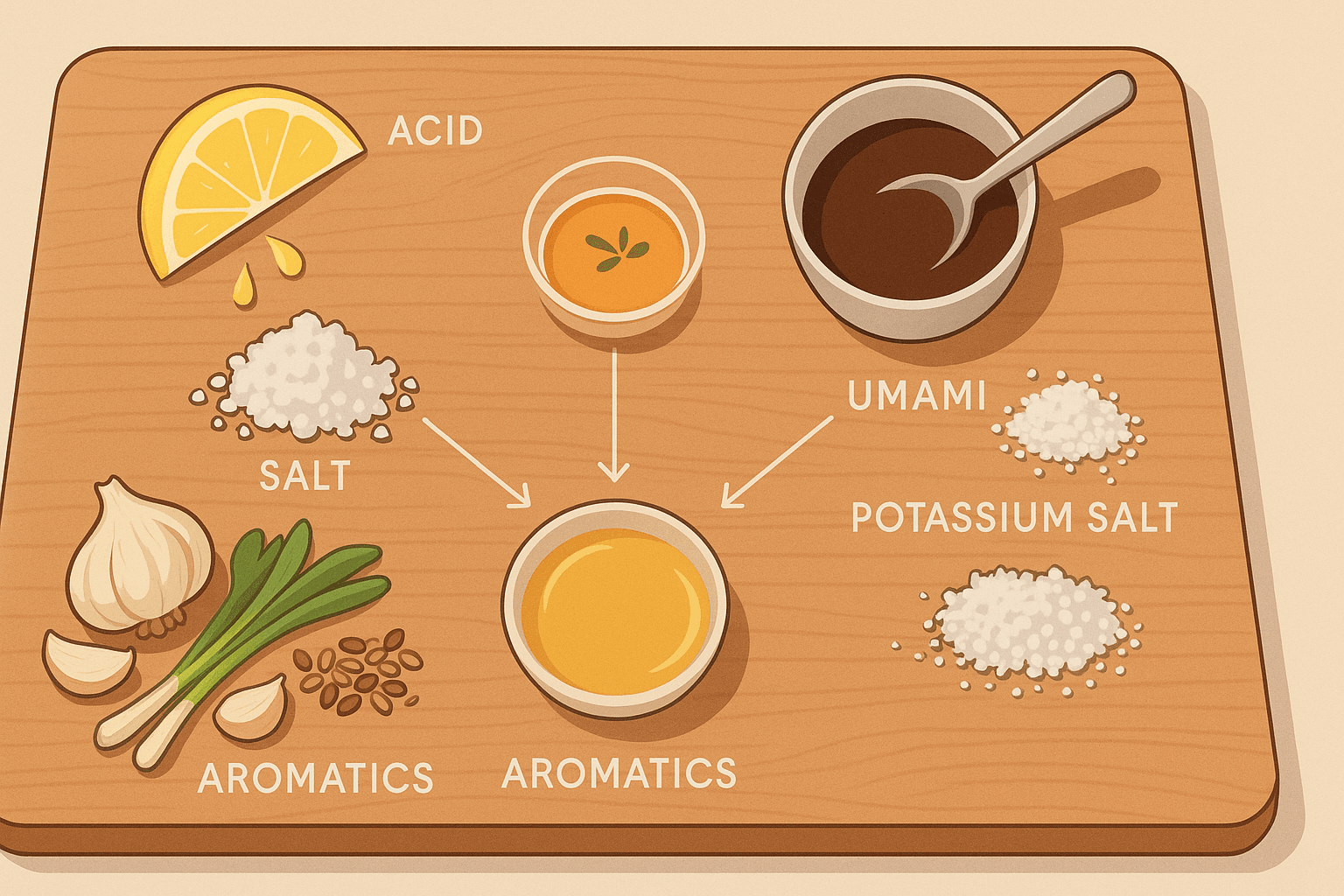
Why “low sodium” so often tastes like “no flavor”
Salt does two big jobs in home cooking:
- It makes food taste more like itself. Sodium ions (Na⁺) enhance the perception of many aromas and suppress some bitterness.
- It provides a specific sensation we recognize as “salty.” That taste is one of the five basic tastes, and it’s powerful.
When you cut sodium, you usually lose both the salty taste and the “flavor amplifier” effect. The result is food that can feel flat, muted, or oddly bitter—even if you used the same herbs and spices.
The good news: you can regain much of what salt did by stacking multiple signals of “seasoned food”—umami, acids, aromatics, controlled bitterness, texture, and strategic timing—so your brain still reads the dish as satisfying and “salty enough,” even with less sodium.
This is the flavor-stacking playbook: practical techniques that reliably increase perceived saltiness and overall deliciousness while reducing sodium.
Note: If you have kidney disease, heart failure, are on potassium-sparing diuretics, ACE inhibitors, ARBs, or have any medical reason to limit potassium, talk with a clinician before using potassium-based salt substitutes.
The core idea: Don’t replace salt—replace salt’s functions
Think of salt as a multi-tool. When you remove it, you don’t need a single replacement; you need a system.
Salt’s key functions (and how we’ll replace them)
- Salty taste: partly replaced with potassium salts, plus “salty illusions” (acid, umami, crunch).
- Flavor enhancement: replaced with umami builders, aromatics, browning, and fat.
- Bitterness suppression: managed with acids, sweetness, and careful ingredient choices.
- Water management/texture (brining, curing): replaced with smarter brines, dry-brining tweaks, and alternative tenderizing methods.
- Distribution: improved with when and how you season (timing and surface area).
Part 1 — Potassium salts: the closest thing to “salty,” used wisely
If your goal is “tastes salty” with less sodium, potassium chloride (KCl) is the workhorse. Many “salt substitutes” are mostly KCl.
How potassium salt tastes (and why people struggle with it)
KCl triggers salt receptors, but it can also bring a bitter/metallic aftertaste, especially at higher percentages. The trick is to blend and mask—not to swap 1:1.
Practical rules for using potassium salt at home
-
Start as a blend:
- Try 25% KCl + 75% NaCl for day-to-day cooking.
- Move to 50/50 if you like it.
- Many people find above ~50% KCl becomes noticeably bitter in simple foods (eggs, potatoes, plain broth).
-
Use it where there’s already complexity:
- Best: chili, stews, curry, tomato sauce, braises, stir-fries.
- Harder: plain scrambled eggs, lightly seasoned fish, simple vinaigrettes.
-
Don’t rely on KCl alone:
- Pair with acid (lemon, vinegar), umami (MSG, mushrooms), and aromatics (garlic, toasted spices). These reduce the perception of bitterness and increase overall savoriness.
-
Keep it on the surface when possible: Saltiness is most intense when it hits your tongue early. A small amount of finishing salt (or a KCl blend) often tastes saltier than more salt mixed deep into a dish.
Safety considerations (important)
Potassium is an essential nutrient, but too much can be dangerous for some people.
- If you have kidney disease or take medications that raise potassium (common blood pressure meds), avoid potassium salt substitutes unless medically cleared.
- For healthy adults, potassium from foods is generally beneficial, but concentrated KCl products can add up quickly.
When in doubt, reduce sodium using the non-potassium strategies below and treat KCl as optional.
Part 2 — MSG and umami: the “savoriness amplifier” that makes low-salt feel complete
MSG: what it does (and what it doesn’t)
Monosodium glutamate (MSG) provides glutamate, which triggers umami taste receptors. It doesn’t taste like table salt, but it makes foods taste meatier, brothier, and more finished—often allowing you to cut sodium while maintaining satisfaction.
MSG contains sodium, but far less by weight than table salt (because much of its mass is glutamate rather than sodium). In practice, a small amount of MSG can replace a larger amount of salt in terms of perceived savoriness.
Cultural context: MSG has been used widely in East Asian cuisines for decades, and scientific reviews have not supported the idea that MSG is uniquely harmful to most people when consumed in normal culinary amounts.
How to use MSG in a low-sodium strategy
- Use less salt than usual, then add a small pinch of MSG, taste, and adjust.
- MSG works best in foods that already have savory depth: soups, sauces, meat dishes, stir-fries, roasted vegetables.
- It’s less useful in sweets or very delicate dishes.
The “umami ladder” (pick 2–4, don’t use everything)
You can create umami without MSG—or stack MSG with natural sources. Here are powerful options:
- Tomato (paste, sun-dried, slow-cooked)
- Mushrooms (dried porcini powder, sautéed cremini)
- Seaweed (kombu; use a small piece in stocks)
- Fermented foods: miso, soy sauce, doubanjiang, fish sauce, shrimp paste
- Aged cheeses: parmesan, pecorino (use sparingly for sodium)
- Anchovies or anchovy paste (tiny amounts)
- Yeast extracts (nutritional yeast; some blends are salty)
Bonus: the “umami synergy” trick
Glutamate pairs synergistically with 5′-ribonucleotides (inosinate and guanylate), found in:
- Dried mushrooms (guanylate)
- Cooked meats and fish (inosinate)
- Bonito flakes (inosinate)
That’s why a little mushroom powder in a meat stew can dramatically boost savoriness—making you miss salt less.
Part 3 — Acids: the brightening lever that makes food feel seasoned
Acid doesn’t taste salty, but it makes low-salt food feel alive.
Why acid helps when salt is lower
- It increases contrast, making flavors pop.
- It can reduce the need for salt by balancing richness and bitterness.
- It helps “aim” aromas upward—especially in fatty dishes.
The acid toolkit (and where each shines)
- Lemon/lime juice: finishing, seafood, vegetables, grain bowls
- Vinegars:
- Champagne/rice vinegar: delicate brightness
- Apple cider vinegar: stews, greens
- Sherry/red wine vinegar: beans, roasted veg
- Balsamic: sweet-acid glaze (watch sugar)
- Fermented acids: yogurt, kefir, sour cream (also adds richness)
- Pickle brine: instant tang + spice (use carefully; often salty)
- Tamarind: sour depth for curries and soups
Timing matters: add acid twice
- Early acid (during cooking): integrates and softens (tomato sauce, braises).
- Late acid (at the end): provides top-note brightness that reads as “seasoned.”
A reliable low-sodium move is to finish with a teaspoon of vinegar or squeeze of citrus instead of extra salt.
Part 4 — Aromatics and spices: build a “seasoned” aroma before salt hits
Salt affects taste, but much of what we call “flavor” is aroma. If you make the kitchen smell incredible, your food often needs less sodium to feel satisfying.
The aromatic base: your low-sodium foundation
- Alliums: onion, garlic, shallot, scallion
- Aromatic vegetables: celery, fennel, bell pepper
- Ginger and chiles: heat + brightness
- Herbs: parsley, cilantro, dill, basil, thyme
Technique: bloom spices in fat
For spices like cumin, paprika, coriander, curry powders, chili flakes:
- Warm oil or butter.
- Add spices 15–30 seconds until fragrant.
- Then add aromatics or liquids.
This increases aromatic release and depth, so the dish feels fuller even with less salt.
Lean into “high impact” seasonings
- Smoked paprika, chipotle, toasted cumin
- Mustard (powder or prepared)
- Citrus zest (huge impact; zero sodium)
- Black pepper (freshly ground)
Part 5 — Texture and temperature: the underrated saltiness multipliers
Crunch and flakes: why finishing texture changes salt perception
A few crystals of salt on the surface deliver bursts of saltiness. That’s why flaky salts (like Maldon) are powerful: you can use less total sodium and still get salty impact.
Low-sodium application:
- Use a tiny amount of flaky finishing salt only on the surface of plated food.
- Or use a KCl/NaCl blend as a finishing sprinkle if you tolerate the taste.
Warm food tastes less salty than cool food
Temperature affects taste perception. Very hot soups may need more seasoning than warm ones. If you taste only while it’s boiling hot, you might oversalt.
Low-sodium habit:
- Taste when the food is warm, not scalding.
Part 6 — Browning and concentration: create depth that reads as “seasoned”
Salt isn’t the only path to “depth.” Browning and reduction create complexity.
Maillard and caramelization: flavor density without sodium
- Sear meat properly (dry surface, high heat)
- Roast vegetables until edges brown
- Toast tomato paste in oil until it darkens
These steps create savory, roasted notes that compensate for lower salt.
Reduce and concentrate wisely
Reducing a sauce concentrates everything—including any salt you added. For low sodium:
- Keep early salt minimal.
- Reduce first, season later.
Part 7 — The timing tricks: when to salt, brine, and finish for maximum impact
Lower-sodium cooking is less about never salting and more about salting with intention.
1) Season in layers, not all at once
If you add all your salt at the end, the interior may taste bland. If you add it all at the beginning, you may need more overall.
Better approach:
- Add small amounts at key steps (onions, protein, simmering liquid).
- Finish with acid + aromatics and only a minimal final salt adjustment.
2) Surface-area strategy: salt where your tongue will notice it
- Salt the outside of roasted vegetables and meats more than the interior of a stew.
- Consider salty elements as garnishes: a few capers, olives, or a shaving of parmesan can deliver “salt hits” without salting the entire pot.
3) Dry-brining meat: powerful, but manage sodium
Dry-brining (salting meat ahead of time) improves juiciness and browning. For sodium reduction:
- Use less than typical dry-brine amounts.
- Combine with a salt/KCl blend (if appropriate).
- Add umami rubs: mushroom powder, smoked paprika, garlic powder, black pepper.
Even a modest dry-brine can make meat taste more seasoned than salting only at the end.
4) Wet brines: consider alternatives
Traditional wet brines can add a lot of sodium. Alternatives:
- Yogurt marinade (acid + enzymes + spices)
- Buttermilk marinade (tenderizes and adds tang)
- Citrus/garlic/herb marinades with minimal salt
5) “Finish” strategically
A dish can taste underseasoned because it lacks a top note, not because it lacks sodium.
Finishing options (choose 1–2):
- Lemon juice or vinegar
- Fresh herbs
- Citrus zest
- Chili oil or toasted sesame oil (a few drops)
- A tiny pinch of flaky salt
Part 8 — Practical flavor-stacking frameworks (use these like templates)
Instead of memorizing rules, use repeatable stacks.
The 5-Part Low-Sodium Stack
For most savory dishes, aim for:
- Aromatic base (onion/garlic/ginger)
- Umami (MSG or mushrooms or miso, etc.)
- Acid (early and/or late)
- Heat or spice (pepper, chile, mustard)
- Finish (herbs, zest, tiny salt)
Salt becomes the last adjustment, not the main engine.
The “Salty Illusion” Stack for vegetables
Vegetables often need less sodium if you:
- Roast hard (browning)
- Add acid (lemon)
- Add umami (miso glaze, mushroom powder)
- Add crunch (toasted nuts, breadcrumbs)
Part 9 — Example makeovers: familiar dishes, less sodium, still satisfying
1) Weeknight tomato sauce
Common problem: You keep adding salt to make it taste “like sauce.”
Low-sodium upgrade:
- Sauté onion/garlic in olive oil.
- Toast tomato paste until it darkens.
- Add crushed tomatoes + a pinch of MSG (or a little mushroom powder).
- Simmer to reduce.
- Finish with red wine vinegar or lemon juice and fresh basil.
- Add only a small final salt adjustment (or a salt/KCl blend).
Why it works: browning + glutamate + acid = depth and brightness that mimic “properly seasoned.”
2) Chicken soup that tastes full without a salty boxed broth
Common problem: Low-sodium broth tastes thin.
Low-sodium upgrade:
- Start with a strong aromatic base: onion, celery, carrot, garlic.
- Add kombu (remove before boiling hard) or dried mushrooms for umami.
- Simmer chicken (or bones) gently for body.
- Finish with lemon juice and lots of chopped dill/parsley.
- If needed, add a small pinch of MSG and minimal salt at the end.
Why it works: umami and aromatics replace some of what salt did in store-bought broth.
3) Crispy roasted potatoes with less salt
Common problem: Potatoes “eat salt.”
Low-sodium upgrade:
- Parboil, rough up edges.
- Roast hot with oil for maximum browning.
- Toss with garlic, smoked paprika, black pepper.
- Finish with malt vinegar or lemon zest + a tiny pinch of flaky salt (or blend).
Why it works: crisp texture + acid + aromatic punch reduces the need for heavy salting.
4) Big salad that doesn’t need a salty dressing
Common problem: You rely on salty cheese or heavy dressing.
Low-sodium upgrade:
- Build contrast: bitter greens + sweet element (fruit or roasted veg).
- Add umami: toasted nuts, mushrooms, or a small amount of parmesan.
- Make a dressing with strong acid (lemon + Dijon) and a touch of sweetness.
- Finish with herbs and black pepper.
Why it works: balanced bitterness/sweetness/acid reads as “seasoned.”
Part 10 — Ingredient tactics: how to keep sodium down without losing your favorite flavors
Choose “big flavor per mg” ingredients
Some ingredients are salty but used in tiny amounts, giving you great return:
- Fish sauce (a few drops)
- Anchovy paste (¼ tsp in a pot)
- Miso (1 tsp can season a whole soup)
- Soy sauce (consider reduced-sodium; still not low, but easier to control)
Use them as seasoning agents, not as main liquids.
Watch the stealth sodium traps
Even serious home cooks get blindsided by:
- Bouillon cubes/powders
- Cured meats (bacon, ham)
- Pickles/olives/capers
- Pre-made spice blends (often salted)
- Bread and tortillas (significant sodium per serving)
Low-sodium cooking works best when you reduce sodium at the ingredient level, not just the salt shaker.
Part 11 — A practical approach: how to retrain your palate
If you’re used to high-sodium food, the first week can feel disappointing. This is normal.
A gradual reduction plan
- Week 1–2: Reduce salt by ~15–20%, add more acid and aromatics.
- Week 3–4: Introduce MSG or umami sources; try a NaCl/KCl blend.
- Week 5+: Reserve “real salt hits” for finishing and special dishes.
Most people adapt, and foods you once liked may start tasting overly salty.
Part 12 — Quick reference: the low-sodium seasoning checklist
When something tastes bland, ask:
- Does it need acid? (lemon/vinegar)
- Does it need umami? (MSG, mushrooms, tomato paste, miso)
- Does it need aroma? (garlic, herbs, spice bloom)
- Does it need contrast? (a touch of sweetness, bitterness control)
- Does it need texture? (crunchy topping, finishing flakes)
- Only then: does it need more salt—or just a smarter salt moment?
Putting it all together: a sample “low-sodium but tastes seasoned” workflow
Here’s a simple, repeatable workflow for a sauté, stew, or roast:
- Build aroma: sweat onions/garlic/ginger.
- Bloom spices: toast in fat.
- Add umami: tomato paste, mushroom powder, small pinch MSG, or fermented paste.
- Cook and brown: don’t rush; develop fond and color.
- Reduce: concentrate flavor before final seasoning.
- Finish bright: lemon/vinegar + herbs/zest.
- Finish salty (optional): minimal flaky salt or a salt/KCl blend on the surface.
This is how you cut sodium while keeping food exciting: you’re not removing pleasure—you’re rebuilding it with better architecture.
Sources and further reading (non-exhaustive)
- Harold McGee, On Food and Cooking (flavor chemistry, taste/aroma, cooking methods)
- Institute of Medicine / National Academies resources on sodium and potassium intake (dietary reference context)
- Reviews on umami and glutamate in food science literature (umami receptor function; culinary applications)
- Public health guidance from major organizations (e.g., CDC, WHO) on sodium reduction strategies
*(These references are included as direction for readers who want deeper science and nutrition context; specific medical advice should come from qualified clinicians.)