Homemade Mayonnaise That Never Breaks: The Emulsion “Rescue Ladder,” Oil Speed Rules, and Pasteurized Egg Options (Stick Blender + Whisk Methods)
RecipeSimpli
Why mayonnaise breaks (and why yours doesn’t have to)
Mayonnaise is a cold emulsion: tiny droplets of oil dispersed in a continuous water-based phase (from egg, acid, and any added water). It’s thick not because it’s “whipped,” but because a stable network of microscopic oil droplets creates friction and structure.
When mayo “breaks” (splits, curdles, looks greasy, or turns thin), what’s happening is usually one of these failures:
- The oil droplets get too big and start merging (coalescing). Once droplets merge, the emulsion loses its fine structure and you see oil pooling.
- There isn’t enough emulsifier available at the moment you’re adding oil. Egg yolk contains lecithin and proteins that coat and stabilize new droplets—but they can be overwhelmed if oil arrives too fast.
- Insufficient shear (mixing force) leads to large droplets from the start. A whisk can work beautifully, but it requires correct pacing and technique.
- The water phase is too small (not enough water/acid/egg), or the ratio is pushed too far. Mayo can hold a surprising amount of oil—often 3/4 cup to 1 cup oil per yolk—but it has limits depending on method and conditions.
- Temperature and viscosity problems: ingredients that are too cold can slow emulsification; ingredients that are too warm can thin the emulsion and encourage separation.
The good news: mayo is one of the most fixable sauces in the kitchen. Once you understand the rules—especially the oil speed rule and the “rescue ladder”—you can make it reliably with either a stick blender or a whisk.
The emulsion fundamentals (home-cook version)
What’s doing the stabilizing?
- Egg yolk lecithin (a phospholipid) is the star emulsifier: it has a water-loving end and an oil-loving end, allowing it to coat oil droplets and keep them separated.
- Egg proteins also help form a protective layer around droplets.
- Mustard (especially Dijon) adds extra emulsifying power due to mucilage and other components; it also boosts stability and gives you a wider safety margin.
- Acid (lemon juice or vinegar) lowers pH, which changes how proteins behave and can improve stability and flavor balance.
This is why classic culinary sources (and food science texts) often describe mayonnaise as a carefully managed balance of emulsifier + water phase + mechanical shear.
Oil-in-water vs. water-in-oil
Mayonnaise is typically oil-in-water. If you dump oil in too fast, you risk forcing a partial phase inversion (toward water-in-oil), which looks like broken mayo: oily, grainy, or curdled.
A stable mayo keeps the water phase continuous and the oil phase finely divided.
The four variables that decide whether mayo breaks
1) Egg temperature (and why “room temp” is only half the story)
The common advice—use room-temperature eggs—works because:
- Warmer yolks are less viscous and blend more easily.
- Emulsifiers disperse more readily.
But “room temperature” is not a magic number. What you want is ingredients within the same general temperature range so the emulsion forms smoothly.
Practical target: ingredients around 18–22°C / 65–72°F are easy to work with.
If your eggs are cold: place them (in shell) in a bowl of warm tap water for 5–10 minutes.
If your kitchen is hot: keep oil at room temp (not warm), and avoid letting the mixture sit near the stove.
2) Oil drip rate (the #1 rule)
When you start the emulsion—especially with a whisk—you must add oil slowly so each new droplet is coated before more arrives.
Think of the early stage as building a “droplet scaffolding.” Once that scaffolding exists, you can add oil faster.
Rule of thumb:
- First 2–3 tablespoons of oil: add drop by drop (or in a hair-thin stream), whisking constantly.
- After it thickens and turns glossy: increase to a thin steady stream.
With a stick blender method (especially the jar method), the tool can create enough shear that you can add oil faster—but only if the initial setup is correct.
3) Acid timing (before, during, or after?)
Acid affects flavor and stability, but timing matters.
- Add some acid early: It boosts water phase volume and helps proteins behave in a way that supports emulsification.
- Hold back a portion: Adding all acid at once can make the mixture too thin early on (rare with typical home quantities, but possible) and can “tighten” flavors.
Best practice: add 1–2 teaspoons acid at the start, then adjust at the end.
4) Shear strength (stick blender vs whisk)
- Stick blender: high shear, fast droplet size reduction, very reliable—if the jar is the right size and the blade is positioned correctly.
- Whisk: lower shear, more technique-dependent, but can produce exceptionally silky mayo.
If you’re learning, use a stick blender first to internalize what “properly emulsified” looks like (glossy, thick, cohesive), then practice whisking.
Ingredients: what matters and what’s optional
Core ingredients (classic mayo)
- 1 egg yolk (or 1 whole egg, for a lighter but slightly less rich mayo)
- 3/4 cup (180 ml) neutral oil (can go to 1 cup / 240 ml depending on yolk size and method)
- 1–2 tsp (5–10 ml) lemon juice or vinegar, plus more to finish
- 1 tsp Dijon mustard (optional but highly recommended for stability)
- 1/4 tsp salt, plus more to taste
- Optional: 1–2 tsp water if you want extra insurance against breaking (more water phase = more stable early emulsion)
Choosing oil (stability + flavor)
- Neutral oils (canola, grapeseed, sunflower, safflower): easiest, clean flavor.
- Olive oil: delicious but can become bitter when aggressively sheared (particularly with high-powered blenders). If using olive oil, consider a whisk method or a gentler blend, or use half olive + half neutral.
- Avocado oil: mild and stable; good for higher heat tolerance, though mayo is typically used cold.
Foolproof stick blender mayo (jar method)
This is the most reliable “never breaks” approach for most home cooks.
Equipment
- Immersion blender
- A tall, narrow jar just wide enough for the blender head (often the jar that comes with the blender)
Jar size matters: if the jar is too wide, the blender won’t create the right vortex and the emulsion can take longer or fail.
Ingredients (base)
- 1 large egg (or 1 yolk for richer)
- 1 tbsp lemon juice (or 2 tsp vinegar)
- 1 tsp Dijon mustard
- 1/4 tsp salt
- 3/4 cup neutral oil
Method (with the “don’t move it yet” rule)
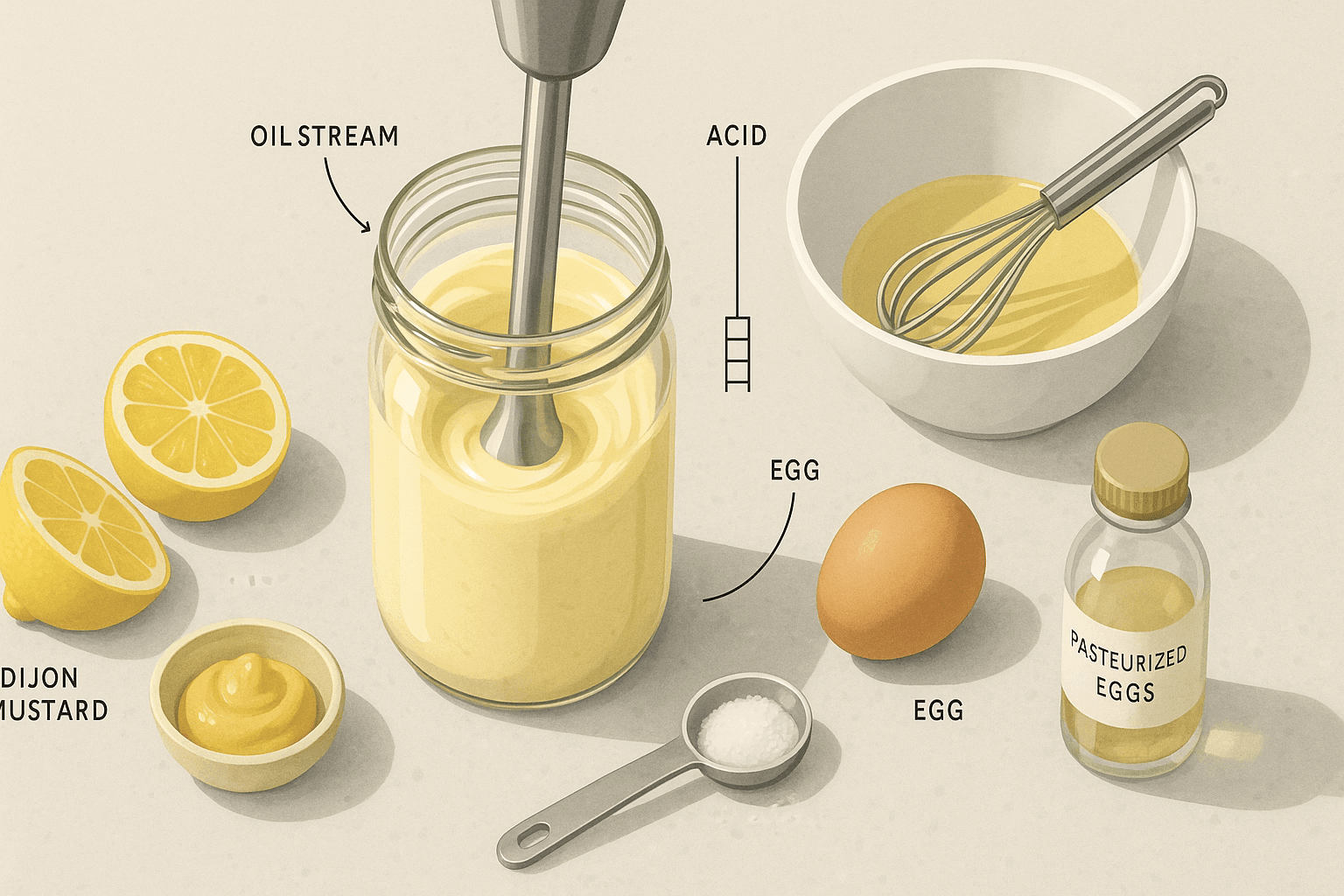
- Add to jar in this order: egg, mustard, acid, salt.
- Pour oil on top. Let it settle for 10–20 seconds so the egg mixture sits at the bottom.
- Insert the stick blender all the way down so the blade is over the egg.
- Blend without lifting for 10–15 seconds. You should see thick white-yellow mayo forming at the bottom.
- Once the bottom is clearly emulsified, slowly lift and tilt the blender to pull oil down into the vortex.
- Blend until uniform, 10–20 seconds more.
- Taste and adjust: more salt, acid, mustard, or a splash of water if too thick.
Why this works
At the bottom of the jar, the blade creates intense shear in a small region, and the egg mixture immediately coats newly formed oil droplets. When you lift the blender, you “feed” more oil into an already-stable emulsion.
Common stick-blender failure points (and fixes)
- Too-wide container: switch to a narrower jar.
- You lifted too soon: restart using the rescue ladder (below).
- Oil too thick/cold: let oil warm slightly to room temp.
Classic whisk mayo (silky, traditional, and totally doable)
Whisk mayo is the traditional approach found in many culinary schools and classic French technique guides. It’s slower but teaches you the emulsion “feel.”
Equipment
- Large bowl (preferably with a damp towel underneath to prevent sliding)
- Balloon whisk
- A small pitcher or measuring cup for oil (for control)
Ingredients (base)
- 1 large egg yolk
- 1 tsp Dijon mustard
- 1 tsp lemon juice or vinegar (start here)
- 1/4 tsp salt
- 3/4 cup neutral oil
- Optional: 1–2 tsp water
Method (the oil speed rules in action)
- In the bowl, whisk yolk, mustard, acid, salt (and optional water) until smooth.
- Begin adding oil drop by drop, whisking briskly. The mixture will look thin at first.
- After about 2–3 tablespoons oil, you should notice it turning thicker and glossier.
- Now you can add oil in a thin steady stream, whisking constantly.
- If it thickens too much before you’ve added all the oil, whisk in 1–2 tsp water or a bit more acid to loosen, then continue.
- Finish by adjusting acid and salt to taste.
The “tighten and loosen” trick
Mayo texture can get so thick it becomes hard to whisk. Professional kitchens often add a teaspoon of water to loosen it—this sounds counterintuitive, but it increases the water phase volume and helps maintain stability while keeping texture spreadable.
The Emulsion Rescue Ladder (from easiest to most powerful)
When mayo breaks, don’t throw it away. Work through this ladder in order. The goal is to reintroduce a stable water phase + emulsifier, then slowly incorporate the broken mixture back in.
Step 1: Pause and assess (30 seconds)
- Did you add oil too fast?
- Is the mixture extremely cold?
- Does it look slightly grainy but still cohesive, or fully separated with a pool of oil?
If it’s only slightly loose: try Step 2. If there’s obvious oil pooling: jump to Step 3 or 4.
Step 2: Whisk in water (or acid) a teaspoon at a time
Sometimes mayo is on the edge of breaking because it’s too tight (too much oil relative to water phase at that moment).
- Whisk in 1 tsp warm water.
- If needed, whisk in another teaspoon.
Alternative: add 1/2 tsp vinegar or lemon juice (flavor-forward fix).
If it comes back glossy and cohesive, continue adding oil more slowly.
Step 3: Add a fresh yolk (or a spoon of mustard) and re-emulsify
If you see separation, you need more emulsifier.
- In a clean bowl, whisk 1 egg yolk (or 2 tsp Dijon mustard + 1 tsp water if avoiding extra egg).
- Very slowly whisk the broken mayo into the new yolk base, a spoonful at a time.
- Once it thickens, you can add the rest in a thin stream.
This works because you’re essentially making a new mayo and using the broken one as the “oil portion.”
Step 4: The “starter emulsion” reset (most reliable)
This is the nuclear option—and the most dependable.
- In a clean bowl/jar, combine:
- 1 tbsp water
- 1 tbsp lemon juice or vinegar
- 1 egg yolk (or 1 whole egg)
- 1 tsp mustard (optional but helpful)
- Start blending/whisking.
- Add the broken mayo very slowly as if it were oil.
This creates an oversized water phase and a strong emulsifier base that can absorb a lot of oil.
Step 5 (rare): Temperature correction
If nothing works and everything is icy-cold, let the mixture sit at room temperature for 10 minutes, then attempt Step 4.
Avoid heating aggressively; mayo is not a warm emulsion, and heat can thin it and destabilize it.
Pasteurized egg options (and how they change your process)
Many home cooks want the flavor and texture of homemade mayo with reduced risk from raw eggs. In the U.S. and some other regions, eggs can carry Salmonella. Risk is low but not zero, and it matters more for young children, pregnant people, older adults, and immunocompromised folks.
Option A: Buy pasteurized shell eggs
Some grocery stores sell pasteurized eggs in the shell. These behave much like regular eggs in mayo.
- Use them 1:1 in any recipe.
- Texture is typically excellent.
Option B: Use liquid pasteurized eggs (carton)
Carton eggs are pasteurized and convenient, but they can behave differently.
- Liquid whole egg often works well with stick blender mayo.
- Liquid yolk products can vary by brand and may contain additives that affect thickening.
Tip: If your mayo comes out thinner with carton eggs, add:
- 1 tsp mustard (if not already)
- or use one extra yolk equivalent (if available)
- or reduce oil slightly (start with 2/3 cup, then add more if it thickens well)
Option C: Pasteurize eggs at home (caution and precision)
Home pasteurization is possible but requires careful temperature control to avoid partially cooking the egg.
- Typical guidance involves holding eggs at about 57–60°C / 135–140°F for a set time using a precise water bath (e.g., sous vide).
- If you overshoot, yolks can thicken, changing emulsification behavior.
If you don’t have reliable temperature control, store-bought pasteurized eggs are simpler.
Option D: Egg-free “mayo” (aquafaba or milk emulsions)
Not traditional mayonnaise, but still an emulsion.
- Aquafaba mayo uses chickpea brine proteins.
- Milk-based emulsions (common in some regional styles) rely on milk proteins.
These can be stable and delicious, but the flavor and richness differ.
Food safety and storage
- Store homemade mayo in a clean jar in the refrigerator.
- Use within 3–5 days as a conservative home guideline, especially with raw egg.
- Always use clean utensils to avoid contamination.
If you’re using pasteurized eggs, you may still choose a short storage window because homemade mayo lacks commercial preservatives and industrial process controls.
Troubleshooting: symptoms and causes
“It’s thin and never thickens”
Likely causes:
- Too much oil too soon (whisk method)
- Not enough shear (weak whisking)
- Container too wide (stick blender)
Fix:
- Use the rescue ladder Step 3 or 4.
“It suddenly turned grainy, then oily”
Likely causes:
- Oil added too fast after seeming stable
- Over-emulsified with temperature issues (rare), or phase inversion beginnings
Fix:
- Step 3 (fresh yolk) is often best.
“It’s so thick it won’t move”
Likely cause:
- High oil ratio + small water phase
Fix:
- Whisk in 1–2 tsp water to loosen.
“It tastes flat or heavy”
Likely cause:
- Not enough acid or salt
Fix:
- Add lemon/vinegar a few drops at a time; add salt gradually.
“It’s bitter”
Likely cause:
- Some olive oils can taste bitter when aggressively blended
Fix:
- Use half neutral oil; whisk instead of high-shear blending; choose a milder olive oil.
Stable flavor variations (that don’t make your mayo split)
The safest time to add bold flavors is after the emulsion is formed. If you add watery ingredients too early, you can accidentally dilute or destabilize the start.
1) Garlic aioli-style (modern home version)
Traditional “aioli” in some regions is garlic emulsified with oil (sometimes without egg), while many modern recipes use egg-yolk mayo plus garlic. For home cooks, stability is easiest with a finished mayo base.
- Stir in 1 small grated garlic clove (or 1/2 clove if strong)
- Add extra lemon to brighten
Tip: Raw garlic can intensify over time; make it slightly milder than you think.
2) Spicy sriracha or gochujang mayo
- Add 1–2 tbsp sriracha or 1 tbsp gochujang
- Balance with a squeeze of lime
These are fairly stable because the base mayo is already formed; just add gradually.
3) Herb mayo (green goddess direction)
Watery herbs can thin mayo.
Best approach:
- Blend herbs with a small amount of oil first (herb oil), or
- Pat herbs very dry before chopping
Then fold into mayo. Add salt and acid after tasting.
4) Miso mayo
Miso adds salt, umami, and some thickness.
- Whisk in 1–2 tbsp white miso
- Add rice vinegar to balance
5) Lemon-dill mayo (fish sandwich favorite)
- Add lemon zest + chopped dill
- Keep extra lemon juice modest to avoid making it runny; add zest for aroma instead.
Cultural context: why mayo techniques differ across kitchens
Mayonnaise is associated with French mother-sauce traditions, but emulsified sauces exist across many cuisines: garlic emulsions in the Mediterranean, rouille-style sauces, and modern restaurant “mayo-based” dressings worldwide.
Technique differences often reflect available tools:
- Whisk method is classical and scalable in a bowl, common in professional training.
- Stick blender method is a modern home-kitchen evolution: it concentrates shear in a narrow container, making the initial emulsion almost automatic.
Understanding the underlying emulsion principles lets you move between traditions and tools confidently.
A practical “never break” checklist
Use this as your pre-flight list:
- Ingredients similar temp (ideally cool-room temp).
- Start with yolk (or egg) + mustard + acid + salt.
- Control oil speed:
- whisk: drop-by-drop at first
- stick blender: don’t lift until you see thick mayo at the bottom
- Add water if needed to loosen and stabilize.
- If it breaks, don’t panic: follow the rescue ladder.
Two complete base recipes (quick reference)
Stick blender base mayo (1 cup-ish)
In a tall jar:
- 1 large egg
- 1 tsp Dijon mustard
- 1 tbsp lemon juice (or 2 tsp vinegar)
- 1/4 tsp salt
- 3/4 cup neutral oil
Blend: blade at bottom 10–15 seconds; then lift slowly to incorporate.
Whisk base mayo (about 3/4–1 cup)
In a bowl:
- 1 yolk
- 1 tsp Dijon mustard
- 1 tsp lemon/vinegar (plus more later)
- 1/4 tsp salt
Whisk: add oil dropwise for first 2–3 tbsp; then thin stream to finish. Loosen with 1–2 tsp water if too thick.
References and further reading (for the curious)
- Harold McGee, On Food and Cooking (emulsions; mayonnaise behavior and variables)
- Julia Child, Louisette Bertholle, Simone Beck, Mastering the Art of French Cooking (classic whisk technique and ratios)
- J. Kenji López-Alt and Serious Eats method testing (immersion blender mayo mechanics and container geometry)
- USDA and public health resources on egg handling and Salmonella risk (food safety context)
If you take only one idea into your kitchen, make it this: mayo breaks when oil arrives faster than your emulsifiers and mixing can handle. Control that early oil speed, use enough shear, and keep the rescue ladder in your back pocket. With that, homemade mayonnaise becomes less of a gamble and more of a dependable weeknight staple.