Cobbler vs. Crisp vs. Crumble vs. Buckle: The Ratio Guide to Nailing Fruit Desserts (Including Gluten‑Free + Sugar‑Free Swaps)
RecipeSimpli
The big idea: fruit desserts are mostly ratios
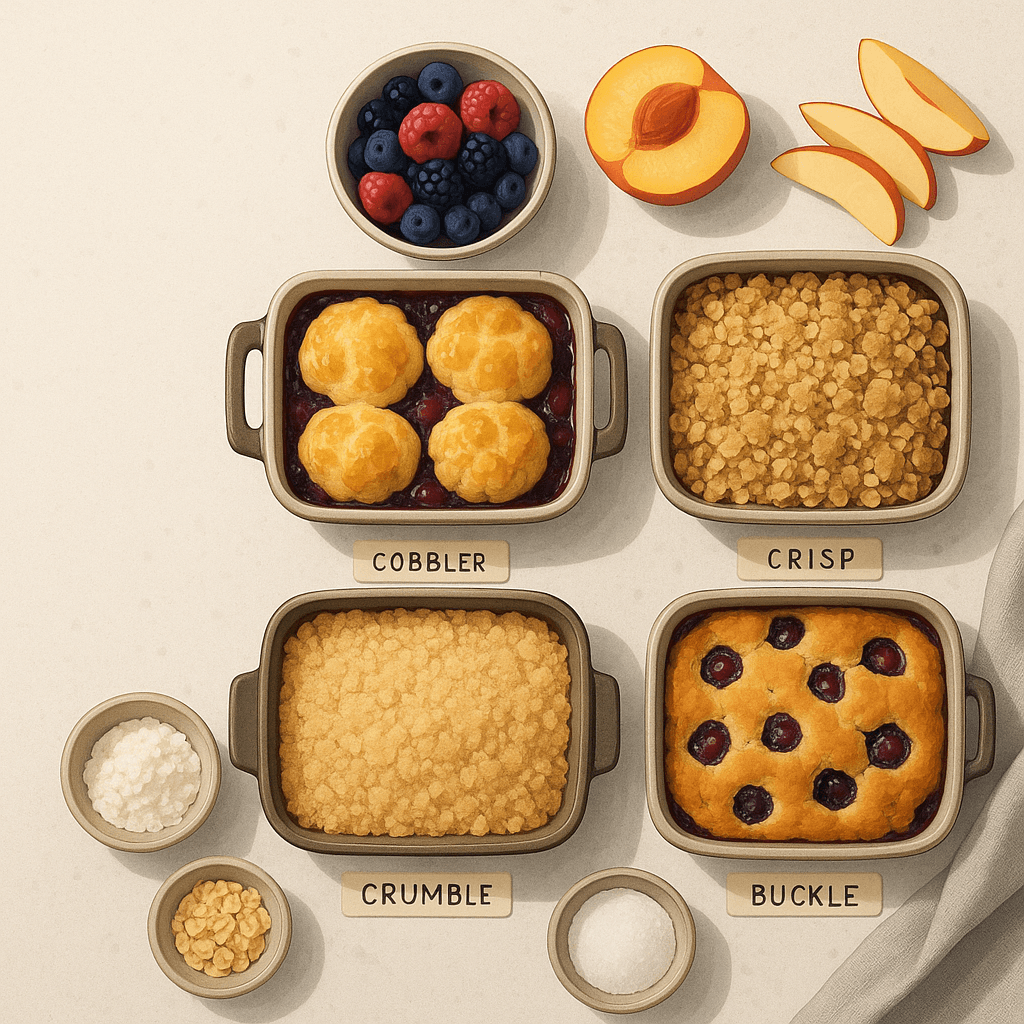
Cobbler, crisp, crumble, and buckle all look like cousins because they are: baked fruit + a starch/fat/sugar structure on top (or around). If you understand a few core ratios and how fruit behaves under heat, you can:
- Make any of these desserts from whatever fruit you have.
- Scale to any pan size without hunting for a “perfect” recipe.
- Swap in gluten‑free flours or sugar alternatives without ending up with soup, sand, or a pale topping.
This guide is ratio-first, technique-forward, and designed for home cooks. You’ll get:
- The defining traits of each dessert (what makes a cobbler a cobbler).
- Master ratios for toppings and fillings.
- How fruit moisture changes bake time and texture.
- When you should pre-cook the filling—and when you shouldn’t.
- Gluten‑free and sugar‑free swaps that still brown and set.
Quick terminology note: In some regions, names overlap (especially “cobbler” vs “crumble”). Don’t stress the label—use the structure and ratios.
At a glance: the family tree
Cobbler
- Structure: baked fruit under a biscuit/scone-like topping (drop biscuits, cut biscuits, or a batter poured over/under fruit).
- Texture goal: fluffy/crumbly topping + juicy fruit.
- Key risk: dough stays raw if the fruit releases lots of liquid or the topping is too thick.
Crisp
- Structure: baked fruit under a craggy oat-forward topping.
- Texture goal: crunchy peaks + syrupy fruit.
- Key risk: topping absorbs too much moisture and turns soft; or fruit stays watery if under-thickened.
Crumble
- Structure: baked fruit under a streusel-like topping (flour/sugar/butter rubbed together), usually without oats.
- Texture goal: sandy, tender crumbs that clump into buttery nuggets.
- Key risk: greasiness (too much butter) or dryness (too little butter / too much flour).
Buckle
- Structure: a cake with fruit folded in or scattered on top; as it bakes, the cake “buckles” around the fruit.
- Texture goal: tender, buttery cake with jammy pockets.
- Key risk: dense gummy crumb from too much fruit or too wet fruit; sinking fruit; underbaked center.
The foundation: how fruit behaves in the oven
Understanding fruit chemistry is the difference between “beautiful bubbling edges” and “puddle with a pale lid.”
Fruit is mostly water + sugar + pectin + acid
When heated:
- Cell walls soften and fruit releases juice.
- Sugar dissolves into those juices, creating syrup.
- Pectin (especially in apples, quinces, citrus, underripe fruit) can help gel.
- Acid (lemon, berries) helps pectin set and brightens flavor.
Why some fillings turn soupy
Soupy fillings usually come from one (or more) of these:
- Too much water (frozen fruit, very ripe stone fruit, watery berries).
- Not enough thickener (or the wrong one for the fruit).
- Not enough heat/time to activate thickening (starch needs to gelatinize; pectin needs time).
- Cut too soon: fillings continue to set as they cool.
Fruit moisture affects bake time
- High-moisture fruit (berries, cherries, peaches, plums) releases lots of liquid quickly. The topping may brown before the filling thickens.
- Low-moisture fruit (apples, pears) needs more time to soften; topping may be done before the fruit is tender.
Your solution is process control: pre-cook in some cases, choose the right thickener, and manage topping thickness and bake temperature.
The ratio toolkit (memorize these, then improvise)
Ratios are given by weight when possible (more accurate), with volume approximations where helpful.
1) The universal fruit filling ratio (baseline)
For 1 kg fruit (about 2.2 lb; roughly 6–8 cups depending on fruit):
- Sugar: 80–150 g (about 1/3 to 3/4 cup)
- Thickener:
- 20–35 g cornstarch (2–3 tbsp) or
- 25–45 g tapioca starch (3–4 tbsp) or
- 40–60 g flour (about 1/3–1/2 cup)
- Acid/salt: 1–2 tbsp lemon juice (or to taste) + 1/4 tsp salt
- Optional flavor: vanilla, cinnamon, ginger, citrus zest
How to choose sugar amount:
- Very sweet ripe fruit: use the low end.
- Tart fruit (rhubarb, sour cherries, underripe berries): use the high end.
How to choose thickener:
- Cornstarch: clean, glossy set; can weep after freezing/thawing.
- Tapioca starch: great for frozen fruit and high-juice berries; slightly translucent, cohesive.
- Flour: more opaque, “homey” thickness; good in crumbles/cobblers where rustic is fine.
Culinary science note: starch thickens when granules gelatinize (roughly 90–95°C / 194–203°F in a sugary, acidic environment). That’s why you need visible bubbling in the center—not just browned edges.
2) Crisp topping ratio (oat-forward)
A reliable crisp topping is built like granola-meets-streusel.
By weight:
- Flour: 1 part
- Sugar: 1 part
- Fat (butter): 1 part
- Oats: 1 to 1.5 parts
Example for a 9-inch pan:
- 100 g flour
- 100 g brown sugar (or mix)
- 100 g butter, melted or cold-cubed
- 120–150 g rolled oats
-
- 1/2 tsp salt
Mixing method matters:
- Melted butter: faster, more clumpy, slightly denser crisp.
- Cold butter rubbed in: more crumbly, pebbly texture with varied crunch.
3) Crumble topping ratio (streusel, usually no oats)
Crumble is essentially a classic streusel.
By weight:
- Flour: 2 parts
- Sugar: 1 part
- Fat (butter): 1 part
Example:
- 200 g flour
- 100 g sugar
- 100 g butter
-
- 1/2 tsp salt
Optional upgrades:
- Replace 25–40% of flour with almond flour for richer crumble.
- Add spices, chopped nuts.
4) Cobbler topping ratios (biscuit vs batter)
There are two common cobbler styles.
A) Drop-biscuit cobbler (most classic)
By weight (easy to remember):
- Flour: 3 parts
- Liquid (milk/buttermilk): 2 parts
- Fat (butter): 1 part
- Sugar: 0.5–1 part (depending on sweetness)
- Baking powder: ~4% of flour weight (e.g., 10–12 g per 250 g flour)
- Salt: ~1% of flour weight
This yields a tender, spoonable dough that “cobbles” over fruit.
B) Batter cobbler (poured)
Often: batter in pan + fruit + hot butter, or fruit + batter poured on top.
A reliable batter ratio:
- Flour: 1 part
- Sugar: 0.75–1 part
- Milk: 1 part
- Butter: 0.5 part
- Leavening: 3–4% of flour weight
This bakes more like a cake-meets-pancake top.
5) Buckle ratio (cake with fruit)
A buckle is essentially a butter cake designed to hold fruit.
By weight:
- Flour: 3 parts
- Sugar: 2 parts
- Butter: 2 parts
- Eggs: 1 part
- Milk/yogurt: 1–1.5 parts
- Baking powder: ~3–4% of flour weight
- Fruit: 2–3 parts (relative to flour)
Example conceptually: for 300 g flour, you might use 600–900 g fruit depending on moisture.
Rule of thumb: the wetter the fruit, the less you can push the quantity without risking a gummy center.
The most important doneness cue: center bubbling
For crisps/crumbles/cobblers, the topping can brown before the filling sets. The fix isn’t “bake until golden.” It’s:
- Bake until you see thick bubbles in the center (not just edges).
- If the top is already browned, tent with foil and keep baking.
A good target is 205°F / 96°C in the center of the filling if you use an instant-read thermometer.
When to pre-cook fruit (and when not to)
Pre-cooking (stovetop or microwave) is the secret weapon for controlling texture.
Pre-cook if:
- You’re using apples/pears and want them tender before the topping overbrowns.
- You’re using frozen fruit, especially berries (excess liquid).
- Your fruit is extremely ripe/juicy (late-season peaches, plums).
- You want a sharper set (sauce thickened before baking finishes).
Don’t pre-cook if:
- You want distinct fruit pieces that hold their shape (firm peaches, blueberries).
- You’re making a buckle and need the cake structure to bake properly around fruit.
How to pre-cook (simple method)
- Toss fruit with sugar + salt + acid.
- Heat until fruit starts releasing juice.
- Add thickener (slurry starch with a bit of cold water first if needed).
- Simmer briefly until glossy and slightly thickened.
- Cool 10–15 minutes before topping.
This reduces total bake time and improves consistency.
Fruit-by-fruit playbook (moisture, thickener, and tweaks)
Berries (strawberries, blueberries, raspberries, blackberries)
- High juice, especially frozen.
- Use tapioca starch for the cleanest, least weepy set.
- Consider pre-cooking frozen berries or at least thawing + draining.
- Add lemon zest to avoid “flat” sweetness.
Stone fruit (peaches, nectarines, plums, apricots, cherries)
- Very seasonal variance in water content.
- Peaches/plums: pre-cook if ultra-ripe.
- Cherries: need more sugar; consider a little almond extract.
Apples and pears
- Lower moisture, higher structure.
- Benefit from pre-cooking or slicing thin.
- Pair with spices; a small amount of lemon juice keeps flavor bright.
Rhubarb
- Releases a lot of water and is quite tart.
- Use more sugar and a solid thickener dose.
- Great with strawberries (but then watch moisture).
Pan choice, depth, and why it changes everything
- Shallow, wide dishes evaporate moisture faster → thicker filling, crisper topping.
- Deep casseroles trap steam → softer topping, longer time to set.
If your crisp always ends up soft, try:
- A wider baking dish.
- Slightly less fruit.
- Baking at 375–400°F (190–205°C) for better evaporation.
Gluten-free swaps that still taste like dessert (not “diet food”)
Gluten’s job in these desserts is mostly structure (not chew), so gluten‑free is very achievable if you choose the right flour for the job.
Best gluten-free choices by dessert type
Crisp / Crumble toppings
These are the easiest to make gluten-free.
- Swap all-purpose flour with:
- Oat flour (certified GF) for a warm, cookie-like flavor.
- Rice flour (white or brown) for extra crispness.
- Almond flour for richness (use with another flour to avoid greasiness).
- Coconut flour in small amounts only (very absorbent).
A dependable GF crisp blend (by weight):
- 50% oat flour or rice flour
- 30% almond flour
- 20% tapioca starch
Add extra salt (GF blends can taste flat) and consider a pinch more spice.
Cobbler (biscuit topping)
Biscuit-style cobbler is trickier because gluten normally provides cohesion.
Use:
- A quality 1:1 gluten-free baking flour with xanthan/guar, or
- A blend: rice flour + tapioca starch + a small amount of psyllium husk.
Practical tip: make drop-biscuit cobbler (spooned) rather than rolled biscuits. Drop dough tolerates GF better.
Buckle (cake)
Buckles work well with:
- 1:1 GF flour blend
- Or a mix of almond flour + starch + a little binder
Caution with almond flour: too much can make the cake fragile and oily; blend with starch and/or GF flour.
Using coconut flour without ruining texture
Coconut flour absorbs water aggressively.
Rules of thumb:
- Replace only 5–15% of flour weight with coconut flour unless the recipe is designed for it.
- Increase liquid or add an extra egg (especially in buckles) to avoid dryness.
Sugar-free (and reduced-sugar) swaps that still brown and set
Sugar does more than sweeten:
- Helps fruit release juice (osmosis), creating syrup.
- Raises boiling point slightly, helping thickening.
- Promotes caramelization and (in baked goods with proteins) Maillard browning.
- Tenderizes some toppings and helps them crisp.
So “just remove it” often leads to watery filling and pale topping.
Strategy 1: Reduce sugar, don’t eliminate
If you want a more fruit-forward dessert, often you can cut sugar by 25–40% and still get great results, especially with ripe fruit.
Strategy 2: Use sweeteners that behave like sugar
Here’s a practical guide:
Allulose
- Browns exceptionally well (more than many substitutes).
- Dissolves like sugar.
- Can make baked goods brown faster—watch the top.
- Great for crisp/crumble toppings.
Erythritol (or erythritol blends)
- Provides bulk and sweetness but browns poorly.
- Can recrystallize → slight cooling effect or crunch.
- Best when blended (monk fruit + erythritol) and paired with a browning helper.
Monk fruit (pure)
- Very sweet, no bulk.
- Use in combination with a bulk sweetener (allulose or erythritol) or you’ll lose texture.
Stevia
- Also high intensity, no bulk.
- Works best in fillings where texture comes from starch/pectin, not sugar crystals.
Strategy 3: Add a “browning helper” in toppings
If you’re using a sweetener that won’t brown, you can still get color and crunch:
- A teaspoon or two of molasses in a topping (not sugar-free, but low amount) boosts color.
- Milk powder (contains proteins + lactose) enhances Maillard browning in crumble/crisp toppings.
- Egg wash on biscuit cobbler tops encourages browning.
Strategy 4: Adjust thickening when sugar changes
With less sugar, fruit may release less juice initially but can still turn watery as it cooks.
Practical adjustments:
- Don’t reduce thickener at the same rate as sugar.
- For very low-sugar fillings, consider slightly more starch or a brief pre-cook to ensure activation.
A workable “sugar-free-ish” framework
For 1 kg fruit:
- Sweetener: use an amount equivalent to ~80–120 g sugar sweetness, but ensure bulk (allulose/erythritol blend).
- Thickener: start at 30–40 g tapioca for berries or 25–35 g cornstarch for stone fruit.
- Add 1–2 tbsp lemon juice and 1/4 tsp salt.
Important: some sugar alcohols can cause digestive upset for some people. If serving guests, consider labeling or choosing reduced-sugar rather than fully sugar-free.
Putting it together: master formulas by dessert type
Master Crisp Formula (any fruit)
- Fruit layer:
- 1 kg fruit
- 80–150 g sugar (or equivalent)
- 20–45 g thickener (based on fruit)
- 1–2 tbsp lemon juice + salt
- Crisp topping (ratio):
- Flour : sugar : butter = 1 : 1 : 1
- Oats = 1 to 1.5 parts
- Bake: 375°F / 190°C until center bubbles thickly (often 35–55 min).
Tip: If you crave extra crunch, toast some oats/nuts separately and sprinkle on during the last 10 minutes.
Master Crumble Formula
Same filling as above.
Crumble topping (ratio):
- Flour : sugar : butter = 2 : 1 : 1
Bake similarly to crisp. Crumble is usually slightly more tender than crisp.
Master Drop-Biscuit Cobbler Formula
- Make fruit filling (raw or pre-cooked depending on fruit).
- Make biscuit dough using:
- Flour 300 g
- Sugar 50–100 g
- Baking powder 12 g
- Salt 4 g
- Butter 100 g
- Buttermilk/milk 200 g
- Spoon dough over hot or warm filling (small gaps are fine).
- Bake 375°F / 190°C until biscuits are cooked through and filling bubbles up around them.
Tip: Sprinkle coarse sugar (or allulose) on the biscuit tops for sparkle and crunch.
Master Buckle Formula
- Make a butter cake batter (creaming method helps aeration).
- Fold in or top with fruit (don’t overload wet fruit).
- Optional: add a thin streusel on top (a crumble ratio works well).
- Bake 350°F / 175°C until the center springs back and a tester comes out with moist crumbs (not wet batter).
Tip: Toss fruit with 1–2 tsp flour/starch before folding in to reduce sinking.
Troubleshooting (the fixes that actually work)
“My filling is watery.”
- Bake longer until the center bubbles thickly.
- Use more appropriate thickener (tapioca for berries/frozen fruit).
- Pre-cook the fruit next time.
- Cool longer before serving; many fillings set as they cool.
“My topping is browned but the filling isn’t done.”
- Tent with foil and keep baking.
- Next time: use a thinner topping layer, a wider pan, or start at 400°F for 10 minutes then drop to 350–375°F.
“My crisp/crumble topping is soggy.”
- Increase oven temp slightly or bake longer.
- Use less butter or switch to cold-butter method.
- Add a little nut flour or chopped nuts for structure.
- Don’t refrigerate uncovered (steam softens topping). Re-crisp in oven.
“My cobbler topping is gummy/undercooked.”
- Make smaller dollops so steam can escape.
- Ensure fruit mixture is hot/warm going into oven (especially if pre-cooked).
- Don’t overload with very wet fruit unless pre-thickened.
“My buckle is dense.”
- Too much fruit or fruit too wet.
- Underbaked center.
- Overmixed batter after adding flour.
Cultural context: why these desserts exist at all
These desserts are deeply practical.
- Cobblers are strongly associated with American home baking, often linked to settler-era improvisation when pie plates or ovens suitable for pie crusts weren’t always available. A biscuit topping was easier than a rolled pastry.
- Crumble is widely associated with Britain, popularized during WWII-era rationing when butter and flour were limited and crumbles were more accessible than traditional pies.
- Crisps (especially oat-based) became a North American staple, echoing granola-like textures and making use of pantry grains.
- Buckles sit in the cake tradition—an easy way to stretch seasonal fruit into something sliceable for breakfasts, potlucks, and coffee tables.
In other words: they’re not just desserts. They’re methods for turning fleeting fruit into something shareable.
Example builds (so you can see the ratios in action)
Example 1: Blueberry-Lemon Crisp (GF option)
Fruit: 1 kg blueberries (fresh or frozen)
- Sugar: 100 g (or allulose equivalent)
- Thickener: 35–40 g tapioca starch
- Lemon juice: 1.5 tbsp + zest
- Salt: 1/4 tsp
Topping (GF-friendly):
- 80 g oat flour (GF)
- 60 g almond flour
- 100 g allulose or brown sugar
- 120 g oats (GF)
- 120 g butter
- Salt 1/2 tsp
Bake until center bubbles like lava, then cool 30–45 minutes.
Example 2: Peach Drop-Biscuit Cobbler (reduced sugar)
Fruit: 1.2 kg sliced ripe peaches
- Sugar: 90 g
- Thickener: 25–30 g cornstarch
- Lemon: 1 tbsp
- Salt: 1/4 tsp
If peaches are extremely ripe and juicy, pre-cook 5–7 minutes before baking.
Biscuit topping:
- Flour 300 g
- Sugar 60 g
- Baking powder 12 g
- Salt 4 g
- Butter 100 g
- Buttermilk 200 g
Dollop, sprinkle sugar, bake until biscuits are cooked through.
Example 3: Apple-Pear Crumble (sugar-free-ish, browning-minded)
Fruit: 1 kg apples/pears, sliced
- Sweetener: erythritol/allulose blend equivalent to ~100 g sugar sweetness
- Thickener: 30–40 g cornstarch (or 45–60 g flour for a more rustic set)
- Lemon juice: 2 tbsp
- Cinnamon + salt
Crumble topping:
- 200 g flour (or GF blend)
- 100 g allulose (best for browning)
- 100 g butter
- Add 2 tbsp milk powder if using erythritol-heavy blends.
The “serve it right” rules (small details, big payoff)
- Rest time matters: 20–60 minutes after baking lets the filling set.
- Reheat to revive crunch: 10–15 minutes in a 350°F / 175°C oven beats the microwave.
- Ice cream isn’t just indulgence: cold fat + hot acidulated fruit is balance. Unsweetened whipped cream also works well for reduced-sugar desserts.
Your cheat sheet (memorize this)
- Crisp topping: flour : sugar : butter = 1 : 1 : 1, plus oats 1–1.5 parts.
- Crumble topping: flour : sugar : butter = 2 : 1 : 1.
- Cobbler topping: biscuit-style, flour-heavy, spooned over fruit.
- Buckle: cake base + fruit; don’t overload wet fruit.
- Doneness: center bubbling is king.
- Pre-cook fruit when: apples/pears, frozen fruit, super-juicy ripe fruit.
- GF easiest: crisp/crumble. GF hardest: biscuit cobbler.
- Sugar-free best for browning: allulose; erythritol needs help.
References and further reading (for the curious)
- Harold McGee, On Food and Cooking (fruit pectin behavior, starch gelatinization, browning reactions).
- J. Kenji López-Alt, discussions and testing on heat, moisture management, and starch thickening principles (Serious Eats-style methodology).
- King Arthur Baking educational resources on gluten-free flour behavior, starches, and substitute sweeteners in baking.
Use the ratios as your map, and let the fruit you have decide the route. Once you can control moisture, thickening, and topping structure, you can “nail” any of these desserts on purpose—no matter what the farmers market (or freezer aisle) gives you.