Crawfish Recipes That Peel Easy and Stay Tender: The Salt “Purge” Debate, Boil Spice Timing, and a Texture-Safe Cook‑Chill Method for Étouffée, Pasta, and Tails
RecipeSimpli
The goal: easy-peeling crawfish that stay juicy
If you’ve ever cooked crawfish at home, you’ve probably heard at least three confident-sounding “rules”:
- “Always purge with salt.”
- “Dump the seasoning in after the boil.”
- “Don’t overcook—just boil for 3 minutes.”
And then you try them… and end up with crawfish that are hard to peel, rubbery in pasta, or bland unless you drown them in spice.
Here’s the truth: tender texture and easy peeling are less about one magic trick and more about controlling a few key variables:
- The health and handling of the live crawfish (clean, lively, recently harvested).
- Salt and “purging” (what it does and what it doesn’t).
- Seasoning timing (boil vs. soak vs. post-season).
- Cook-chill technique (how you stop the cooking and preserve moisture).
- Gentle reheating (especially for étouffée, pasta, and sauced dishes).
This article breaks down the salt purge debate, the spice timing strategies used in real crawfish boils, and a texture-safe cook‑chill method you can use for weeknight étouffée, creamy pasta, tacos, bisque, and tail meat you actually want to eat.
Cultural context matters: A Louisiana crawfish boil is as much about community as it is about technique. There isn’t one “official” method. But there are repeatable principles—grounded in food science—that help home cooks get consistent results.
Part 1: The salt “purge” debate—what’s real, what’s folklore
What people mean by “purging”
When cooks say “purge,” they usually mean rinsing live crawfish in multiple changes of water—sometimes with salt, sometimes without—to remove:
- Mud and grit stuck to shells
- Pond debris (grass, leaves)
- Organic funk on the exterior
Some also believe purging forces crawfish to expel waste from their digestive tract (“clean out the poop line”). That’s where the debate heats up.
What salt actually does
Salt in the purge water does a few things, and not all are helpful:
- It can stress crawfish. Crawfish are freshwater animals; dumping them into salty water creates an osmotic shock. Stress can mean lethargy, higher mortality, and in worst cases, off flavors.
- It can loosen surface grime by changing how water interacts with the shells and debris. You may see murkier water faster.
- It can lead to “false confidence.” The water gets cloudy, so it feels like “it’s working,” even if much of the cloudiness is just stirred sediment and not necessarily internal “purge.”
Does purging remove internal grit?
In practice, the biggest contributor to “muddy” crawfish is typically external dirt and poor handling, not the digestive tract.
- Crawfish do have a digestive vein (“sand vein”), and you can sometimes taste grit if you eat it.
- However, a short soak in salted water is unlikely to reliably “flush” the gut in a way that makes a measurable difference—especially compared with buying from a reputable source and rinsing thoroughly.
Many experienced crawfish boilers avoid salt purges entirely, arguing that:
- It can kill crawfish before cooking.
- Dead crawfish spoil fast and can create unpleasant flavors.
- It doesn’t meaningfully improve eating quality compared to simple rinsing.
When purging helps
Purging (as in rinsing in clean water) is absolutely useful when:
- Crawfish arrive with lots of mud or debris.
- The sack includes pond scum, grass, or leaf litter.
- You’re cooking outside and need a quick way to reduce grit on the shells.
A freshwater rinse purge improves the eating experience because it makes the shells cleaner—so when you peel, you’re not grinding dirt into your fingers and transferring it to the meat.
When purging does not help (and can hurt)
Avoid salt purging if:
- The crawfish are already clean and lively.
- It’s hot outside and you can’t keep them cool and oxygenated.
- You’re tempted to soak them for a long time.
Salt + heat + long soaking is the trifecta for dead crawfish.
A practical, low-risk purge method (no salt)
If your crawfish need cleaning, do this:
- Keep them cool, shaded, and ventilated (not submerged for long periods).
- Dump crawfish into a large clean cooler or tub.
- Rinse with cold water, stir gently with a paddle/hand, then drain.
- Repeat until runoff is mostly clear (often 2–4 rinses).
- Do not soak for extended periods. A brief rinse and drain is enough.
If you want an “extra step,” use a final rinse with very lightly salted water (think barely brackish), for 1–2 minutes max, then drain completely. But consider this optional—not essential—and stop immediately if crawfish seem stressed.
Part 2: Easy peeling—what actually makes crawfish peel well
People often blame peeling difficulty on undercooking or lack of purge. More often it’s a combination of cook precision, resting/soaking, and freshness.
The big factors
1) Fresh, lively crawfish
- Lively crawfish generally cook more evenly.
- Dead crawfish are risky for flavor and safety and can be mushy or off.
Rule of thumb: Cook the same day you buy when possible.
2) Not overcooking
Crawfish tail meat is mostly muscle protein. When overcooked, the muscle fibers tighten and squeeze out moisture—leading to:
- Rubberiness
- Shrunken tails
- Meat that sticks to the shell
3) A controlled soak (seasoning absorption without extra heat)
A classic crawfish boil is less about boiling for a long time and more about:
- Bringing water to a boil with seasoning
- Cooking briefly once crawfish go in
- Turning off heat and soaking to let seasoning permeate
Soaking also gives the shells time to relax a bit and can improve peelability.
4) Rapid chilling if you’re using tails later
If your goal is étouffée or pasta, you may not want to serve straight from the pot. In that case, a cook‑chill method keeps meat tender and easy to peel.
Part 3: Boil spice timing—boil vs. soak vs. post-season
Why timing matters
Spices and aromatics behave differently in boiling water:
- Salt dissolves and penetrates quickly.
- Acids (lemon, vinegar) can slightly firm proteins and can dull some aromatics if overused.
- Volatile aromas (citrus oils, garlic notes, some herbs) can flash off with extended boiling.
- Capsaicin and oil-soluble flavors (chiles) distribute differently depending on fat content.
The three common approaches
Approach A: Seasoning in the boil (foundation method)
You add boil seasoning to the water before crawfish go in.
Pros:
- Creates a seasoned cooking medium.
- Predictable salinity.
- Good base flavor.
Cons:
- Some aromatics get muted with prolonged boiling.
Best for: Traditional boil where you’ll soak afterward.
Approach B: Seasoning mostly during the soak (heat off)
You boil with a moderate spice level, then add more seasoning after turning off heat.
Pros:
- Preserves brighter spice and aroma.
- Reduces harsh bitterness that can develop from overboiling certain spices.
Cons:
- Requires tasting and adjustment.
Best for: Cooks who want bolder flavor without overcooking.
Approach C: Post-seasoning (after cooking)
You cook more plainly and add seasoning via finishing butter, spice dust, or sauced applications.
Pros:
- Maximum control over salt and heat.
- Great for dishes like pasta, étouffée, tacos.
Cons:
- Won’t taste like a classic boil unless you build those flavors elsewhere.
Best for: Tail meat intended for recipes.
A smart hybrid for home cooks
For crawfish you’ll eat as a boil: season the water + soak.
For crawfish you’ll peel for later: keep the boil more moderate and do most flavoring in the final dish (étouffée, pasta sauce, compound butter).
This reduces the risk that your tail meat ends up over-salted or aggressively spiced after reheating.
Part 4: The texture-safe cook‑chill method (ideal for étouffée, pasta, and tails)
If you’ve ever reheated crawfish tails and ended up with chewy little commas, this is the fix.
The core idea
Cook just to doneness, then chill quickly to stop carryover cooking and preserve moisture. Reheat gently in sauce.
This is the same logic used in many professional kitchens (and adjacent to sous vide thinking): controlling the temperature curve matters more than the exact minutes.
What “overcooked” looks like in crawfish
- Tail meat is tough and dry.
- Meat shrinks and clings to shell.
- Spices seem “stuck” on the outside but the meat tastes bland.
That last point happens because overcooked proteins tighten, leaving less room for seasoned liquid to cling and less moisture to carry flavor.
Step-by-step cook‑chill for tender tails
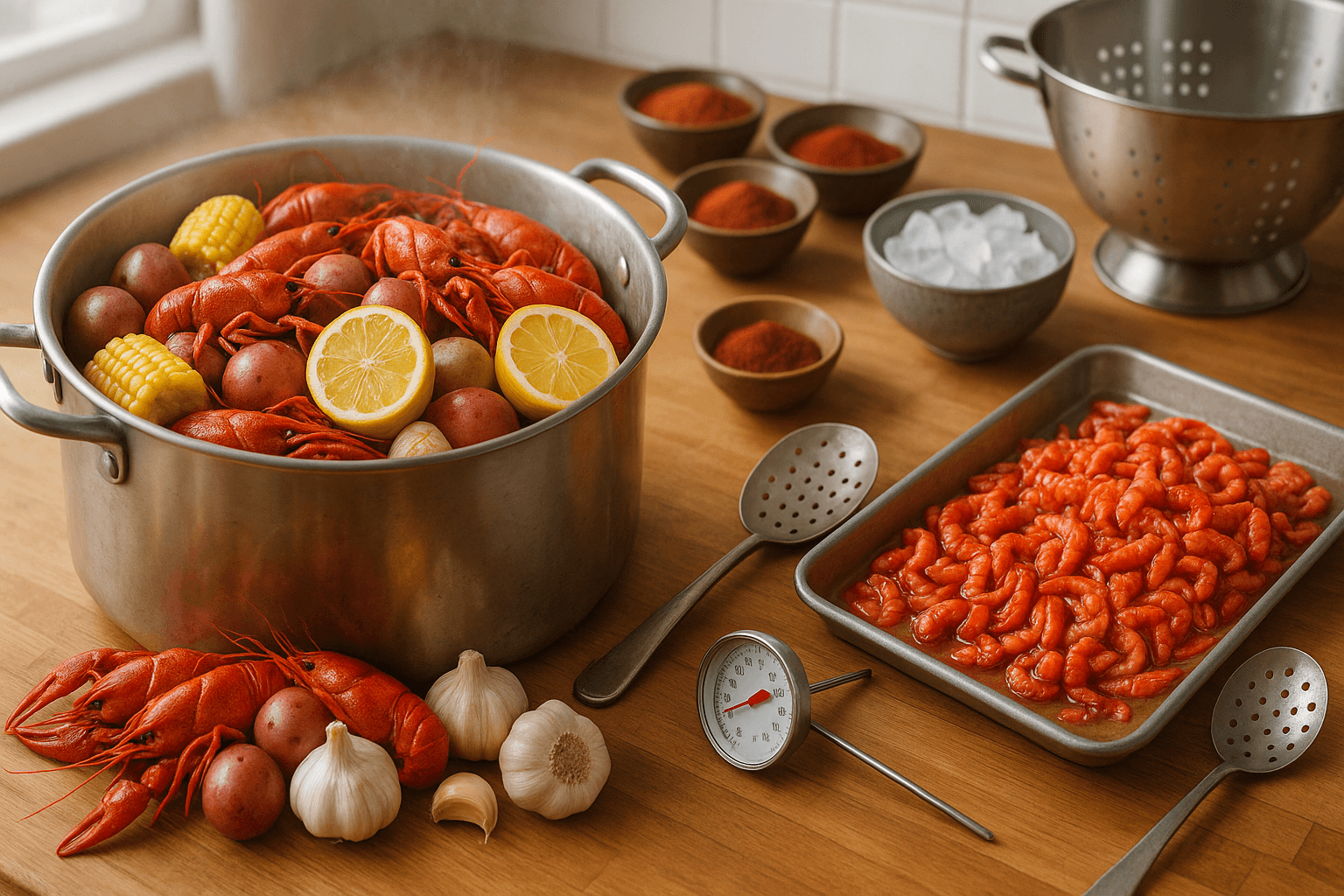
Equipment
- Large pot + basket
- Cooler or large tub for rinsing
- Instant-read thermometer (helpful)
- Sheet pans or large bowls
- Ice + water for an ice bath
1) Pre-season the water (moderate)
Bring water to a boil with:
- Salt (don’t be shy, but avoid turning it into seawater)
- Cajun/creole boil seasoning
- Aromatics: garlic, bay, lemon
Keep it moderate if you plan to use tails in sauced dishes later.
2) Add crawfish, return to a boil briefly
Add live crawfish, stir, and return to a boil.
- Once it returns to a boil, cook briefly (often just a few minutes).
- You’re aiming for: shells red, crawfish fully heated through, tails just set.
Because pot sizes and crawl volumes vary, watch signs more than the clock.
3) Turn off heat and soak (shorter for cook‑chill)
For a party boil you might soak longer for spice penetration.
For cook‑chill tails, soak shorter—you want doneness and light seasoning, not maximum heat.
4) Rapid chill
Drain crawfish, then quickly cool them:
- Spread on sheet pans to vent steam, or
- Put in a clean cooler and add bags of ice around them (avoid soaking them in dirty meltwater).
For maximum texture protection, an ice bath works well if you can manage it hygienically:
- Submerge briefly in ice water to drop temperature fast.
- Drain thoroughly afterward.
The goal is to stop carryover cooking.
5) Peel when cool enough to handle
Peeling warm crawfish is fine for eating now.
For peeled tails you’ll use later, slightly cooled crawfish can be easier to peel neatly (less finger burn, less tearing).
6) Store safely
- Refrigerate peeled tails promptly.
- Keep them covered and cold.
Food safety note: cooked shellfish should not linger in the “danger zone” (roughly 40–140°F / 4–60°C). Rapid chilling and prompt refrigeration matter.
Part 5: How to reheat crawfish tails without toughening
Crawfish tails are delicate. The mistake is treating them like chicken—boiling them again in a sauce for 20 minutes.
The rule
Reheat tails at the very end—just long enough to warm through.
Best methods
1) Warm in sauce off-heat
For étouffée, bisque, cream sauce, or butter sauce:
- Finish the sauce fully.
- Turn heat to low or off.
- Stir in crawfish tails.
- Cover 2–3 minutes, then serve.
2) Gentle low simmer (not a hard boil)
If you must heat on the stove:
- Keep it barely steaming.
- Stir gently.
- Pull it as soon as tails are warmed.
3) Avoid the microwave (or use carefully)
Microwaving is uneven and can overcook edges.
If you do it:
- Use low power.
- Short bursts.
- Stir between bursts.
Part 6: Étouffée with tender tails (method, not just a recipe)
Étouffée is the perfect use for cook‑chill tails because the sauce is rich and protective—if you add the meat at the end.
Key technique: build flavor in the roux and stock, not by cooking the tails
What to focus on:
- A well-cooked roux (blond to peanut butter for many home styles)
- The “holy trinity” (onion, celery, bell pepper)
- Good stock (seafood stock or chicken stock)
- Seasoning balance (salt, cayenne, black pepper)
Texture-safe étouffée workflow
- Make roux.
- Sweat trinity until tender.
- Add garlic briefly.
- Add stock and simmer to thicken.
- Adjust seasoning.
- Add tails off-heat and rest covered.
Practical tip
If your tails were strongly seasoned from a heavy boil, your étouffée can become over-salty fast. That’s another reason the moderate boil + final dish seasoning strategy works.
Part 7: Creamy crawfish pasta without rubbery tails
Cream sauces and seafood are a classic match—but cream sauces tempt people to simmer too long.
What keeps it tender
- Build the sauce first.
- Reduce to the right thickness.
- Add tails at the end.
A reliable home-cook method
- Sauté aromatics (shallot/onion + garlic).
- Optional: a little tomato paste for depth.
- Deglaze with stock or a splash of white wine.
- Add cream and reduce gently.
- Season.
- Stir in crawfish tails just to warm.
- Finish with lemon zest (not too much juice early) and herbs.
Why lemon timing matters
A lot of acid early can slightly firm seafood proteins and can also cause dairy sauces to break. Add bright acids late and in small amounts.
Part 8: Boiled tails for cold applications (salads, dips, po’boys)
Cook‑chill tails aren’t only for hot dishes.
Cold uses that shine
- Crawfish dip (cream cheese + seasonings)
- Crawfish salad with herbs and citrus
- Po’boys with remoulade
For cold dishes, the cook‑chill approach prevents the “chalky” texture that can happen when tails are cooked aggressively and then refrigerated.
Part 9: Troubleshooting common crawfish problems
“They’re hard to peel.”
Likely causes:
- Overcooked.
- Too hot/too long in the boil.
- Crawfish not fresh.
Fixes:
- Shorten the high-heat phase.
- Use soak time strategically, not extra boiling.
- Chill quickly if peeling for later.
“They’re rubbery in étouffée.”
Cause: tails simmered too long in sauce.
Fix: add tails at the end, heat off.
“They taste bland inside but spicy outside.”
Cause: spice clinging to shell; meat not benefiting from seasoned liquid; sometimes overcooked.
Fix: ensure water is properly salted; rely on soak (heat off) for penetration; don’t overcook.
“They’re too salty.”
Cause: heavy boil seasoning + long soak + reheating in seasoned sauce.
Fix: moderate the boil if tails are for recipes; season the final dish instead.
“Muddy flavor.”
Cause: poor sourcing, dirty shells, dead crawfish, or prolonged warm holding.
Fix: buy from reputable suppliers; rinse well; keep cool; cook promptly.
Part 10: A practical seasoning strategy (especially if you’re cooking for multiple dishes)
If you’re boiling a big batch and using it in different ways, consider splitting your output:
- Party tray: season boldly and soak longer for eat-now crawfish.
- Recipe batch: moderate seasoning, shorter soak, rapid chill.
This lets you serve classic boil crawfish while reserving tender tails for étouffée and pasta.
Part 11: What culinary science says about tenderness (in plain language)
Seafood muscle proteins set at relatively low temperatures compared to tougher land meats. When heated too high or too long:
- Proteins tighten.
- Moisture is squeezed out.
- Texture becomes springy and dry.
That’s why the two most important “science moves” for tender crawfish are:
- Avoid extended high-heat cooking.
- Stop carryover cooking with rapid cooling if you’re not serving immediately.
A third principle is flavor-related:
- Salt helps proteins hold onto some moisture (up to a point). But too much salt in the cooking medium can push you into harshness—especially once you reduce sauces later.
Part 12: A simple, repeatable home-cook blueprint
Use this as a template you can adjust.
If you’re serving a traditional boil
- Rinse crawfish (no salt needed).
- Boil seasoned water.
- Add crawfish; short boil.
- Turn off heat; soak to desired spice level.
- Serve.
If you’re peeling for étouffée/pasta
- Rinse crawfish.
- Moderate seasoning in water.
- Short boil + short soak.
- Rapid chill.
- Peel.
- Refrigerate.
- Reheat gently at the end of the recipe.
Closing: settle the debate with your actual goal
The salt purge debate won’t end soon because crawfish boils are tradition-heavy and regionally varied. But you can make it simple:
- If your crawfish are dirty: rinse thoroughly (fresh water), drain well.
- If someone insists on salt purge: keep it brief and mild—or skip it if crawfish are already clean and lively.
- If you want bold boil flavor: season + soak.
- If you want tender tails for étouffée, pasta, and leftovers: moderate the boil, cook‑chill, and reheat gently.
Do those things consistently, and you’ll get the holy grail: crawfish that peel easier, stay tender, and taste like you meant it.