Ice Cream Maker Recipes That Don’t Freeze Rock‑Hard: The Science of Sugar, Fat, Alcohol, and Stabilizers (Plus a Custom Base Formula)
RecipeSimpli
Ice Cream Maker Recipes That Don’t Freeze Rock‑Hard: The Science of Sugar, Fat, Alcohol, and Stabilizers (Plus a Custom Base Formula)
Homemade ice cream has a predictable heartbreak: you churn a gorgeous batch—creamy, light, scoopable—taste it straight from the machine and think I nailed it. Then you freeze it overnight and the next day it’s a brick. You bend spoons. You wait. It melts at the edges before the center yields.
This isn’t because your ice cream maker is “weak” or because you didn’t churn long enough. It’s because home freezers are cold (often around -18°C / 0°F), and many home recipes are formulated like soft-serve—they taste perfect when freshly churned but don’t have enough built-in freezing-point control to stay scoopable later.
The good news: you don’t need professional stabilizer kits or fancy equipment to fix this. You need to understand four levers that professional ice cream makers use every day:
- Sugar type and total dissolved solids (freezing-point depression)
- Fat and emulsification (texture and meltdown behavior)
- Alcohol and other “antifreeze” ingredients (powerful scoopability tools)
- Stabilizers and milk solids (water management and iciness control)
Once you understand those levers, you can design a base that works in popular home machines—Cuisinart freezer-bowl models, Dash compact churners, and even the Ninja Creami (which has its own quirks)—and you can customize flavors without turning your freezer into a rock quarry.
Why homemade ice cream freezes hard (and why store-bought doesn’t)
Ice cream is not a single frozen solid. It’s a complex structure:
- Ice crystals (frozen water)
- Unfrozen syrup phase (water + dissolved sugars + salts + proteins)
- Fat droplets (partially coalesced into a network)
- Air cells (incorporated during churning; “overrun”)
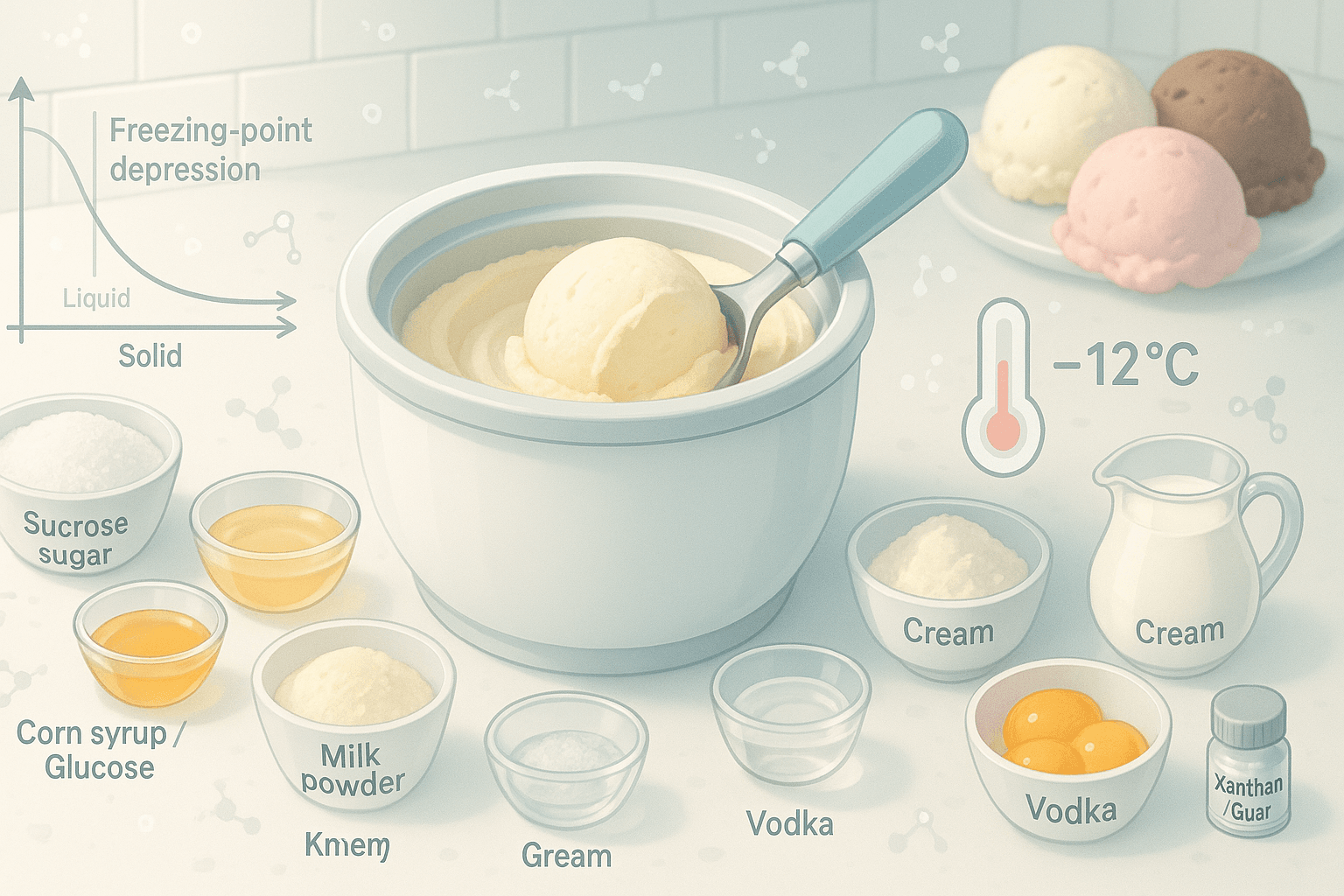
When ice cream is scoopable at freezer temperature, it’s because a meaningful fraction of the water stays unfrozen. Dissolved sugars, salts, and other solids lower water’s freezing point—this is freezing-point depression, a core concept in food science.
Commercial ice cream also typically contains:
- More sophisticated blends of sugars (sucrose + glucose syrup + dextrose)
- Higher total solids (milk solids-not-fat, sometimes added whey proteins)
- Stabilizers/emulsifiers (locust bean gum, guar gum, mono- and diglycerides)
- Often a carefully controlled fat percentage and emulsification
Home recipes often rely on a single sweetener (granulated sugar) and may be light on milk solids and stabilizers. The result: more water freezes into larger crystals, and the texture becomes hard and icy.
A useful mental model:
If your base is “watery,” your freezer will reveal it.
Lever #1: Sugar is not just for sweetness—it’s for scoopability
Freezing-point depression in plain language
Sugar molecules dissolved in water interfere with ice crystal formation. The more dissolved particles you have (and the “stronger” they are at lowering freezing point), the softer the ice cream at a given temperature.
But there’s a catch: using more sucrose alone can make ice cream too sweet, not just softer.
So professionals change the type of sugar, not only the amount.
Different sweeteners, different “antifreeze” power
A simplified way to think about it:
- Sucrose (table sugar): baseline sweetness and body
- Glucose syrup / corn syrup: less sweet than sucrose, helps prevent iciness, improves chew
- Dextrose (glucose powder): stronger freezing-point depression than sucrose, less sweet; great for scoopability
- Invert sugar / honey: contains glucose + fructose; strong antifreeze effect, can add flavor notes
- Brown sugar / molasses: adds invert sugars and minerals; can soften texture but brings strong flavor
Why some sugars soften more: freezing-point depression depends on the number of dissolved particles. Sugars with smaller molecules (like glucose and fructose) can deliver more particles per gram than sucrose.
Practical swaps that reduce hardness without making it cloying
If a recipe uses only granulated sugar and freezes too hard, try one of these adjustments:
- Replace 10–25% of sucrose with corn syrup (glucose syrup) by weight.
- Replace 10–20% of sucrose with honey (expect honey flavor).
- Add 1–3 tablespoons of corn syrup to a typical 1-quart base.
- Use dextrose powder (often sold as “glucose” powder in brewing/candy supplies) to replace some sucrose.
Example (1 quart base):
- Instead of 150 g sugar, try 110 g sugar + 40 g corn syrup.
This often makes a noticeable difference in scoopability without dramatically increasing sweetness.
Don’t forget salt
Salt also lowers freezing point slightly and improves flavor perception. It won’t fix a rock-hard base alone, but a small amount (0.1–0.2%) helps.
For a 1000 g base, that’s 1–2 g salt (about 1/4–1/2 teaspoon Diamond Crystal kosher salt; less if fine salt).
Lever #2: Fat and emulsification—creaminess isn’t just “more cream”
Fat contributes to:
- Creamy mouthfeel
- Perceived softness (fat doesn’t freeze hard like water)
- Stable air bubbles during churning
- Slower meltdown (when properly emulsified)
But more fat is not automatically better. Too much can feel greasy, mute flavors, and sometimes lead to a dense texture.
A home-friendly fat target
Most scoopable, satisfying “standard” ice creams land around 12–18% fat.
- Gelato-style: often lower fat (4–10%), but higher milk solids and careful formulation.
- Premium American-style: often 14–18%.
If your base is made with mostly milk and not much cream, it may be more likely to freeze hard/icy because more of it is water.
Emulsification: why egg yolks help (and when you don’t need them)
Egg yolks contain lecithin, a natural emulsifier that helps fat and water stay integrated and supports a smooth texture.
Egg yolks also add:
- Additional solids
- A custardy richness
- Better resistance to ice crystals during storage
However, you can make excellent egg-free ice cream if you use:
- A bit of milk powder (more on that below)
- A small amount of stabilizer
- A better sugar blend
The “fat network” and over-churning
During churning, fat droplets partially clump (partial coalescence) and form a network that supports air cells—this contributes to body.
- Under-churned: can feel thin and icy
- Over-churned: can edge toward buttery/grainy
Home machines vary, but a good endpoint is when the texture resembles soft-serve and the dasher leaves clear trails.
Lever #3: Alcohol—powerful softening, easy to overdo
Alcohol lowers freezing point dramatically. It’s one of the fastest ways to prevent rock-hard texture.
But it’s easy to add too much and end up with ice cream that won’t set.
Practical guidelines
For most 1-quart (about 1 liter) bases:
- 1 tablespoon (15 ml): subtle softening, usually safe
- 2 tablespoons (30 ml): noticeable softness
- 3 tablespoons (45 ml): can become soft/loose depending on other sugars and fat
Use 40% ABV spirits (vodka, rum, bourbon). Liqueurs vary widely in sugar and alcohol.
Best alcohol choices by flavor
- Vodka: neutral; best when you want softening without flavor
- Dark rum: great for caramel, banana, tropical, brown sugar profiles
- Bourbon: excellent with vanilla, pecan, chocolate, coffee
- Amaretto / Frangelico: flavorful and sweet; reduce sugar slightly
Where alcohol fits in the science toolkit
Think of alcohol like a “trim tab” on a boat: small adjustments have big effects. Use it after you’ve balanced sugars and solids.
Lever #4: Stabilizers and milk solids—controlling water so it can’t form big crystals
“Icy” texture is mostly about free water turning into large crystals during freezing and storage.
Stabilizers help by:
- Binding water
- Increasing viscosity (slows ice crystal growth)
- Improving melt resistance
Milk solids (especially proteins and lactose) help by:
- Increasing total solids
- Improving body
- Supporting emulsification and foam stability
Easy, accessible stabilizers for home cooks
You have a few good options:
1) Xanthan gum (easy, powerful)
- Use 0.1–0.2% of base weight.
- For a 1000 g base: 1–2 g (roughly 1/4–1/2 teaspoon, depending on brand).
- Best blended into sugar first, then whisked in, or dispersed with an immersion blender.
Too much xanthan can feel slick or gummy—measure carefully.
2) Guar gum (common in ice cream)
- Similar usage range: 0.1–0.2%
- Often gives a slightly “cleaner” melt than xanthan in dairy systems.
3) Cornstarch (old-school, reliable)
A classic approach used in many “Philadelphia-style” egg-free bases:
- Use 1–2 teaspoons cornstarch per quart.
- Cook briefly to gelatinize.
Cornstarch won’t mimic commercial stabilizer blends perfectly, but it’s widely available and effective.
4) Gelatin (great texture, needs blooming)
- Use about 1/2 to 1 teaspoon powdered gelatin per quart.
- Bloom in cold water, then dissolve into warm base.
Gelatin can create a lush texture, though it is animal-derived and less ideal for some diets.
Milk powder: the underrated home ice cream hack
Nonfat dry milk powder increases milk solids-not-fat without adding more water. That means:
- More body
- Better chew
- Less iciness
A common, safe range:
- 20–60 g nonfat dry milk powder per quart base (depending on your formula)
Too much can taste “milky” or slightly chalky, so find your sweet spot.
Cultural context: why gelato can be so smooth with less fat
Traditional gelato often uses more milk than cream (lower fat) but is formulated with:
- Higher total solids
- Carefully balanced sugars
- Often stabilizers (even if minimal)
- Warmer serving temperature
So it can feel intensely creamy without relying on high fat alone.
Temperature and storage: the non-recipe reasons ice cream gets hard
Even with a great formula, these factors matter:
1) Home freezer temperature swings
Most home freezers cycle and may run colder than necessary. Ice cream stored in the back or near vents can become harder.
Tip: store your ice cream in the door-side half (still frozen, slightly warmer) or insulate it in a small cooler bag inside the freezer.
2) Container shape
A wide, shallow container freezes and tempers more evenly than a deep pint.
Tip: use a flat, tight-lidded container and press parchment directly on the surface to reduce ice crystals from air exposure.
3) Serving temperature matters
Many commercial scoop shops serve ice cream around -12 to -14°C (10 to 7°F), warmer than a home freezer.
Tip: let the container sit at room temperature 5–10 minutes, or move it to the refrigerator 15–30 minutes before scooping.
Equipment realities: Cuisinart, Dash, and Creami
Freezer-bowl churners (Cuisinart, Dash)
- They freeze the mix while churning, but they usually don’t get as cold as a compressor machine.
- That means your churned ice cream is often softer at the end of churn (more like soft-serve), then hardens more in the freezer.
Implication: you benefit greatly from sugar blending + milk powder + stabilizer.
Ninja Creami
Creami works differently: you freeze the base solid, then shave/spin it into a creamy texture.
Implication: Creami can “rescue” a harder base through mechanical processing, but the base still needs good formulation. If it’s under-sweetened or low in solids, it can spin out icy or crumbly.
For Creami bases, slightly higher solids (milk powder, sugar blend) and a small stabilizer dose can make spins more consistent.
A custom base formula that stays scoopable (and how to customize it)
Below is a flexible, home-friendly base designed to resist rock-hard freezing while staying balanced in sweetness and texture.
The “Scoopable Home Ice Cream” Base (1 quart / ~1 liter)
Target: creamy, scoopable at home-freezer temps with minimal iciness.
Ingredients (by weight for consistency)
- Whole milk: 500 g
- Heavy cream (36–40%): 300 g
- Sucrose (granulated sugar): 110 g
- Corn syrup (glucose syrup) or light corn syrup: 40 g
- Nonfat dry milk powder: 35 g
- Salt: 1.5 g (about 1/4 tsp fine salt)
- Vanilla extract: 8–12 g (2–3 tsp), or equivalent vanilla bean paste
- Stabilizer option (choose one):
- Xanthan gum: 1.0 g (about 1/4 tsp) or
- Guar gum: 1.0 g or
- Cornstarch: 8 g (about 1 tbsp) (requires cooking)
- Optional alcohol: 15–30 g vodka (1–2 tbsp)
This base uses multiple sugars + milk powder + a small stabilizer to control freezing and texture without becoming overly sweet.
Method (xanthan/guar version: no eggs)
- Mix dry ingredients: Combine sugar, milk powder, salt, and xanthan (or guar). Whisk thoroughly so the gum disperses.
- Warm the dairy: Heat milk and cream in a saucepan to about 50–60°C / 122–140°F (steaming but not simmering).
- Whisk in dry mix: Slowly rain in the dry ingredients while whisking.
- Heat to hydrate: Bring to 75–82°C / 167–180°F (do not boil). Hold for 1–2 minutes, whisking.
- Add corn syrup and whisk smooth.
- Blend (highly recommended): Use an immersion blender 20–30 seconds for perfect dispersion.
- Chill and age: Cool quickly (ice bath), then refrigerate at least 4 hours, ideally overnight.
- Churn: Churn according to your machine. Transfer to a container.
- Harden: Freeze 4–6 hours.
Method (cornstarch version)
- Whisk cornstarch into a small amount of cold milk to make a slurry.
- Heat milk + cream + sugar + milk powder + salt until steaming.
- Whisk in slurry and bring to a gentle simmer, stirring until slightly thickened (about 1 minute).
- Cool, age, churn.
How to customize the base without breaking scoopability
Use this as a “plug-and-play” framework.
1) Chocolate base
Add:
- 25–40 g cocoa powder (Dutch-process preferred)
- Optional: 50–100 g melted dark chocolate for a denser, fudgier texture
Adjustments:
- Cocoa adds solids and bitterness; you may want +10–20 g sugar depending on taste.
- Chocolate also adds fat and solids, which usually improves scoopability.
2) Fruit swirl or berry base
Fruit brings water—water increases iciness—so be strategic.
Best practice:
- Use fruit puree that’s cooked down to reduce water.
- Or use a jammy swirl added after churning.
If adding a lot of puree (say 200 g), reduce milk slightly and consider:
- +10–20 g corn syrup
- Keep stabilizer in place
3) Coffee base
Add:
- 10–20 g instant espresso powder (dissolve in warm dairy) or
- 150–250 g strong cold brew (but replace some milk to keep water in check)
Coffee can read bitter; a touch of corn syrup and vanilla helps round it.
4) Boozy “scoopable from the freezer” base
If you want it notably softer:
- Increase alcohol to 30–45 g per quart and/or
- Increase corn syrup by 10–20 g
Watch for the point where it won’t set.
Troubleshooting: diagnose your ice cream like a pro
Problem: “It’s rock-hard the next day”
Likely causes:
- Too little dissolved solids (sugar + milk solids)
- Too much water (low fat, lots of milk, watery mix-ins)
- No stabilizer
Fixes:
- Swap 20–30% of sugar for corn syrup/glucose
- Add 25–40 g nonfat dry milk powder
- Add 0.1% xanthan/guar or a cornstarch cook
- Add 1 tbsp vodka
Problem: “It’s icy/grainy”
Likely causes:
- Not enough stabilizer or total solids
- Base not aged
- Poor dispersion of stabilizer
- Temperature abuse (thaw/refreeze cycles)
Fixes:
- Use immersion blender for stabilizer
- Age base overnight
- Store with parchment on surface; minimize door opening
Problem: “It’s gummy or stretchy”
Likely causes:
- Too much gum
Fixes:
- Reduce xanthan/guar by 25–50%
- Prefer guar over xanthan for a cleaner bite (or use cornstarch)
Problem: “It tastes too sweet but still hard”
Likely causes:
- Sugar type not optimized; recipe relies on sucrose
Fixes:
- Replace some sucrose with dextrose (less sweet, more antifreeze) if available
- Replace some sugar with corn syrup
- Add milk powder + stabilizer rather than more sucrose
Problem: “It melts too fast”
Likely causes:
- Low fat and low stabilizer
- Not enough emulsification
Fixes:
- Add egg yolks (custard base) or ensure gum is properly dosed
- Slightly increase cream percentage
A quick note on custard bases (egg yolks): still relevant, not mandatory
Classic French-style ice cream uses a custard (crème anglaise) base. Yolks provide emulsifiers and proteins that improve texture and shelf life.
A typical home custard base might use 4–6 yolks per quart.
If you love custard flavor, use yolks—but still consider a sugar blend and milk powder. Eggs help with smoothness, but they don’t automatically fix freezing-point balance.
If you don’t want eggs, the custom base above is designed to get you most of the way there with modern, simple tools.
Practical workflow for consistently scoopable homemade ice cream
- Formulate with intention: use more than one sugar; add milk powder; use a tiny stabilizer.
- Heat and blend: hydrate proteins and gums; eliminate lumps.
- Age the base: at least 4 hours, preferably overnight.
- Churn cold: start with a base below 4°C / 39°F.
- Harden quickly: shallow container; coldest part of freezer for the first few hours.
- Store smart: parchment on surface; tight lid.
- Temper before serving: 5–10 minutes at room temp.
If you do only one thing: stop relying on a single sugar and no stabilizer. That change alone fixes the majority of rock-hard outcomes.
References and further reading (science-forward, home-cook friendly)
- Harold McGee, On Food and Cooking: foundational explanations of freezing, emulsions, and dairy proteins.
- Jeni Britton Bauer, Jeni’s Splendid Ice Creams at Home: popularized the cornstarch-and-cream-cheese stabilization approach for home recipes.
- Dana Cree, Hello, My Name Is Ice Cream: detailed, practical ice cream science and formulation concepts.
- Ice Cream Science (icecreamscience.com) by Ruben Porto: deep dives into sugars, stabilizers, and structure.
A final calibration: what “scoopable” really means
Even perfectly formulated ice cream will be firmer in a home freezer than at an ice cream shop. The win isn’t “never freezes hard.” The win is:
- It yields to a scoop without a 15-minute wait.
- It stays creamy for days, not just the first serving.
- It doesn’t turn icy after a few freeze/thaw cycles.
With sugar blending, balanced fat, a small stabilizer dose, and smart storage, your homemade ice cream can be reliably scoopable—whether you churn in a Cuisinart, a Dash, or spin it in a Creami.