Vegan Slow Cooker Recipes That Don’t Turn Mushy: Layering Order, Liquid Math, and “End‑Game” Add‑Ins for Real Texture
RecipeSimpli
Slow cookers are famous for comfort food—and infamous for turning vegetables into baby food and beans into beige mush. That reputation is deserved in one key way: slow cookers are designed to trap moisture. That’s great for braising tough cuts of meat, but vegan cooking leans heavily on vegetables, legumes, grains, and plant proteins that can go from tender to collapsed quickly when simmered for hours.
The good news is that “mushy” isn’t inevitable. Texture in vegan slow-cooker food is mostly a matter of engineering:
- Layering order (what sits in the hottest zone)
- Liquid math (how much water is actually necessary in a sealed environment)
- Timing zones (what needs 8 hours vs. what needs 20 minutes)
- End-game add-ins (finishes that bring snap, brightness, and contrast)
This article gives you a practical framework you can apply to almost any recipe—whether you’re making chili, curry, stew, taco filling, or grain bowls. You’ll learn how to protect vegetables, keep beans distinct, prevent chalky lentils, and finish with restaurant-style pop.
Why slow-cooker vegan meals get mushy (and bland)
1) Slow cookers don’t evaporate like a pot
A stovetop pot loses water through evaporation. A slow cooker’s lid traps steam, which condenses and returns to the food. That means:
- Ingredients release water (especially zucchini, mushrooms, tomatoes, spinach).
- That water stays in the pot.
- The longer it cooks, the more plant cell walls break down, and the more everything merges.
This is why a recipe that looks “normal” on the stovetop can turn soupy in a slow cooker if you use the same liquid amounts.
2) Gentle heat is still relentless heat
Low heat won’t scorch easily, but it will soften pectin and hemicellulose in vegetables over time. Think of a carrot: it might stay intact after 20–30 minutes of simmering, but it won’t stay intact after 6–8 hours.
3) Acid and salt timing matters
Acid (tomatoes, vinegar, citrus) can slow softening in some vegetables but can also toughen beans if added too early, depending on the bean and the concentration. Salt helps flavor penetrate, but when and how you add it affects perceived seasoning and texture.
4) Vegan flavor needs deliberate building
Meat dishes often carry built-in savory depth from fats, collagen, and browned proteins. Vegan slow-cooker meals can be deeply savory, but they usually need:
- More intentional umami (miso, tomato paste, mushrooms, soy sauce)
- Aromatic development (onion/garlic/spices)
- A finishing “lift” (acid, herbs, crunch)
The fix isn’t complicated—it’s systematic.
The slow-cooker “timing zones”: a mental model for texture
Instead of thinking “dump everything in and cook 8 hours,” think in zones based on how long an ingredient can cook before it loses its ideal texture.
Zone A: Long-haul ingredients (6–10 hours on LOW)
These can handle long cooking and often benefit from it.
- Dried beans (if your slow cooker runs hot enough; details below)
- Chickpeas (best cooked separately unless you know your cooker)
- Large chunks of potatoes, sweet potatoes (2-inch pieces)
- Winter squash (kabocha, butternut—large chunks)
- Carrots, parsnips (thick pieces)
- Cabbage wedges (surprisingly durable)
- Dried mushrooms (rehydrate into broths)
Zone B: Mid-cook ingredients (2–4 hours on LOW)
These are the “tender but not collapsed” group.
- Cauliflower florets (large)
- Green beans (thick ones)
- Bell pepper strips (if you don’t mind them soft)
- Tempeh cubes (for absorption without disintegration)
- Seitan chunks (can over-soften if left too long)
Zone C: Short-cook ingredients (20–60 minutes)
These are the biggest source of mush when added at the start.
- Zucchini and summer squash
- Broccoli florets
- Peas
- Corn kernels
- Spinach, kale (thinly sliced)
- Fresh herbs (cilantro, basil, parsley)
- Coconut milk (can split or dull flavors if cooked all day)
Zone D: End-game add-ins (0–10 minutes, or off-heat)
These provide snap, brightness, and layered flavor.
- Citrus juice/zest
- Vinegars
- Pickles/pickled onions
- Toasted nuts/seeds
- Chili oils/crisps
If you take nothing else from this article: most vegetables belong in Zones B–D, not Zone A.
Layering order: the temperature map inside your slow cooker
Slow cookers heat mostly from the sides and bottom; the bottom zone tends to get hottest and stay hottest. That means the physical placement of ingredients matters.
The practical layering rule (works for most recipes)
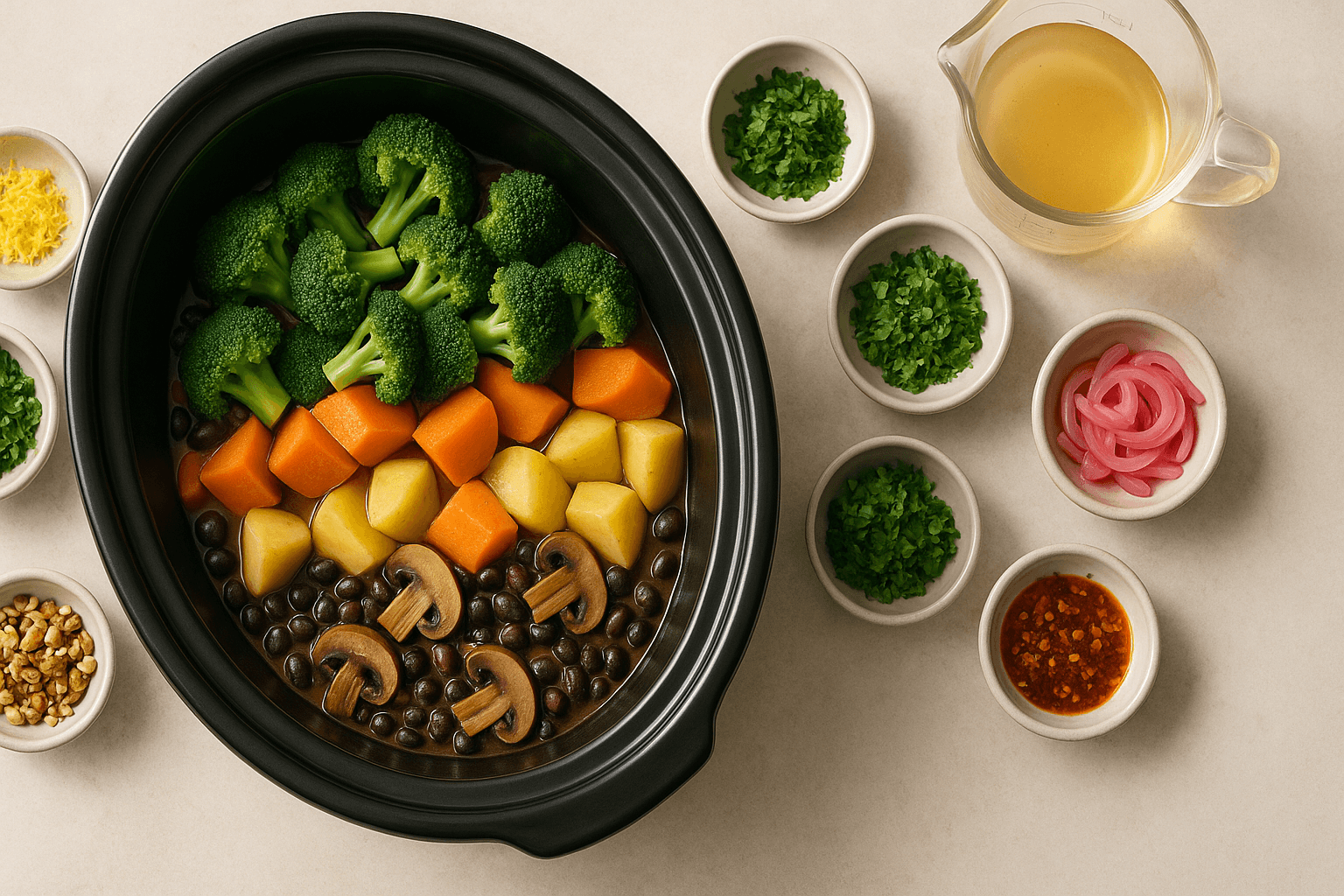
- Bottom (hottest): long-haul, sturdy ingredients + aromatics that can take heat
- Middle: medium-sturdy vegetables and plant proteins
- Top: delicate vegetables (or save them for later)
- Finish: greens, herbs, acid, crunchy elements
A layering example: vegan “stew” that keeps its shape
- Bottom: onions (sliced), carrots (big chunks), mushrooms (whole or halved), dried thyme, bay leaf
- Middle: potatoes (2-inch), chickpeas (cooked), tempeh cubes
- Top: cauliflower florets (large)
- Last 30 min: green beans
- Off-heat: lemon juice + parsley + toasted almonds
This structure does two things:
- The bottom ingredients can soften and sweeten without sacrificing overall texture.
- The top ingredients avoid prolonged direct heat.
When to stir (and when not to)
Stirring breaks tender vegetables and encourages everything to equalize into one texture. For many slow-cooker dishes, don’t stir until the end unless you’re intentionally making something creamy (like dal or refried-style beans).
If you need even cooking, stir once halfway through—but stir gently.
Liquid math: how much liquid you actually need
The most common slow-cooker mistake is adding stovetop-level liquid. Because evaporation is minimal, you often need less.
A simple baseline formula
Start with ½ to 1 cup of added liquid per 4-quart slow cooker for most vegetable-and-bean dishes, then adjust based on water-heavy ingredients.
Use this cheat sheet:
- High-water ingredients (release a lot): tomatoes, mushrooms, zucchini, spinach, frozen vegetables
- Moderate-water ingredients: onions, bell peppers, cauliflower
- Low-water ingredients: potatoes, sweet potatoes, winter squash, dried legumes
If your pot includes a lot of tomatoes + mushrooms, you may need almost no added liquid—especially if you’re not cooking dried beans.
Two categories: “braise” vs. “simmer”
Think about what you want:
- Braise-style (thick, stew-like): add minimal liquid; rely on vegetable release.
- Simmer-style (soupy): add more liquid, but build in thickening at the end.
For thick outcomes, aim for ingredients that sit partly above the liquid line—the cooker will still steam-cook them.
Lid management is liquid management
Every time you lift the lid, you lose heat and extend cook time. Many slow cookers can lose significant temperature and take 15–30 minutes to recover. So:
- If you’re trying to reduce liquid, don’t keep checking.
- If you need thickening, plan an end-step (see below).
Thickening without mush
Instead of overcooking to “reduce,” use one of these end tactics:
- Cornstarch or arrowroot slurry (1 tbsp starch + 1 tbsp cold water; scale up)
- Mashed beans (mash ½–1 cup beans and stir back in)
- Nut/seed butter (tahini, cashew butter) for creamy body
- Instant mashed potato flakes (surprisingly effective in small amounts)
Use these in the last 10–20 minutes on HIGH or with the lid slightly ajar if your cooker allows.
Beans that stay distinct (and safe)
Beans are the heart of many vegan slow-cooker recipes. They can also be the quickest route to blandness if you don’t season correctly.
Dried beans: the big safety and texture notes
- Kidney beans (and some other red beans) contain phytohaemagglutinin, a lectin that’s deactivated by a hard boil. Many food safety authorities recommend boiling kidney beans for at least 10 minutes before slow cooking, because some slow cookers may not reach a high enough temperature quickly.
- If you’re unsure, pre-boil kidney beans or use canned.
For texture, dried beans often do best when:
- Cooked with aromatics (onion, garlic, bay)
- Cooked with enough water (beans need hydration) but not drowned with extra watery vegetables
- Finished with salt and acid after they’re tender
Salt and acid timing for beans
Traditional wisdom says “don’t salt beans early.” Modern testing and many cooks’ experience suggest salting early can actually help beans cook more evenly and taste better, but acid (tomatoes, vinegar) can slow softening.
Practical approach for slow cookers:
- Add some salt early for baseline seasoning.
- Add tomatoes and strong acids later (or use them, but expect longer cook times).
Canned beans: the texture shortcut
Canned beans are already cooked, so long slow-cooking can turn them chalky-soft and split. If you want beans that hold their shape:
- Add canned beans in the last 60–90 minutes on LOW (or last 30–45 on HIGH).
- Or cook the sauce/veg base all day and stir beans in near the end.
Rinse canned beans if you want a cleaner flavor; don’t rinse if you want extra body from the canning liquid (especially in chili).
Lentils, pasta, and grains: when to add them
These ingredients are texture landmines in slow cookers because they keep absorbing liquid long after they’re “done.”
Lentils
Different lentils behave differently:
- Red/yellow lentils: break down quickly → great for dal, thick soups; add early if you want creamy.
- Green/brown lentils: hold shape better, but can still go soft if cooked too long.
- French/Puy lentils: best for staying distinct; still shouldn’t cook 8 hours.
Timing guideline:
- For intact lentils, add in the last 1.5–2.5 hours on LOW (depending on cooker and quantity).
- If you’re doing creamy dal, add at the start and plan to whisk/finish with fat and acid.
Pasta
Pasta will expand, soften, and can turn gummy.
Best practice: cook pasta separately and combine at the end.
If you must cook it in the slow cooker:
- Add in the last 20–40 minutes on HIGH, and keep it slightly underdone.
- Use sturdy shapes (penne) over delicate (angel hair).
Rice and other grains
Rice is unpredictable in slow cookers because heat and evaporation vary. If you want reliable grain texture:
- Cook rice/quinoa separately.
- Use the slow cooker for the topping (curry, chili, stew).
If cooking grains in the slow cooker, you’ll need more precise ratios and should expect some edge-case variability by model.
Building flavor: how to avoid “all tastes the same” slow-cooker food
Texture is half the battle; flavor is the other half. Slow cooking can mute high notes (fresh herbs, citrus) and flatten spice.
The three-layer flavor strategy
- Base depth (early): aromatics + umami
- Mid-cook bloom (optional): spices or pastes that benefit from heat
- Top-note lift (late): acid, herbs, crunchy contrast
Umami boosters that work especially well in vegan slow cookers
- Tomato paste (add early, ideally sautéed first)
- Miso (add late; prolonged boiling dulls it)
- Soy sauce/tamari
- Mushroom powder or dried porcini
- Nutritional yeast (late for nuttiness)
- Olive brine or capers (late)
A quick cultural note: why many traditional braises finish bright
Across cuisines—Mexican stews finished with lime and cilantro, Thai curries finished with herbs and lime, Mediterranean braises finished with lemon and parsley—long-cooked dishes are often finished with something sharp and fresh. That’s not garnish; it’s balance.
Five “end-game” add-ins for bright flavor and bite
These are the most reliable way to make a slow-cooker vegan meal taste alive and feel textured.
1) Citrus zest + juice (lemon, lime, orange)
Why it works: Acid brightens flavors and cuts perceived heaviness; zest adds aromatic oils that don’t taste “sour.”
How to use:
- Stir in 1–2 tbsp juice per 4 servings off-heat.
- Add zest right before serving.
Best with: lentil soups, chickpea stews, white bean ragù, mushroom dishes.
2) Vinegars (sherry, rice, apple cider, balsamic)
Why it works: Adds sharpness and complexity; different vinegars add different aromas.
How to use:
- Start with 1 tsp, taste, and scale up.
- Add at the end to keep it bright.
Best with: chili, collards, black beans, barbecue-style dishes.
3) Something pickled (pickled onions, jalapeños, kimchi, sauerkraut)
Why it works: Acid + crunch + fermented complexity in one move.
How to use:
- Add as a topping rather than stirring in (keeps crunch).
Best with: smoky beans, lentil “sloppy joes,” taco fillings, stew bowls.
4) Toasted nuts/seeds or a crisp topping
Why it works: Crunch is the fastest way to undo “mush perception.” Also adds richness.
Ideas:
- Toasted pepitas for chili
- Slivered almonds for Moroccan-ish stews
- Sesame seeds for soy-ginger dishes
- Panko toasted in olive oil with garlic (vegan “pangrattato”)
Add at the table, not in the cooker.
5) Chili crisp / infused oils / spiced finishing fats
Why it works: Fat carries aroma; infused oils add intensity without long cooking.
Options:
- Chili crisp
- Garlic oil
- Smoked paprika oil
- Toasted sesame oil (tiny amount)
Drizzle right before serving.
Practical technique upgrades (small steps, big texture)
Sautéing is optional—but sometimes decisive
Many slow-cooker recipes skip browning for convenience. If you can spare 8–10 minutes, sautéing can add:
- Sweeter onions
- Bloomed spices
- Concentrated tomato paste
If you don’t want to sauté, compensate with end-game boosters and umami.
Cut size is a texture dial
- Bigger pieces = better structure over long cooks.
- Aim for 1.5–2 inch chunks for potatoes/squash.
- Keep softer veg (zucchini) thick-cut and add late.
Frozen vegetables: use strategically
Frozen peas/corn are ideal end additions (they cool the pot slightly and keep their shape). Add in the last 10–20 minutes.
Don’t fear HIGH—use it intentionally
LOW isn’t always “better.” HIGH can be useful for:
- Finishing pasta or quick veg
- Activating a slurry to thicken
- Reheating quickly without adding cook time to everything else
Three example templates you can remix (with exact timing)
These aren’t full recipe cards; they’re blueprints you can adapt with whatever you have.
Template 1: “Not Mushy” Vegetable Chickpea Stew
Goal: chunky vegetables, distinct chickpeas, thick broth.
Layering + timing
- Bottom: sliced onion + carrot chunks + mushrooms + garlic + bay leaf
- Middle: potato chunks + carrots (if extra) + spices
- Top: cauliflower florets (large)
- Add ½ cup broth + 1 can crushed tomatoes (tomatoes provide lots of liquid)
- Cook 6–7 hours LOW
- Add cooked or canned chickpeas last 60–90 min LOW
- Last 20 min: green beans or frozen peas
- Finish: lemon + parsley + toasted almonds
Liquid notes: If using lots of mushrooms + tomatoes, start with minimal broth. You can always add more.
Template 2: Black Bean Chili With Real Bite
Goal: thick chili, beans intact, bright finish.
Start (optional stovetop): sauté onion + garlic + tomato paste + chili powder + cumin.
Slow cooker:
- Bottom: sautéed base (or raw onion/garlic/spices)
- Add: bell pepper (optional), diced sweet potato (chunky), crushed tomatoes
- Add liquid: 0–½ cup (often none needed)
- Cook: 6–8 hours LOW
- Add canned black beans: last 60–90 min LOW
- Thicken: mash 1 cup beans into chili OR add small cornstarch slurry
- Finish: lime juice, pickled onions, cilantro, pepitas, chili crisp
Template 3: Coconut Lentil Curry Without Chalky Lentils
Goal: creamy sauce + lentils that aren’t overcooked + bright aromatics.
Slow cooker base:
- Bottom: onion + ginger + garlic + curry paste (or spices)
- Add: carrots (thick), sweet potato (chunky)
- Liquid: ½–1 cup broth
- Cook: 4–5 hours LOW
Add later:
- Lentils (brown/green): last 2 hours LOW
- Coconut milk: last 30–45 min LOW
- Greens (spinach): last 5–10 min
Finish: lime juice, Thai basil/cilantro, toasted coconut or cashews.
Troubleshooting guide (fast fixes)
“It’s watery”
- Remove lid and cook 15–30 minutes on HIGH (if your cooker allows evaporation), or
- Use a slurry (cornstarch/arrowroot), or
- Mash some beans/potatoes into the broth.
“Vegetables turned to mush”
- Next time: move them to Zone C (late add) or cut larger.
- Today: turn it into a feature—blend part of it for a creamy base, then add fresh or roasted veg on top for contrast.
“Beans are bland”
- Add salt (often more than you think) and a hit of acid.
- Add umami: miso, soy sauce, mushroom powder.
“Lentils are chalky/hard”
- They may need more time or more liquid.
- Acid may be slowing cooking; add tomatoes/vinegar later next time.
“Everything tastes flat”
Flat usually means missing one of these:
- Salt
- Acid
- Fat (olive oil, tahini, coconut milk)
- Fresh aromatics (herbs, zest)
- Texture contrast (crunchy topping)
A quick note on equipment differences
Slow cookers vary widely in actual temperature and how “hot” LOW runs. Some newer models run hotter for food safety, which can accelerate softening.
If you’re trying to dial in your cooker:
- Note how long it takes your potatoes to become tender.
- Use that as your personal calibration for Zone A ingredients.
If you frequently get mush even with good timing, consider:
- Using LOW for long cooks and reserving HIGH for finishing.
- Avoiding small dice cuts.
- Reducing added liquid further.
The takeaway: a repeatable method for texture-first vegan slow cooking
To keep vegan slow-cooker food from turning mushy, you don’t need complicated recipes—you need a reliable system:
- Layer by durability: sturdy on bottom, delicate on top.
- Use liquid math: start with less liquid; remember vegetables make their own.
- Cook in timing zones: add lentils/pasta/greens late.
- Finish aggressively: acid + herbs + crunch + a finishing oil.
Once you internalize those four steps, the slow cooker becomes what it was meant to be for home cooks: a tool that delivers comfort with almost no effort—without sacrificing bite, color, and personality.
References and further reading (for the curious)
- Harold McGee, On Food and Cooking (foundational culinary science on plant cell walls, texture changes with heat, and flavor).
- U.S. FDA and food safety guidance on dried beans (kidney bean lectins and safe cooking temperatures).
- Serious Eats and other test-kitchen style resources on bean salting and texture (helpful modern perspectives on traditional “don’t salt beans” advice).
(Exact temperatures and safety recommendations can vary by region and agency; when in doubt, pre-boil kidney beans or use canned.)