Why Cheese Gets Stringy, Greasy, or Perfectly Melty: Casein Networks, Calcium Balance, and the Heat Rules for Pizza, Queso, and Gratins
RecipeSimpli
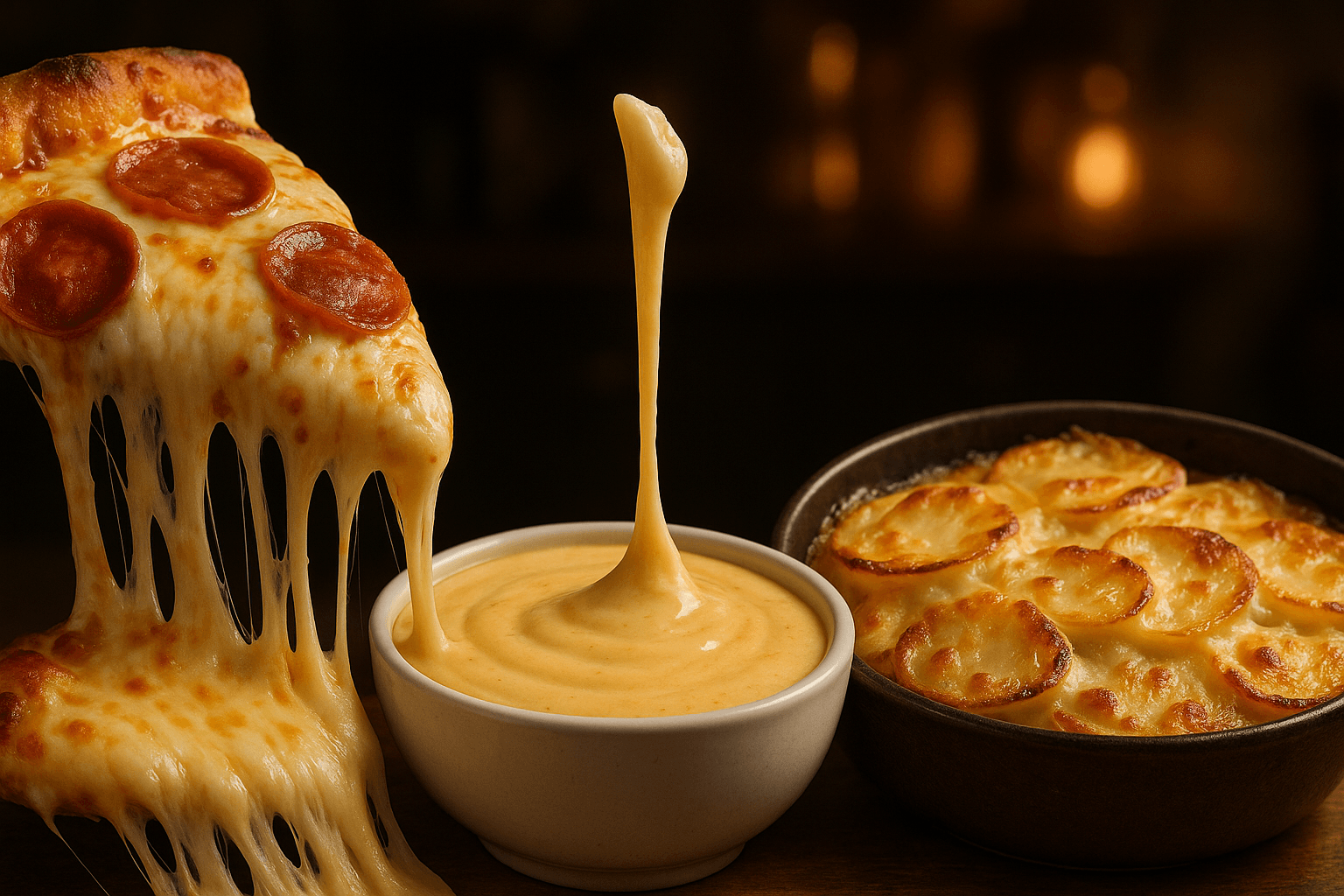
Few ingredients inspire more kitchen hope—and more kitchen disappointment—than cheese. You slide a pizza into a blazing oven dreaming of those long, glossy strands. You stir cheddar into milk expecting velvet and get greasy orange puddles with grainy bits. You top a gratin with Gruyère, wanting a bronzed, savory lid, and end up with a rubbery blanket that sweats oil. Cheese can stretch, slump, blister, brown, flow, seize, split, and weep, sometimes all in the span of a few minutes. The difference between glorious melt and greasy failure is not luck. It is structure.
Underneath the comfort-food magic, cheese is a carefully built protein-and-fat system. The way it behaves under heat depends on how tightly its casein proteins are linked, how much calcium is holding those proteins together, how much moisture remains, how acidic the cheese is, how old it is, and whether anything has been added to help those fat and water phases stay friendly. Once you understand those few variables, the mystery falls away. Mozzarella makes sense. So does why aged cheddar can go oily, why American cheese melts with almost suspicious smoothness, why feta softens but never turns stretchy, and why a pinch of sodium citrate can transform broken queso into satin.
This is the useful science of melted cheese: not abstract dairy chemistry for its own sake, but the kind that lets you choose the right cheese for pizza night, rescue a grainy sauce, and know when high heat helps versus when it destroys. If you have ever asked, “Why did this cheese break?” or “Why doesn’t this cheese melt like that one?” the answer usually lives in the casein network.
Cheese as a protein network, not just solid milk
Cheese begins with milk, whose proteins are mostly casein. In milk, casein proteins gather into bundles called micelles. Those micelles carry calcium phosphate, and that calcium matters enormously because it helps hold the protein structure together. When milk is turned into cheese—through rennet, acid, or both—the casein proteins are encouraged to link up into a gel that traps water, milk fat, minerals, and flavor compounds.
What you eventually eat as cheese is a condensed protein matrix filled with moisture and fat. Think of it as a sponge-like network. Heat changes how flexible that network is. If the network loosens in a controlled way, the cheese melts beautifully. If the network is too tight, too dry, too acidic, or too mineral-bound, it resists flowing and may instead clump or turn rubbery. If it loosens too much while the emulsion falls apart, fat leaks out and you get grease.
The broad goal of good melting is this: soften the protein network enough that it can flow, while keeping fat dispersed and moisture present enough to lubricate the system.
That is why meltability is not one single trait. A cheese can soften without stretching. It can stretch without becoming creamy. It can brown well but split in sauce. It can seem stubborn at first and then suddenly leak oil. “Melty” is a package of behaviors that includes:
- Flow: does it spread and slump under heat?
- Stretch: can it form elastic strands?
- Emulsification: do fat and water stay together?
- Browning: does the surface blister and color attractively?
- Oil-off resistance: does the cheese keep its fat, or shed it?
- Reheating quality: does it stay pleasant after cooling and warming again?
Different dishes prize different versions of melting. Pizza wants stretch, blistering, and controlled browning. Queso wants smooth flow and zero stringiness. A gratin wants surface browning, spoonable body, and no greasy puddles.
A little history: why some cheeses were built to melt and others were not
Traditional cheese styles evolved for preservation, transport, local milk conditions, and culinary habits. Melting performance was often a byproduct.
Fresh pasta filata cheeses like mozzarella were designed through a hot-stretching process that aligns proteins and creates their famous elastic structure. Alpine cheeses such as Gruyère, Emmental, and Comté developed in mountain regions where large cooked-curd wheels aged for months and became ideal for gratins and fondue because they can soften into rich, cohesive mixtures. Brined cheeses like feta were made to store in salt and acid, preserving freshness and tangy flavor, not to become molten.
Processed cheese is a more modern answer to a very practical problem: natural cheeses can be inconsistent under heat. Early processed cheese makers discovered that by grinding cheese and reheating it with emulsifying salts, they could create a stable product that melted smoothly, resisted separation, and stayed homogeneous. That is why American cheese works so reliably in burgers, breakfast sandwiches, and stovetop sauces. It is not “fake” in the sense people often imply; it is engineered for melt control.
Once you know the intended structure of each cheese style, their behavior becomes predictable.
The key variables: moisture, age, acidity, calcium, fat, and emulsifying salts
1. Moisture: the built-in lubricant
High-moisture cheeses generally melt more readily because water plasticizes the protein network. It helps proteins move past one another and lowers the temperature at which the cheese softens.
A low-moisture cheese has less internal lubrication. That can be useful for browning and concentration of flavor, but if the cheese is also aged and tightly knit, it can turn tough before it turns fluid.
Examples:
- Fresh mozzarella: high moisture, softens quickly, can release water onto pizza if not managed.
- Low-moisture mozzarella: less wet, better for pizza because it melts and stretches without flooding the crust.
- Aged Parmesan: low moisture and long-aged; softens a little, but does not become gooey.
2. Age: time reshapes the protein network
As cheese ages, proteins break down in some ways, but moisture also decreases and the cheese’s structure changes significantly. Younger cheeses often melt more smoothly because they still retain enough water and their protein matrix is less compacted. Aged cheeses can become fantastic flavor boosters but tricky primary melters.
A practical rule: the older the cheddar, the less ideal it is as your only sauce cheese. Mild or medium cheddar melts better than extra-sharp clothbound cheddar. The older cheese may still taste better, but it needs help—often from a béchamel base, processed cheese, or sodium citrate.
3. Acidity: tang changes texture
As pH drops and cheese becomes more acidic, casein proteins behave differently. In many acid-set systems, the proteins lose the kind of flexibility that supports smooth, elastic melting. Higher acidity often means a more crumbly cheese that softens but does not flow into long strands.
That is why cheeses like feta, chèvre, paneer, and queso fresco generally do not melt into stretchy pools. They may warm, soften, or hold shape, but their protein structure is not built for smooth elastic flow.
4. Calcium balance: the hidden architect
This is one of the least discussed and most important factors.
Calcium acts like structural reinforcement in the casein network. More calcium crosslinking usually means a firmer, tighter protein matrix. That can make a cheese less prone to smooth melting and more likely to remain cohesive, rubbery, or grainy under heat.
Reducing the effect of calcium crosslinks loosens the network and can improve meltability. This is exactly where emulsifying salts, especially sodium citrate, become such powerful tools. They bind calcium and help reorganize the cheese proteins into a smoother, more stable emulsion.
If moisture is lubrication, calcium is scaffolding. Too much rigid scaffolding, and the structure will not relax gracefully under heat.
5. Fat: flavor and softness, but also a source of grease
Fat makes cheese rich and helps interrupt dense protein structure, which can support tender melting. But once overheated, fat can separate from the protein-water matrix. When the protein network tightens or the emulsion destabilizes, the fat escapes as visible oil.
That means more fat does not automatically equal better melt. It means potentially richer melt—if the system stays stable.
6. Emulsifying salts: the smooth-operator molecules
Processed cheese owes much of its behavior to emulsifying salts such as sodium citrate or sodium phosphate. These salts do two things that matter to home cooks:
- They help pull calcium away from casein crosslinks.
- They improve the ability of proteins to emulsify fat and water together.
The result is remarkable: cheeses that might otherwise separate can melt into a glossy, unified sauce.
This is why sodium citrate is such a good rescue ingredient for queso, mac and cheese, or beer cheese. It does not just “thicken” a sauce. It changes the chemistry enough to create a more stable melt.
Why different cheeses behave differently
Mozzarella: the stretch champion
Mozzarella, especially low-moisture whole-milk mozzarella, is the classic pizza cheese because it lands in the sweet spot of moisture, protein alignment, and moderate fat. In pasta filata cheeses, the curd is heated and stretched during production. That aligns casein fibers and creates the elastic structure that turns into long strands when heated.
On pizza, mozzarella softens around 130 to 150°F / 54 to 66°C, then becomes increasingly fluid and stretchy as it heats further. But if you overbake it—especially beyond the point where the surface blisters heavily and internal moisture has been driven off—the proteins tighten and fat can separate. That is when you see orange or clear oil puddling on top.
Fresh mozzarella behaves differently from low-moisture mozzarella:
- Fresh mozzarella: milky, delicate, watery, less salty; lovely on Neapolitan-style pizza baked very hot and very fast, often 700 to 900°F / 370 to 480°C for 60 to 120 seconds in a pizza oven. In a home oven, it can dump too much moisture unless drained.
- Low-moisture mozzarella: drier, saltier, more concentrated; ideal for home pizza baked at 500 to 550°F / 260 to 290°C for 6 to 10 minutes.
A practical pizza blend often includes 70 to 80% low-moisture mozzarella plus 20 to 30% provolone, fontina, Monterey Jack, or young cheddar for flavor.
Cheddar: flavorful, but prone to grease and graininess
Cheddar is beloved in sauces because it is assertive and familiar, but it is not naturally the easiest smooth-melter, especially when aged. As cheddar matures, it loses moisture, develops acidity, and changes protein structure. Under direct heat, those proteins can contract while fat leaks out.
That is why shredded sharp cheddar thrown straight into a hot pan often turns:
- stringy at first,
- then clumpy,
- then oily.
For stovetop use, cheddar behaves best when:
- it is young to medium-aged,
- it is melted gently into a starchy or emulsified base,
- the sauce stays below a simmer, ideally 150 to 180°F / 66 to 82°C.
At a full boil, cheddar sauces are much more likely to break.
American cheese: engineered smoothness
American cheese melts almost absurdly well because it contains emulsifying salts and is formulated for stability. It does not usually split, and it forms a smooth, cohesive melt over relatively low heat.
That makes it an excellent ingredient even for cooks who think they do not like it. A small amount—say 2 to 4 ounces / 55 to 115 g in a cheese sauce serving 4 to 6 people—can stabilize a sauce made mostly from cheddar, pepper Jack, or Colby.
In queso, one or two slices can make the difference between glossy and broken.
Feta: softens, but does not stretch
Feta is usually brined, acidic, and crumbly. It may get creamy at the edges when baked, but it does not become elastic or fluid like mozzarella. Its protein network and acidity simply do not support that type of melt.
This is why baked feta dishes work best when you treat feta as a cheese that warms and relaxes rather than melts conventionally. Combine it with tomatoes, olive oil, or cream if you want a sauce-like texture.
Alpine cheeses: gratin royalty
Gruyère, Emmental, Appenzeller, Fontina Val d’Aosta, and related alpine styles often melt beautifully in gratins and fondue because they balance moisture, fat, and protein structure in a way that promotes smooth softening without extreme stringiness.
They are excellent for dishes where you want:
- even coverage,
- nutty depth,
- good browning,
- spoonable cohesion rather than pizza-style pull.
For potato gratin, onion soup, croque monsieur, or fondue, alpine cheeses are often better than cheddar because they melt more gracefully and oil off less aggressively.
The science of stringy, greasy, and smooth
Why cheese gets stringy
Stringiness happens when the protein network softens enough to deform and elongate, but still remains continuous. Mozzarella is the obvious example. Provolone and some young Jacks can behave similarly.
Stringiness is desirable on pizza, grilled cheese, and some casseroles. It is undesirable in queso or mac and cheese.
To encourage stringiness:
- use cheeses with elastic protein structure,
- apply enough heat to soften them,
- avoid over-acidic cheeses,
- do not dilute too aggressively with water or starch.
Why cheese gets greasy
Grease happens when fat separates from the protein-water matrix. This is often called oil-off. Common triggers include:
- overheating,
- prolonged holding on heat,
- insufficient moisture,
- older cheese,
- high surface temperatures under broilers,
- broken emulsions in sauces.
Imagine the protein network as a net holding droplets of fat. As heat rises, the net first relaxes. But if the conditions are wrong, it then contracts, squeezes, or fails, and the fat escapes.
You see this on:
- overbaked pizza,
- cheddar-heavy casseroles,
- broiled cheese toppings left too long,
- cheese sauces cooked at a simmer instead of gentle heat.
Why cheese turns smooth
Smooth melted cheese requires an emulsion: fat dispersed in water, supported by proteins and often helped by starch or emulsifying salts. In a smooth queso, for example, you want no distinct protein grains and no free fat.
Three common ways to achieve this at home are:
- Use processed cheese with built-in emulsifying salts.
- Use sodium citrate with natural cheese.
- Use a béchamel or starch-thickened base that physically helps stabilize the sauce.
Each method gives a slightly different texture. Sodium citrate creates a very clean, glossy cheese-forward sauce. Béchamel makes a plusher, more casserole-like sauce. Processed cheese gives the classic diner or concession-stand smoothness.
Pre-shredded cheese and anti-caking agents: convenient, but not neutral
Bagged shredded cheese is usually coated with anti-caking agents such as cellulose, potato starch, or natamycin-containing surface treatments. These help shreds remain separate in the bag, but they can interfere with the smoothest possible melting, especially in sauces.
Potential effects include:
- slightly dusty texture,
- slower incorporation,
- small clumps in queso or mac and cheese,
- muted surface fusion on toppings.
This does not mean pre-shredded cheese is unusable. On pizza, nachos, casseroles, and baked dishes, it is often perfectly acceptable. But for silky stovetop sauces, freshly grated cheese is usually superior.
If you must use pre-shredded cheese in sauce:
- add it gradually,
- keep heat low,
- use a stabilizer such as 1 to 2 teaspoons cornstarch per 8 ounces / 225 g cheese or a small amount of sodium citrate.
Sodium citrate: when and how it rescues grainy queso
Sodium citrate is the home cook’s shortcut to processed-cheese reliability with natural-cheese flavor. It is especially useful when making queso, nacho cheese sauce, beer cheese, or ultra-smooth mac and cheese without flour.
A reliable starting ratio is:
- 8 ounces / 225 g cheese
- 1 cup / 240 g liquid
- 1 teaspoon / about 4 g sodium citrate
This ratio can vary depending on the cheese and desired thickness, but it is a very workable baseline.
Basic sodium citrate queso method
For about 2 cups sauce:
- 8 ounces / 225 g cheese, freshly grated
- 1 cup / 240 g liquid: milk, water, beer, or a mix
- 1 teaspoon / 4 g sodium citrate
- optional: 1 to 2 teaspoons pickled jalapeño brine for tang
- Combine liquid and sodium citrate in a saucepan.
- Bring just to a bare simmer, about 180°F / 82°C, whisking to dissolve.
- Lower heat.
- Add cheese a handful at a time, whisking until smooth before the next addition.
- Hold warm, ideally 140 to 160°F / 60 to 71°C.
If your queso has already gone grainy, do not panic. Add a few tablespoons of warm liquid and 1/4 teaspoon sodium citrate at a time, blending or whisking vigorously over low heat. Often the sauce will come back together.
Heat rules: when high heat helps and when it breaks cheese
The single biggest practical mistake home cooks make with cheese is assuming more heat means faster success. Cheese is not steak. It is a fragile emulsion and protein network. The correct heat depends entirely on the dish.
Rule 1: For pizza, use high heat and short time
Pizza benefits from very high oven heat because the dough and toppings need rapid cooking before the cheese has time to dry out and leak fat.
Home oven target:
- Preheat thoroughly for 45 to 60 minutes if using a steel or stone
- Bake at 500 to 550°F / 260 to 290°C
- Typical bake: 6 to 10 minutes depending on pizza style
Signs of ideal melt:
- cheese fully liquefied,
- some blistering,
- no broad orange oil lakes,
- stretch when sliced,
- crust done before cheese toughens.
Rule 2: For gratins, use moderate oven heat and finish with brief broiling
Gratins need enough time for the interior to heat through, but not so much direct top heat that the cheese breaks before the dish is ready.
Best practice:
- Bake gratins at 350 to 400°F / 175 to 205°C until hot through
- Add cheese at the start if the dish cooks relatively quickly, or in the final 10 to 20 minutes for long-baking dishes
- Broil only at the end for 30 seconds to 2 minutes, watching constantly
Broilers are powerful. Surface temperatures can soar quickly, which promotes fat separation. You want color, not prolonged assault.
Rule 3: For stovetop sauces, never boil after the cheese goes in
This is the golden rule for mac and cheese, queso, Mornay, beer cheese, and cheddar sauces.
Target range after adding cheese:
- ideally 150 to 180°F / 66 to 82°C
- avoid simmering bubbles
- if using a thermometer, pull the pan from direct heat around 170°F / 77°C and stir in cheese off-heat if needed
Once cheese is incorporated, prolonged heat only increases the chance of tightening proteins and split fat.
Rule 4: For broiled toppings, use thin layers
A very thick cap of cheese on French onion soup, casseroles, or open-faced sandwiches can trap steam below while the top overheats. Thin, even layers melt and brown more predictably.
Aim for:
- 1/4 to 1/2 inch / 6 to 12 mm topping thickness for most gratins and casseroles
- enough coverage to protect the surface, but not so much mass that it insulates itself into greasiness.
Step-by-step: choosing the right cheese strategy for each dish
Pizza
Best cheeses
- Low-moisture whole-milk mozzarella
- Mozzarella-provolone blend
- Mozzarella with small amounts of fontina, Monterey Jack, or young cheddar
Avoid as primary cheese
- very aged cheddar,
- feta alone,
- pre-crumbled goat cheese alone,
- Parmesan alone.
Method
- If using fresh mozzarella, drain it on towels for 20 to 30 minutes and tear into small pieces.
- Use about 6 to 8 ounces / 170 to 225 g cheese for a 12-inch pizza.
- Distribute evenly; overcrowding increases oiling and moisture issues.
- Bake in a fully preheated oven at 500 to 550°F / 260 to 290°C.
- Pull the pizza when cheese is melted and spotted, before broad pools of oil form.
Common mistakes
- too much cheese,
- underpreheated oven,
- fresh mozzarella not drained,
- too long a bake at too low a temperature.
Low heat for too long is one of the sneakiest pizza mistakes. It gives the cheese time to dehydrate and separate before the crust is done.
Queso and nacho cheese sauce
Best cheeses
- American cheese,
- Monterey Jack,
- young cheddar,
- pepper Jack,
- Oaxaca, with stabilizer if needed.
Best methods
- sodium citrate,
- processed cheese base,
- starch-thickened milk base.
Simple queso without breaking
For 4 to 6 servings:
- 1 cup / 240 g whole milk
- 8 ounces / 225 g cheese, grated
- 1 teaspoon / 4 g sodium citrate
- optional spices: 1/2 teaspoon cumin, 1/2 teaspoon chili powder
- Warm milk with sodium citrate until dissolved.
- Keep heat low.
- Add cheese gradually, whisking smooth.
- Season.
- Hold warm, not hot.
Common mistakes
- dumping all cheese in at once,
- using extra-sharp cheddar as the only cheese,
- boiling the sauce,
- leaving queso in a hot slow cooker without added liquid.
If holding queso for a party, use a warm setting no hotter than about 140 to 150°F / 60 to 66°C, and stir in extra milk 1 tablespoon at a time as needed.
Gratins
Best cheeses
- Gruyère,
- Comté,
- Emmental,
- fontina,
- moderate amounts of Parmesan for top flavor.
Method
For a potato gratin serving 6 to 8:
- use 6 to 8 ounces / 170 to 225 g melting cheese inside or on top,
- add 1 to 2 ounces / 30 to 55 g Parmesan for browning and savory punch,
- bake at 375°F / 190°C until bubbling and tender,
- broil briefly at end if needed.
Common mistakes
- all cheddar topping,
- too thick a cheese layer,
- broiling too early,
- too much aged hard cheese as the sole melt component.
Parmesan is excellent in support. It is less excellent as the whole roof.
Common mistakes across all cheese melting
1. Using aged cheese where youth is needed
Older cheese tastes wonderful, but structure matters. If you want sauce, blend aged cheese with younger cheese.
2. Applying direct high heat on the stovetop
Cheese sauces like gentle, indirect heat. A double boiler is not excessive if you are making a delicate sauce.
3. Ignoring moisture balance
A dry cheese on a dry dish under long heat is a recipe for oil-off. Add cream, milk, sauce, or another moister cheese when appropriate.
4. Overloading with acid
Beer, wine, tomatoes, and pickled jalapeños add flavor, but too much acidity can push a sauce toward graininess unless the emulsion is stabilized. Add acidic ingredients thoughtfully.
5. Shredding too coarsely
Very large chunks melt unevenly. For sauces, grate on the large holes of a box grater or use a food processor shred disk.
Smart tips and useful variations
- Blend cheeses on purpose: mozzarella for stretch, provolone for flavor, Gruyère for nuttiness, American for stability.
- Use starch strategically: tossing grated cheese with 1 tablespoon cornstarch per pound / 450 g can help in fondue-style applications.
- Reserve hard cheeses for flavor: use Parmesan, Pecorino, and aged Gouda as accents rather than primary melters in most sauces.
- Drain fresh cheeses: fresh mozzarella and ricotta can flood a dish if added wet.
- Let shredded cheese warm slightly: cold cheese can seize a hot sauce more easily than cheese that has sat out for 10 to 15 minutes.
- Add cheese off heat: especially in béchamel-based sauces, remove the pan from the burner before stirring in the cheese.
- For smoother mac and cheese: combine 8 ounces / 225 g young cheddar with 4 ounces / 115 g American cheese per 1 pound / 450 g pasta and 3 cups / 720 ml sauce base.
- For burger melts: cover the pan for the final 30 to 60 seconds to trap steam and melt slices gently without overcooking the meat.
- For feta applications: pair with cream, yogurt, or roasted vegetables rather than expecting classic melt behavior.
The science in one sentence for each cheese
- Mozzarella: moderate moisture plus stretched protein alignment equals excellent elasticity and pizza stretch.
- Cheddar: strong flavor, but lower moisture and age-related structural changes can make it greasy or grainy under harsh heat.
- American: emulsifying salts tame proteins and stabilize fat for exceptionally smooth melting.
- Feta: acidic, crumbly structure softens but resists stretchy melt.
- Alpine cheeses: balanced moisture and protein structure make them superb for smooth, cohesive oven melting.
What to do when cheese goes wrong
If pizza cheese is greasy
- use less cheese,
- switch to lower-moisture mozzarella,
- reduce aged cheese in the blend,
- bake hotter and faster,
- avoid extended hold time after baking.
If queso is grainy
- lower heat immediately,
- whisk in warm liquid,
- add sodium citrate in small increments,
- use younger cheese next time,
- grate your own cheese.
If gratin topping is rubbery
- use more Gruyère or fontina, less cheddar,
- reduce topping thickness,
- broil only briefly,
- add hard grating cheese only as a small fraction.
If cheese sauce split
- remove from heat,
- whisk in 1 to 3 tablespoons warm milk or water,
- add 1/4 teaspoon sodium citrate or a small piece of American cheese,
- blend if necessary.
Takeaways: the rules worth remembering
Perfect melted cheese is not about one miracle ingredient. It is about matching cheese structure to the job and respecting heat.
Remember these core rules:
- Young, moister cheeses melt more readily than older, drier ones.
- Acidic, crumbly cheeses soften but usually do not stretch.
- Calcium strengthens the casein network; emulsifying salts loosen and stabilize it.
- Fat brings richness, but overheating lets it escape as grease.
- Pizza wants very high heat and short bake time.
- Sauces want low heat and no boiling.
- Gratins want moderate baking and brief broiling.
- Freshly grated cheese melts more smoothly than pre-shredded in sauces.
- Sodium citrate is one of the best fixes for broken or grainy queso.
When you understand cheese as a network of casein, calcium, water, and fat, the behavior stops looking random. Mozzarella stretches because its protein structure allows it. Cheddar breaks because age, acidity, and heat can push it past stability. American melts smoothly because it has chemical assistance. Gruyère bronzes beautifully because its balance suits gratins. Feta stays itself because it was never meant to become pizza cheese.
And that is the good news for cooks: once you know the rules, you can stop blaming yourself for every oily casserole or grainy queso. Sometimes the issue is not technique alone. It is that the cheese was being asked to do a job it was never built to do.
Choose the right cheese, manage the calcium and the heat, and melted cheese becomes far less mysterious—and much more delicious.