Why Gelatin Sets, Weeps, or Melts Too Fast: Bloom Strength, Protease Enzymes, and the Sugar‑Acid Rules for Silky Desserts, Glazes, and Gummies
RecipeSimpli
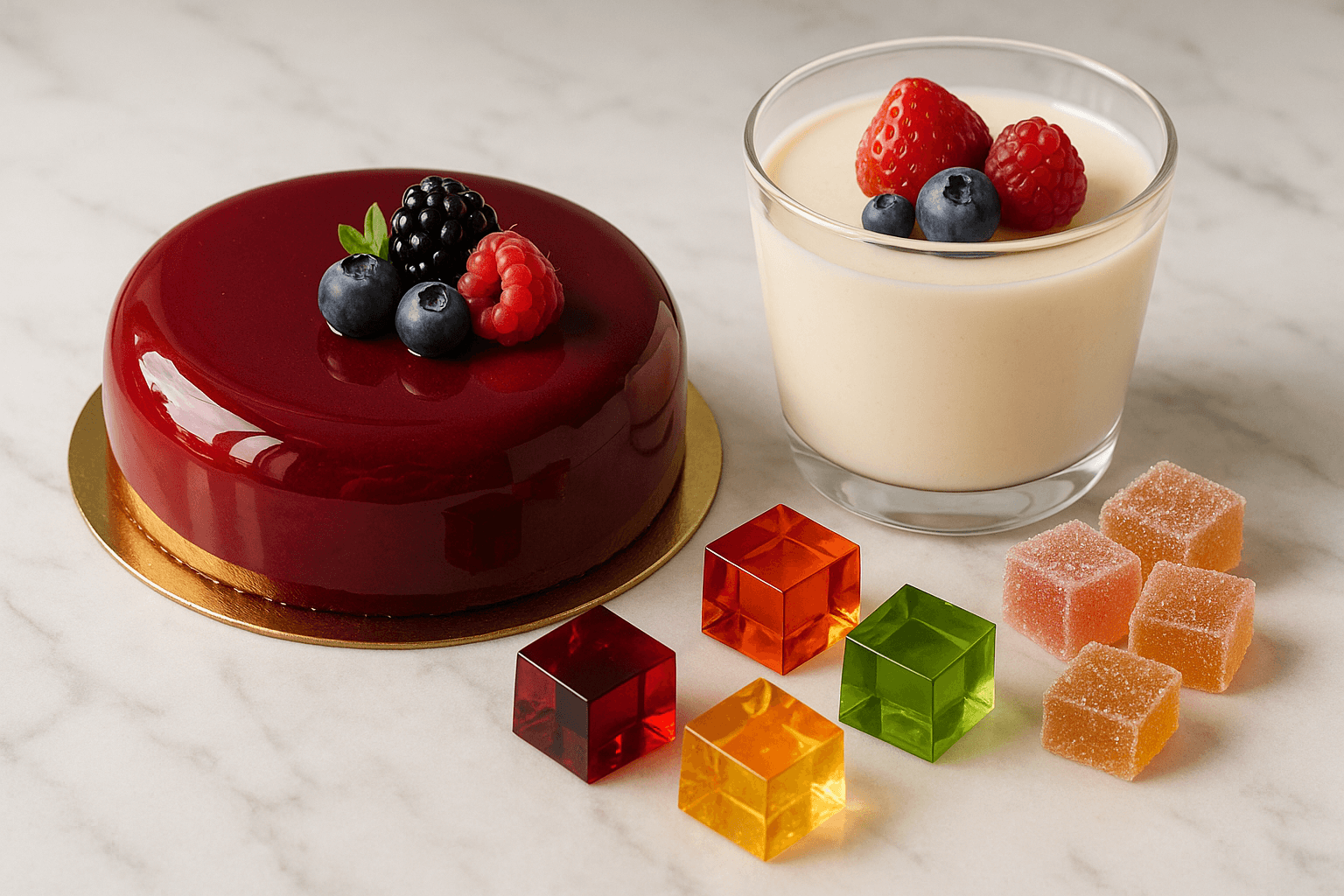
Gelatin seems almost magical when it behaves: cream turns into a trembling panna cotta, fruit puree slices into clean translucent cubes, a mirror glaze drapes over a cake in one glossy sheet, and a pot of syrup becomes chewy gummies after a night of drying. But when it misbehaves, it can be baffling. One batch refuses to set. Another sets but leaks liquid by the next day. A glaze turns rubbery. A panna cotta melts into soup on a warm table. Fresh pineapple somehow sabotages everything.
The good news is that gelatin is not random. It follows rules—clear, predictable, kitchen-usable rules. If you understand three big ideas, you can troubleshoot almost any gelatin recipe: bloom strength, protease enzymes, and the way sugar, acid, and temperature shape gel formation.
This is the home cook’s version of gelatin science: practical enough to make better desserts tonight, but detailed enough that you’ll actually understand why your last batch failed. We’ll cover what bloom strength really means, why some fruits attack gelatin, how sweetness and tartness change texture, and the exact temperature windows that separate silky from rubbery, sliceable from slumpy, glossy from lumpy.
Gelatin in context: what it is and why it behaves unlike starch or agar
Gelatin is a protein made by partially hydrolyzing collagen, the structural protein found in animal connective tissue. When collagen is processed into gelatin, its long protein chains become dispersible in warm water. Once dissolved and cooled, some portions of those chains reassociate into a loose network that traps water. That network is your gel.
This is why gelatin feels different from a starch-thickened pudding or an agar jelly. Starch thickens because granules absorb water and swollen starch molecules tangle up. Agar sets through polysaccharide chains that form a much firmer, more brittle structure. Gelatin, by contrast, creates an elastic, delicate network that melts close to body temperature. That is the secret behind panna cotta that dissolves luxuriously on the tongue and glazes that don’t feel waxy.
That same body-temperature melt is also gelatin’s weakness. It can soften quickly in a hot room, slump on a buffet, or liquefy if a dessert sits too long outdoors in summer. Gelatin’s beauty is inseparable from its fragility.
Historically, gelatin desserts were once labor-intensive and associated with wealth because extracting collagen from bones and skins took time and fuel. Commercial powdered and sheet gelatin transformed that process into a pantry ingredient, but the old culinary logic still matters: gelatin is not just a thickener. It is a protein system with a memory of heat, water, and acidity.
The first rule: bloom strength determines the personality of the gel
If gelatin has one technical term worth learning, it is bloom strength. Bloom is a measure of gel strength: specifically, how firm a standard gelatin gel becomes under controlled testing. Higher bloom gelatin forms a stronger gel than lower bloom gelatin when used at the same concentration.
In practical kitchen terms:
- Low bloom gelatin gives a softer, more tender set.
- High bloom gelatin gives a firmer, springier, more elastic set.
- Higher bloom gelatin is often better when you want clean slices, chewy gummies, or a glaze that clings well.
- Lower bloom gelatin can be lovely in softly trembling desserts.
Common commercial ranges look like this:
- Bronze sheet gelatin: roughly 125–155 bloom
- Silver sheet gelatin: roughly 160 bloom
- Gold sheet gelatin: roughly 190–220 bloom
- Platinum sheet gelatin: roughly 230–250 bloom
- Powdered gelatin in many U.S. grocery stores: often around 225 bloom, though brands vary
This matters because recipes are often written as though “1 packet gelatin” or “4 sheets gelatin” were universal units. They are not. A recipe developed with 200-bloom gelatin may set noticeably softer if you use a lower-bloom product, or become firmer and bouncier if you use a higher-bloom one.
How to think about bloom strength at home
If a recipe is written in grams of gelatin, bloom strength still affects the result, but the recipe is at least measurable. If a recipe is written in packets or sheets, you need more caution.
As a rough U.S. reference:
- 1 packet powdered gelatin = about 7 g gelatin
- This usually sets about 2 cups / 475 ml liquid to a soft but sliceable gel, depending on sugar, acid, alcohol, and dairy
Typical usage ranges for 225-bloom gelatin:
- Soft panna cotta: 0.8% to 1.2% gelatin by weight of total mixture
- Standard dessert gel / spoonable set: 1.2% to 1.6%
- Clean-cut fruit gel: 1.5% to 2%
- Mirror glaze: often 0.8% to 1.3%, depending on chocolate, condensed milk, glucose, and cocoa solids
- Chewy gummies: 6% to 10%, sometimes higher depending on drying and sugar solids
For example, for 500 g panna cotta base, a delicate restaurant-style set might use:
- 5 g gelatin for very soft
- 6 g for classic silky unmoldable or barely unmoldable
- 7 to 8 g if you need cleaner unmolding or warmer serving conditions
For a 500 g fruit gel you want to cut into cubes:
- 8 to 10 g gelatin is more realistic, especially if the fruit is acidic
For 500 g gummy syrup:
- 30 to 45 g gelatin is common, depending on chew and drying time
Why higher bloom doesn’t just mean “better”
A stronger gelatin is not always an upgrade. High-bloom gelatin can create a texture that is too tight, squeaky, or rubbery if used indiscriminately. For panna cotta, the ideal is not maximum firmness; it is a delicate gel that barely holds shape. For mirror glaze, too much gelatin makes the glaze thick, elastic, and prone to tearing instead of flowing in a smooth curtain.
If your dessert feels bouncy rather than silky, the problem may not be technique. You may simply have too much gelatin for the application—or a stronger bloom than the recipe author used.
The second rule: gelatin must be bloomed and dissolved correctly
Before gelatin can set properly, it has to hydrate. This step is called blooming.
Powdered gelatin
Sprinkle powdered gelatin evenly over 5 to 6 times its weight in cold water.
For example:
- 7 g gelatin
- 35 to 42 g cold water
Let it stand 5 to 10 minutes until fully swollen. It should look thick and opaque, not grainy.
Sheet gelatin
Soak sheets in a bowl of very cold water for 5 to 10 minutes until flexible, then lift out and gently squeeze away excess water before adding to the warm base.
Dissolving temperature
Once bloomed, gelatin should be melted into a warm mixture—not boiled aggressively. A target of about 122 to 140°F / 50 to 60°C is usually plenty to dissolve it smoothly. It can tolerate somewhat higher temperatures during normal cooking, but prolonged boiling weakens gel strength over time and can alter texture.
Common mistake: adding bloomed gelatin to a base that is too cool. The gelatin may not fully dissolve, leaving invisible strands or graininess that later cause weak setting or an uneven texture.
Common mistake: dumping powdered gelatin directly into hot liquid. It can clump instantly, trapping dry granules inside. Bloom first, always.
The science of setting: how gelatin becomes a gel
When gelatin dissolves in hot liquid, its protein chains are dispersed. As the liquid cools, parts of those chains begin to realign into short triple-helix-like segments, somewhat resembling collagen’s original structure. These segments act as junction points in a flexible 3D network. Water gets trapped inside that network, and the liquid becomes a gel.
This explains several classic gelatin behaviors:
- It sets as it cools, rather than through chemical reaction.
- It melts again when warmed, because the network junctions come apart.
- It is thermoreversible, meaning you can often remelt and reset it.
- It benefits from time, because the network continues organizing as it chills.
Most gelatin desserts begin thickening in the refrigerator and become fully reliable after 4 hours, though many improve after 8 to 24 hours.
If you cut gelatin too soon, it may seem weak not because the formula is wrong, but because the network has not fully matured.
The third rule: protease enzymes can destroy your gel
If you have ever made a gelatin dessert with fresh pineapple, kiwi, papaya, figs, or ginger and found that it stayed liquid, you met protease enzymes. These are enzymes that cut proteins into smaller pieces. Since gelatin is a protein, those enzymes can literally snip the chains needed to form the gel network.
The main culprits include:
- Pineapple: bromelain
- Kiwi: actinidin
- Papaya: papain
- Figs: ficin
- Ginger: zingibain
These enzymes are most active in fresh fruit. Canned fruit often works because the canning process heats the fruit enough to denature the enzymes.
How to make these fruits safe for gelatin
You must heat the fruit or puree sufficiently before combining it with gelatin.
A practical home guideline:
- Bring the fruit puree or juice to at least 185°F / 85°C for about 1 minute, or simmer gently for several minutes, then cool slightly before adding gelatin.
This heat denatures the enzymes so they can no longer chop up the gelatin.
For example, if you want a pineapple gel:
- Puree or juice the pineapple.
- Heat it to 185°F / 85°C and hold briefly.
- Cool to around 140°F / 60°C or below.
- Add bloomed gelatin and dissolve.
- Chill to set.
Important nuance: if you mix fresh protease-rich fruit into a dairy base after the gelatin is dissolved, the dessert may partially set and then weaken over time. That can look like a mysterious delayed failure. The enzyme damage can continue until the fruit is heated or the system is otherwise altered.
Sugar rules: sweetness changes more than flavor
Sugar does not just make gelatin desserts sweet. It changes water availability, viscosity, setting behavior, and texture.
What sugar does in gelatin systems
-
Competes for water Sugar binds water, leaving less free water available. In moderate amounts, this can support a tighter-feeling gel because the whole system is less loose.
-
Raises viscosity before setting A syrupy base feels thicker even before the gelatin network forms. This can make glazes coat better and gummies feel denser.
-
Can slow hydration or dissolution if mishandled Very sugary mixtures can make gelatin harder to disperse smoothly unless it is bloomed separately first.
-
Affects perceived firmness A high-sugar gel often feels more substantial, though not always “firmer” in a clean instrumental sense. Mouthfeel matters.
Moderate sugar vs. very high sugar
In desserts like panna cotta or fruit gel, moderate sugar levels usually help texture. But in very high-sugar systems, especially gummies, the texture becomes a combined effect of gelatin concentration + sugar concentration + moisture loss.
A homemade gummy formula often includes:
- Fruit puree or juice: 200 g
- Granulated sugar: 150 to 250 g
- Glucose syrup or corn syrup: 75 to 150 g
- Gelatin: 30 to 40 g
- Citric acid solution added late for tartness
That is not just a gelatin dessert. It is a concentrated candy system. As the gummies dry for 12 to 48 hours, water evaporates, sugar concentration increases, and chewiness intensifies.
Common sugar mistake
Reducing sugar dramatically in a gummy or glaze recipe does not just make it less sweet. It changes body, shine, flow, water activity, and setting behavior. The result may be softer, wetter, less stable, or more prone to weeping.
Acid rules: brightness helps flavor but can weaken the gel
Acid is where many elegant gelatin desserts go wrong. Citrus, passion fruit, berries, yogurt, cultured dairy, wine, and fruit concentrates all contribute acidity. A little acid sharpens flavor and keeps sweet gels from tasting flat. Too much acid, or acid added at the wrong stage, can weaken gelatin.
Why acid matters
Gelatin is a protein. Proteins are sensitive to pH. In strongly acidic environments, especially when heated, gelatin chains can undergo more hydrolysis—breaking into shorter pieces that form a weaker network.
In practice:
- Mild acidity is usually fine.
- High acidity, especially combined with heat, can reduce set strength.
- The lower the pH, the more cautious you should be.
Best practice for acidic ingredients
If possible:
- Dissolve gelatin in a neutral or only mildly acidic warm base.
- Add strongly acidic ingredients after the gelatin is dissolved and the mixture has cooled somewhat, ideally below 140°F / 60°C.
- For very tart formulas, increase gelatin slightly—often by 10 to 25%.
Example: a lemon panna cotta that works better than one made by boiling cream, sugar, lemon juice, and gelatin together.
Better method:
- Heat cream, milk, and sugar.
- Dissolve bloomed gelatin.
- Cool slightly to about 120 to 130°F / 49 to 54°C.
- Whisk in lemon juice or passion fruit puree.
- Pour and chill.
This minimizes acid-driven damage during heating.
The sour gummy rule
For gummies, many recipes include citric or malic acid. Add it too early, while the mixture is hot, and the gummies may set weaker or become sticky over time.
Best practice:
- Add powdered acid blended with a little sugar, or an acid solution, after cooking, when the syrup has cooled somewhat but is still fluid—often around 160 to 175°F / 71 to 79°C.
This preserves tartness and limits unnecessary breakdown of gelatin during heating.
Temperature rules: the hidden key to every gelatin success
Temperature determines almost everything with gelatin: blooming, dissolving, setting, melting, slicing, glazing, even weeping.
Rule 1: Bloom cold
Always hydrate gelatin in cold water. Warm water can create uneven swelling or clumping.
Rule 2: Dissolve warm, not violently boiling
Aim for 122 to 140°F / 50 to 60°C to dissolve bloomed gelatin smoothly. Short excursions above that are not catastrophic in many recipes, but long boiling is unhelpful and can weaken the final gel.
Rule 3: Chill thoroughly to set
Most gelatin desserts should chill at 34 to 39°F / 1 to 4°C.
Typical set times:
- Thin glaze: 2 to 4 hours to become fully cold and stable
- Panna cotta: 4 to 6 hours minimum, overnight ideal
- Fruit gel slabs: 4 to 8 hours
- Gummies in molds: 2 to 4 hours to demold, then 12 to 48 hours drying for chew
Rule 4: Respect melting temperature
Gelatin gels soften significantly as they approach warm room and body temperature. Many melt in the range of roughly 77 to 95°F / 25 to 35°C, depending on formula. That is why panna cotta tastes luscious on the tongue—and why it suffers on a summer patio.
If you need a dessert to hold longer at room temperature:
- Increase gelatin modestly
- Serve colder
- Use smaller portions
- Reduce alcohol
- Avoid excessive acid
- Consider combining with other stabilizers if appropriate
Rule 5: Mirror glaze needs a narrow pouring window
Most gelatin-based mirror glazes pour best around 90 to 95°F / 32 to 35°C, though exact ideal temperature varies by formula and thickness.
Too warm:
- glaze runs too thin
- coverage is poor
- underlying cake may show through
Too cool:
- glaze thickens too much
- surface becomes uneven
- drips become lumpy or thick
For best results, pour over a fully frozen cake, ideally at 0°F / -18°C or below. The cold surface helps the glaze set quickly and evenly.
Why gelatin weeps: the science of syneresis
When a gelatin dessert leaks liquid, that is often syneresis, commonly described as weeping. The gel network contracts or becomes damaged, forcing out trapped water.
Causes of syneresis
-
Too much gelatin Counterintuitively, an over-firm gel can squeeze out water more readily over time.
-
Acid damage A weakened, partially broken network may not hold water well.
-
Enzyme damage Proteases can produce a gel that seems to set but later collapses and leaks.
-
Freeze-thaw stress Ice crystals puncture the gel network. Thawed gelatin desserts often weep badly.
-
Mechanical damage Over-whisking as the gel begins to set can break the forming network.
-
Storage time Gels can gradually rearrange and contract over several days.
How to reduce weeping
- Use only as much gelatin as needed
- Protect from enzyme-rich fresh fruits unless heated first
- Avoid prolonged cooking with strong acid
- Do not freeze plain gelatin desserts if texture matters
- Store covered in the refrigerator
- Serve within 24 to 72 hours for best quality, depending on recipe
Step-by-step applications
1) Silky panna cotta that trembles but holds
Formula
For 6 small servings:
- Heavy cream: 360 g / 1 1/2 cups
- Whole milk: 120 g / 1/2 cup
- Sugar: 60 to 75 g / 1/3 cup
- Powdered gelatin (about 225 bloom): 6 g
- Cold water for blooming: 36 g / 2 1/2 tablespoons
- Fine salt: 1 pinch
- Vanilla extract: 1 teaspoon or 1/2 vanilla bean
Method
- Sprinkle gelatin over cold water and bloom 5 to 10 minutes.
- Heat cream, milk, sugar, and salt to 140 to 160°F / 60 to 71°C. Do not boil hard.
- Remove from heat and whisk in bloomed gelatin until fully dissolved.
- Add vanilla.
- Cool to about 120°F / 49°C before pouring into molds.
- Chill at least 4 hours, preferably overnight.
Why it works
The dairy base is only mildly acidic, the gelatin level is low enough for silkiness, and the dessert is served cold but melts on the tongue. If you add acidic fruit puree, increase gelatin to 6.5 to 7.5 g and add the puree after the gelatin dissolves.
Common mistakes
- Using too much gelatin: texture becomes bouncy
- Boiling aggressively: can dull flavor and slightly weaken set
- Unmolding too warm: panna cotta slumps quickly
2) Clean-cut fruit gel for cubes or plated desserts
Formula
- Fruit puree, heated if enzyme-rich: 400 g
- Water or juice: 80 g
- Sugar: 60 to 100 g depending on fruit
- Lemon juice: 10 to 20 g, added after dissolution if needed
- Powdered gelatin: 8 to 10 g
- Cold water for blooming: 48 to 60 g
Method
- Bloom gelatin in cold water.
- Heat puree, water, and sugar to 140 to 160°F / 60 to 71°C. If using pineapple, kiwi, papaya, fig, or fresh ginger, first heat to 185°F / 85°C briefly.
- Remove from heat; dissolve gelatin thoroughly.
- Cool to below 140°F / 60°C, then add lemon juice.
- Pour into a lined pan.
- Chill 4 to 8 hours before cutting with a hot knife.
Why it works
Fruit acids are managed by adding the sharpest acid later, and the gelatin percentage is high enough for slicing. If the gel tears when cut, it may be under-set or too warm.
3) Shiny mirror glaze that flows, not clumps
Formula
A simple white-chocolate style glaze:
- Water: 75 g
- Sugar: 150 g
- Glucose syrup or light corn syrup: 150 g
- Sweetened condensed milk: 100 g
- White chocolate, chopped: 150 g
- Powdered gelatin: 10 g
- Cold water for blooming: 60 g
- Optional titanium-free coloring or gel color as desired
Method
- Bloom gelatin.
- Heat water, sugar, and glucose to a simmer, about 217 to 220°F / 103 to 104°C.
- Remove from heat; whisk in condensed milk.
- Add bloomed gelatin and stir to dissolve.
- Pour over white chocolate; rest 1 minute.
- Blend with an immersion blender, keeping the head submerged to avoid bubbles.
- Strain.
- Cool glaze to 90 to 95°F / 32 to 35°C.
- Pour over a fully frozen cake on a rack.
Why it works
Sugar and glucose control shine and viscosity. Gelatin gives elasticity and body. White chocolate contributes cocoa butter, which helps set the coating. The exact pour temperature is crucial.
Common mistakes
- Pouring too warm: thin coverage
- Pouring too cool: ridges and thick drips
- Incorporating bubbles: dull or pitted finish
- Too much gelatin: rubbery mouthfeel
4) Chewy homemade gummies with real bite
Formula
- Fruit juice or strained puree: 200 g
- Sugar: 180 g
- Glucose or corn syrup: 100 g
- Powdered gelatin: 35 g
- Cold water for blooming: 175 g
- Citric acid: 3 g mixed with 3 g water, added late
Method
- Bloom gelatin in cold water for 10 minutes.
- Heat juice, sugar, and glucose to 230 to 235°F / 110 to 113°C.
- Let cool slightly to around 185°F / 85°C.
- Stir in bloomed gelatin until fully melted.
- Cool to 165 to 175°F / 74 to 79°C; stir in citric acid solution.
- Deposit into starch-dusted or lightly oiled silicone molds.
- Rest at room temperature 30 to 60 minutes, then chill 1 to 2 hours if needed for demolding.
- Unmold and dry 12 to 48 hours until chewy.
- Coat lightly in sugar only when the surface is no longer tacky.
Why it works
This is a high-solids candy, not just a gelatin dessert. The syrup concentration, gelatin percentage, and drying all matter. Adding acid late keeps tartness bright and protects texture.
Common mistakes
- Not cooking syrup enough: wet, weak gummies
- Too much acid too early: stickiness and poor set
- Not drying long enough: soft centers, sweating sugar coat
Converting between sheet and powdered gelatin
Recipes from different countries can be maddening because some use sheets and some use powder. The most reliable way to convert is by gelatin weight in grams, then adjusting only if bloom strength differs significantly.
Practical guideline:
- Ignore the number of sheets as a primary measure.
- Find the gram weight of the sheets you are using.
- Compare bloom if known.
If converting between products of different bloom strengths, a rough proportional adjustment is:
new amount = original amount × original bloom / new bloom
Example: A recipe uses 10 g of 200-bloom gelatin. You have 250-bloom gelatin.
10 × 200 / 250 = 8 g
This is not perfect in every formula, but it is a useful starting point.
Troubleshooting guide
“My gelatin dessert never set.”
Possible causes:
- Too little gelatin
- Fresh pineapple, kiwi, papaya, figs, or ginger not heated first
- Gelatin not fully dissolved
- Too much alcohol
- Strong acid heated too long
- Dessert not chilled long enough
Fix next time:
- Increase gelatin by 10 to 20%
- Heat enzyme-rich fruit first
- Dissolve completely at 122 to 140°F / 50 to 60°C
- Limit alcohol to about 10% or less of the formula for reliable setting
“It set, but it’s rubbery.”
Possible causes:
- Too much gelatin
- High-bloom gelatin substituted without adjustment
Fix next time:
- Reduce gelatin by 10 to 25%
- Recalculate for bloom strength
“It melts too fast on the table.”
Possible causes:
- Formula designed for refrigerator service
- Too little gelatin for room temperature conditions
- Warm ambient temperature
Fix next time:
- Increase gelatin slightly
- Serve colder
- Use smaller molds or glasses
- Avoid outdoor service in heat
“It weeps overnight.”
Possible causes:
- Syneresis from over-firm gel
- Acid or enzyme damage
- Freeze-thaw damage
Fix next time:
- Use less gelatin
- Heat protease-rich fruit before use
- Avoid freezing
- Eat sooner
“My mirror glaze is thick and dull.”
Possible causes:
- Too cool when poured
- Too much gelatin
- Air bubbles from blending
Fix next time:
- Pour at 90 to 95°F / 32 to 35°C
- Blend carefully and strain
- Check formula balance
Tips and variations
Use dairy strategically
Milk proteins and fat soften perception of gelatin firmness. A cream-rich panna cotta can use the same gelatin percentage as a fruit gel but feel much softer. That is not a contradiction—it is mouthfeel.
Be careful with alcohol
Alcohol interferes with gel formation. A Champagne gel or boozy panna cotta often needs more gelatin than the same formula made with juice or milk. Keep alcohol modest unless the recipe is specifically developed for it.
Salt matters
A tiny pinch of salt improves flavor dramatically in sweet gelatin desserts. Because chilled desserts mute flavor, proper seasoning matters more than many home cooks think.
Strain for elegance
If your base contains zest, cocoa, fruit fibers, or undissolved bits, strain before pouring. A smooth gel looks shinier, cuts cleaner, and feels more refined.
Use hot water for clean slices
Dip a knife in hot water, wipe dry, and cut in single decisive strokes. This prevents tearing and gives jewel-like edges.
For layered gels, watch temperatures
Pouring a hot layer over a set gelatin layer can melt the surface and blur the line. Let the next layer cool until just fluid, often around 80 to 95°F / 27 to 35°C, before adding.
Do not trust freezer shortcuts
Putting gelatin in the freezer to “set faster” often backfires. Partial freezing creates ice crystals, and once thawed, the gel may leak or become coarse.
The big takeaways
Gelatin is one of the most elegant ingredients in the pastry kitchen because it does something few others can: it creates a texture that is structured yet delicate, stable when cold yet meltingly tender in the mouth. But it only feels magical when you know its rules.
Those rules are straightforward:
- Bloom strength controls texture. Higher bloom means stronger gel at the same dose.
- Protease-rich fresh fruits can destroy gelatin. Heat pineapple, kiwi, papaya, figs, and ginger before use.
- Sugar changes body and stability. In gummies and glazes, reducing sugar alters much more than sweetness.
- Acid can weaken gelatin, especially with heat. Add tart ingredients later when possible.
- Temperature is everything. Bloom cold, dissolve warm, chill thoroughly, and pour glazes in the proper window.
- More gelatin is not always better. Too much can make desserts rubbery and even increase weeping.
If you remember just one mental model, make it this: gelatin is a protein network that needs enough intact chains, enough water, the right level of dissolved solids, and the right temperature history to form gracefully. When one of those factors is off—enzyme attack, excess acid, bad hydration, wrong bloom strength, overheated glaze, undercooked gummy syrup—the texture tells the story.
Once you understand that story, you stop guessing. You can design the exact wobble of a panna cotta, the exact cut of a fruit gel, the exact shine of a glaze, or the exact chew of a gummy. And that is when gelatin stops being temperamental and starts becoming one of the most precise, rewarding tools in your kitchen.