Why Tofu Turns Rubbery, Crumbles, or Crisps Like a Dream: Protein Gels, Freeze‑Thaw Pores, and the Salt‑Acid‑Starch Rules for Better Searing, Braising, and Frying
RecipeSimpli
If tofu has ever disappointed you, it probably wasn’t because tofu is bland, boring, or inherently spongy. It was because tofu is a structure. A delicate, water-filled protein gel can be coaxed into a custard, a springy bite, a crackly crust, or a chewy, meaty lattice depending on how you treat its water, its proteins, and its surface. The difference between tofu that sticks, weeps, crumbles, or fries up beautifully is usually not mysterious. It is chemistry, temperature, and handling.
That is good news for home cooks, because once you understand the rules, tofu becomes one of the most controllable ingredients in the kitchen. You can make silken tofu tremble in a gingery broth without breaking apart. You can get extra-firm tofu deeply golden in a skillet instead of pale and stubborn. You can braise fried tofu so it drinks in sauce without collapsing. You can even use the freezer to transform a tight, smooth block into a porous, sponge-like network that behaves almost like a different ingredient.
This article is about what happens after tofu leaves the package. We are not making tofu from soy milk here. We are learning how the tofu you buy behaves once heat, salt, acid, starch, and time get involved. Why does one block turn rubbery? Why does another crumble? Why do some cubes crisp like a dream while others steam in their own moisture? And why do so many marinades seem to coat tofu rather than truly penetrate it? The answers live in protein gel structure, water management, and surface engineering.
Tofu in context: one ingredient, many textures
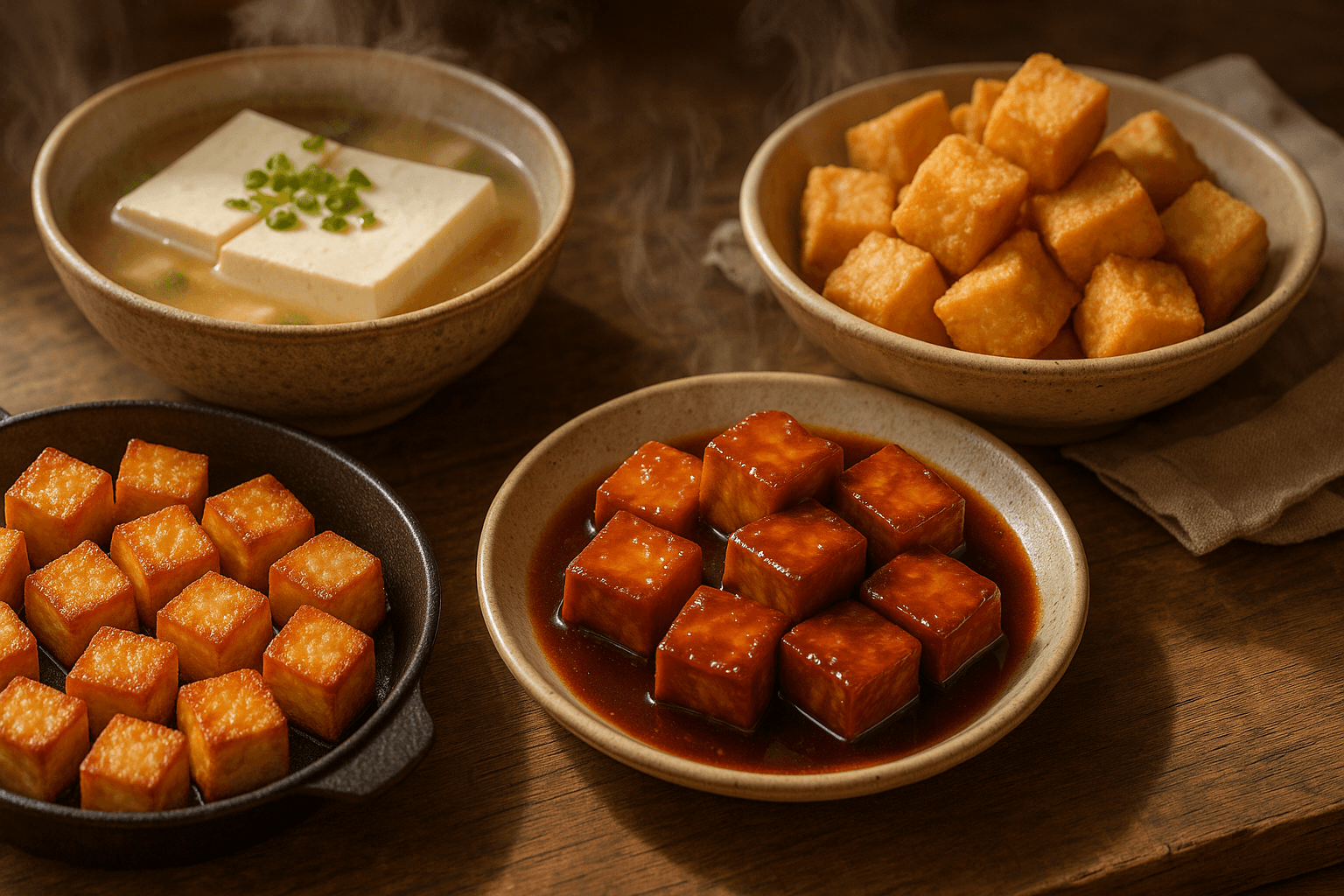
Tofu is not one thing. In East and Southeast Asian cooking traditions alone, tofu appears in astonishingly different forms: fresh silken tofu dressed simply with soy sauce and scallions; soft tofu simmered in Korean stews; firm tofu pan-fried and braised in Chinese red-cooked sauces; deep-fried tofu puffs tucked into soups and hot pots; agedashi tofu with its fragile crust and custardy center; pressed five-spice tofu sold as a snack; frozen tofu with a honeycomb interior for braising.
That diversity matters because advice like “always press tofu” or “tofu must be marinated overnight” is too blunt to be useful. Silken tofu should not be pressed. Deep-fried tofu puffs are already structurally transformed. A braise often seasons tofu better than a cold marinade ever will. A custardy dish wants retained moisture; a crisp sear wants moisture removed from the surface and, often, from the interior as well.
Most supermarket tofu falls into several broad categories:
- Silken tofu: unpressed, fragile, high moisture, very smooth. Best for cold dishes, gentle soups, steaming, blending.
- Soft tofu: slightly more set than silken, still delicate. Good for soups, mapo tofu styles, gentle simmering.
- Firm tofu: more pressed, lower moisture, holds shape in stir-fries and pan-frying.
- Extra-firm tofu: denser and drier, best for searing, grilling, baking, and frying where structure matters.
- Fried tofu / tofu puffs / aburaage-style products: already fried, porous, sauce-friendly, often ideal for braises and soups.
Even within these labels, brands vary a lot. Coagulant choice, pressing level, soybean concentration, and packaging all affect texture. That’s why two “firm” tofus can behave very differently in the same pan.
The underlying structure: tofu is a soy protein gel full of water
At its core, tofu is a protein network made from soy milk. During production, coagulants cause soy proteins to aggregate and trap water, creating a gel. Pressing changes how tightly that gel is packed and how much free water remains.
Think of tofu as a microscopic scaffold of soy proteins holding water in different ways:
- Bound water: associated closely with proteins; harder to remove.
- Entrapped water: held within gel spaces; can be squeezed or heated out more easily.
- Surface water: the obvious moisture on the outside; evaporates or interferes with browning.
Texture depends on how dense and continuous this scaffold is. A delicate tofu has a looser network with more water and less mechanical strength. Extra-firm tofu has a tighter, denser network and less moisture, so it can withstand tossing and high heat.
This also explains why tofu is not exactly like a sponge when raw. People often say tofu “soaks up” marinades. It can absorb some liquid, especially if its structure is porous or if it has been fried or frozen, but ordinary fresh tofu is mostly a gel, not an open-pore sponge. Much of what you add stays near the surface unless heat, time, pore structure, or concentration gradients help move it inward.
Coagulants quietly shape texture
Although this article focuses on cooking packaged tofu rather than making it, coagulants still matter because they influence the texture of what you buy.
Common coagulants include:
- Calcium sulfate (gypsum): often associated with a slightly more tender, opaque, somewhat brittle-set tofu.
- Magnesium chloride (nigari): often yields a smoother, sometimes more delicate gel.
- Glucono delta-lactone (GDL): commonly used for silken tofu; creates a very smooth, custardy texture through gradual acidification.
You do not need to memorize these to cook well, but it helps explain why one tofu breaks cleanly and another bends, squeaks, or crumbles. The protein network formed by different coagulants is not identical, and that affects how tofu responds to pressing, searing, and simmering.
Why tofu crumbles
Crumbly tofu usually comes down to one or more of these factors:
- Low structural strength to begin with. Soft and silken tofu simply are not meant for vigorous stir-frying.
- Mechanical stress. Thin slices, rough spatula work, and overcrowded tossing can fracture the gel.
- Excess pressing or squeezing. Especially with medium or firm tofu, aggressive pressing can create fractures that later split apart.
- Acid or salt exposure over time. These can alter protein interactions and draw water, sometimes making the exterior firmer and more fragile.
- Freeze-thaw damage. Useful when you want chew and pores, but it can also make tofu more fragile at the edges.
If your tofu breaks apart in the pan, the most common practical cause is simple: it was too moist to brown quickly, so it stuck; then you tried to move it before a crust formed. Sticking and crumbling often happen together.
Why tofu turns rubbery or tough
Rubbery tofu is usually not “overcooked” in the same way meat can be, but it can absolutely become unpleasantly firm and bouncy when its protein network tightens and loses water.
Common causes:
- Using extra-firm tofu when you wanted tenderness. Dense tofu will stay dense.
- Over-pressing. Pressing out too much water can make the final bite dry and tight.
- Long exposure to high heat without protective sauce or crust. The gel contracts, moisture leaves, and the interior toughens.
- Repeated reheating. Each heating cycle can drive off more moisture.
- Strong salt or acid treatments for too long. These can alter water retention and firm the surface.
This is why a tofu cube can go from pleasantly springy to squeaky and dry if left too long in a hot skillet or oven. With moisture loss, the protein matrix becomes denser. The result is chew without succulence.
Why tofu sometimes weeps water
“Weeping” is syneresis: liquid separating from the protein gel. It can happen in the package, on the cutting board, or in the pan.
Triggers include:
- Mechanical pressure from pressing or stacking.
- Heat, which causes the gel to contract and expel water.
- Salt or acid, which change how proteins hold onto water.
- Freezing and thawing, which physically damages the gel and releases liquid.
A little weeping is normal. In fact, some water release during cooking is expected. The problem is when that released water floods the pan faster than it can evaporate. Then your intended sear becomes a steam bath.
The freeze-thaw trick: why frozen tofu becomes porous and chewy
Freezing tofu is one of the most dramatic texture transformations available to a home cook. When tofu freezes, water inside forms ice crystals. Those crystals disrupt the protein gel, pushing and puncturing the network. When thawed, the tofu loses a large amount of water, and what remains is a more open, porous structure.
That structural change does three important things:
- Creates visible pores and channels. Sauce can move into these spaces more easily.
- Makes pressing much more effective. Thawed tofu gives up water readily.
- Changes bite from smooth to spongy-chewy. This can be wonderful in braises and hot pots.
How to do it:
- Freeze the tofu right in its package or drain and wrap first.
- Freeze until solid, at least 8 hours, ideally 24 hours.
- Thaw in the refrigerator overnight, or in cool water for 1 to 2 hours.
- Squeeze gently but firmly once thawed; a lot of water will come out.
Best uses for frozen-thawed tofu:
- Soy-braised dishes
- Spicy stews
- Curry
- Skewers with glaze
- Stir-fries where chew is welcome
Not ideal for:
- Silken applications
- Custardy interiors
- Dishes where you want a smooth, creamy bite
The myth to retire here is that freezing simply “helps marinade absorb.” It does increase porosity, yes, but what it really does is change the ingredient itself. Frozen-thawed tofu is not better in every context. It is different.
Pressing: useful, but not universal
Pressing tofu removes free and entrapped water, improves contact with the pan, and can help prevent steaming. But pressing is often overprescribed.
When to press
Press firm or extra-firm tofu for:
- Pan-searing
- Stir-frying
- Grilling
- Baking for crisp edges
- Deep-frying, if using fresh tofu
When not to press
Avoid pressing:
- Silken tofu
- Soft tofu for soups or gentle braises
- Any tofu when you want a custardy, juicy interior
- Pre-fried tofu products
How to press properly
- Drain the block.
- Wrap in a clean towel or paper towels.
- Set on a plate or board.
- Top with another plate or small sheet pan.
- Weight with 1 to 3 pounds / 450 g to 1.4 kg.
- Press 15 to 30 minutes for firm tofu, 20 to 40 minutes for extra-firm.
You are not trying to flatten tofu into drywall. You are just removing excess water.
Common pressing mistakes
- Too much weight: causes cracking and crumbly edges.
- Too long: can dry the exterior excessively while doing little more for the center.
- Pressing then soaking in weak marinade: often undoes your effort by adding surface moisture before searing.
A useful compromise for crisp tofu is to press, then cut, then let the cut surfaces air-dry on a rack for 10 to 20 minutes before cooking.
The salt-acid-starch rules
If you remember nothing else, remember these three levers.
1) Salt changes water behavior and seasoning
Salt seasons tofu, but it also changes how moisture behaves at the surface.
A light salting of cut tofu, about 1/2 teaspoon kosher salt per 14-ounce / 400 g block, can:
- Draw a little surface moisture outward
- Improve surface drying if you let it rest 10 to 15 minutes
- Season more effectively than a bland marinade
- Help a crust form more reliably
But heavy salting or long brining can make the exterior firmer and sometimes drier. That can be good if you want chew; not so good if you want tenderness.
A brief brine can also be useful. Try dissolving 1 tablespoon kosher salt in 2 cups / 475 ml hot water, cooling slightly, then soaking tofu pieces for 10 to 15 minutes before drying very well. Some cooks find this seasons the tofu more evenly and improves browning. The key is to dry the surface afterward.
2) Acid brightens flavor, but can tighten the surface
Acidic ingredients like rice vinegar, lime juice, lemon juice, or acidic sauces bring balance, but they can also contribute to syneresis and a slightly tighter exterior texture.
This is why acid is often better:
- Added to the sauce after browning
- Included in a finishing glaze
- Used in braises, where moisture offsets tightening
Acid-forward marinades on raw tofu can work, but they often leave the exterior wet and can hinder searing. For pan-crisp tofu, save most of the acid for the end.
3) Starch is your best friend for crispness
Surface starch is one of the most reliable ways to get tofu crisp. Cornstarch, potato starch, and sweet potato starch each create slightly different crusts.
- Cornstarch: light, familiar, crisp but somewhat delicate.
- Potato starch: excellent brittle crispness, especially for shallow or deep-frying.
- Sweet potato starch: often produces a slightly craggier, robust crust.
Use about 1 to 2 tablespoons starch per 14-ounce / 400 g block of tofu, cut into cubes or slabs. Dust lightly and evenly; do not cake it on.
Why it works:
- Absorbs residual surface moisture
- Forms a dry interface with the pan oil
- Gels and dehydrates into a crisp shell during frying
- Protects the tofu from sticking while crust develops
The starch should be applied just before cooking. If it sits too long on damp tofu, it turns pasty.
Why marinades don’t penetrate as much as you think
This is one of the biggest tofu misconceptions in home cooking.
Fresh tofu is not highly permeable. Most cold marinades mainly flavor the surface and any cracks, cut edges, or pores. If you marinate firm tofu overnight in a thin liquid, you often end up with:
- A wet exterior that hinders browning
- Modest internal flavor change
- Potentially diluted sauce after cooking
Better ways to build flavor:
- Season after crisping with a reduced sauce or glaze
- Braise tofu in a flavorful liquid so heat helps movement and concentration
- Use freeze-thawed or fried tofu when you want more sauce absorption
- Use concentrated seasonings like soy sauce, doubanjiang, miso, black bean paste, chili crisp, or mushroom powder rather than weak marinades
A practical rule: if your goal is crisp tofu, do not soak it in a wet marinade first. Crisp first, sauce second.
Why tofu sticks to the pan
Tofu sticks when surface proteins and moisture bond to the pan before a crust sets. Usually one or more of these is happening:
- The pan was not hot enough.
- The tofu surface was wet.
- There was not enough oil to create even contact.
- You tried to move it too soon.
- The pan surface was poor for the task.
Better searing setup
- Use a well-heated skillet, preferably cast iron, carbon steel, or a good nonstick.
- Preheat over medium-high heat for 2 to 3 minutes.
- Add 1 to 2 tablespoons neutral oil for a 10- to 12-inch skillet.
- Wait until the oil shimmers.
- Lay tofu in with space between pieces.
- Do not touch for 3 to 5 minutes.
If the tofu resists release, it probably is not ready. Once browning develops, it usually lets go more easily.
Heat strategies for three ideal textures
Different dishes want different heat paths. Here are the reliable ones.
For custardy centers
Use soft, medium, or firm tofu depending on how delicate you want it.
Best methods:
- Gentle simmering
- Steaming
- Brief shallow frying followed by saucing
Target temperatures and cues:
- Keep soup or braising liquid at a gentle simmer, around 185 to 205°F / 85 to 96°C, not a violent boil.
- Steam tofu for 6 to 10 minutes until heated through.
- If pan-frying, use medium heat and shorter browning, about 2 to 3 minutes per side for slabs.
Avoid extended dry heat, which drives out moisture and sacrifices the custardy quality.
For bouncy, springy bite
Use firm or extra-firm tofu, or freeze-thawed tofu.
Best methods:
- Press lightly to moderately
- Pan-sear, then braise
- Grill with glaze
- Freeze, thaw, and simmer in sauce
Heat strategy:
- Brown over medium-high heat to create structure on the outside.
- Finish in sauce over low to medium heat for 5 to 10 minutes.
This gives contrast: resilient outside, moist interior, flavorful coating.
For shatteringly crisp edges
Use firm or extra-firm tofu, pressed and dried well.
Best methods:
- Shallow fry with starch coating
- Deep-fry
- Roast at high heat with oil and starch
Targets:
- Shallow fry oil surface temperature: roughly 350 to 375°F / 175 to 190°C
- Deep-fry oil: 350°F / 175°C for first fry, optionally 375°F / 190°C for a brief second fry
- Oven roasting: 425 to 450°F / 220 to 230°C
- Air fryer: 400°F / 205°C
The central rule is dryness plus heat plus enough oil contact.
Step-by-step: best methods for common cooking goals
Method 1: Pan-seared tofu with crisp edges and tender center
Best for stir-fries, grain bowls, salads, and glazing afterward.
You need
- 1 block firm or extra-firm tofu, 14 ounces / 400 g
- 1/2 teaspoon kosher salt
- 1 tablespoon cornstarch or potato starch
- 1 to 2 tablespoons neutral oil
Steps
- Drain and press tofu for 20 minutes.
- Cut into cubes, triangles, or 1/2-inch / 1.25 cm slabs.
- Salt lightly and let rest 10 minutes.
- Pat dry very well.
- Toss gently with starch just until lightly coated.
- Heat skillet over medium-high for 2 to 3 minutes.
- Add oil; when shimmering, add tofu in a single layer.
- Cook undisturbed 3 to 5 minutes on the first side.
- Turn and cook 2 to 4 minutes per remaining side.
- Sauce only after crust forms, or remove tofu and toss with sauce off heat.
Why it works
Pressing and salting reduce surface moisture. Starch creates a dry shell. Delayed saucing preserves crispness.
Method 2: Braised tofu that actually tastes seasoned
Best for firm tofu, frozen-thawed tofu, or pre-fried tofu.
You need
- 1 block firm tofu or frozen-thawed tofu
- 1 tablespoon oil
- 1 cup / 240 ml stock or water
- 2 tablespoons soy sauce
- 1 teaspoon sugar
- 1 tablespoon Shaoxing wine or sake optional
- Aromatics like ginger, garlic, scallion
- Optional acid added at end: 1 to 2 teaspoons rice vinegar
Steps
- Cut tofu into large cubes or slabs.
- Brown lightly in oil over medium heat for 2 to 3 minutes per side.
- Add aromatics and cook 30 seconds.
- Add braising liquid and seasonings.
- Bring to a gentle simmer.
- Braise 8 to 15 minutes, turning once or twice.
- Reduce the liquid until glossy.
- Add acid or sesame oil at the end.
Why it works
Heat and concentration do more for tofu flavor than a cold marinade. Braising lets the exterior and pore spaces take on seasoning while preserving moisture.
Method 3: Deep-fried tofu with a crackling crust
Best for extra-firm tofu or starch-coated firm tofu.
You need
- 1 block extra-firm tofu, pressed 30 minutes
- 2 tablespoons potato starch
- Oil for frying
- Thermometer
Steps
- Cut tofu into 1-inch / 2.5 cm cubes.
- Dry thoroughly and coat lightly in starch.
- Heat oil to 350°F / 175°C.
- Fry in batches for 3 to 5 minutes until pale gold.
- For extra crispness, remove and rest 2 minutes.
- Fry again at 375°F / 190°C for 45 to 90 seconds.
- Drain on a rack, not paper towels if possible.
- Salt immediately.
Why it works
First fry sets the crust and heats through. Second fry rapidly dehydrates the outer layer for a more brittle crunch.
Method 4: Soft tofu for soups without breakage
Best for miso soup, soondubu-like preparations, and delicate broths.
Steps
- Cut soft tofu into large spoonable pieces rather than neat cubes.
- Heat broth first.
- Slip tofu in at the end.
- Keep the liquid below a hard boil.
- Simmer gently 2 to 4 minutes or simply warm through.
- Stir the broth around the tofu, not through it aggressively.
Why it works
Soft tofu is already the final texture. Your job is to warm and season it, not “cook it hard.”
Method 5: Roasted tofu for easy weeknight crispness
You need
- 1 block extra-firm tofu
- 1 tablespoon oil
- 1 tablespoon cornstarch
- 1/2 teaspoon kosher salt
Steps
- Heat oven to 425°F / 220°C.
- Press tofu 20 to 30 minutes.
- Cut into cubes.
- Toss with oil, salt, and starch.
- Spread on a parchment-lined sheet pan with space.
- Roast 20 minutes.
- Flip and roast 10 to 15 minutes more.
Why it works
High dry heat slowly dehydrates the exterior. It is less dramatic than frying but very reliable.
How different tofu styles behave in specific dishes
Silken tofu
Best in: cold dishes, steamed dishes, blended sauces and desserts, delicate soups.
Behavior: smooth, high-moisture, fragile. It does not “firm up” into stir-fry tofu no matter how hard you try.
Use strategy: drain gently, spoon rather than cube if needed, season on or around it, and avoid aggressive movement.
Soft tofu
Best in: soups, mapo-style dishes, gentle braises.
Behavior: tender but slightly more manageable than silken.
Use strategy: cut larger pieces, simmer gently, let sauce coat rather than toss vigorously.
Firm tofu
Best in: versatile all-purpose cooking, pan-frying, braising, lighter stir-fries.
Behavior: balanced moisture and structure.
Use strategy: press when searing, skip pressing when tenderness matters.
Extra-firm tofu
Best in: searing, grilling, baking, deep-frying.
Behavior: dense, sturdy, drier.
Use strategy: ideal for crust formation; may need sauce or careful timing to avoid toughness.
Fried tofu and tofu puffs
Best in: braises, soups, curries, hot pots.
Behavior: porous, elastic, sauce-friendly.
Use strategy: rinse or blanch if oily, then simmer in flavorful liquid. These absorb sauce far better than fresh tofu.
Common mistakes and how to fix them
Mistake: Overcrowding the pan
Problem: tofu steams instead of browns.
Fix: cook in batches or use a larger skillet. Leave at least 1/2 inch / 1.25 cm between pieces when possible.
Mistake: Saucing too early
Problem: crust dissolves and tofu releases water.
Fix: brown first, sauce after.
Mistake: Choosing the wrong tofu style
Problem: silken tofu breaks in a stir-fry; extra-firm feels too dense in soup.
Fix: match the tofu to the cooking method.
Mistake: Assuming longer marinating equals deeper flavor
Problem: wet exterior, little payoff.
Fix: use glazes, braises, concentrated sauces, or porous tofu styles.
Mistake: Pressing everything
Problem: dry or cracked tofu in dishes that need tenderness.
Fix: press selectively based on your texture goal.
Mistake: Not drying after pressing or brining
Problem: residual moisture blocks browning.
Fix: pat very dry and, if possible, air-dry briefly.
A note on starches, sugars, and sauces
If your sauce contains sugar, honey, mirin, or syrup, it will brown and burn faster. That is another reason to apply sauce after the tofu is mostly crisp. Sugars are wonderful for lacquered tofu, but they can sabotage the searing stage if added too soon.
A good workflow is:
- Crisp tofu.
- Remove from pan.
- Reduce sauce separately until glossy.
- Toss tofu in at the end for 30 to 60 seconds.
This keeps flavor intense without sacrificing texture.
The science of crispness in one paragraph
Crispness comes from dehydration and rigid structure at the surface. As water leaves the outer layer, starches gelatinize and then dry, proteins set, and microscopic bubbles and fissures create a brittle shell that fractures when you bite it. If water keeps migrating outward faster than it can evaporate, the crust softens. That is why tofu loses crispness after sitting in sauce, being covered, or steaming in a container.
Practical texture playbook
If you want a quick cheat sheet, here it is.
For a custardy center
- Use silken, soft, or gently handled firm tofu
- Do not press aggressively
- Use gentle simmering or steaming
- Add acid at the end
- Avoid prolonged dry heat
For a bouncy bite
- Use firm, extra-firm, or frozen-thawed tofu
- Press moderately
- Brown lightly, then braise
- Season with concentrated sauces
- Simmer, don’t blast with high heat forever
For crisp edges
- Use firm or extra-firm tofu
- Press 20 to 30 minutes
- Salt lightly and dry thoroughly
- Coat with 1 to 2 tablespoons starch per block
- Fry or roast at high heat
- Sauce after crisping
The big takeaways
Tofu texture is not random. It is the result of a protein gel managing water under stress. Pressing, salting, freezing, acid, starch, and heat all change how that gel behaves.
If tofu turns rubbery, you likely drove out too much water or started with too dense a style for the result you wanted. If it crumbles, you likely used a delicate type, handled it too roughly, or fought it before a crust formed. If it crisps beautifully, you probably controlled surface moisture, used enough heat and oil, and delayed the sauce.
The smartest way to cook tofu is to stop asking, “What is the one best method?” and start asking, “What texture do I want?” Custardy, springy, porous, chewy, crisp, sauce-soaked, or silky each call for a different treatment.
Once you understand that, tofu stops being an obligation and starts being a toolkit. A block of soy protein gel in water may not sound romantic, but in the pan it can become golden and crackly, plush and delicate, or deeply braised and savory. And when you get it right, the transformation feels less like a kitchen hack and more like what it really is: cooking with structure, intention, and respect.